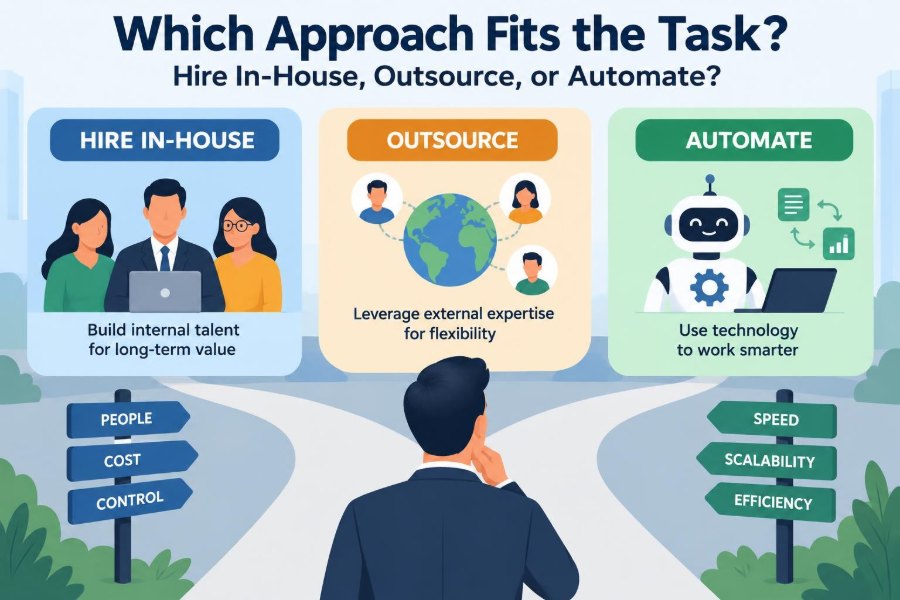

A growing online retailer needs better customer support. Its team is already stretched, but hiring a full-time specialist feels expensive. An agency promises round-the-clock coverage, while a software provider demonstrates a chatbot that can answer common questions in seconds.
None of those options is automatically right. The best choice depends on what the work involves, how often it happens, what can go wrong, and whether the capability matters to the company’s future.
Managers face this decision constantly: build a marketing team or use a freelancer, employ a bookkeeper or engage an accounting firm, develop software internally or buy a platform, automate reports or ask analysts to prepare them.
The question is not simply which option costs less this month. It is which arrangement delivers reliable work, protects the organization, and leaves people focused on work where human judgment creates the most value.
🧭 Start With the Work, Not the Supplier
Teams often begin by comparing job candidates, agencies, and software demonstrations. That is backwards. First define the task itself: the expected output, volume, quality standard, deadline, inputs, and consequences of an error.
“Manage social media” is too broad to evaluate. “Publish four approved posts weekly, respond to routine messages within one business day, and escalate complaints” is a task description that can be staffed, outsourced, or partly automated.
Clear work definition prevents a common mistake: choosing a delivery model before understanding what must actually be delivered.
🔍 Separate Core Work From Supporting Work
Core work directly creates the organization’s distinctive value. For a specialist design studio, creative direction may be core. For a food manufacturer, product quality and production knowledge may be core.
Supporting work enables the business without usually differentiating it, such as payroll processing, standard IT maintenance, or routine office administration. Supporting work is often easier to outsource or automate because the organization does not need to own every capability.
The distinction is not permanent. Data analysis may begin as support work but become strategically central if the firm competes through superior customer insight.
🎯 Identify the Decision That Truly Needs Human Judgment
A task may contain repetitive steps and a smaller number of difficult decisions. Treating the whole process as one unit can lead to an expensive or risky choice.
Consider invoice handling. Capturing invoice details, matching purchase orders, and routing approvals may be suitable for automation. Resolving unusual discrepancies, supplier disputes, and suspected fraud requires context and judgment.
Break work into steps, then ask where ambiguity, empathy, accountability, or creative thinking is essential. Those are often the points where capable people add value.
📦 When In-House Hiring Fits Best
Hiring internally is usually strongest when work is continuous, closely tied to strategy, and requires daily collaboration with other teams. Internal employees develop organizational memory: they learn the products, customers, informal processes, and history behind decisions.
An in-house product manager, for example, can align engineering, sales, and customer feedback over time. That role is difficult to define fully in a contract because much of its value comes from relationships and evolving judgment.
Internal hiring also makes sense when leaders need direct control over priorities, methods, and capability development.
🏢 The Hidden Strength of Organizational Knowledge
Knowledge is more than a documented procedure. It includes knowing which customer complaint signals a serious issue, which approval route is practical, or why a previous project failed.
Employees can accumulate this tacit knowledge through repeated exposure. They can also transfer it informally across departments, improving coordination in ways that are hard to price in a supplier agreement.
This does not mean knowledge must stay internal. It means a business should identify knowledge it cannot afford to lose before moving work outside.
💷 Count the Full Cost of an Employee
A salary is only one part of an in-house decision. Employers also need to consider recruitment time, onboarding, benefits, workspace or equipment, management attention, training, leave coverage, and the cost of replacing someone who leaves.
At the same time, comparing salary with a supplier’s monthly fee can be misleading. An employee may take on adjacent responsibilities, improve processes, and remain available when priorities change. A vendor may charge separately for each extra request.
Use a total cost of ownership view: estimate all meaningful costs across the period the capability will be needed, not just the first invoice or first pay cycle.
🧩 The Limits of Building Everything Internally
Internal control can become overbuilding. A small business may spend months recruiting a niche cybersecurity expert when it needs occasional specialist assessment rather than a permanent role.
Hiring also creates fixed capacity. If demand drops, the organization still carries payroll and management obligations. If demand rises unexpectedly, a small internal team may become a bottleneck.
Choose in-house ownership deliberately, especially where the work is essential, frequent, and difficult to coordinate at arm’s length—not merely because internal work feels safer.
🤝 When Outsourcing Makes Sense
Outsourcing means using an external provider to perform work that the organization could otherwise perform itself. It is often useful when demand fluctuates, specialist expertise is scarce, or the work requires tools and processes that would be costly to build.
A company launching a short campaign may use a video production agency rather than hire a permanent production team. A small firm may engage an IT support provider because it needs broad technical coverage without enough work for several specialists.
Outsourcing turns some fixed staffing commitments into a more flexible operating expense, though the contract terms matter greatly.
🧠 Buy Expertise, Not Just Extra Hands
The strongest outsourcing case is not simply “we are busy.” It is “this provider has a repeatable capability we do not need to develop ourselves.” That may include specialist legal drafting, payroll administration, accessibility testing, or event logistics.
A capable provider brings methods, trained staff, and exposure to similar problems. However, external expertise does not remove the need for an informed internal owner. Someone must define outcomes, review quality, and make decisions the supplier cannot make.
Outsourcing responsibility is possible; outsourcing accountability is not.
📄 Write a Scope That Can Be Managed
Vague agreements create vague results. A useful scope specifies deliverables, service levels, deadlines, approval points, responsibilities, exclusions, pricing assumptions, and how changes will be handled.
For customer support, “improve response quality” is subjective. A clearer arrangement identifies supported channels, operating hours, escalation categories, reporting format, training responsibilities, and the process for updating product information.
Detailed scope does not mean inflexibility. It creates a shared baseline so that changes are visible, discussable, and properly resourced.
🔗 Manage the Vendor Relationship, Not Just the Contract
A signed contract is the beginning of supplier management, not the end. Providers need context, timely feedback, access to accurate information, and decisions when exceptions arise.
Appoint an internal relationship owner with enough authority to resolve issues. Review performance against agreed measures, but also discuss upcoming changes that may affect workload or quality.
When a vendor repeatedly misses expectations, the cause may be an unclear brief, delayed approvals, changing internal requirements, or insufficient capacity—not necessarily poor effort by the provider.
🛡️ Protect Data, Quality, and Continuity
External partners may handle customer records, financial information, intellectual property, or operational access. Before outsourcing, determine what data is necessary, who can access it, how it will be protected, and what happens when the engagement ends.
Quality and continuity also need practical safeguards. What happens if a key supplier contact leaves, a platform becomes unavailable, or the provider cannot meet a peak-period demand?
Risk controls should be proportionate. A low-risk transcription task needs different safeguards from an outsourced process that can approve payments or access sensitive personal data.
⚙️ What Automation Actually Means
Automation uses technology to perform a task or sequence of tasks with limited ongoing human intervention. It ranges from simple spreadsheet formulas and scheduled reminders to workflow software, robotic process automation, and systems that generate or classify content.
Automation is not synonymous with artificial intelligence. A rule that sends an invoice reminder after a due date is automation. A system that interprets unstructured messages may use AI, but it still needs suitable data, controls, and review.
The practical question is whether the process is stable enough for a tool to perform it consistently.
🔁 Look for Repetition, Rules, and Reliable Inputs
Automation fits best where work is frequent, rule-based, and based on structured or dependable inputs. Common candidates include appointment reminders, stock alerts, routine data transfer, approval routing, and standard report generation.
Three signals are especially useful:
- The same decision rules are applied repeatedly.
- Inputs arrive in a consistent format or can be validated.
- Exceptions are relatively limited and can be routed to a person.
If every case is unique, the process may need redesign before automation will help.
🧹 Fix the Process Before Automating It
Automation makes a process faster; it does not automatically make it better. If staff duplicate information across several systems, use unclear categories, or rely on undocumented workarounds, a tool can spread the confusion at speed.
Map the existing workflow first. Remove unnecessary steps, standardize definitions, clarify ownership, and identify exceptions. Then automate the simplified process.
A useful analogy is paving a road: doing so helps traffic move, but it is unwise to pave a route that leads in the wrong direction.
🚨 Design for Exceptions and Escalation
Even a well-designed automated process will encounter incomplete data, unusual requests, system failures, or conditions outside its rules. A safe workflow needs an exception path.
For instance, an automated refund process might approve routine, low-value requests that meet stated conditions while sending unusual patterns or high-value cases to a trained employee. The employee needs enough context to understand why the case was flagged.
Measure exception types over time. A rising exception rate may indicate a broken input, a changing business rule, or an automation that no longer fits the work.
👥 Keep Humans in the Right Loop
Human-in-the-loop design means people review, approve, or intervene at points where automation alone is not appropriate. The right level of oversight depends on the consequences of a mistake.
Automatic calendar reminders may require little review. Automated hiring screening, credit decisions, safety controls, or customer communications involving sensitive issues demand much stronger oversight and careful evaluation.
Human review should not be a ceremonial click. Reviewers need authority, time, training, and enough information to challenge a system’s output.
⚖️ Compare the Three Approaches Side by Side
| Decision factor | In-house | Outsource | Automate |
|---|---|---|---|
| Best fit | Strategic, ongoing, collaborative work | Specialist or variable-demand work | Stable, repeatable, rule-based work |
| Main advantage | Control and organizational knowledge | Flexible access to expertise | Speed and consistency at scale |
| Main trade-off | Fixed cost and hiring effort | Less direct control and vendor dependency | Setup effort and exception risk |
| Management need | Leadership, development, capacity planning | Scope, governance, relationship management | Process ownership, monitoring, maintenance |
The table is a starting point, not a formula. Many important processes use a combination of all three approaches.
📈 Use Volume and Variability as Decision Clues
Work volume affects economics. High, stable volume can justify internal hiring or automation because the organization can use capacity consistently. Low or unpredictable volume often favors an external provider that can serve several clients.
Variability matters too. A seasonal retailer might retain a small internal customer service team, use an outsourced overflow team during peak periods, and automate routine order-status updates throughout the year.
This blended model matches each source of capacity to a different pattern of demand.
🧮 Compare Cost Beyond the Price Tag
Use scenario-based comparison rather than a single headline price. Estimate normal demand, a busy period, and a disruption scenario. Include setup, transition, supervision, rework, integration, and exit costs where relevant.
Also consider the cost of delay. A cheap solution that cannot start for months may be less suitable than a more expensive temporary provider when an urgent compliance or customer need exists.
Financial estimates will contain uncertainty. State assumptions openly and test which assumptions would change the decision most.
⏱️ Consider Speed, Capacity, and Learning Curves
An external specialist may begin faster than a new employee can be recruited and trained. Yet an internal hire may become more productive over time as their knowledge deepens. Automation may take longer initially because processes, data, and integrations need preparation.
Ask two separate questions: “How quickly can this option start?” and “How capable will it be six or twelve months from now?” Confusing short-term readiness with long-term suitability leads to poor trade-offs.
Transitions deserve their own plan, including documentation, parallel running where appropriate, and a clear handover point.
📏 Define Quality Before Measuring It
Quality is not always speed or volume. For a design task, quality may involve brand fit and user understanding. For payroll, it may involve accuracy, confidentiality, and timely correction. For customer support, it may include resolution quality as well as response time.
Choose measures that reflect the actual purpose of the work. Avoid rewarding a narrow metric that encourages damaging behavior, such as closing customer tickets quickly without solving the underlying issue.
A small set of meaningful measures, combined with samples and feedback, is usually more useful than a large dashboard nobody acts on.
🧪 Pilot Before Committing at Full Scale
A pilot is a limited trial designed to test assumptions before a broad rollout. It can reveal whether a vendor understands the work, whether an automation handles real-world exceptions, or whether a proposed role truly has enough sustained demand.
Set pilot boundaries in advance: what work is included, how long it will run, what success looks like, and what decision will follow. A pilot without decision criteria can become an indefinite experiment.
Where risk is meaningful, retain a fallback process while testing. This protects customers and gives the team a fair basis for comparison.
🧱 Avoid Lock-In and Preserve Options
Vendor lock-in occurs when changing provider becomes unusually difficult or costly. It can arise from proprietary data formats, undocumented processes, custom integrations, or knowledge held by one contractor.
Reduce this risk through documentation, data access arrangements, clear ownership of work products, and transition expectations. For automated systems, ensure staff understand core workflows rather than leaving all practical knowledge with an implementation partner.
Preserving options does not mean changing suppliers often. It means being able to make a considered change if performance, strategy, or risk conditions shift.
🧭 Assign One Accountable Process Owner
Every important process needs an internal owner, even if every operational step is outsourced or automated. The owner is accountable for outcomes, approves meaningful changes, monitors risk, and coordinates stakeholders.
Without ownership, failures can become a chain of blame: the vendor says the instructions were unclear, the software team says the rules were approved, and managers assume someone else is watching results.
Accountability should be visible in the operating model, not inferred after a problem occurs.
🧑🤝🧑 Consider the People Affected by the Change
A sourcing or automation decision changes jobs, workloads, and status. Employees may reasonably worry that efficiency language masks job loss, while external teams may lack context that internal staff once provided.
Communicate what is changing, why, what work remains human-led, and how affected people will be supported. Invite frontline staff into process mapping; they often understand the exceptions managers cannot see.
Good change management is not just reassurance. It includes training, revised responsibilities, realistic workload planning, and channels for reporting problems early.
⚠️ Common Mistakes That Distort the Choice
Several patterns repeatedly lead to disappointing outcomes:
- Choosing solely on the lowest quoted price.
- Automating a process before standardizing it.
- Outsourcing a strategic capability without retaining internal understanding.
- Hiring permanently for a short-lived workload spike.
- Assuming a tool or supplier eliminates management effort.
- Ignoring exit, transfer, and business-continuity planning.
These mistakes share a theme: treating a delivery model as a purchase rather than an operating decision that needs design and oversight.
🗺️ A Practical Decision Sequence
- Define the outcome, work steps, volume, quality requirements, and risks.
- Classify what is strategic, sensitive, variable, repetitive, and judgment-heavy.
- Redesign inefficient steps before changing who performs them.
- Develop realistic in-house, outsource, automate, and blended options.
- Compare total cost, speed, control, quality, resilience, and learning value.
- Pilot the most promising option where uncertainty is material.
- Assign an owner, measures, exception route, and review schedule.
This sequence is deliberately practical: it turns an abstract debate into a set of observable decisions.
🔄 Revisit the Decision as Conditions Change
No approach is permanent. A startup may initially outsource finance operations, then hire internally once transactions become complex. A manual process may become worth automating when volume grows. A business may bring work back in-house after discovering that customer experience depends on deeper integration.
Review decisions when strategy, demand, regulation, technology, or risk changes—not simply because a contract expires or a new tool is fashionable.
The goal is not to prove the original choice was correct forever. It is to keep the operating model aligned with current needs.
🌟 The Core Principle: Match the Model to the Work
In-house hiring, outsourcing, and automation are not competing ideologies. They are different ways of organizing capability. Each can be effective when it matches the nature of the task and the organization’s responsibilities.
Keep strategic judgment, relationship-rich work, and essential knowledge close. Use external specialists where flexibility or deep expertise matters. Automate stable, repeatable steps while designing clear human oversight for exceptions and consequential decisions.
The strongest solution is often a thoughtful combination: people lead where judgment matters, partners contribute where specialization helps, and technology removes routine friction.
Choose the arrangement that gives the work—not the trend, the tool, or the cheapest quote—the level of ownership, expertise, control, and adaptability it requires. 📊🤝⚙️