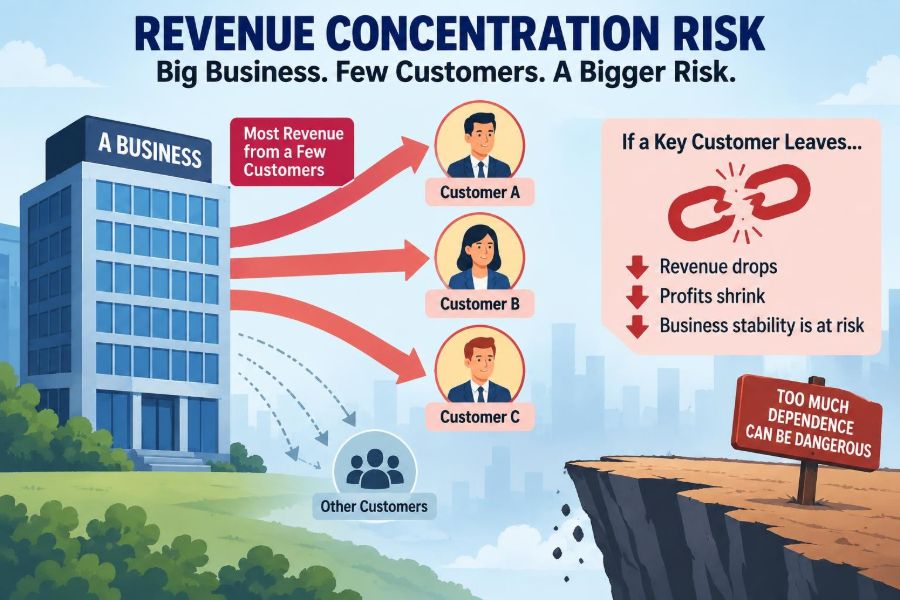

A small software company has one client that accounts for nearly half of its sales. The relationship is strong, invoices are paid on time, and the client keeps requesting more work. From the outside, the business looks secure.
Then the client changes leadership, freezes a project, or decides to build the capability internally. Nothing may be wrong with the supplier’s product or people, yet its monthly cash inflow can change overnight.
This is the uncomfortable reality of revenue concentration risk: a business can be profitable, respected, and busy while remaining highly exposed to the decisions of a few customers.
Understanding that exposure helps managers make better choices about pricing, sales priorities, cash reserves, contracts, and growth. Concentration is not automatically a flaw, but it must be measured and managed deliberately.
🎯 What Revenue Concentration Risk Means
Revenue concentration risk arises when a relatively small number of customers produce a large share of a company’s total revenue. If one of those customers reduces spending or leaves, the effect on the business can be disproportionate.
It is often described using simple questions: What percentage of revenue comes from the largest customer? How much comes from the largest three, five, or ten customers? The answers reveal whether revenue is broadly distributed or dependent on a narrow base.
This is a business risk rather than a prediction that a customer will leave. A concentrated company may have loyal, high-quality customers; it is still vulnerable because its outcomes depend heavily on a few external decisions.
🧺 Why Customer Mix Matters
A diversified customer base works like a basket with several sources of support. Losing one account hurts, but other accounts continue generating income while the business adapts.
With concentrated revenue, a single event can affect sales, cash flow, staffing, purchasing, debt obligations, and valuation at the same time. The business may have little room to absorb the disruption.
Customer mix also affects negotiating power. A buyer that represents a large portion of sales may know it has leverage when discussing prices, payment terms, service levels, or contract renewals.
📏 The Basic Metrics to Track
The simplest measurement is the share of total revenue generated by each customer during a defined period. Management should view both annual figures and recent monthly or quarterly trends, since a formerly minor account can grow into a major exposure quickly.
- Largest-customer concentration: revenue from the biggest account divided by total revenue.
- Top-five concentration: combined revenue from the five largest accounts divided by total revenue.
- Revenue retention: the portion of customer revenue that continues over time.
- Customer profitability: profit after service, support, delivery, and account-management costs.
Revenue is the starting point, not the whole picture. A customer can be large in sales but modest in profit, or small in sales but operationally essential because it fills otherwise unused capacity.
🔢 A Simple Hypothetical Example
Imagine a manufacturer with annual revenue of $10 million. One retailer contributes $4 million, three other customers contribute another $3 million, and many smaller customers make up the remaining $3 million.
If the largest retailer cuts orders by half, the manufacturer immediately loses $2 million in annual sales unless it can replace those orders. Fixed costs such as rent, equipment leases, and core salaries may remain largely unchanged.
The company does not necessarily lose $2 million in profit, because variable production costs also fall. But a large drop in contribution toward fixed costs can turn a previously profitable operation into a loss-making one.
💵 Revenue Is Not the Same as Cash Flow
Customer concentration becomes more dangerous when the largest account also has slow payment terms. A business may report strong sales while waiting many weeks or months for the cash needed to pay employees and suppliers.
If that customer disputes an invoice, delays payment, or enters financial difficulty, the company may face a liquidity problem before it has time to find replacement revenue.
Managers should therefore review accounts receivable concentration alongside revenue concentration. A customer that owes a large share of outstanding invoices can create a separate and immediate cash-risk exposure.
🏗️ Fixed Costs Increase the Stakes
Businesses with substantial fixed costs are generally more sensitive to revenue loss. Fixed costs are expenses that do not decline quickly when sales fall, such as premises, permanent staff, insurance, software platforms, and debt repayments.
A consultancy with flexible contractors may be able to reduce costs more rapidly than a factory operating specialized equipment. Neither business is immune, but their ability to adjust differs.
The practical question is not only, “What happens if this customer leaves?” It is also, “How much cost can we reduce, and how fast, if it does?”
🤝 Why Concentration Often Develops Naturally
Many businesses do not choose concentration as a strategy. It emerges because their best customer grows faster than expected, refers more work, or has purchasing needs that align closely with the supplier’s capabilities.
Early-stage firms are especially exposed. Landing one major customer can validate an offering, provide valuable feedback, and fund operations while the company is still building a sales process.
Concentration can also arise from industry structure. A supplier serving a market dominated by a few large buyers may have limited options, even when it actively pursues diversification.
🌱 When a Major Customer Can Be a Strength
A large customer is not inherently bad news. Long-term accounts can create predictable demand, lower selling costs, operational learning, and opportunities to improve a product with meaningful real-world feedback.
They may also help a young firm establish credibility. Completing demanding work for a recognized buyer can strengthen future sales conversations without guaranteeing future contracts.
The issue is whether management treats the relationship as an asset with risks to manage, rather than as a permanent source of revenue. Healthy dependence is monitored; blind dependence is assumed away.
⚖️ Concentration Versus Customer Quality
A company with one financially stable, contractually committed customer may face less immediate danger than a company with many fragile buyers that purchase irregularly. Customer count alone does not determine risk.
Managers need to consider payment behavior, financial health, contract duration, renewal history, switching costs, industry conditions, and the customer’s strategic plans. A high-quality relationship can reduce risk, but it rarely removes it completely.
It is useful to separate probability from impact. A loss may seem unlikely, yet its impact can still justify contingency planning.
🔍 Look Beyond the Customer Name
One apparent customer may conceal several sources of exposure. For example, different divisions of the same corporate group may buy through separate accounts but follow one central budget decision.
Likewise, several customers may depend on one end market, geography, distributor, or public funding source. Their orders can decline together during the same downturn.
Revenue concentration analysis should group related entities and common economic drivers where possible. Otherwise, a dashboard can look diversified while the underlying demand is not.
📉 How Customer Loss Becomes a Wider Crisis
The first effect of a lost major account is lower sales. The second-order effects are often more damaging: excess inventory, idle staff, unused capacity, weakened supplier relationships, and pressure to discount for new work.
Morale can also suffer when employees associate the customer with a major project or team identity. In some businesses, a sudden departure triggers rushed restructurings that damage service for the remaining customers.
A good response plan recognizes this chain reaction. It prepares operational and financial actions before a crisis forces decisions under pressure.
🗣️ Negotiating Power Can Shift Quietly
As a customer becomes larger, its bargaining position often strengthens. It may request customized reporting, dedicated staff, extended payment terms, price reductions, exclusivity, or unusually broad contractual commitments.
Some requests are commercially reasonable. Problems arise when a supplier accepts each concession because it fears losing the account, without pricing the added cost or considering the precedent it creates.
Managers should ask whether the relationship remains profitable after all service requirements are included. High revenue can mask a customer that consumes scarce resources at poor margins.
📝 Contracts Reduce Uncertainty, Not Dependence
A well-designed contract can clarify scope, pricing, notice periods, payment obligations, ownership of work, and termination procedures. These provisions can improve planning and reduce avoidable disputes.
However, a contract does not create demand where demand has disappeared. A customer may be able to reduce purchases under agreed terms, decline to renew, or face its own financial pressures.
For major accounts, businesses should obtain appropriate legal advice on terms that matter in their jurisdiction and industry. The commercial objective is clear: understand the realistic protection available, rather than assuming a signature solves concentration risk.
🧮 Use Scenario Planning Instead of Guesswork
Scenario planning turns an abstract concern into decisions. Management can model what happens if the largest customer reduces spend by a modest amount, delays payment, pauses a project, or exits entirely.
Each scenario should estimate lost revenue, gross margin, cash timing, capacity effects, and required actions. The point is not to forecast the future precisely; it is to discover where the business is least prepared.
- Which expenses can be paused within 30, 60, or 90 days?
- What pipeline opportunities could close soon enough to help?
- Which roles and capabilities must be protected?
- How much working capital is needed during a replacement-sales cycle?
🛟 Build Financial Resilience Before It Is Needed
Cash reserves, suitable credit facilities, and disciplined working-capital management give a company time to respond thoughtfully. They cannot replace lost demand, but they can prevent a temporary shock from becoming an urgent solvency problem.
The right buffer depends on the business model, volatility of revenue, fixed-cost structure, and access to financing. There is no universal reserve level that fits every organization.
A practical approach is to connect reserves to scenario planning. If replacing a major customer is likely to take several months, the financial plan should reflect that realistic sales cycle.
📣 Diversification Requires a Deliberate Sales System
Simply deciding to “get more customers” is not a plan. Diversification requires a repeatable way to identify prospects, communicate value, qualify opportunities, manage follow-up, and convert suitable leads.
The goal is not to replace one large account with dozens of unprofitable ones. Better diversification improves the number of viable revenue sources while preserving pricing discipline and service quality.
Useful indicators include the share of pipeline outside the largest customer, the number of qualified opportunities by segment, sales-cycle length, and conversion rates. These measures show whether diversification is becoming real rather than remaining an aspiration.
🧭 Choose New Segments Carefully
Entering a new market can reduce dependence, but it may also introduce unfamiliar competitors, regulations, buying processes, and support requirements. Diversification works best when the new segment has a credible fit with existing capabilities.
For example, a business that serves one type of retailer may extend to adjacent retail categories using similar products and sales skills. That is often less risky than pursuing a completely unrelated sector merely because it is large.
Managers should assess whether a new segment diversifies the underlying economic driver, not just the customer list. Ten customers tied to the same fragile market can still move together.
🧱 Product Diversification Has Limits
Adding products or services may create new revenue streams, especially when current customers have related needs. It can also deepen concentration if the new offering is sold mainly to the same dominant account.
New products require investment, operational capability, and a clear route to market. A rushed expansion can distract the organization from strengthening its core sales engine.
Before investing, ask two questions: will this offering attract meaningfully different buyers, and can the company deliver it profitably at scale? If the answer to both is uncertain, the diversification benefit may be overstated.
👥 Avoid Building the Company Around One Account
A major customer may justify dedicated attention, but excessive customization can make a supplier hard to sell to anyone else. Processes, technology, personnel, and product features gradually become tailored to one buyer’s preferences.
This creates operational concentration: even if revenue is later diversified, the company may lack the flexible capabilities needed to serve a broader market.
Where possible, separate truly unique customer requirements from reusable capabilities. Standardizing the reusable parts of delivery helps the organization serve more accounts without recreating work each time.
🔐 Protect Knowledge and Relationships
When a few accounts matter greatly, customer knowledge can become concentrated in one salesperson, founder, or account manager. If that person leaves, the company may lose context, trust, and access at the same time.
Document account history, decision-makers, contract commitments, service issues, and future opportunities in a shared system. Involve more than one internal contact in strategic relationships when appropriate.
This is not about weakening personal relationships. It is about ensuring that customer trust is supported by the organization rather than held entirely by one individual.
📊 Create a Concentration Dashboard
A concise dashboard makes exposure visible before it becomes urgent. It should be reviewed regularly by leaders who can act on the findings, not stored as a finance-only report.
| Indicator | What it reveals | Useful management question |
|---|---|---|
| Top-customer revenue share | Dependence on one buyer | Is exposure rising or falling? |
| Top-five revenue share | Depth of overall customer concentration | Would several related losses be manageable? |
| Receivables by customer | Near-term cash exposure | Who could disrupt cash flow through late payment? |
| Pipeline by segment | Progress toward diversification | Are new sources of demand developing? |
| Margin by account | Economic value of relationships | Which large customers are truly profitable? |
Trends matter more than a single snapshot. A dashboard should show whether dependence is gradually increasing, even during a period of healthy overall growth.
🚦 Set Internal Risk Thresholds
Some organizations set internal thresholds that trigger discussion or action when a customer reaches a defined share of sales, receivables, or capacity. The threshold is a management tool, not a universal rule.
A threshold might prompt stronger contract review, additional executive oversight, contingency planning, or a specific diversification target. It should account for the company’s sector and ability to replace revenue.
The value of a threshold lies in preventing denial. Without one, a business can normalize rising dependence because each individual increase seems manageable.
🧑💼 Communicate Openly With Major Customers
Regular, professional communication can provide early signals about changing priorities, budget cycles, leadership changes, product plans, and satisfaction concerns. Listening carefully is more useful than assuming a long relationship guarantees continuity.
Account reviews should explore future needs while respecting commercial boundaries. Suppliers should avoid putting customers in the uncomfortable position of feeling responsible for the supplier’s entire business model.
A customer may be willing to give reasonable notice or discuss a transition, but that goodwill is strongest when the relationship is reliable, transparent, and not overly dependent.
⚠️ Watch for Early Warning Signals
No single signal proves that an account is at risk. Still, patterns deserve attention: shrinking order volumes, reduced contact with decision-makers, repeated invoice disputes, requests for deeper discounts, delayed projects, or a shift toward short-term commitments.
External changes also matter, including a customer acquisition, leadership turnover, strategic restructuring, regulatory pressure, or weakness in the customer’s own market.
The right response is investigation, not panic. Confirm what has changed, update scenarios, protect cash, and increase sales activity elsewhere rather than making assumptions from incomplete information.
🪤 Common Responses That Make Things Worse
One mistake is pursuing any new customer at any price. Discounting heavily or accepting poor-fit work may increase customer count while weakening margins and overloading the team.
Another is hiding the exposure from lenders, investors, employees, or managers who need an accurate picture to plan. Clear communication should be proportionate and confidential where necessary, but avoiding the issue delays useful action.
Businesses also sometimes neglect their major customer while chasing diversification. The aim is to reduce unhealthy dependence, not to treat a valuable existing relationship as unimportant.
🔄 A Practical Response if an Account Leaves
If a major customer exits, first establish the facts: the timing, contractual position, outstanding receivables, return obligations, data or inventory issues, and any possibility of a phased transition. Assign clear owners for financial, operational, legal, and customer communication tasks.
Next, protect the business’s core capacity. Reduce discretionary spending where appropriate, accelerate collection of receivables, and focus the sales team on opportunities with a realistic path to revenue.
Finally, conduct a structured review after the immediate pressure has eased. Determine whether the loss resulted from factors outside the company’s control, relationship weaknesses, product gaps, pricing, or an unrecognized overdependence that should have been addressed earlier.
🏦 Why Lenders and Investors Pay Attention
External funders often examine customer concentration because it affects the predictability of future cash flows. A company that relies on a few buyers can appear more volatile, even when current performance is strong.
This may influence due diligence questions, financing terms, valuation discussions, or requests for evidence of contract durability and diversification plans. The exact implications vary by transaction and sector.
Management is better positioned when it can explain the exposure clearly: who the customers are, why they buy, how relationships are protected, and what practical steps are reducing risk.
🌍 Different Industries Face Different Patterns
Government contractors may depend on a limited number of large awards and renewal cycles. Manufacturers can be tied to major retailers, distributors, or original equipment buyers. Agencies may rely on a handful of retainers, while platform businesses can depend on a few enterprise clients.
In professional services, a client may represent modest revenue but consume a large share of senior staff attention. In subscription businesses, concentration can be hidden if several contracts renew at the same time.
The management principle remains consistent: assess both the commercial relationship and the operational consequences of a reduction in demand.
🧠 A Balanced Management Mindset
Revenue concentration should not lead leaders to reject every large customer or to force diversification so fast that quality declines. Growth often arrives unevenly, and major accounts can be strategically valuable.
The better mindset is to enjoy the benefits of a strong relationship while building options. Options include a wider pipeline, transferable capabilities, adequate liquidity, documented relationships, and credible contingency plans.
Risk management is not pessimism. It is the discipline of making sure one commercial success does not become the sole condition for survival.
✅ The Core Principle: Dependence Must Be Visible and Manageable
A business depends on customers by definition. The problem begins when dependence is so concentrated that one buyer can determine the company’s financial health, operating capacity, and negotiating position.
Measure concentration regularly, examine related exposures such as receivables and fixed costs, and test realistic loss scenarios. Then invest in the systems that create alternatives: stronger sales processes, thoughtful market expansion, resilient finances, and adaptable operations.
The goal is not perfect diversification. It is a business that can make sound decisions even when an important customer changes course.
Revenue concentration becomes manageable when leaders see it clearly, plan for disruption, and steadily expand the business’s sources of value. 📊🧭🤝