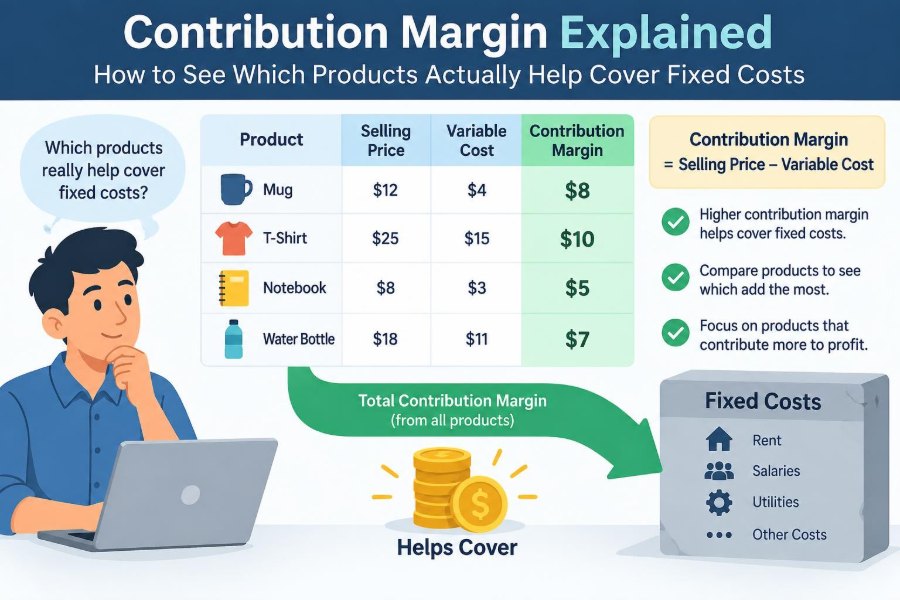

A café owner sees that iced drinks sell quickly, pastries have attractive prices, and sandwiches bring in the most revenue. Yet, at the end of the month, cash is tight. Which item is actually helping pay the rent, manager’s salary, and insurance?
Revenue alone cannot answer that question. A product can look successful because it sells often or has a high selling price, while leaving very little after the costs that rise with each sale.
This is where contribution margin becomes useful. It shows how much each sale contributes toward fixed costs first—and profit after those costs have been covered.
For students learning managerial accounting and professionals making pricing or product decisions, contribution margin offers a practical way to look beyond sales volume and identify the economic role of each product, service, customer, or channel.
🧩 What Contribution Margin Means
Contribution margin is the amount of sales revenue left after subtracting variable costs. It is called a contribution because the remainder contributes to covering fixed costs and, eventually, generating operating profit.
The basic formula is:
Contribution margin = Sales revenue − Variable costsIf a product sells for $50 and has $30 of variable cost per unit, its contribution margin is $20. That $20 does not automatically equal profit. It must first help pay costs that do not change directly with each unit sold.
🎯 Why Revenue Is an Incomplete Performance Measure
High revenue can be misleading when costs differ sharply among products. A $100 item with $85 in variable cost provides less toward the business’s fixed-cost burden than a $40 item with $15 in variable cost.
Sales tell managers what customers bought. Contribution margin helps them assess what those sales created financially. Both views matter, but they answer different questions.
🔄 Separating Variable Costs from Fixed Costs
A cost is variable when its total amount changes with activity, such as units produced, hours delivered, or orders shipped. Direct materials, sales commissions, transaction fees, and unit packaging are common examples.
A fixed cost usually remains unchanged within a relevant operating range for a period. Monthly rent, salaried office staff, depreciation, and a software subscription may be fixed in the short run.
Some costs are mixed. A delivery service might charge a monthly base fee plus an amount per shipment. The base is fixed; the per-shipment charge is variable.
🧮 Calculating Contribution Margin per Unit
Unit contribution margin is especially useful for decisions about individual products.
Unit contribution margin = Selling price per unit − Variable cost per unitSuppose a bookstore sells a planner for $24. It costs $9 to buy from the supplier, $1 for a sales commission, and $2 for packaging and payment processing. Variable cost is $12, so the unit contribution margin is $12.
Each additional planner sold adds $12 toward fixed costs and profit, assuming the store has capacity and the classification of costs is appropriate.
📈 Understanding the Contribution Margin Ratio
The contribution margin ratio expresses contribution margin as a percentage of sales. It indicates how much of each sales dollar remains after variable costs.
Contribution margin ratio = Contribution margin ÷ Sales revenueIf the planner produces a $12 contribution margin on a $24 sale, its ratio is 50%. In broad terms, every additional dollar of planner sales contributes 50 cents toward fixed costs and profit.
This ratio is helpful when products have different prices or when managers are planning sales in dollars rather than units.
🧾 A Simple Multi-Product Example
Consider a hypothetical small meal-prep company selling two weekly meal options. The following figures focus only on sales-related variable costs:
| Product | Selling price | Variable cost | Unit contribution margin | CM ratio |
|---|---|---|---|---|
| Standard meal box | $60 | $42 | $18 | 30% |
| Premium meal box | $90 | $54 | $36 | 40% |
The premium box brings in more revenue and a larger contribution per box. It also retains a larger share of its selling price. That does not automatically mean it should replace the standard box, but it gives management a clearer basis for evaluating sales mix and promotions.
🏢 How Fixed Costs Fit into the Picture
Contribution margin is not the final destination. A business uses total contribution margin to cover fixed costs such as kitchen rent, supervisor salaries, insurance, and scheduling software.
Operating income = Total contribution margin − Fixed costsIf the meal-prep company earns $30,000 in total contribution margin and has $25,000 in fixed costs for the period, operating income is $5,000. If contribution margin is below fixed costs, the business reports an operating loss.
🚪 The Link to Break-Even Analysis
Break-even point is the sales level at which total contribution margin exactly equals fixed costs. At that point, operating income is zero: the business has covered its costs but has not yet earned profit.
Break-even units = Fixed costs ÷ Unit contribution marginWith fixed costs of $24,000 and a $12 unit contribution margin, a single-product business needs 2,000 units to break even. Every unit beyond that level contributes $12 to profit, provided the underlying assumptions remain valid.
🗺️ Why the Relevant Range Matters
Cost behavior is rarely fixed forever. The relevant range is the activity level over which assumptions about fixed and variable costs are reasonably expected to hold.
A factory might have room to produce 5,000 units without new equipment. At 5,001 units, it may need another shift supervisor, more floor space, or a machine lease. Fixed costs then jump, changing the economics.
Contribution-margin analysis is most reliable when managers state the time period, capacity limits, and activity range behind their calculations.
🛒 Using Contribution Margin in Pricing Decisions
A price needs to exceed relevant variable cost if a sale is to create positive contribution margin. But choosing a price involves more than adding a desired markup: demand, competitors, customer value, capacity, and long-term positioning all matter.
Contribution margin helps managers see the immediate financial effect of a proposed price. A discount that increases unit sales can still reduce total contribution if the price cut is larger than the benefit from extra volume.
It is therefore more useful to ask, “How much total contribution will this pricing choice produce?” than simply, “Will more customers buy?”
🏷️ Evaluating Discounts Without Guesswork
Suppose an online retailer sells an item for $40 with $22 variable cost, creating an $18 contribution margin. A temporary price reduction to $34 lowers unit contribution to $12.
To maintain the same total contribution from that item, the retailer must sell 50% more units: $18 divided by $12 equals 1.5. This does not prove the discount is wrong; it clarifies the volume increase required before considering capacity, returns, and possible effects on future pricing expectations.
📣 Choosing Products for Promotions
Products with a strong unit contribution margin may be promising promotion candidates, particularly when the business has unused capacity. Additional demand can then add meaningful contribution without requiring major fixed-cost increases.
However, a high-margin product may not be the right promotional choice if it already sells at capacity, has limited inventory, or displaces an even more profitable use of staff time. Promotional decisions should consider the constraint, not just the margin.
⏱️ When a Scarce Resource Changes the Answer
If production time, machine hours, shelf space, or skilled labor is limited, unit contribution margin alone can mislead. The relevant comparison becomes contribution margin per unit of the scarce resource.
Imagine Product A contributes $30 and takes three machine hours, while Product B contributes $18 and takes one hour. Product A generates $10 per machine hour; Product B generates $18. When machine time is the bottleneck, B is the stronger use of that resource.
This is a common reason why “highest margin per item” is not always the same as “best product to prioritize.”
⚖️ Contribution Margin Versus Gross Margin
Contribution margin and gross margin are related but not interchangeable. Gross margin usually equals sales minus cost of goods sold under financial accounting rules, while contribution margin subtracts all costs that vary with sales or production for the decision being analyzed.
For a retailer, credit-card processing fees and sales commissions may be variable but sit outside cost of goods sold. For a manufacturer, some labor may be treated differently depending on whether it varies with output and how the company reports inventory costs.
Always check which costs have been included before comparing the two measures.
📚 Contribution Margin Versus Net Profit
Net profit is the broad bottom-line result after operating costs, interest, taxes, and other applicable items. Contribution margin is an intermediate management measure, not a substitute for a full income statement.
A business can have a healthy contribution margin and still lose money because fixed costs are too high. Conversely, it can have a low contribution margin ratio but remain profitable at a large enough volume and with controlled fixed costs.
🧱 Building a Contribution Format Income Statement
A contribution format income statement organizes costs by behavior rather than by traditional function. It makes the route from sales to profit easier to see.
Sales
− Variable costs
= Contribution margin
− Fixed costs
= Operating income
Managers often use this format internally for planning. External financial reporting may use a different presentation, so the two reports should not be expected to match line for line.
🧠 Reading Sales Mix in a Multi-Product Business
Sales mix is the relative proportion in which a business sells different products or services. In a multi-product company, total profit depends on both total sales and the mix of high- and low-contribution offerings.
If a gym sells many low-margin day passes and fewer high-contribution memberships, a shift toward day passes can reduce total contribution even when revenue rises. Managers need to track the mix rather than assuming every sales dollar has the same value.
For break-even planning, a weighted-average contribution margin can be useful when the expected sales mix is reasonably stable.
🔀 Calculating a Weighted-Average Contribution Margin
A weighted average combines product margins based on expected sales proportions. Suppose 60% of expected sales units are Product A with a $10 contribution margin and 40% are Product B with a $25 contribution margin.
Weighted-average unit CM = (60% × $10) + (40% × $25) = $16If fixed costs are $160,000, the estimated break-even volume is 10,000 composite units at that expected mix. This estimate becomes less useful if actual product proportions change substantially.
🧪 Deciding Whether to Accept a Special Order
A special order is a one-time request, often at a price below the regular list price. The relevant question is not whether the order covers every allocated fixed cost; it is whether it produces positive incremental contribution and creates no unacceptable downside.
When there is unused capacity, fixed costs may not change. A special order priced above its incremental variable costs can improve short-run operating income.
But management should also consider regular-customer reactions, contractual restrictions, quality requirements, extra shipping, and whether the order could consume capacity needed for normal sales.
🏭 Make-or-Buy Decisions Need Relevant Costs
Contribution thinking also supports make-or-buy decisions, though the analysis changes. The key is to compare costs that will actually change if production is outsourced or brought in-house.
Allocated fixed costs can create confusion. A factory supervisor’s salary may appear in a unit cost calculation, but if the salary continues regardless of the decision, it is not avoided by outsourcing and should not be treated as a short-run savings.
Longer-term decisions may differ because facilities, contracts, and staffing can eventually change.
🧹 Why Allocated Fixed Costs Can Distort Product Decisions
Businesses often allocate rent, executive salaries, IT, and other shared costs across products. Allocation is useful for understanding full cost and long-term sustainability, but it can make a product look unprofitable when it still provides positive contribution.
Dropping that product may not eliminate the allocated costs. If the fixed costs remain, total profit can fall because the business has lost the product’s contribution.
The better question is: Which costs will disappear, and which revenues and variable costs will change?
🚫 The Danger of Dropping a “Low-Profit” Product Too Quickly
A product with a low or negative reported net margin deserves investigation, not an automatic exit. It may contribute toward unavoidable overhead, attract customers who buy other items, or use idle capacity.
On the other hand, keeping a product simply because it has positive contribution can also be unwise. It may require excessive management attention, damage the brand, create quality problems, or block a stronger alternative.
Contribution margin is a decision input, not a substitute for judgment.
📦 Including Variable Selling and Distribution Costs
Managers sometimes calculate contribution margin using only materials and production labor. That can overstate what a sale contributes if shipping, sales commissions, marketplace fees, returns, and payment charges rise with each transaction.
The appropriate variable costs depend on the decision. For an online order, the incremental packaging and delivery cost may be highly relevant. For a storewide product review, a broader set of variable selling costs may be needed.
Consistent definitions make product comparisons more meaningful.
🧾 Handling Returns, Waste, and Customer Support
Some variable costs occur after the initial sale. Returns, warranty claims, spoilage, and per-customer support can materially affect contribution, particularly in retail, food service, subscription businesses, and electronics.
When these costs vary predictably with product volume, managers can estimate an expected per-unit amount. The estimate should be reviewed over time because return patterns and waste rates can change.
Ignoring these costs may make a seemingly attractive product appear stronger than it is.
📊 Contribution Margin by Customer and Channel
The same product can produce different contribution margins through different channels. A direct website sale may avoid a marketplace commission but require higher advertising expense or shipping support. Wholesale may bring lower prices but larger, more predictable orders.
Similarly, a customer with frequent small orders, customized service, and high returns may contribute less than one buying the same product in larger, simpler transactions.
Channel and customer analysis should be handled carefully: not every support cost is truly variable, and simplistic rankings can damage valuable long-term relationships.
🧭 Short-Run Decisions and Long-Run Sustainability
In the short run, a business may accept work that covers incremental variable costs and contributes something toward unavoidable fixed costs. This can be sensible during temporary excess capacity.
In the long run, prices must generally support the full economic cost of operating, replacing assets, maintaining quality, and earning an adequate return. A strategy based permanently on thin contribution margins can leave little room for disruption.
The time horizon should be explicit whenever contribution margin guides a decision.
⚠️ Common Classification Mistakes
Most contribution-margin errors begin with weak cost classification. Costs do not become fixed or variable merely because they have a familiar name.
- Treating all labor as variable: salaried staff may not change with short-run output.
- Treating all overhead as fixed: utilities, supplies, and support may include activity-driven portions.
- Forgetting step costs: capacity additions can cause fixed costs to rise in chunks.
- Using averages carelessly: average costs can hide different behavior at different volumes.
- Mixing time periods: monthly fixed costs should not be compared with annual sales without adjustment.
Documenting assumptions is often as valuable as completing the calculation.
🗂️ Gathering Better Data for the Analysis
Useful contribution analysis starts with transaction-level information: selling prices, materials, commissions, freight, payment fees, labor usage, and returns. Accounting records, point-of-sale systems, operational logs, and supplier invoices may all provide pieces of the picture.
Managers should reconcile the analysis with actual results periodically. A model is not a one-time spreadsheet; it is a working estimate that needs updating when supplier prices, wages, pricing, or customer behavior change.
🔍 Running Sensitivity Analysis
Because assumptions can be uncertain, test several plausible scenarios rather than relying on one forecast. Sensitivity analysis asks how the result changes when a key input changes.
For example, a manager might examine what happens if material costs rise, a discount reduces price, returns increase, or expected volume falls. This reveals which assumptions have the greatest influence on contribution and break-even risk.
A range of outcomes is usually more informative than false precision from a single estimate.
🛠️ A Practical Workflow for Managers
A disciplined process keeps contribution-margin analysis connected to the decision at hand.
- Define the decision: pricing, promotion, product mix, special order, or discontinuation.
- Set the time horizon and identify relevant capacity constraints.
- List revenues and costs that will change because of the decision.
- Calculate unit and total contribution margin using consistent assumptions.
- Compare alternatives, including the opportunity cost of scarce resources.
- Test reasonable changes in price, volume, and variable cost.
- Consider qualitative effects such as customer trust, quality, and strategic fit.
- Monitor actual results and revise the model.
📌 Questions to Ask Before Acting
Before using a contribution result to make a major decision, pause for a few practical questions:
- Does the sale use idle capacity or displace a more valuable activity?
- Which costs are genuinely avoidable, and which are merely allocated?
- Are variable costs complete, including fulfillment and expected returns?
- Will the decision change customer expectations or regular pricing?
- Is this a short-run exception or a sustainable long-run policy?
- What assumption would most change the conclusion if it proved wrong?
These questions turn a simple formula into a more reliable management tool.
✅ The Core Principle to Remember
Contribution margin focuses attention on the financial value created by incremental sales after their variable costs. It reveals how products and services help carry the fixed-cost structure of a business.
A high contribution margin can support growth, pricing flexibility, and resilience, but it should be interpreted alongside capacity, sales mix, customer effects, and long-term costs. A low margin is not automatically a reason to stop selling; it is a signal to investigate the economics.
The most useful habit is to separate the question “Does this sale add more than it costs to serve?” from the broader question “Can this business cover all of its costs over time?” Contribution margin answers the first question clearly and informs the second.
When managers understand what each sale contributes after variable costs, they can make more grounded decisions about prices, products, capacity, and profit. 📊 💡