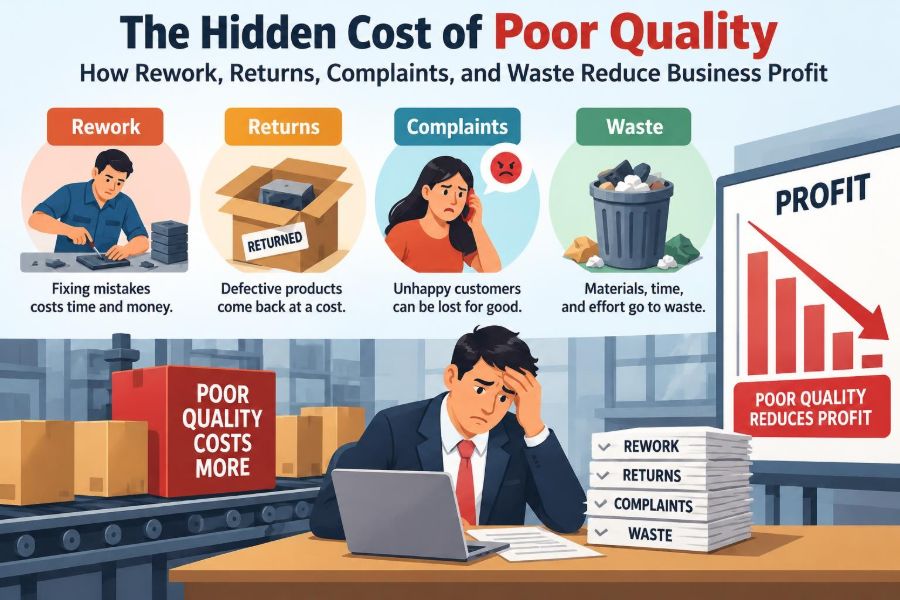

A customer opens a long-awaited delivery and finds the wrong item inside. A technician spends part of the morning correcting yesterday’s installation. In an office, a finance team discovers that invoices were sent with incorrect prices and must be reissued.
None of these problems may look disastrous in isolation. The business can resend the order, redo the work, apologize, or absorb the cost of a refund. Yet each correction uses materials, time, attention, and customer trust that could have supported profitable work instead.
This is the hidden cost of poor quality: the expense is rarely limited to the defective item. It spreads through operations, customer service, inventory, cash flow, employee morale, and future sales.
Understanding that chain reaction helps managers make better decisions. Quality is not simply a production concern; it is a practical driver of profit, competitiveness, and long-term resilience.
🔍 What “Poor Quality” Really Means
Poor quality occurs when a product, service, process, or experience fails to meet a relevant requirement. The requirement may come from a customer, a contract, an internal specification, a safety rule, or a sensible expectation such as receiving accurate information on time.
A defect is not always a visibly broken product. An incomplete insurance form, a late appointment, a confusing bill, and an incorrectly packed online order can all be quality failures because they create extra work or disappointment.
Quality therefore has two sides: conformance, meaning work meets stated requirements, and fitness for use, meaning it actually works for the customer’s purpose.
💰 Why the Cost Is Often Hidden
Many businesses can see obvious losses, such as refunds and scrapped materials, but fail to connect them to a broader quality problem. Costs are commonly recorded in separate budgets: customer service pays for calls, operations pays overtime, and marketing handles reputation repair.
Because no single report combines these consequences, a recurring defect can appear smaller than it is. Managers may treat it as normal “business friction” rather than a preventable drain on margin.
The key question is not merely, “What did this faulty item cost?” It is, “What did the failure force the business and the customer to do next?”
🧮 Understanding the Cost of Quality
The cost of quality is a management concept that groups spending related to achieving and failing to achieve quality. It does not mean that quality itself is inherently expensive. Instead, it helps compare the cost of prevention with the cost of correcting failure.
| Cost category | What it includes | Simple example |
|---|---|---|
| Prevention costs | Training, process design, supplier qualification, maintenance | Training staff to verify orders before dispatch |
| Appraisal costs | Inspection, testing, audits, reviews | Checking a finished batch against specifications |
| Internal failure costs | Defects found before the customer receives them | Reworking an incorrectly assembled unit |
| External failure costs | Defects found after delivery | Returns, warranty claims, complaints, lost customers |
Prevention and appraisal require resources, but they can reduce expensive internal and external failures. The aim is not unlimited checking; it is a sensible system that prevents predictable errors at an appropriate cost.
🔁 Rework Consumes Capacity Twice
Rework means doing a task again because it was not completed correctly the first time. It may involve repairing a product, correcting data, revising a report, remaking food, or repeating a service visit.
Its direct cost includes labour and materials. Its larger operational cost is lost capacity: employees are busy fixing yesterday’s output instead of completing new work, serving customers, improving processes, or handling planned demand.
Imagine a design team that repeatedly corrects inaccurate client specifications. Even if the team does not buy new materials, its project schedule slips. That delay can prevent it from accepting another assignment or can require rushed work later.
⏱️ The Opportunity Cost of Correction
Every hour spent resolving a defect has an opportunity cost: the value of the best alternative use of that hour. This is especially significant in businesses where skilled time is scarce, such as consulting, healthcare administration, software development, maintenance, and professional services.
Rework can also make capacity planning misleading. A department may appear fully staffed on paper, but much of its time is quietly consumed by avoidable corrections. Managers may respond by hiring more people when process improvement would release capacity more sustainably.
Extra staffing can still be necessary when demand genuinely rises. The mistake is assuming that all workload growth is customer-driven rather than failure-driven.
📦 Returns Turn Revenue into Reverse Logistics
A return is more than a reversed sale. The business may need to authorize it, arrange collection or postage, inspect the item, update inventory, issue a refund, answer questions, and decide whether the product can be resold, repaired, or discarded.
For physical products, this is called reverse logistics: moving goods back through the supply chain. Returned items may arrive damaged, incomplete, out of season, or unsuitable for resale as new.
A retailer that sends the wrong size due to an inaccurate product listing faces a wider issue than one refund. It may pay shipping in both directions, lose packaging, tie up stock, and prompt the shopper to buy from a competitor next time.
🚚 The Complications of Replacement Orders
Replacing a defective or incorrect order may preserve goodwill, but it creates another full order cycle. Staff must pick, pack, ship, track, and communicate again, often at an expedited pace.
Expedited shipping is particularly revealing because it converts a preventable quality failure into a visible cash expense. It may be justified when protecting an important customer relationship, but it should not become a routine workaround for weak processes.
Businesses should record replacement orders separately where possible. Otherwise, fulfilment volume can look healthy while a meaningful share of activity produces no new revenue.
📞 Complaints Create Service Work
A complaint often begins as an emotional moment for the customer but becomes a workflow for the business. Someone must receive the message, understand the issue, check records, investigate responsibility, decide a remedy, communicate it clearly, and document the outcome.
That work can be valuable because complaints reveal defects that internal measures missed. However, a high complaint volume signals that employees are spending time recovering from failures rather than creating value.
Quick, respectful complaint handling matters. It cannot erase the original problem, but it can reduce escalation and help the business learn what failed.
🗣️ Customer Effort Can Damage Loyalty
Customers judge quality not only by whether something goes wrong, but by how much effort they must expend to put it right. Repeating information, waiting for responses, uploading proof, returning to a store, or chasing a refund all add friction.
A customer may accept an occasional mistake from a business that resolves it easily. Repeated friction is different: it teaches the customer that buying again carries risk and inconvenience.
This is why a small operational error can have a large commercial effect. The visible refund may be modest, while the lost future relationship is much more difficult to measure.
📉 Refunds Can Distort Sales Performance
Gross sales figures can make a business look stronger than it is. If a substantial portion of orders is later refunded, discounted, replaced, or written off, the relevant measure is closer to net revenue and contribution after those costs.
Managers should examine which products, locations, channels, suppliers, or customer journeys generate the most refunds. A growing sales line is not automatically good news if the underlying quality of those sales is deteriorating.
For example, a promotion may increase orders rapidly while causing warehouse picking errors. The campaign may appear successful until returns, support costs, and customer dissatisfaction are included.
🗑️ Waste Includes More Than Scrap
Scrap is material that cannot be used or sold because it is damaged, defective, or incorrectly processed. It is one form of waste, but not the only one.
Quality-related waste may also include spoiled ingredients, obsolete labels, excess packaging, duplicated paperwork, unused spare parts, unnecessary transport, and energy consumed making products that cannot be sold.
In service settings, waste often takes the form of wasted effort: duplicate data entry, avoidable approvals, repeated calls, or meetings held solely to resolve an error. The material is invisible, but the payroll cost is real.
🏭 Defects Can Disrupt the Whole Process
Processes are connected. A mistake at one stage often creates queues and disruption downstream. An incorrect component may stop assembly; a missing customer detail may delay billing; an inaccurate forecast may create the wrong inventory mix.
This is why inspection at the final stage, while useful, is rarely sufficient. Finding a problem late means most of the labour, materials, and time have already been spent.
The most valuable quality improvements usually address the point where the error begins or where it can be detected early with minimal disruption.
🔗 Suppliers Can Introduce Quality Risk
A business can have careful internal controls and still receive faulty materials, inaccurate information, late deliveries, or inconsistent service from suppliers. These problems can transfer cost downstream to production, sales teams, and customers.
Supplier quality should be managed through clear specifications, realistic lead times, communication, incoming checks where risk justifies them, and constructive feedback. Selecting only on the lowest purchase price can be misleading if poor inputs generate costly failures later.
At the same time, excessive incoming inspection can slow operations and duplicate a supplier’s work. The appropriate control depends on the item’s risk, variability, and impact on the final customer.
🧾 Poor Data Quality Causes Operational Errors
Data is an input to many business processes. Wrong addresses, duplicate customer records, inaccurate stock counts, outdated prices, and incomplete job instructions can produce errors even when employees work carefully.
Data-quality problems are particularly costly because they can be copied quickly across systems. A single incorrect product attribute, for instance, may affect marketing, online orders, customer advice, packing, and returns.
Useful controls include validation rules, clear ownership of key data, controlled updates, and regular checks on high-impact records. Technology helps, but it cannot compensate for unclear definitions or careless handoffs.
🧑🏭 Human Error Is Usually a System Signal
When an error occurs, organizations sometimes focus too quickly on the individual who made it. Personal accountability matters, especially where procedures are deliberately ignored, but many recurring mistakes are shaped by the system around the employee.
Unclear instructions, confusing screens, interruptions, unrealistic workload, poor training, similar-looking parts, and ambiguous responsibility all make errors more likely. Blaming people without examining these conditions usually encourages silence rather than learning.
A better question is: What made this error easy to make and hard to detect? That question points toward more reliable design.
🧭 Process Variation Creates Inconsistent Results
Variation is the difference in how a process performs from one case to another. Some variation is expected: customers have different needs, materials differ slightly, and demand changes over time.
Uncontrolled variation is more troublesome. If each employee uses a different method to approve returns or assemble a product, outcomes can depend on who happens to perform the work.
Standardized work, clear decision rules, and well-designed tools reduce unnecessary variation. They should guide routine work without removing the professional judgment needed for unusual cases.
🧩 Root Cause Analysis Goes Beyond Symptoms
Fixing the immediate failure is necessary, but it does not prevent recurrence. Root cause analysis is the disciplined effort to identify the underlying conditions that allowed a problem to occur.
Suppose customers receive incorrect orders. “The picker chose the wrong item” describes the event, not necessarily the root cause. The deeper issue may be nearly identical packaging, an unclear location label, a confusing order screen, or pressure to work too quickly.
Useful investigation separates evidence from assumptions. Review records, observe the actual process, involve people who do the work, and test whether the proposed cause truly explains the pattern.
❓ Asking “Why?” Carefully
A simple method is to ask “why?” repeatedly until the team reaches a controllable process condition. This technique is often called the “five whys,” although there is no magic number of questions.
For example: Why was the invoice wrong? A manual price was entered. Why was it entered manually? The system did not contain the agreed rate. Why was the rate missing? The contract-update process did not notify the billing team.
The useful action is not “tell staff to be more careful.” It might be to create a clear handoff, assign ownership, and build a confirmation step into the contract process.
🛡️ Prevention Is Usually Cheaper Than Recovery
Prevention means designing work so that defects are less likely to occur. It can include training, maintenance, simpler forms, approved suppliers, clearer specifications, realistic staffing, and process redesign.
It is not always economical to prevent every possible error. A low-impact, rare mistake may be cheaper to correct than to build an elaborate control system around. Decisions should reflect probability, customer impact, safety, cost, and the detectability of failure.
For frequent or high-consequence failures, prevention normally deserves priority because recovery costs multiply after the product or service reaches the customer.
✅ Detection Controls Still Have a Role
Inspection, testing, reviews, and audits are detection controls. They do not necessarily eliminate the underlying cause, but they can stop a defect from moving further through the process.
Examples include a second check on bank details, software tests before release, a pre-flight checklist, or a final quality inspection. Controls are especially useful where failure would be difficult to reverse or could create serious harm.
However, adding layers of checking to every task can create delay, fatigue, and false confidence. The best controls are focused on critical risks and are easy for people to use correctly.
⚙️ Error-Proofing Makes the Right Action Easier
Error-proofing, sometimes called mistake-proofing, changes a process so that an error is prevented or immediately visible. It is stronger than simply reminding someone to pay attention.
A digital form that rejects an incomplete postcode, a connector that fits only the correct port, and a barcode scan that confirms the selected item are everyday examples. These controls reduce reliance on memory and concentration.
Good error-proofing is practical. If it slows routine work too much or creates frequent unnecessary alerts, employees may find ways around it. Test changes in real conditions before relying on them.
📊 Measuring Quality Costs Without False Precision
Not every quality cost can be measured perfectly. Lost trust, employee frustration, and future purchases not made are real but difficult to assign an exact value to.
That uncertainty should not lead managers to ignore the issue. Start with observable measures, then use them to identify patterns and prioritize investigation.
- Rework hours and overtime linked to corrections
- Scrap, spoilage, and repair costs
- Return, replacement, refund, and warranty volumes
- Complaint themes and time to resolve them
- First-pass yield: work completed correctly without rework
- Defect rates by product, process step, shift, supplier, or channel
Definitions must be consistent. A metric is useful only when teams record it in the same way over time.
📈 Use Trends and Segments, Not Just Totals
A monthly total can hide the story. A stable return rate, for example, may conceal a serious issue affecting one new product, one warehouse, or one supplier.
Segmenting data by relevant factors helps locate concentration. Useful categories may include product version, customer type, order size, time period, location, process stage, or reason code.
Managers should avoid treating every correlation as proof of cause. A pattern is a prompt for investigation, observation, and testing—not a substitute for them.
👥 Employees Need Psychological Safety to Report Problems
Frontline employees often see quality issues first. They may notice recurring workarounds, confusing instructions, defective inputs, or customer complaints before those signals reach senior managers.
If reporting problems leads to embarrassment or punishment, employees may stay quiet, correct issues informally, or hide defects to meet targets. This makes the data look better while the underlying system becomes less reliable.
A constructive culture distinguishes between honest mistakes, weak process design, and reckless behavior. It asks people to raise concerns early and gives them a credible route for doing so.
🎯 Quality Targets Can Create Unintended Behavior
Metrics shape behavior. If a call center is measured only on call length, employees may rush customers off the phone rather than resolve problems. If a factory is measured only on output volume, staff may feel pressure to pass along questionable work.
Balanced measures reduce this risk. Pair speed with accuracy, sales with return rates, production volume with first-pass yield, and complaint response time with resolution quality.
Targets should guide improvement, not encourage gaming. When employees explain that a measure is causing harmful trade-offs, leaders should investigate rather than dismiss the feedback.
💵 The Margin View Changes Management Decisions
Revenue is not profit. A business can replace a product at no charge and retain the original sale on a report, yet still lose margin through shipping, labour, materials, support, and disposal.
Viewing defects through contribution margin makes trade-offs clearer. It highlights why reducing a recurring error can be financially equivalent to winning additional sales—without requiring more demand generation.
This perspective also helps prioritize. A defect affecting a high-margin, strategically important product may deserve attention before a more visible but low-impact annoyance.
🌱 Quality and Sustainability Often Meet
Quality failures can create environmental as well as financial costs. Scrapped materials, repeat deliveries, excess packaging, energy-intensive rework, and product disposal all use resources without producing intended value.
Better quality does not automatically make every operation sustainable; some quality controls themselves consume materials and energy. Still, reducing avoidable failures often aligns operational efficiency with lower waste.
Teams can look for improvements that serve both goals, such as reducing damage in transit, improving yield, extending product life, and avoiding unnecessary remanufacture.
🧪 Pilot Improvements Before Scaling Them
A sensible improvement idea can fail in practice if it disrupts workflow, confuses users, or creates a new bottleneck. Piloting a change on a limited product line, shift, location, or customer segment allows the business to learn at lower risk.
Define what success should look like before the pilot begins. Measure not only the targeted defect but also side effects such as processing time, employee workload, customer confusion, and new error types.
Successful pilots should be documented and standardized before expansion. Otherwise, the improvement may weaken as different teams interpret it differently.
🔄 Continuous Improvement Prevents Backsliding
Quality management is not a one-time cleanup project. Processes change when suppliers change, systems are updated, demand rises, employees join, and products evolve.
A continuous-improvement cycle is straightforward: identify a problem, understand the process, test a change, measure results, standardize what works, and review performance over time. Small, repeated improvements can have a substantial cumulative effect.
Leaders should also check whether improvements remain in place. A process may drift back when training fades, workload increases, or an informal shortcut becomes normal.
🚫 Common Responses That Fail
Some responses feel decisive but do little to reduce the true cost of poor quality. They may even make it harder to learn.
- Blaming one employee: this overlooks design flaws and discourages reporting.
- Adding a final inspection only: this catches some defects but leaves the source untouched.
- Chasing every minor issue equally: this spreads attention too thinly.
- Using discounts to silence complaints: this may resolve a case while hiding the recurring cause.
- Measuring output without quality: this rewards volume even when it creates future rework.
Effective responses are proportionate, evidence-based, and focused on preventing recurrence where it matters most.
🗺️ A Practical Starting Plan for Managers
Businesses do not need a complex quality program before taking useful action. Begin with one recurring failure that affects customers, cost, risk, or employee workload.
- Define the defect clearly and describe the customer impact.
- Map the process from input to outcome, including handoffs.
- Collect available evidence on frequency, rework, returns, complaints, and cost.
- Observe the work and ask employees where errors begin or escape detection.
- Identify likely root causes and test a focused improvement.
- Track the result, including unintended effects, then standardize the better method.
Visible early wins help build confidence, but the purpose is learning, not merely producing a quick metric.
🤝 Quality Is Everyone’s Work, With Clear Ownership
Quality should not be assigned solely to an inspection team or a customer service department. Product designers influence usability, purchasing influences input quality, operations influences consistency, and leaders influence priorities and resources.
Shared responsibility does not mean vague responsibility. Each critical process needs an owner who can coordinate improvement, maintain standards, and escalate barriers that require leadership support.
Customers also provide part of the definition of quality. Listening carefully to how they use a product or experience a service can reveal requirements that internal teams did not recognize.
🏁 The Core Principle: Get It Right Earlier
The hidden cost of poor quality grows as a defect travels. An error caught while entering data may take seconds to correct. The same error discovered after shipment may involve returns, support, replacement, refund, and lost confidence.
That is why strong quality management emphasizes prevention, early detection, and learning from failure. It does not promise a defect-free world, nor does it require spending without limit on controls.
It asks a disciplined business question: where can we make correct work easier, detect serious problems sooner, and stop repeated failures from consuming profitable capacity?
Poor quality reduces profit not only by creating bad output, but by forcing a business to spend its time, money, and goodwill fixing work that should have created value the first time. When organizations see that full cost, quality improvement becomes a practical investment rather than an optional extra. 📊🔧🌱