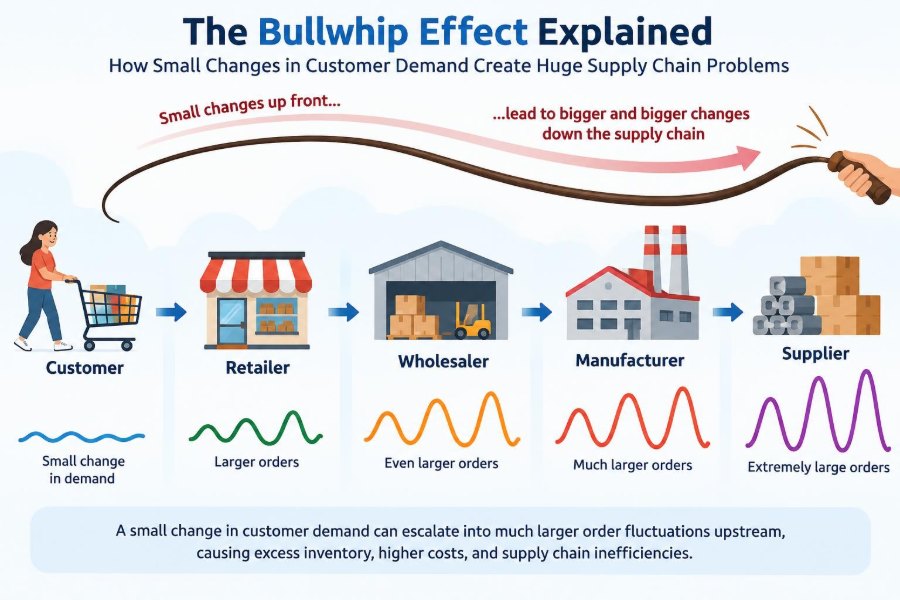

A popular café sells a few more oat-milk lattes than usual one week. The manager worries that demand is rising and orders extra cartons. The distributor sees the bigger order and assumes several cafés are expanding their menus. The manufacturer ramps up production.
Weeks later, the rush fades. Now every stage holds more oat milk than it can comfortably store or sell. What began as a small, ordinary shift in customer purchases has become a costly inventory problem.
This pattern appears in supermarkets, factories, hospitals, online retail, automotive supply chains, and service operations. It helps explain why shelves can be empty one month and warehouses overfull the next.
The pattern has a name: the bullwhip effect. Understanding it gives managers a practical way to make better forecasts, reduce waste, and respond to uncertainty without creating even more of it.
📈 What the Bullwhip Effect Means
The bullwhip effect occurs when small fluctuations in customer demand create progressively larger swings in orders and inventory as information moves upstream through a supply chain.
“Upstream” means moving away from the customer: from retailer to wholesaler, from wholesaler to manufacturer, and from manufacturer to raw-material supplier. A slight flick of a whip’s handle becomes a large movement at its tip; order variability can behave similarly.
The key distinction is that orders are not the same as actual customer sales. Businesses upstream often react to orders placed by their immediate customer, not to the final consumer’s real purchases.
🔗 The Supply Chain Behind the Pattern
A supply chain is the network that transforms materials into products and delivers them to users. It may include suppliers, producers, logistics providers, distributors, retailers, and customers.
Each organization makes decisions with incomplete information. A retailer may know daily sales, but a component supplier may only see a manufacturer’s purchase order, which can reflect forecasts, promotions, safety stock, and operational constraints rather than genuine market demand.
That limited visibility allows reasonable local decisions to combine into an unstable system-wide result.
🛒 A Simple Retail Example
Imagine a store normally sells 100 rechargeable batteries per week. A local event raises sales to 110 for one week. The store cannot know immediately whether this is a one-off change or the beginning of a trend.
To avoid a stockout, it orders 130 batteries: 110 to cover expected sales plus extra units to rebuild its buffer. The distributor interprets the 30% order increase as a meaningful demand signal and may order even more from the manufacturer.
By the time the manufacturer responds, final customer demand may already have returned to around 100 units. The larger upstream orders were reactions to uncertainty, not evidence that consumers suddenly wanted many more batteries.
🧭 Why Small Changes Become Large Ones
Every stage adds its own forecast, inventory policy, lead-time allowance, and risk adjustment. A small increase in downstream demand can therefore be enlarged several times before it reaches production.
Managers are not necessarily behaving irrationally. If deliveries are slow or unreliable, ordering extra can be sensible for one firm. The problem is that when every firm protects itself independently, the total response may overshoot what the market needs.
In short, the bullwhip effect is a coordination problem, not simply a forecasting problem.
🔍 Demand Signals Get Distorted
Actual point-of-sale data answers a basic question: what did customers buy? Purchase orders answer a different question: what did one business decide to request from another business?
Orders may be increased because shelves need replenishing, reduced because a warehouse is full, delayed until a purchasing cycle closes, or divided among suppliers. None of those actions necessarily describes underlying consumption.
When upstream partners treat orders as pure demand data, they can mistake operational noise for a lasting market shift.
🔮 Forecast Updating Can Amplify Noise
Forecasts are estimates of future demand based on past sales, current conditions, and managerial judgment. Because forecasts are uncertain, businesses revise them when they receive new information.
A sudden order increase may lead a supplier to update its forecast sharply. If its customer also made a sharp forecast revision, the same small consumer movement can be counted and magnified at multiple levels.
Frequent forecasting is not the issue by itself. The risk rises when firms revise aggressively using weak signals without sharing the evidence behind those revisions.
⏳ Long Lead Times Raise the Stakes
Lead time is the delay between placing an order and receiving the goods. It can include approval, manufacturing, transport, customs clearance, and receiving processes.
Long lead times force planners to make decisions well before demand is known. To cover that uncertainty, they often order earlier and in larger quantities. If demand changes during the wait, the business can receive inventory that no longer matches its needs.
Reducing lead time will not eliminate uncertainty, but it shortens the period that must be forecast and makes corrections less expensive.
📦 Batch Ordering Creates Artificial Peaks
Many firms do not order continuously. They place large orders weekly, monthly, or when inventory reaches a trigger point. This is called order batching.
Batching may lower administrative work or make transport cheaper per shipment. Yet it also turns relatively steady customer sales into lumpy orders. A supplier sees silence for several weeks, followed by a large spike.
From the supplier’s viewpoint, that pattern can look like volatile demand even when consumers are buying at a stable pace.
💸 Price Promotions Can Send Misleading Signals
Temporary discounts, rebates, and volume deals encourage customers in the supply chain to buy more than they immediately need. This behavior is often called forward buying.
For example, a retailer may buy extra detergent during a supplier promotion, then sell from that inventory for weeks without placing another normal-sized order. The manufacturer sees a surge followed by a drop, even if household usage barely changed.
Promotions can be commercially useful, but managers should separate promotion-driven purchasing from true changes in consumption before adjusting long-term production plans.
🚚 Shortages Encourage Over-Ordering
When products are scarce, buyers may order more than they expect to receive. They may also place overlapping orders with several suppliers in case one cannot fulfill them.
Suppliers then see demand that is partly real and partly precautionary. If supply later improves, buyers cancel, reduce, or stop ordering because they already have enough stock.
This cycle makes allocation difficult. A supplier that cannot distinguish genuine requirements from inflated requests may direct scarce capacity inefficiently.
🗣️ Poor Information Sharing Leaves Everyone Guessing
A retailer may hold detailed sales data, promotion calendars, and information about local events. A manufacturer may have capacity plans and material constraints. If these facts remain isolated, each participant must infer the rest.
That guessing creates a chain of defensive decisions: more safety stock, larger orders, longer production runs, and more urgent transport. Better information sharing does not remove risk, but it reduces the need to infer demand from incomplete order data.
Shared data must be timely, defined consistently, and trusted. A dashboard full of outdated or incompatible figures can create false confidence rather than clarity.
🧮 Safety Stock Has a Useful but Limited Role
Safety stock is inventory held to protect against uncertain demand or supply delays. It is often necessary, particularly for essential items, unreliable supply routes, or products with serious stockout consequences.
Problems arise when every stage adds a large independent buffer without considering stock already held elsewhere. The system may carry far more inventory than is needed overall while still placing it in the wrong locations.
The goal is not “zero inventory.” It is a deliberate buffer based on service needs, variability, lead time, and the visibility available across the network.
🏭 Production Rules Can Worsen Variability
Factories often prefer long production runs because setup time, cleaning, changeovers, and scheduling effort can be costly. Producing a large batch of one product may be efficient inside the plant.
However, a large production batch can flood downstream warehouses and delay other needed products. Local production efficiency may conflict with the supply chain’s need for flexible replenishment.
Managers should evaluate the combined cost of setup, holding inventory, obsolescence, lost sales, and emergency logistics rather than optimizing only one factory metric.
📊 Orders, Sales, and Inventory Tell Different Stories
One reason bullwhip problems persist is that teams focus on a single measure. Sales, orders, inventory, and service levels each reveal part of the picture, but none explains the whole system alone.
| Measure | What it can reveal | Common misreading |
|---|---|---|
| Customer sales | What end users actually purchased | Assuming it shows future demand by itself |
| Orders received | What immediate customers requested | Treating all orders as final demand |
| Inventory on hand | Current stock position | Ignoring stock already in transit or elsewhere |
| Fill rate | How well demand was met from available stock | Improving it only by adding excessive inventory |
Looking at these measures together helps planners identify whether a surge reflects consumption, replenishment, panic buying, or a temporary promotion.
🏪 Retailers Feel the Problem First
Retailers are closest to the consumer, so they often experience the first visible signs of a demand change: empty shelves, abandoned carts, substitutions, and customer complaints.
Yet retailers can also trigger amplification through irregular ordering, inaccurate inventory records, or promotions that generate demand spikes. Their ordering policies strongly affect every partner behind them.
Reliable shelf-level and online sales data are therefore valuable not just to the retailer, but to the entire network.
🏗️ Manufacturers Face Costly Swings
For manufacturers, volatile orders can mean unstable production schedules. They may add overtime, switch lines, buy materials urgently, or postpone maintenance when orders rise.
When the expected demand fails to arrive, the same business may face idle capacity, excess finished goods, and materials that cannot easily be reassigned. Perishable, seasonal, regulated, or highly customized products are especially exposed.
Capacity decisions should account for the possibility that orders are amplified signals rather than a precise forecast of final sales.
🚛 Logistics Networks Absorb the Shock
Transport and warehousing systems also feel the bullwhip effect. A spike in orders can create pressure for trucks, containers, dock appointments, labor, and storage space.
Urgent shipments may help in the short term but are usually more expensive and can displace planned freight. Later, excess inventory may occupy warehouse space needed for faster-moving products.
Logistics is not merely a delivery function; it is part of the feedback loop that determines how quickly the supply chain can correct course.
💰 The Financial Consequences Go Beyond Inventory
Excess stock ties up working capital: money invested in goods before those goods are sold. It can also lead to storage costs, markdowns, spoilage, damage, and write-downs when products lose value.
At the other extreme, shortages can reduce sales, weaken customer trust, and force firms to use costly expedited production or transport. Both too much and too little inventory can be symptoms of poor demand coordination.
Finance teams should question whether revenue growth is coming from end-customer sales or simply from partners building inventory.
🧑🤝🧑 Customers Experience Availability, Not Forecasts
Customers rarely see the forecasting models behind a stockout. They see an unavailable item, a late order, limited choice, or a higher price.
If substitutes are easy to find, a missed sale may become a lost customer relationship. If substitutes are not available, customers may delay purchases or change how they use a product.
Service targets matter, but they should be designed by product importance. A critical spare part, staple product, and slow-moving decorative item do not require the same availability strategy.
🦠 Disruptions Can Expose Existing Weaknesses
Major disruptions can make demand and supply unusually uncertain. They can trigger rapid shifts in purchasing behavior, transport delays, material shortages, and changed operating rules at the same time.
But disruption does not automatically equal the bullwhip effect. The effect specifically refers to demand variability becoming amplified as it moves upstream. A genuine large increase in consumer demand is different from an order spike caused mainly by misinterpretation.
This distinction matters because the response differs: real demand may require capacity changes, while distorted orders may require better visibility and allocation.
🧪 A Hypothetical Four-Stage Chain
Consider a retailer, distributor, manufacturer, and packaging supplier. End customers increase purchases of a snack by a modest amount after a social-media trend.
The retailer orders extra stock to avoid empty shelves. The distributor, seeing the larger order and a promotional calendar, adds more buffer. The manufacturer schedules a longer run to avoid another changeover. The packaging supplier receives a much larger materials request.
If the trend fades quickly, the packaging supplier may be producing for inventory already accumulated at several other stages. The lesson is not that buffers or production runs are always wrong; it is that each decision needs shared context.
🔄 Feedback Loops Keep the Cycle Going
Supply chains contain feedback loops. A shortage causes larger orders; larger orders make demand appear stronger; the apparent surge creates capacity pressure; capacity pressure lengthens lead times; longer lead times prompt even larger orders.
Without a mechanism to distinguish real demand from precautionary demand, the loop reinforces itself. This is why a problem can continue even after consumer behavior has stabilized.
Breaking the loop requires credible information, consistent replenishment rules, and decisions that look beyond one firm’s immediate position.
🤝 Collaborative Planning Aligns Decisions
Collaborative planning means trading partners discuss forecasts, promotions, capacity limits, and inventory plans rather than merely exchanging purchase orders. It is most useful when major decisions are made jointly and exceptions are explained.
For instance, a retailer can tell a supplier that an upcoming order increase is tied to a two-week campaign rather than a permanent demand change. The supplier can then plan a temporary response instead of expanding output unnecessarily.
Collaboration requires effort and trust. Partners may be reluctant to share commercially sensitive information, so agreements should define what is shared, how it is used, and who can access it.
💻 Technology Improves Visibility, Not Judgment Automatically
Modern planning systems can combine point-of-sale data, inventory positions, shipment status, supplier capacity, and forecasts. Sensors and scanning tools can also improve inventory accuracy.
These capabilities help teams spot mismatches earlier. They do not automatically produce sound decisions. Poor product data, unexamined assumptions, and incentives that reward excessive ordering can still create distortion.
Technology is most effective when paired with clear operating rules: which data drive replenishment, who approves exceptions, and how planners investigate unusual demand.
🎯 Demand-Driven Replenishment Reduces Guesswork
A demand-driven approach uses actual consumption signals as close to the customer as possible to guide replenishment. Instead of relying mainly on large periodic orders, partners replenish more regularly based on agreed inventory targets.
This can reduce the need for each stage to create its own large forecast adjustment. Smaller, more frequent replenishment orders often reveal the underlying demand pattern more clearly.
It is not suitable in exactly the same form everywhere. Long production cycles, low-value bulk goods, and remote locations may still require batching, but the logic of using better demand signals remains valuable.
🧩 Segment Products Instead of Using One Rule
Not every item deserves identical forecasting and inventory policies. Products differ in demand stability, profit margin, shelf life, lead time, substitutability, and stockout consequences.
A stable, fast-selling household staple may suit automated replenishment. A slow-moving replacement part may need a carefully justified buffer. A fashion item may require shorter commitment horizons because unsold stock can lose value quickly.
Segmentation prevents a common mistake: applying a single “best” supply chain policy to products with fundamentally different risks.
📏 Measure Variability Across the Chain
Managers can monitor how variable orders are at each stage compared with variability in customer sales. If order swings become much larger upstream, that is a warning sign worth investigating.
Useful questions include:
- Did customer sales actually change, or did only orders change?
- Was a promotion, shortage, or seasonal event involved?
- Are customers ordering in larger batches than before?
- Did lead times, allocation rules, or inventory targets change?
- Is inventory building at one stage while another stage is short?
The purpose is diagnosis, not blame. A variance measure can flag a problem, but operational context explains what action makes sense.
⚠️ Common Responses That Backfire
When demand becomes uncertain, teams often respond quickly. Some reactions provide temporary relief but worsen the system over time.
- Adding inventory everywhere: this may hide a visibility problem while increasing cash and obsolescence risk.
- Treating every order spike as permanent: this can create avoidable capacity and purchasing commitments.
- Chasing the latest forecast weekly: frequent changes without decision discipline can destabilize schedules.
- Using deep promotions to clear excess stock: this may create another artificial order spike.
- Blaming one partner: bullwhip patterns usually emerge from connected policies, incentives, and information gaps.
🛠️ A Practical Manager’s Response Plan
When volatility appears, start by separating facts from assumptions. Compare point-of-sale demand, open orders, on-hand stock, goods in transit, backlog, and planned promotions.
- Identify the first point where variability increased.
- Ask whether the change reflects consumption, replenishment, shortage behavior, or a data issue.
- Share the explanation with affected suppliers and customers.
- Review order quantities, lead times, and inventory buffers before adding capacity.
- Set a short review cycle until the pattern stabilizes.
This process does not promise perfect forecasts. It helps prevent an uncertain signal from becoming an unexamined chain reaction.
👩💼 What Students and Professionals Should Notice
The bullwhip effect is a useful reminder that organizations are systems. A decision that looks sensible inside one department can create hidden costs for procurement, operations, logistics, finance, and customers.
Students can use it to connect topics such as forecasting, operations management, incentives, data quality, and strategic relationships. Working professionals can use it as a diagnostic lens whenever order patterns look more dramatic than end-customer demand.
The most valuable skill is not predicting every disruption. It is learning to ask what the data truly represent before making a large commitment.
🌊 The Core Principle: Stabilize the Signal, Not Just the Stock
The bullwhip effect shows why supply chains can become unstable even when customer demand is relatively calm. Forecast revisions, long lead times, large batches, promotions, shortage behavior, and poor visibility can turn modest change into major upstream volatility.
Better results come from sharing real demand information, shortening and clarifying replenishment processes, matching policies to product characteristics, and treating unusual orders as questions to investigate rather than automatic instructions to escalate.
The aim is not to eliminate all uncertainty; it is to stop uncertainty from being amplified at every handoff.
When businesses see the difference between customer demand and the noisy signals surrounding it, they can carry smarter inventory, plan capacity with more care, and build supply chains that respond without overreacting. 📦📊🤝