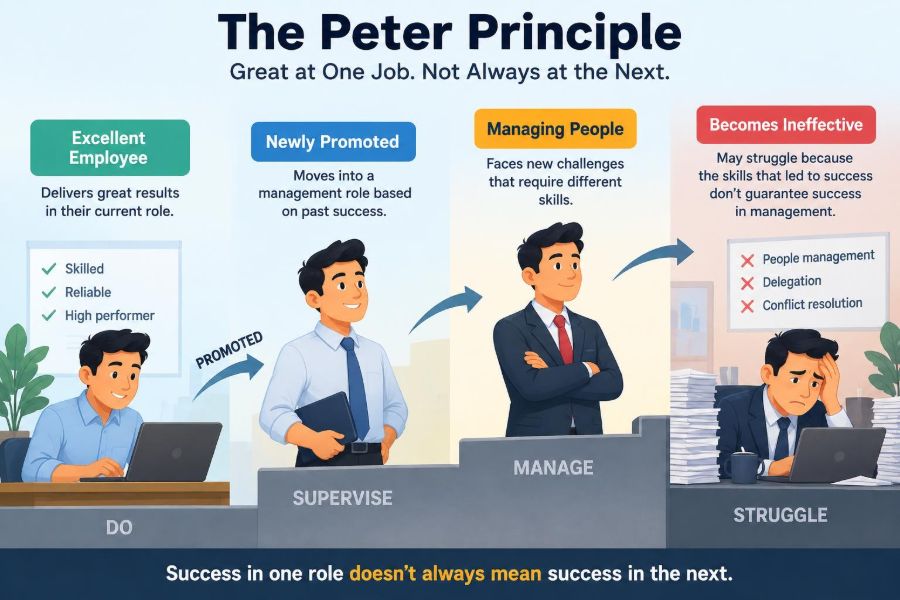

Jordan is the most reliable salesperson on the team. Clients trust them, targets are routinely met, and difficult deals often land on their desk. When a management vacancy opens, promoting Jordan feels obvious.
Six months later, the results are mixed. Jordan still knows the product inside out, but now spends days resolving conflicts, assigning work, giving feedback, and defending the team’s needs to senior leaders. The skills that made Jordan exceptional in sales do not automatically make the new role comfortable.
This pattern can be frustrating for everyone involved. The employee may lose confidence, the team may lose a strong contributor, and the organization may gain a manager who is trying hard but operating without the right support.
The Peter Principle gives this familiar situation a name. It is not a law of nature, nor a reason to stop promoting talented people. It is a useful warning about the risks of treating promotion as the only form of recognition.
📌 The Peter Principle in Plain Language
The Peter Principle is commonly summarized as the idea that, in a hierarchy, people tend to be promoted until they reach a role in which they are no longer fully competent. They may perform well in one job, receive a promotion, perform adequately or well again, and continue moving upward until the next job demands abilities they have not developed.
Its central insight is simple: success in a current role is evidence of current-role competence, not proof of readiness for a different role. A promotion often changes the work itself rather than merely increasing its seniority.
📚 Where the Idea Came From
The term was introduced by Laurence J. Peter and Raymond Hull in their 1969 book, The Peter Principle. The book used satire to examine bureaucracies and workplace absurdities, so it should not be read as a precise scientific model of every organization.
Yet its underlying observation has endured because it captures a real management challenge. Employers frequently use past performance as the clearest available signal when choosing who should advance, even when the next job calls for a different mix of skills.
🔄 Why Promotion Changes the Job
A promotion can look like a reward for doing more of the same work. In reality, it often means doing less of the old work and more work through other people.
A high-performing engineer may become responsible for planning, hiring, performance conversations, and cross-functional priorities. A standout cashier may become responsible for staffing a shift, handling complaints, and maintaining standards. The change is not simply vertical; it is functional.
🧩 Competence Is Role-Specific
Competence is not one general quality that follows a person unchanged from job to job. It is a fit between someone’s capabilities and a particular set of responsibilities, constraints, tools, and relationships.
A person can be excellent at diagnosing technical problems and still struggle to coach a colleague through repeated mistakes. Another can be brilliant at building client relationships but dislike the administrative discipline required to run a department. Neither fact cancels the other.
🚀 The Individual Contributor-to-Manager Leap
The most visible form of the Peter Principle occurs when a strong individual contributor becomes a first-line manager. Individual contributors are often assessed on the quality, speed, and reliability of their own output. Managers are assessed on the collective output, capability, and coordination of a team.
This transition requires a difficult mental shift: the manager must stop being the person who solves every problem personally. Instead, they must create conditions in which others can solve problems well.
🛠️ Technical Excellence Is Not People Leadership
Technical mastery can earn credibility, but management requires additional skills. These include setting priorities, listening, explaining decisions, resolving tension, delegating authority, and making fair judgments with incomplete information.
Technical experts may initially find management especially uncomfortable because the outcomes are less controllable. A coding error can often be traced and fixed. A disengaged employee or unresolved conflict may require patience, context, and repeated conversations rather than a single correct answer.
🎯 The Promotion Signal Problem
Organizations promote people partly because performance is visible. Sales numbers, project delivery, accuracy, output volume, and customer praise are easier to observe than potential for leadership.
Management potential is harder to assess. It appears in behaviors such as developing others, sharing credit, handling disagreement constructively, making sound trade-offs, and helping colleagues succeed without taking over. If these behaviors are not measured, they may be overlooked.
📈 When Incentives Point Only Upward
In many workplaces, promotion is tied to status, pay, influence, and recognition. A highly capable specialist may therefore feel that becoming a manager is the only respectable path, even if they prefer expert work.
This creates a distorted choice: remain in a role you enjoy but accept slower career progress, or move into management to gain financial and professional recognition. The issue is not personal ambition; it is a career system that treats leadership as the only meaningful advancement.
💡 The Myth That Every High Performer Wants to Lead
Some people genuinely want management responsibilities. Others enjoy deep craft, client work, analysis, design, or operational problem-solving and do not want to supervise people. Both preferences are legitimate.
Wanting to remain an individual contributor does not mean lacking ambition. It may reflect clear self-knowledge about where a person produces their best work and derives satisfaction.
🪜 What “Incompetence” Really Means
The word incompetence can sound harsh, and the Peter Principle is often used carelessly to label struggling managers. In practice, it may mean a person has not yet gained the experience, support, authority, or training required for a new role.
Someone can be temporarily ineffective during a transition and become highly capable with development. The principle is most helpful when it points to a mismatch or an unsupported transition—not when it becomes a fixed judgment about someone’s worth.
🧠 The Hidden Skills of Management
Many management skills remain invisible until someone needs them. A new manager may not realize that they must learn to run useful meetings, define expectations, identify workload risks, communicate upward, and adapt their approach to different people.
They also need judgment. Good management rarely means applying one rule mechanically; it means balancing team needs, organizational constraints, fairness, quality, and deadlines.
🗣️ Delegation Is More Than Handing Off Tasks
New managers often keep doing too much themselves because they were promoted for being dependable. They may believe that stepping in protects quality or saves time. Over time, this can turn the manager into a bottleneck and deprive team members of growth.
Effective delegation clarifies the outcome, boundaries, decision rights, resources, and check-in points. It is not abandonment. It is a structured transfer of responsibility that allows the employee to own meaningful work.
🤝 Managing Relationships, Not Just Workflows
Processes matter, but teams are made of people with different motivations, communication styles, pressures, and levels of confidence. A manager needs to notice when a workload looks reasonable on paper but is creating confusion or burnout in practice.
Relationship management does not require becoming everyone’s friend. It requires consistency, respect, discretion, and the willingness to have direct conversations when standards or behavior need attention.
⚖️ The Challenge of Fairness and Boundaries
Individual contributors can focus primarily on their own responsibilities. Managers must make decisions that affect several people, sometimes with no outcome that makes everyone happy.
For example, approving one person’s preferred schedule may leave a coverage gap for others. Assigning an attractive project may disappoint a colleague who also wanted it. Fair management means using clear criteria and explaining decisions, rather than avoiding them to preserve short-term harmony.
🌉 Moving From Peer to Manager
Managing former peers adds a distinct challenge. Yesterday’s teammate may now expect private information, informal exceptions, or preferential treatment. The newly promoted manager may overcompensate by becoming distant or overly strict.
A better approach is to acknowledge the transition without dramatizing it. Clarify responsibilities, apply standards consistently, protect confidential information, and keep normal professional relationships where appropriate. Trust grows from predictable behavior, not from pretending the power change did not occur.
🔍 A Hypothetical Example: The Star Designer
Consider a hypothetical product designer named Mei. She is known for elegant work, rapid problem-solving, and a sharp eye for quality. When promoted to design lead, she continues reviewing every small decision herself because she can spot flaws faster than her team.
At first, output may look strong. Later, designers wait for approval, Mei works late, and newer team members do not develop confidence. Mei’s problem is not lack of design talent; it is that the leadership role requires coaching, decision frameworks, and selective involvement rather than constant personal correction.
🏢 How Organizational Design Can Create the Problem
The Peter Principle is not only an individual problem. Organizations can create it by offering vague job descriptions, weak hiring processes, insufficient manager training, and promotion decisions based on urgency rather than readiness.
A company that promotes its best performer simply because a vacancy must be filled is making a staffing decision under pressure. The employee may be capable, but the organization has not reduced the risk or defined what success in the new position actually looks like.
⏱️ Why Immediate Promotion Can Be Risky
A sudden vacancy can make an internal promotion feel efficient. The candidate already knows the systems, customers, and culture. Those advantages are real, but speed can conceal unanswered questions about people leadership, strategic thinking, or the ability to manage former peers.
Temporary acting assignments, project leadership, mentoring responsibilities, or a structured trial period can reveal whether the work suits the person before the role becomes permanent. These approaches should be fair and well-supported, not a way to extract management labor without recognition.
🧪 Assessing Readiness Before the Title Changes
Readiness assessments should examine evidence beyond individual results. Useful questions include:
- Does the person help others improve without needing credit?
- Can they explain priorities clearly when demands conflict?
- Do they handle feedback and disagreement calmly?
- Can they make decisions without perfect information?
- Do they understand what the management role actually involves?
No checklist can predict performance perfectly. It can, however, make promotion conversations more honest and reduce reliance on a single impressive metric.
🧭 Realistic Job Previews Matter
A realistic job preview shows candidates the less glamorous parts of management: documentation, difficult feedback, scheduling, performance concerns, budget limits, and accountability for work they did not personally complete.
This is not meant to discourage capable people. It lets them make an informed choice. A candidate who understands the full role can seek needed development early—or decide that a specialist path is a better fit.
🎓 Training Should Begin Before the Crisis
Many organizations train managers only after they are promoted and facing urgent problems. Foundational learning is more useful when it begins earlier, through mentoring, facilitated practice, observation, and limited leadership opportunities.
Training should be practical. New managers benefit from rehearsing a feedback conversation, learning how to plan one-to-ones, and discussing real scenarios involving workload, conflict, and unclear expectations. A slide deck alone rarely builds confidence in sensitive moments.
🧑🏫 Coaching During the First Year
The first year of management is often a learning period, not a final verdict. A more experienced manager or coach can help a new leader interpret situations they have never faced, such as a team member’s declining performance or disagreement between departments.
Regular reflection is valuable: What decisions are they avoiding? Where are they doing work their team could own? What feedback are they receiving? Coaching turns vague discomfort into specific skills to practice.
📊 Clear Measures for a New Manager
New managers need goals that reflect management work, not merely the output they personally produced before promotion. Measures might include delivery reliability, team capability, quality, retention patterns, stakeholder communication, and progress on agreed priorities.
Metrics must be interpreted carefully. A single number cannot explain team health or management quality, and managers should not be held responsible for factors they cannot control. Still, clear expectations prevent the role from becoming an undefined collection of demands.
🛤️ Dual Career Ladders Offer a Better Choice
A dual career ladder gives employees credible paths to progress as either leaders or specialists. Senior technical, professional, or operational roles can carry increased pay, scope, influence, and recognition without requiring direct reports.
This model does not eliminate the need for excellent managers. It improves manager selection by making leadership a choice based on fit and interest, rather than the default price of advancement.
💰 Reward Expertise Without Forcing Management
Career architecture sends a powerful message. If only managers receive meaningful raises, titles, and strategic access, organizations should expect specialists to pursue management even when it is not their strength.
Recognizing expertise can include leading complex projects, advising senior decision-makers, setting standards, mentoring peers, or owning a professional discipline. These roles need real authority and respect, not honorary titles with no influence.
🔁 Promotion Is Not the Only Development Move
Development can be lateral, temporary, or project-based. A person may expand their skills through a cross-functional assignment, a complex customer account, a process-improvement project, or a role in another part of the business.
These moves provide broader experience without assuming that every career step must involve supervising people. They can also prepare future managers by exposing employees to ambiguity, coordination, and organizational trade-offs.
🚨 Warning Signs a New Manager Needs Support
Early signs are often behavioral rather than dramatic. A manager may redo employees’ work, avoid feedback, make every decision alone, hold excessive status meetings, or stay constantly busy without clarifying priorities.
None of these behaviors proves permanent inability. They are prompts for a constructive conversation. The goal is to identify the underlying issue: lack of confidence, unclear authority, missing skills, overloaded capacity, or a role that is genuinely mismatched.
🗨️ Feedback Should Be Specific and Timely
Vague feedback such as “be more strategic” leaves a new manager guessing. Better feedback identifies an observable pattern, its effect, and a next step: “Your team is waiting for approval on routine decisions; let’s define which decisions they can make independently.”
Timely feedback protects both performance and dignity. Waiting until an annual review can allow small management habits to become entrenched and make improvement feel much more daunting.
🔧 When a Role Is Not the Right Fit
Even with support, some people discover that management is not the work they want or do best. Treating a return to an individual contributor role as failure can trap both the employee and the team.
A thoughtful reassignment can preserve valuable expertise and demonstrate mature career management. It should involve clear communication about responsibilities, compensation, and status, so the move is not quietly framed as a punishment.
🚫 Common Misuses of the Peter Principle
The concept can become an excuse for cynical thinking. It should not be used to assume that all managers are ineffective, that promotion is inherently harmful, or that technical experts cannot become excellent leaders.
It is also unfair to apply the label to someone who has received little training, no authority, and unrealistic expectations. Before judging a person, examine the system around them: selection, onboarding, workload, incentives, and support.
🧱 What Employees Can Do Before Accepting a Promotion
Employees can ask practical questions before saying yes. What outcomes define success? How much time is spent on people management versus specialist work? What authority comes with the role? What training, mentoring, and transition support will be available?
It is also worth asking, honestly, whether the role’s difficult tasks are tolerable. Enjoying influence, a higher title, or a salary increase is different from being willing to conduct hard conversations and accept accountability for a team’s results.
🌱 How Aspiring Managers Can Build Readiness
People who want to lead need not wait for a formal title to practice. They can mentor a colleague, coordinate a small project, facilitate a meeting, document a process, or volunteer to help resolve a recurring team problem.
The key is to seek feedback on leadership behaviors, not only project outcomes. Did others understand the goal? Were decisions inclusive but timely? Did teammates leave with greater clarity and ownership?
🏗️ What Senior Leaders Must Own
Senior leaders shape whether the Peter Principle becomes common or occasional. They decide what gets rewarded, what management capability means, whether specialist careers are credible, and whether new managers receive time to learn.
They must also resist the temptation to reward a strong employee by removing them from the work where they add the most value. A promotion should solve a business need and support a person’s development, not merely signal appreciation.
✅ The Core Lesson: Promote for the Work Ahead
The Peter Principle is most useful as a planning principle: evaluate people for the demands of the role ahead, not only the achievements behind them. Past performance remains valuable evidence, but it should be joined by realistic previews, demonstrated leadership behaviors, and development support.
Strong organizations create several ways to grow, treat first-time management as a serious transition, and make course correction respectable. That approach protects great specialists, gives willing managers a stronger start, and improves the experience of the teams they lead.
Excellent employees do not automatically become ineffective managers; problems arise when organizations assume that excellence in one role is enough preparation for a fundamentally different one. Better career paths, careful selection, and sustained support make advancement more useful for people and for the business. 📊🌱🤝