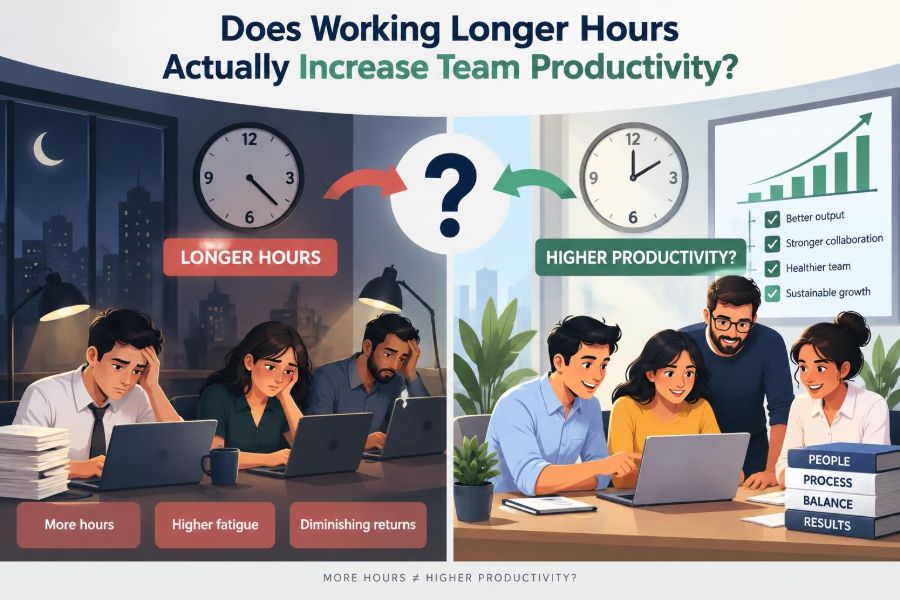

It is 6:15 p.m., and a project team is still online. A manager sees messages moving, spreadsheets being updated, and calendars filling with another late meeting. From the outside, the team looks committed and busy.
Yet the next morning, a proposal contains avoidable errors. Two people have completed overlapping work, a decision has been postponed, and the most difficult task remains untouched. The team worked longer, but did it produce more value?
This question matters because long hours are often treated as evidence of dedication. For students, employees, and managers, that assumption can shape deadlines, performance reviews, staffing decisions, and workplace culture.
Hours do matter in some situations. A deadline may genuinely require an extra push. But sustainable team productivity depends on far more than the amount of time people remain at their desks.
🧭 Start With the Right Definition of Productivity
Productivity is not simply being active, available, or logged in for a long time. In a team setting, it is the amount of useful, reliable output produced from the time, attention, money, and effort invested.
A productive design team might deliver a clear solution that customers can use. A productive operations team might resolve issues accurately without creating new ones. Output, quality, timeliness, and rework all belong in the productivity picture.
If extra hours increase the number of completed tasks but also create mistakes, delays, and confusion, the apparent gain may disappear.
⏱️ Separate Hours Worked From Value Created
Longer working time can raise output in a simple, short-term sense. If a warehouse must process an unusual backlog, additional staffed hours can help move more items. If an accountant must close a time-sensitive report, focused overtime may complete necessary work.
But knowledge work is different from work that can be expanded one unit at a time. Writing, analysis, coding, planning, negotiation, and creative problem-solving depend heavily on concentration and judgment.
A person may spend two additional hours looking at a problem without making meaningful progress. The key management question is not “How long did people work?” but “What valuable result did those hours make possible?”
🧠 Attention Is a Limited Operating Resource
People do not have an unlimited supply of high-quality attention. Concentration has to be directed, protected, and restored. Complex work becomes slower when workers repeatedly switch between tasks, messages, meetings, and urgent requests.
As a day lengthens, attention can become more fragmented. Employees may choose easy tasks because they feel manageable, while postponing work that requires deeper thought. This can create the appearance of productivity without moving the team’s most important work forward.
Think of attention like a phone battery: extending use is possible, but performance eventually changes when the charge is low.
📉 Why Marginal Returns Can Decline
The first extra hour during a genuine peak period may be highly useful. The next may be moderately useful. Later hours may deliver very little, especially if they are spent fixing errors, waiting for input, or rereading work completed while tired.
This pattern is called diminishing returns: each additional unit of input produces a smaller gain than the one before it. It does not mean overtime is always wasteful. It means leaders should not assume that output rises in a straight line with hours.
The point at which returns decline differs by task, person, workload, and working conditions. A routine task may tolerate longer stretches better than work requiring judgment or originality.
🧪 Quality Can Fall Before Quantity Does
One reason long hours can look successful at first is that quantity is easy to count. A team may close more tickets, write more pages, or send more emails. Quality problems may appear later, after customers respond or another department tries to use the work.
Fatigue can make people miss details, make weaker assumptions, or accept a “good enough” answer too quickly. In collaborative work, one faulty handoff can also consume another person’s time.
Managers should therefore track not just volume, but indicators such as revisions, defects, complaints, delayed approvals, and repeated questions.
🔁 Rework Quietly Erases Overtime Gains
Rework is time spent correcting, rebuilding, clarifying, or repeating work that should have been completed correctly the first time. It is one of the clearest ways that long hours can create misleading productivity signals.
Imagine a tired project team rushing a client presentation late at night. The deck is sent on time, but key figures are inconsistent. The next day, several team members must stop other work to verify data, rewrite slides, and repair trust with the client.
The late session produced a visible deliverable. The full cost only becomes clear when correction time is counted.
🧩 Team Output Depends on Coordination
A team is not just a collection of individual work hours. Its performance depends on how well members coordinate tasks, share information, make decisions, and hand work from one person to another.
Longer hours can hurt coordination when tired employees communicate less clearly or when different people work at incompatible times. A rushed message can create multiple interpretations; an exhausted reviewer may approve something they would normally question.
More individual effort does not automatically produce more collective output. A well-aligned team can often outperform a harder-working but poorly coordinated one.
📬 Communication Overload Creates Hidden Work
When teams stay online longer, they may generate more messages, updates, meeting invitations, and requests for confirmation. Some communication is essential, but excess communication creates administrative work for everyone else.
For example, a late-night chat thread can lead to a morning of catching up, interpreting decisions, and checking whether an issue was already resolved. The team feels responsive, yet its available focus has been reduced.
Set clear norms around where decisions are recorded, which matters are urgent, and when a response can wait. These norms reduce the need to compensate for ambiguity with constant availability.
🚨 Emergencies Are Different From Everyday Operations
There are situations where extended hours are reasonable: a service outage, a safety incident, a major event, an unexpected absence, or a deadline with serious consequences. Teams sometimes need a temporary surge of effort.
The risk begins when emergency behavior becomes the standard operating model. If every week feels urgent, the organization is no longer responding to exceptions; it is using overtime to cover a planning, capacity, or priority problem.
After a surge, leaders should ask what caused it and what recovery is needed. Treating recovery as optional makes the next surge less effective.
🛠️ Different Tasks Respond Differently to Extra Time
Not all work has the same relationship with longer hours. Routine, clearly defined tasks may gain more directly from temporary additional capacity. Ambiguous or creative work often suffers sooner when people are depleted.
| Type of work | Likely effect of extra hours | Management focus |
|---|---|---|
| Routine processing | May increase output for a limited period | Accuracy checks and staffing limits |
| Complex analysis | Progress may slow as concentration falls | Protected focus and review time |
| Creative problem-solving | Ideas can narrow under pressure | Breaks, diverse input, realistic scope |
| Customer-facing work | Fatigue may affect service quality | Coverage, escalation, recovery |
A useful response starts with the work itself rather than a blanket rule about hours.
🌙 Sleep and Recovery Affect Tomorrow’s Work
Working late does not only affect the final hour of a current day. It can reduce recovery time before the next one. When people return tired, routine tasks may take longer and difficult decisions may feel disproportionately hard.
Recovery includes sleep, breaks, time away from work demands, and enough space to mentally reset. It is not a reward for finishing work; it is part of the system that makes sustained performance possible.
Organizations cannot control every employee’s personal routine, but they can avoid creating expectations that make recovery consistently difficult.
🧯 Burnout Is an Organizational Signal
Burnout is commonly used to describe a state of prolonged exhaustion, detachment, and reduced effectiveness linked to chronic work stress. It should not be casually assumed from one busy week, and individuals can experience stress differently.
Still, recurring signs deserve attention: unusually high absence, rising turnover, emotional withdrawal, persistent cynicism, declining quality, or employees who never seem able to catch up.
These signs are not solved by telling people to become more resilient. They may indicate excessive workload, unclear roles, inadequate support, or a culture that rewards visible overwork.
🎯 Priorities Matter More Than a Longer To-Do List
Teams often work late because everything has been labelled important. When priorities are unclear, employees must decide what to defer, often without enough context. They may respond by trying to do all of it.
Strong prioritization identifies the few outcomes that matter most now, the work that can wait, and the work that should stop. This is not laziness or lowered ambition; it is choosing where limited capacity will create the greatest value.
A manager who removes low-value work may improve results more than one who asks for an extra hour every day.
📌 Capacity Planning Prevents Predictable Overload
Capacity planning compares expected demand with the people, skills, and time available to meet it. It is never perfectly precise, but it helps teams recognize overload before it becomes a late-night emergency.
Planning should account for more than task estimates. Meetings, training, approvals, interruptions, leave, onboarding, and unexpected work all consume capacity. Ignoring them creates a schedule that is busy on paper but impossible in practice.
When demand regularly exceeds capacity, the realistic choices are to change scope, timing, staffing, process, or quality expectations. Asking people to stretch indefinitely is not a sixth solution.
🧱 Bottlenecks Do Not Disappear With Overtime
A bottleneck is the point in a workflow that limits the pace of the whole system. It could be one approval stage, a scarce technical specialist, slow access to data, or a tool that fails under heavy use.
If every team member works later but one reviewer still has only limited decision capacity, work will simply pile up before that stage. Overtime may increase the queue rather than increase completed output.
Find the constraint, then improve it through clearer authority, better tools, cross-training, simpler approval rules, or adjusted workflow.
👥 Staffing Levels and Skills Both Count
A team can be short of people, short of a particular skill, or both. These problems require different responses. Adding general capacity may not help if only one person can perform a specialist task or make a critical decision.
Overreliance on a few high performers can also hide a structural risk. They may repeatedly work long hours because everyone depends on them, while knowledge remains concentrated.
Cross-training, documented processes, and thoughtful delegation can reduce this dependency. They may take time upfront, but they make team output less fragile.
🪜 Autonomy Reduces Unnecessary Waiting
People often work late not because their core task is difficult, but because they spent much of the day waiting for permission, clarification, or approval. By evening, they finally receive what they need and try to recover the lost time.
Appropriate autonomy lets employees make routine decisions within agreed boundaries. Clear decision rights—who recommends, who decides, and who must be informed—can remove repeated delays.
Autonomy needs guardrails, especially where financial, legal, safety, or customer risks are involved. But excessive control can turn a normal workflow into a sequence of avoidable bottlenecks.
🗓️ Meetings Can Consume the Workday
A calendar packed with meetings often pushes focused work into early mornings, evenings, or weekends. Employees then appear to be choosing long hours, when they may actually be compensating for a fragmented day.
Before scheduling another meeting, ask whether a decision truly requires real-time discussion. A short written update, a shared document, or a smaller decision group may be enough.
- State the decision or outcome the meeting must produce.
- Invite only people who contribute or need the result.
- End with owners, deadlines, and recorded decisions.
- Protect blocks of time for work that requires concentration.
Better meeting design creates productive hours without adding any hours at all.
🔕 Availability Is Not the Same as Accountability
Some workplaces confuse rapid replies with responsible performance. This encourages people to stay visible at all times, even when no response is needed. The result can be shallow work interrupted by constant monitoring.
Accountability means delivering agreed outcomes, raising risks early, and communicating reliably. It does not require every person to answer every message immediately.
Teams benefit from response-time expectations that match the work. A genuine urgent channel can coexist with normal communication that waits until the recipient has finished a focused task.
📊 Measure Outcomes, Not Heroics
When managers praise people primarily for staying late, they may unintentionally reward the wrong behavior. Employees learn that visible sacrifice earns recognition, while efficient planning, quiet prevention, and process improvement go unnoticed.
Use measures connected to the team’s purpose: completed customer outcomes, accuracy, cycle time, service quality, revenue-related results where relevant, or project milestones. Pair quantitative measures with judgment, because a single metric can be gamed.
Also examine workload patterns. Repeated late work by the same people is not automatically a sign of superior commitment; it may reveal uneven distribution or weak boundaries.
⚖️ Fairness Shapes Sustainable Performance
Long-hours cultures can create unfair burdens. Caregivers, people with health needs, and employees with long commutes may have less freedom to remain online late, even when their daytime work is excellent.
If promotions and high-profile assignments go mainly to those who are visibly available outside normal hours, the organization may confuse schedule flexibility with talent. It can lose capable people who need predictable boundaries.
Fair performance systems evaluate contribution, quality, collaboration, and outcomes—not merely who is still connected at night.
🧭 Managers Set the Real Norm
Written policies matter, but employees pay close attention to what leaders do. A manager who sends non-urgent messages at midnight, praises weekend work, or repeatedly changes priorities establishes a norm even if they say work-life balance matters.
Managers can model healthier practice by planning realistically, stating when replies can wait, taking breaks, and discussing workload openly. They should also avoid making employees feel guilty for using agreed time off.
Culture is reinforced through small, repeated signals. The most effective ones make good work visible without making overwork a requirement.
🔍 Diagnose the Cause Before Prescribing More Effort
When a team is behind, “work harder” is a fast response but rarely a diagnosis. Leaders should investigate where time is actually going: unclear requirements, poor tools, duplicated work, waiting, too many meetings, skill gaps, or unrealistic scope.
A simple review can ask: What work created the most value this week? What took longer than expected? What blocked progress? What could be removed or simplified?
These questions shift the conversation from personal endurance to system design. That is where durable productivity improvements usually begin.
🧾 Make Work Visible Without Micromanaging
Teams need a shared view of priorities, ownership, deadlines, and blockers. A simple task board, project plan, or weekly operating review can make work visible enough to coordinate without demanding constant status updates.
Visibility helps managers see overload earlier. It also helps colleagues understand dependencies, so they can sequence work rather than unknowingly creating urgent requests for one another.
The purpose is not surveillance. Useful visibility supports decisions about work; micromanagement focuses on watching people.
🔄 Use Short Experiments Instead of Grand Declarations
A team does not need to redesign its whole culture overnight. It can test a practical change for a few weeks: meeting-free focus blocks, a clearer intake process, fewer approval layers, or a rule that non-urgent messages wait until the next working day.
Define what success would look like before starting. For example, the team might look for fewer late escalations, faster turnaround, lower rework, or better ability to complete priority work during normal hours.
Then review the results honestly. Keep what works, adapt what does not, and avoid treating any one practice as universally suitable.
🗣️ Talk About Workload Early
Employees should not have to reach exhaustion before saying that a workload is unmanageable. Regular one-to-ones and team check-ins create opportunities to discuss deadlines, competing priorities, support needs, and hidden work.
Useful conversations are specific. Instead of asking only “Are you okay?”, ask “What is most likely to slip?” or “Which task could we stop, delay, or reassign?” Specific questions lead to choices a manager can act on.
Psychological safety matters here: people need to believe they can raise a risk without being labelled uncommitted or incapable.
🚩 Common Mistakes When Managing Long Hours
Several responses sound practical but often deepen the problem:
- Celebrating the rescue but ignoring the cause: this makes recurring crises seem normal.
- Adding people late without clarifying work: new contributors can increase coordination demands.
- Measuring activity alone: hours, messages, and meetings are weak proxies for results.
- Applying one rule to every role: task types and personal circumstances vary.
- Promising flexibility while rewarding constant availability: employees notice the contradiction.
A better response combines immediate support with a review of the process that created the pressure.
🌱 When Longer Hours Can Be a Sensible Choice
The case against routine overwork is not a case for rigidly refusing all extra effort. People may voluntarily invest additional time in a meaningful launch, a learning opportunity, or a temporary project peak. Some roles also require structured coverage outside standard hours.
The difference is whether the demand is time-limited, fairly managed, and supported by recovery. Employees should understand why the effort is needed, what the endpoint is, and how workload will return to a sustainable level.
Choice matters, but so does power. A manager should be careful not to describe an expectation as voluntary when employees reasonably fear consequences for declining.
🏁 The Core Principle: Design Work for Sustainable Output
Working longer hours can sometimes increase team output for a short period, especially when tasks are clear and a genuine peak must be managed. It is not, however, a dependable long-term strategy for productivity.
Sustainable performance comes from clear priorities, realistic capacity, good coordination, capable staffing, protected focus, sensible decision-making, and time to recover. These conditions allow people to use their effort where it matters rather than spending it compensating for a broken process.
The strongest teams do not prove their value by being permanently exhausted. They build systems that make consistently good work possible during reasonable working time.
Longer hours are a temporary tool, not a substitute for clear priorities, sound processes, and sustainable team capacity. When leaders measure value rather than visibility, they can protect both results and people. 📊🧠🤝