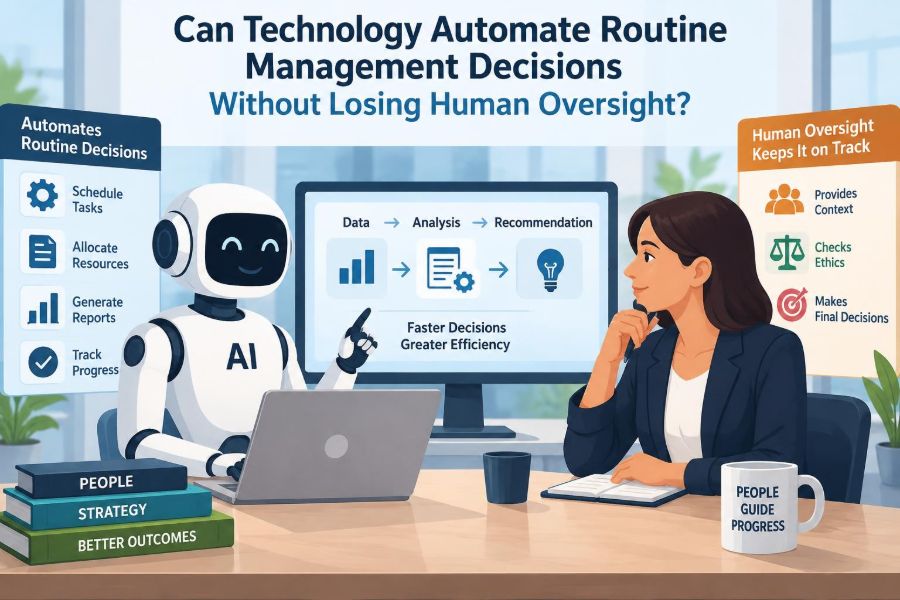

At 8:30 on a Monday morning, a store manager opens a dashboard that has already reordered fast-selling items, flagged an unusually high refund rate, and assigned extra staff to a busy afternoon shift. The recommendations arrived before the manager had reviewed the weekend’s results.
For many teams, this is no longer a futuristic scenario. Scheduling systems, workflow platforms, forecasting tools, and AI assistants increasingly make or recommend the small decisions that keep operations moving.
The attraction is obvious: fewer repetitive tasks, faster responses, and more consistent decisions. But management is not only a sequence of calculations. A decision that looks sensible in a dashboard can be unfair to an employee, wrong for a customer, or risky in a changing market.
The practical question is not whether managers should accept or reject automation altogether. It is whether an organization can automate routine management decisions while keeping people meaningfully responsible for the outcomes.
🧭 What Counts as a Routine Management Decision?
Routine decisions are recurring choices made through relatively stable rules. They often involve known inputs, predictable outcomes, and a need for speed rather than extensive debate.
Examples include approving low-value purchases within a budget, assigning incoming service tickets, replenishing stock, sending payment reminders, and alerting a supervisor when overtime exceeds a threshold. These decisions are different from setting strategy, resolving a sensitive conflict, or entering a new market.
Routine does not mean unimportant. Small decisions can affect workload, customer experience, cash flow, and employee trust when repeated every day.
⚙️ What Decision Automation Actually Does
Decision automation uses software to select an action, recommend an action, or route a case based on defined information. It may rely on simple rules, statistical forecasts, machine-learning models, or a combination of these methods.
A rule-based system might state: if inventory falls below a reorder point, create a purchase request. A predictive system might estimate expected demand and suggest a reorder quantity based on sales patterns, lead times, and seasonality.
Automation is therefore broader than robotics. A spreadsheet with conditional alerts can automate part of a decision process, while an AI-enabled platform can automate more complex pattern recognition.
🧩 Separate Decisions from Tasks
Managers often say they want to automate a decision when they actually want to automate the administrative work around it. The distinction matters because the risks are not the same.
Collecting data, checking a form for missing fields, calculating a total, and sending a standard message are tasks. Choosing whether an exception deserves approval is a decision. Software can often complete the first group with little concern; the second usually needs clearer accountability.
A useful design principle is to automate the preparation of a decision before automating the judgment itself. Better information can save managers time without quietly transferring authority away from them.
🎯 Why Organizations Automate Management Choices
Managers face a volume problem. A growing business may generate hundreds of requests, alerts, orders, and customer cases each day. Treating each one as a fresh judgment can create delays and inconsistency.
Automation can help organizations apply agreed policies at scale. For example, a travel-expense system can verify whether a claim falls within an approved limit before a finance employee reviews exceptions.
The goal should not be to remove managers from ordinary work simply because software can act. It should be to reserve human attention for cases where context, trade-offs, or consequences make judgment valuable.
📈 The Speed and Consistency Advantage
Software does not become distracted at the end of a long shift, forget an approval rule, or apply a different formula to identical cases. For high-volume, well-defined processes, this consistency can reduce avoidable variation.
Speed also changes operational performance. A system that immediately routes a damaged-delivery complaint can prevent a customer from waiting days for a response. A capacity alert can help a manager address a bottleneck before it becomes a missed deadline.
Yet consistent execution is only an advantage when the underlying rule is sensible. Automation can make a weak policy operate faster and more widely.
🧮 Rules, Models, and Generative AI Are Not the Same
Different technologies deserve different levels of trust and control. Clear rules are usually easier to inspect than models that infer patterns from historical data. Generative AI adds another category: it can draft, summarize, classify, or suggest actions using language, but its output may be plausible without being correct.
| Approach | Typical use | Oversight need |
|---|---|---|
| Rule-based automation | Budget limits, routing, reminders | Review rules and exceptions |
| Predictive model | Demand or staffing forecasts | Monitor accuracy and changing conditions |
| Generative AI | Drafting responses or summaries | Verify facts, tone, and final action |
Calling all of these tools “AI” can hide important differences. Managers should ask what the system is actually doing before deciding how much authority it receives.
👤 Human Oversight Is More Than a Final Click
A manager who clicks “approve” on every automated recommendation without understanding it is not providing meaningful oversight. Human oversight means someone can examine the basis of an action, challenge it, alter it, and accept responsibility for the result.
That requires usable information. A supervisor needs to know why a schedule was changed, what assumptions drove the recommendation, and whether an employee’s circumstances were considered where appropriate.
Oversight is a capability, not a ceremonial step. If people lack time, authority, training, or access to explanation, the human review is mostly symbolic.
🚦 Choose the Right Level of Automation
Not every process needs the same design. A helpful spectrum runs from manual decision-making to fully automatic execution.
- Assist: the tool organizes information or suggests an option.
- Recommend: the tool proposes an action; a person decides.
- Act with review: the tool acts within limits and flags selected cases.
- Act automatically: the tool executes a stable, low-risk rule.
As impact, uncertainty, and reversibility change, the appropriate point on this spectrum changes too. Automatic routing of routine emails is not comparable to automatically changing an employee’s hours or restricting a customer account.
🔍 Start with Decision Suitability
A strong candidate for automation has a clear objective, dependable data, repeatable conditions, and consequences that can be corrected. It should also have a known owner who can revise the process.
Consider automated invoice matching. If a purchase order, delivery record, and invoice align within established tolerances, the system can process the payment efficiently. A mismatch can be held for review.
By contrast, deciding whether a struggling employee needs support, training, or formal action requires context that may not appear in structured data. Such cases should not be reduced to a score alone.
⚖️ Assess Impact, Uncertainty, and Reversibility
Three questions clarify the boundary. What happens if the system is wrong? How uncertain is the available information? Can the decision be easily reversed?
Ordering a modest extra quantity of a non-perishable item may be reversible. Rejecting a supplier, denying a customer remedy, or changing someone’s performance evaluation may have lasting effects. Higher-impact or harder-to-reverse decisions need stronger human involvement.
This approach avoids a simplistic rule that “humans must approve everything.” It directs attention where mistakes carry greater operational, financial, or human cost.
🗂️ Data Quality Determines Decision Quality
Automation does not repair incomplete or misleading records. It often exposes and accelerates the consequences of poor data.
A scheduling tool may treat an employee as available because an absence record was not updated. A demand forecast may overreact because a one-time promotion is recorded as ordinary sales. A customer-priority model may misclassify a case because key interactions were logged inconsistently.
Before automation, managers should identify who enters the data, how errors are corrected, and which fields truly influence a decision. Data governance is not an IT detail; it is part of management control.
🧠 Context Is Where Human Judgment Earns Its Place
Systems work best with information that has been made visible and structured. Managers often know facts that are harder to encode: a supplier has a temporary delivery problem, a team member is covering an emergency absence, or a long-standing customer has a legitimate complaint.
Context should not become an excuse for inconsistent favoritism. Instead, organizations should define legitimate reasons to override a recommendation and record them where useful.
This creates a productive division of labor: the tool handles the standard pattern, while the manager evaluates whether this case genuinely falls outside it.
🧾 Explainability Builds Better Control
Explainability means that users can understand, at an appropriate level, why a system reached a recommendation or action. It does not always require revealing every technical detail, but it should reveal the relevant factors and limits.
A useful staffing recommendation might show expected demand, planned absences, required skills, and the assumptions behind the forecast. That helps a manager spot an implausible output quickly.
“The system says so” is not an adequate explanation for a consequential management action. If a result cannot be questioned, it cannot be governed well.
🛑 Build Exception Paths Before Launch
No operating process is entirely standard. An automation initiative needs a clear path for unusual, incomplete, disputed, or high-risk cases.
Exception handling should specify who receives the case, what information they see, how quickly they should act, and when the issue should be escalated. Otherwise, edge cases accumulate in a neglected queue while the normal process appears efficient.
A good exception path also protects customers and employees from being trapped by a rigid system. The ability to appeal or request review is often essential when automated decisions affect them directly.
🔔 Use Thresholds and Escalation Triggers
Thresholds translate oversight into operational rules. A system may approve routine requests up to a defined limit, while larger, unusual, or repeated requests go to a manager.
Useful triggers can include:
- a cost beyond an approved range;
- a recommendation based on missing or stale data;
- a sharp change from normal patterns;
- an action affecting a protected customer, employee, or safety process;
- a repeated override by managers.
Triggers should be reviewed over time. Limits that are too low create unnecessary work; limits that are too high can allow risky decisions to pass unnoticed.
🧑⚖️ Keep Accountability Named and Visible
When a system makes an operational recommendation, someone still owns the policy, the data, the tool configuration, and the business outcome. “The algorithm” cannot be accountable in the managerial sense.
Organizations should assign clear roles. An operations manager may own the process outcome, a finance lead may own approval rules, and a technical team may maintain system performance. These responsibilities overlap but should not be ambiguous.
Visible ownership prevents a familiar failure: each department assumes another group is checking the system.
🪞 Watch for Automation Bias
Automation bias occurs when people give undue weight to a system’s recommendation, especially when it appears precise or arrives in a polished interface. Users may overlook conflicting evidence or assume that a recommendation has been fully validated.
Training should normalize constructive challenge. Managers need permission to ask, “What information is missing?” and “What would make this recommendation wrong?”
Interface design matters too. Showing uncertainty, data freshness, and reasons for an alert can encourage review more effectively than presenting one confident-looking answer.
⚠️ Watch for Alert Fatigue
The opposite problem is also common. If a dashboard produces too many low-value alerts, people stop noticing them. Important warnings become part of the background noise.
Alert systems should prioritize actions that require a response, group related notifications, and remove warnings that rarely lead to useful intervention. An alert should answer a practical question: what does the manager need to do now?
Periodic review of ignored alerts can reveal either a training problem or a poorly designed threshold.
👥 Fairness Matters in People Decisions
Automation affecting recruitment, scheduling, performance, promotion, pay, discipline, or access to work deserves particular care. Historical records may reflect past practices rather than neutral measures of merit or need.
For example, a hypothetical scheduling system that prioritizes workers with prior high availability could unintentionally disadvantage people whose availability is constrained by caring responsibilities. The issue may arise from the objective chosen, not only from the code.
Human review, documented criteria, and regular checks for unexpected patterns are essential. Sensitive employment decisions should not be treated like ordinary inventory routing.
🔐 Protect Privacy and Sensitive Information
Decision systems frequently combine employee, customer, supplier, and financial information. More data may improve a prediction, but collecting or sharing it without a clear business purpose increases privacy and security risk.
Managers should ask whether each data element is necessary, who can access it, how long it is retained, and whether a vendor can use it for other purposes. Sensitive information requires controls suited to its potential harm if exposed or misused.
Local legal and contractual requirements vary, so organizations should seek appropriate specialist advice when automated decisions involve personal data or regulated activities.
🧪 Test Before Giving the System Authority
Testing should go beyond checking whether software runs. A valuable method is parallel running: let the system produce recommendations while people continue making the actual decisions for a limited period.
Managers can compare the recommendation with the human decision, examine differences, and identify cases the system handles poorly. This also reveals whether the process inputs are reliable enough for automation.
Testing should include awkward but realistic scenarios: missing records, sudden demand changes, conflicting policies, and cases that need an exception. Ordinary examples rarely reveal the most costly flaws.
📊 Measure Outcomes, Not Just Time Saved
Time saved is useful, but it is not a complete measure of success. A system may process requests faster while increasing rework, customer complaints, stock shortages, or unfair outcomes.
A balanced review can examine operational quality, error and override patterns, service outcomes, compliance with policy, and user confidence. The right measures depend on the decision being automated.
Look especially at exceptions and reversals. They often reveal where the system’s assumptions do not fit reality.
🔄 Monitor Drift and Changing Conditions
Business conditions change. Customer behavior shifts, suppliers alter lead times, policies change, and teams reorganize. A model or rule that once worked well can become less useful without any obvious technical failure.
This is sometimes called drift: the relationship between past data and current conditions changes. A demand forecast trained around one pattern of purchasing may need review when products, channels, or market conditions change.
Set review dates, but also create event-based reviews after major operational changes. Automation is a managed process, not a one-time installation.
📝 Keep an Audit Trail That People Can Use
An audit trail records what the system did, the information used, the rule or version applied, and any human override. It supports troubleshooting, learning, and accountability.
The record should be practical rather than overwhelming. A manager investigating a disputed decision needs to reconstruct the relevant path without searching through obscure technical logs.
Good records also help distinguish a bad recommendation from a bad execution. That distinction is essential when improving the system rather than merely assigning blame.
🛠️ Design Overrides as Learning Signals
An override is not automatically a failure. It may show that a manager used necessary context. But frequent overrides deserve attention because they can indicate a flawed rule, incomplete data, poor training, or inconsistent management practice.
Ask why overrides occur, not merely how often. If different managers repeatedly correct the same recommendation, the process should be redesigned. If overrides vary widely between managers, the organization may need clearer policy.
Capturing the reason for an override turns human judgment into feedback that can improve future automation.
🏢 Redesign Work, Not Just Software
Automation changes roles. A supervisor who once spent hours assigning work may spend more time resolving exceptions, coaching staff, interpreting performance patterns, and improving processes.
That shift needs preparation. People require training in the tool, but also in judgment: when to trust a recommendation, when to challenge it, and how to explain decisions to others.
Organizations that treat automation only as a cost-cutting project often miss this transition. The best results usually come when saved time is intentionally redirected toward higher-value management work.
🤝 Involve Frontline Users Early
Employees who work inside a process see its informal rules, recurring exceptions, and customer realities. Involving them early makes automation more accurate and improves adoption.
A service team may explain that certain phrases in a customer message signal urgency even when a ticket’s formal category does not. A warehouse team may identify why a seemingly efficient picking rule creates congestion at a particular time.
Participation does not mean every preference becomes a system requirement. It means the design is informed by the work as it is actually performed.
📋 A Practical Governance Checklist
Before expanding an automated management process, leaders can ask a short set of disciplined questions:
- What exact decision or task is being automated?
- What objective and policy does the system apply?
- What data influences the outcome, and how reliable is it?
- What harms could result from a wrong action?
- Which cases require review, escalation, or an appeal?
- Who owns the outcome, the rules, and the technical operation?
- How will performance, fairness, exceptions, and changes be monitored?
If these questions cannot be answered plainly, the organization is not ready to grant the tool more authority.
🌱 Begin Small and Expand Deliberately
A narrow pilot is often more valuable than an ambitious rollout. Choose a process with clear rules, manageable consequences, and enough volume to reveal real operating conditions.
For instance, a team might first automate the classification and routing of standard internal requests, while retaining human approval for unusual or high-cost requests. Once the workflow is stable, leaders can consider adjacent decisions.
Gradual expansion gives the organization time to improve data, train users, and establish review habits before the consequences of error become larger.
🏁 The Core Principle: Automate Execution, Preserve Judgment
Technology can reliably handle many routine management decisions when objectives are clear, data is trustworthy, and exceptions are well designed. It can reduce delays and help managers focus on work that requires interpretation, relationships, and trade-offs.
But human oversight must be designed into the workflow, not added as an afterthought. People need authority to question outputs, pathways to intervene, records to investigate decisions, and responsibility for the policy behind the system.
The strongest approach is neither blind automation nor permanent manual control. It is a deliberate partnership in which machines manage repeatable patterns and humans remain accountable for meaning, fairness, and consequences.
Technology should make routine management more disciplined and responsive, while human judgment remains responsible for the decisions that shape people and performance. 📊🤝🧭