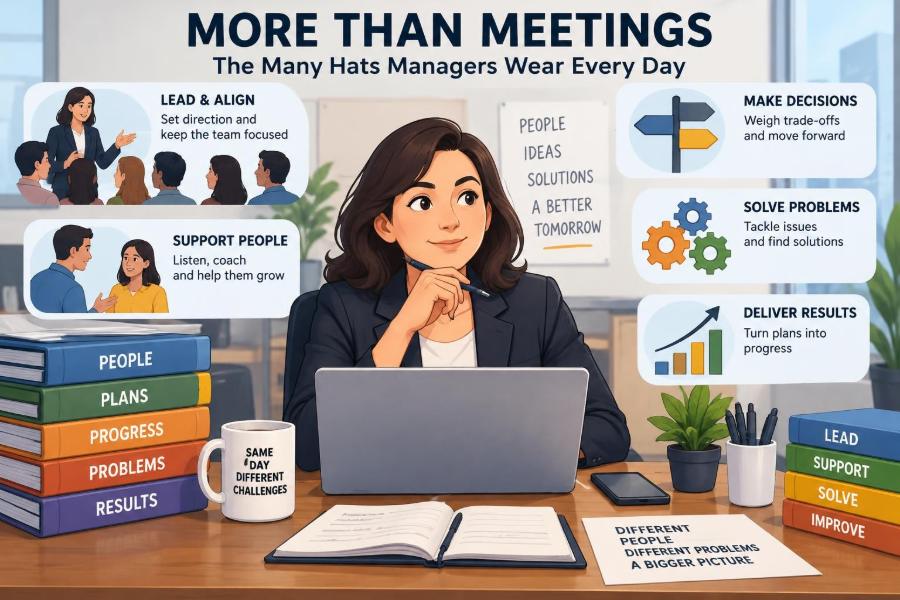

A project is late, two colleagues disagree about priorities, a customer wants an answer, and a senior leader asks for an update before lunch. From the outside, the manager may appear to be “just in meetings.”
Yet someone has to turn all of those moving parts into clear decisions, coordinated work, and a result the organization can stand behind. That person is often the manager.
Management matters because most work is no longer completed by one person acting alone. Teams depend on shared information, compatible decisions, usable processes, and enough trust to raise problems early.
Good management is difficult not because every manager is busy, but because the job requires judgment under uncertainty. It is the work of helping people and systems perform when time, attention, and resources are limited.
🧭 Management Is Work Through Other People
A manager’s output is rarely a report, sale, design, or repaired machine alone. Their larger output is the team’s ability to produce useful work reliably.
That distinction changes the job. A capable individual contributor can focus mainly on doing a task well; a manager must create the conditions in which several people can do related tasks well together.
This does not mean managers merely delegate and watch. They set direction, remove barriers, make trade-offs, develop capability, and remain accountable for results.
🏗️ The Manager Sits Between Strategy and Reality
Senior leaders may define broad goals such as improving customer retention or reducing delivery time. Frontline employees encounter the practical details: incomplete data, conflicting requests, equipment limits, and customer exceptions.
Managers translate in both directions. They turn strategy into priorities people can act on, then turn operational reality into information leaders can use to adjust plans.
Without that translation, strategy stays abstract and frontline concerns become isolated complaints rather than organizational learning.
📅 A Manager’s Day Is Usually Fragmented
Managerial work is often brief, varied, and interruption-heavy. A day might include a coaching conversation, a budget approval, a planning meeting, an urgent escalation, and time reviewing performance data.
This fragmentation can look unproductive if activity is judged only by visible output. But many management decisions are time-sensitive: a delayed clarification can cause several people to work on the wrong thing.
The challenge is not simply filling a calendar. It is protecting enough focused time for decisions that require thought while remaining available when the team genuinely needs help.
🎯 Setting Priorities Is a Core Responsibility
Teams usually have more possible work than capacity. A manager helps decide what should be done now, what can wait, what should be stopped, and what must be escalated.
Priority setting is more than making a list. It requires explaining the reason behind choices so people can make sensible decisions when the manager is unavailable.
- What outcome matters most this period?
- Which work is urgent because delay creates real harm?
- What is valuable but not currently essential?
- What work should be paused to protect focus?
A team with ten “top priorities” has not received a priority; it has received a workload problem.
🔍 Turning Vague Goals into Clear Work
“Improve service” is an aspiration, not an operating instruction. A manager makes it usable by defining the customer group, the desired change, the owner, the deadline, and the evidence that will show progress.
For example, a hypothetical support manager may turn a complaint about slow responses into a trial: assign ownership at intake, identify cases waiting for another department, and review the backlog twice a week.
Clear work does not require rigid control. It gives people a shared target while leaving room for professional judgment about the best route.
🗣️ Communication Is More Than Announcements
Managers communicate constantly, but sending information is not the same as creating understanding. People need to know not only what has changed, but why it matters and what they should do differently.
Effective communication also travels upward and sideways. A manager may need to tell another department that a deadline is unrealistic, or tell leadership that a policy is creating avoidable customer friction.
Useful communication is timely, specific, and matched to the decision people need to make. A long update can still fail if its audience cannot identify the requested action.
👂 Listening Detects Risks Before Dashboards Do
Performance data is essential, but it often describes what has already happened. Conversations can reveal emerging problems: unclear ownership, burnout, a supplier issue, or a process people quietly work around.
Listening does not mean accepting every request without question. It means asking enough to understand the work before deciding.
A manager who only listens for bad news after a missed target has made candor expensive. Regular one-to-ones and team discussions make it safer to raise concerns while options still exist.
🤝 Coordination Is an Invisible Deliverable
Many delays occur at handoffs: sales promises a feature, operations cannot deliver it, finance needs approval, and the customer receives mixed messages. No individual may be failing, yet the system fails.
Managers coordinate dependencies by clarifying who owns which decision, what information must be shared, and when a handoff is complete. This is particularly important when teams have different goals or vocabulary.
Good coordination reduces duplicated effort and prevents “I assumed someone else was handling it” from becoming a recurring operating model.
⚖️ Managers Make Trade-offs, Not Perfect Choices
Management frequently involves choosing between legitimate needs: speed versus quality, customization versus consistency, short-term output versus training time, or cost control versus resilience.
There is rarely a universally correct answer. The quality of a decision depends on the available evidence, the risks, the reversibility of the choice, and whether the reasoning fits the organization’s goals.
Strong managers make trade-offs visible. They explain what is being prioritized and what consequence the team is accepting, rather than pretending every objective can be maximized at once.
🚦 Decision Rights Prevent Bottlenecks
A common management failure is either centralizing every choice or leaving every choice ambiguous. In the first case, work waits for approval. In the second, people make incompatible decisions.
Decision rights specify who recommends, who decides, who must be consulted, and who needs to be informed. The level of formality should match the risk; a routine customer adjustment needs less governance than a major contract commitment.
Clear decision rights give employees appropriate autonomy while allowing managers to focus their attention where judgment and accountability matter most.
🧩 Delegation Builds Capacity, Not Just Relief
Delegation is often misunderstood as giving away unwanted tasks. Done well, it is a development tool and a way to distribute decision-making closer to the work.
A manager should delegate an outcome with context: the expected result, constraints, available resources, decision boundaries, and check-in points. Handing over a task without authority is not meaningful delegation.
The manager remains accountable, but does not need to prescribe every step. If every decision returns to the manager, the team cannot grow and the manager becomes the constraint.
🌱 Coaching Turns Experience into Improvement
Coaching helps someone think through a problem rather than simply receive an answer. A manager might ask, “What have you observed?”, “What options do you see?”, and “What support would help you move forward?”
This approach is not appropriate for every moment. In a safety-critical incident or a time-sensitive emergency, direct instruction may be necessary. But when learning is the goal, immediate answers can create dependence.
Good coaching connects feedback to a real work situation and agrees on one or two specific next actions.
🧑🤝🧑 Building a Team Is Different from Hiring Individuals
A team needs complementary skills, but also shared expectations about communication, quality, escalation, and mutual support. Hiring talented people does not automatically create those conditions.
Managers shape team norms through what they reward, tolerate, repeat, and correct. If interruptions are praised as responsiveness while planning time is constantly cancelled, the team learns that firefighting is the real priority.
Culture is therefore not just a statement on a wall. It is the pattern of behavior people observe when pressure rises.
📈 Performance Management Creates Clarity
Performance management should not be limited to an annual evaluation. It is the ongoing process of agreeing on expectations, observing work, discussing progress, and responding when results or behavior fall short.
Fairness requires specificity. “Be more proactive” is difficult to act on; “raise delivery risks as soon as you identify a likely delay, with a proposed option” is more concrete.
Managers also need to distinguish a skill gap, an unclear process, insufficient resources, and a motivation problem. Treating every issue as an attitude problem damages trust and misses the real cause.
💬 Feedback Works Best When It Is Timely and Observable
Useful feedback describes behavior and impact rather than assigning a personality label. Instead of “You are disorganized,” a manager can say, “The client brief was sent without the agreed details, which caused the team to redo the estimate.”
That conversation can then focus on what should happen next time. Feedback should include recognition as well as correction; people need to understand which behaviors create value, not only which ones create trouble.
Private correction is usually more respectful than public embarrassment. Public praise can be helpful when it is sincere and tied to a visible contribution.
🧠 Emotional Regulation Is Part of the Job
Managers set an emotional tone, especially during uncertainty. A manager who becomes visibly defensive when challenged teaches people to hide bad news; one who responds calmly makes problem-solving more possible.
Emotional regulation does not mean being emotionless or endlessly cheerful. It means pausing long enough to choose a response that serves the situation rather than amplifying it.
This is demanding because managers have pressures of their own. They still need to communicate honestly without transferring unmanaged anxiety to the team.
🛠️ Removing Obstacles Is High-Value Work
Teams lose time to missing information, outdated tools, approval loops, unclear policies, and cross-department delays. A manager may not personally complete the task, but can often remove the obstacle that prevents completion.
A simple question is revealing: “What is making this harder than it needs to be?” Repeated answers point to process improvement opportunities rather than isolated frustrations.
Managers should avoid becoming a hero who solves every issue personally. The better long-term response is often to fix the underlying workflow or equip the team to resolve similar issues.
📊 Using Data Without Becoming Data-Blind
Metrics help managers notice patterns, allocate attention, and test whether a change helped. They are most useful when tied to a meaningful decision, such as whether workload is sustainable or whether customers are waiting too long.
But a metric is a partial representation of reality. A team can improve a measured number while harming an unmeasured outcome, such as quality, employee learning, or customer trust.
| Useful management question | Evidence to combine |
|---|---|
| Is work flowing predictably? | Work backlog, cycle time, team observations |
| Is quality improving? | Error patterns, customer feedback, reviews |
| Is capacity adequate? | Workload trends, absences, delivery commitments |
Managers should combine numbers with direct observation and conversations, especially before drawing conclusions about people.
🧯 Handling Problems Before They Become Crises
Risk management in everyday work means noticing assumptions that could fail and deciding what preparation is worthwhile. It does not mean trying to eliminate every uncertainty.
For a planned launch, a manager might identify a single point of failure, confirm who can approve an urgent change, and establish how customers will be informed if timing shifts.
When an incident occurs, good management brings structure: stabilize the situation, assign roles, communicate known facts, record decisions, and review lessons afterward. Blame-first responses make future reporting less likely.
⚔️ Conflict Is Often a Signal, Not a Disaster
Conflict can reveal scarce resources, competing incentives, unclear roles, or different interpretations of facts. Avoiding it entirely often means leaving those issues unresolved.
A manager’s role is to keep disagreement focused on the work. That includes separating evidence from assumptions, naming the decision required, and preventing personal attacks or status battles.
Not all conflict should end in compromise. Sometimes one option must be chosen. The key is that people understand the reasoning and the next step, even when they preferred another outcome.
🔄 Managing Change Means Managing Meaning
People rarely resist change simply because it is new. They may be concerned about workload, competence, fairness, job security, customer impact, or whether the stated rationale is credible.
Managers cannot always remove those concerns, but they can reduce avoidable uncertainty. Explain what is changing, what is not changing, why the change is occurring, and how questions will be handled.
Implementation also needs follow-through. A new process that is announced but never reinforced becomes one more reason employees distrust future initiatives.
⏳ Time Management Is Attention Management
Managers cannot add hours to the day, but they can decide where their attention creates the most leverage. Calendar choices reveal practical priorities more accurately than slogans do.
Helpful habits include reserving time for one-to-ones, preparing for consequential decisions, grouping routine approvals, and declining meetings without a clear purpose. Some managers also use short weekly reviews to identify unresolved decisions and emerging risks.
Availability matters, but permanent interruption makes careful thinking impossible. The aim is a balance between accessibility and protected focus.
🪜 New Managers Face an Identity Shift
New managers are often promoted because they were excellent individual contributors. Their old strengths still matter, but success now depends less on being the person with the best answer and more on helping others produce answers.
The temptation is to keep doing the team’s hardest work personally. That may feel efficient in the moment, but it prevents delegation, hides capability gaps, and can create resentment when ownership is unclear.
A useful transition is to ask: “What can only I do as the manager?” Often the answer includes prioritizing, coaching, resolving dependencies, and clarifying decisions—not taking over every complex task.
🚫 Micromanagement and Neglect Are Opposite Failures
Micromanagement removes room for judgment by controlling unnecessary details. Neglect provides too little direction, support, or feedback. Both leave employees less effective, although they feel very different.
The appropriate level of involvement depends on the person’s experience, the task’s risk, and the clarity of the process. A new employee handling an unfamiliar high-stakes task may need close support; an experienced specialist may need clear outcomes and space.
Good managers adjust their approach instead of applying one leadership style to every person and situation.
🧾 Accountability Must Include the System
Accountability means owning commitments and addressing missed expectations. It should not become a shortcut for blaming individuals whenever outcomes disappoint.
Before assigning fault, managers should examine the system: Were goals clear? Did people have authority and resources? Were incentives conflicting? Was the workload realistic? Did a handoff fail?
Individual responsibility still matters, particularly when someone ignores clear standards. But system-aware accountability produces better fixes because it addresses conditions that may cause the same failure again.
🌐 Managing Across Functions Requires Influence
Many managers cannot command the people whose cooperation they need. Product, legal, finance, operations, and technology teams may each have different priorities and constraints.
Influence in this setting comes from preparation, credibility, and mutual understanding. Managers frame requests around shared outcomes, provide relevant evidence, and learn what pressures the other group faces.
Escalation is sometimes necessary, but using it as a first move can damage relationships. A direct, well-prepared conversation often resolves more than a chain of copied emails.
📚 Reflection Turns Activity into Better Judgment
Because management is fast-moving, managers can repeat ineffective habits without noticing. Regular reflection creates a pause to ask what worked, what did not, and what the team is learning.
A short review after a project or difficult decision can examine assumptions, handoffs, communication, and outcomes. The purpose is not to produce a perfect retrospective document; it is to improve the next cycle of work.
Managers also need feedback on their own impact. A person with formal authority may not see how their tone, availability, or decision habits affect others unless someone tells them.
🏛️ Good Management Is a System of Small Choices
There is no single behavior that makes someone a good manager. Clear priorities without listening become rigid; empathy without accountability becomes vague; fast decisions without context create confusion.
Effective management combines direction, coordination, judgment, development, and care for the operating system around the team. It is less about appearing constantly busy than about making work more understandable, achievable, and reliable for others.
The best evidence of good management is often quiet: fewer preventable surprises, clearer ownership, healthier disagreement, stronger capability, and a team that can perform without waiting for one person to rescue every situation.
Good management is the disciplined practice of creating clarity, capability, and coordinated action so that people can do meaningful work well together. It may be hard to see from a calendar, but its effects show up everywhere a team succeeds. 📊🤝🌱