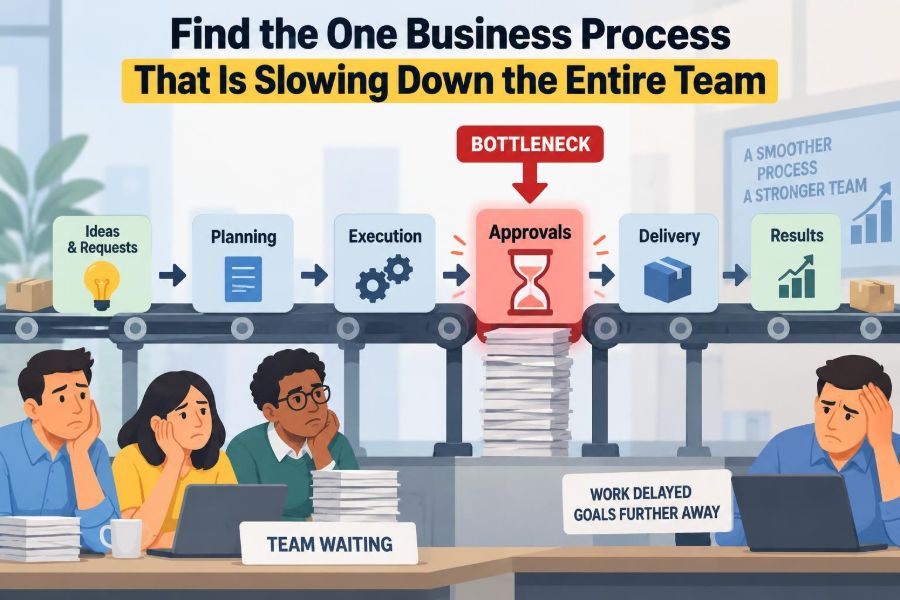

A team can look busy all day and still make surprisingly little progress. Messages are answered, meetings are held, and work moves from one person to another—yet customer requests wait, projects drift, and deadlines become negotiations.
The immediate explanation is often “we need more people” or “everyone needs to work faster.” Sometimes that is true. More often, the team is being constrained by one part of the workflow that cannot keep up with the work arriving behind it.
That constraint may be a manager’s approval queue, a poorly designed handoff, a spreadsheet only one person understands, or a system that forces people to re-enter the same data. Until it is identified, improvement efforts tend to add activity without increasing output.
Finding the slowest process is less about blaming a person and more about seeing how work actually flows. Once the team can see that flow, it can improve the right point instead of trying to optimize everything at once.
🚦 Understand What a Bottleneck Really Is
A bottleneck is the step in a process that limits how much completed work the whole system can produce. Like the narrow neck of a bottle, it restricts flow even if every other part is wide and efficient.
A bottleneck is not necessarily the task that feels hardest, takes the longest for one item, or creates the most complaints. It is the point where demand regularly exceeds available capacity, causing work to queue up.
For example, a marketing team may create campaign materials quickly, but if legal review can approve only a limited number each week, legal review determines how many campaigns can launch. Faster design alone will not solve the overall delay.
🔗 Think in Terms of a Complete Flow
Most work is not a single task. It is a chain: request, clarify, create, review, approve, deliver, and sometimes revise. The customer experiences the total time from request to useful result, not the speed of any individual stage.
Map the process from beginning to end before deciding where the problem lies. Include waiting periods, rework loops, information requests, and transfers between teams. These are often invisible in formal process diagrams but highly visible in day-to-day frustration.
A useful starting question is: What must happen before a customer, colleague, or downstream team receives a finished result?
⏱️ Separate Work Time From Waiting Time
People commonly focus on touch time: the minutes or hours someone actively spends working on an item. But lead time includes everything from initial request to completion, including waiting.
A purchase request might require only 20 minutes of administrative work but take two weeks to complete because it sits in several approval inboxes. Reducing the administrative task to 15 minutes barely changes the customer’s experience.
Measure both. A process with low touch time and high lead time is signaling that queues, handoffs, priorities, or decisions deserve attention.
📥 Start With the Work That Enters the System
You cannot judge capacity without understanding demand. Track what enters the process over a typical period: requests, orders, support cases, designs, reports, or change requests.
Look beyond averages. A team that handles a manageable volume most weeks may still fail during predictable spikes, such as month-end reporting, seasonal demand, or a recurring leadership meeting.
Also examine request quality. Incomplete or ambiguous inputs create hidden demand because employees spend time asking for clarification, correcting errors, or restarting work.
📦 Make Work Visible, Including the Unfinished Work
Work that cannot be seen is difficult to manage. Create a simple visual view of the workflow using a board, shared spreadsheet, ticketing system, or process-management tool.
Use columns that reflect real stages rather than vague labels such as “in progress.” For instance: request received, requirements confirmed, drafting, review, approval, scheduled, complete.
The goal is not a prettier dashboard. It is to reveal where items accumulate. A large, persistent pile before one stage is a strong clue that the next step is constraining flow.
🧱 Look for Queues That Do Not Clear
A queue is work waiting for the next step. Short queues can be normal, particularly when work arrives unevenly. A queue that remains large or grows over time deserves investigation.
Pay particular attention to work waiting before a stage, not just within it. If six proposals are waiting for pricing and pricing staff are continually busy, the pricing step may be the limiting factor.
Do not assume that a queue means the people at that stage are careless. It may reflect too much incoming work, unclear rules, missing information, competing responsibilities, or a tool that creates unnecessary effort.
📈 Compare Demand With Capacity
Capacity is the amount of work a process can reliably complete in a given period at an acceptable quality level. It is not the theoretical maximum someone could achieve in an unusually intense week.
Compare the incoming workload with the completed workload at each major stage. If 30 requests enter review each week but reviewers reliably finish 20, the backlog will grow unless demand changes or capacity improves.
Capacity is shaped by available time, skill, systems, interruptions, task complexity, and quality requirements. Counting headcount alone gives an incomplete picture.
🧮 Use Simple Measures Before Complex Analytics
You do not need sophisticated software to identify a likely constraint. A basic record of arrival date, current stage, completion date, and reason for delay can reveal patterns within a few cycles of work.
Useful measures include:
- Work in progress: how many items are currently open.
- Queue age: how long items have waited at a stage.
- Throughput: how many items are completed in a period.
- First-pass completion: how often work moves forward without correction.
- Rework rate: how often an item returns to an earlier stage.
Use measurements to ask better questions, not to create a surveillance system. Data without context can misrepresent the work.
🔍 Follow One Item Through the Process
Aggregate data can hide the lived experience of work. Choose a recent, typical item and trace its journey from request to completion. Record each stage, handoff, wait, question, correction, and approval.
This exercise often exposes delays that no system captures: a manager who reviews work only on Fridays, a missing template, a weekly meeting required before a decision, or an employee who must chase information across three channels.
Choose a typical case, not only an unusually difficult one. Then trace an urgent or delayed case separately to understand how exceptions behave.
👀 Observe the Work Where It Happens
Process documentation often describes the intended workflow, while observation reveals the actual workflow. Spend time with people doing the work and ask them to explain what happens when an item is straightforward, incomplete, urgent, or unusual.
Listen for phrases such as “we usually have to,” “it depends who is available,” or “I keep a separate list.” These can point to unofficial workarounds that protect the process but also create risk.
Observation should be respectful. The purpose is to understand constraints in the system, not to judge someone’s pace or create a case for individual blame.
🗣️ Ask the People Closest to the Delay
Employees working at a suspected bottleneck often know exactly why work slows down. They may lack authority, data, or a safe setting to describe it clearly.
Ask specific questions: What arrives incomplete? What takes longer than it should? What must you wait for? What work gets interrupted? What errors return most often? Which requests should not enter your queue at all?
Ask upstream and downstream teams too. Upstream staff may see confusing entry requirements, while downstream staff can explain why completed-looking work still causes delays later.
🔄 Distinguish a Bottleneck From a One-Off Incident
A delayed project does not automatically prove that a stage is the system constraint. A supplier failure, absence, unusual customer requirement, or technology outage may create a temporary disruption.
A true bottleneck tends to show a repeated pattern: work gathers before the same activity, people there are regularly overloaded, and improving other steps does not materially improve overall completion.
Review several weeks or comparable cycles where possible. The aim is to identify a persistent pattern while remaining alert to seasonal or event-driven changes.
🧠 Check Whether Decision-Making Is the Constraint
Many organizations treat approvals as a minor administrative detail. In practice, decision-making can become the slowest part of a process when authority is unclear or too many people must agree.
Signs include work waiting for a senior leader, repeated requests for “one more review,” decisions revisited after they are made, and meetings that end without a clear owner or deadline.
Not every approval should be removed. Financial, legal, safety, and reputational risks may require formal checks. The better question is whether the right decision is being made at the right level with the right information.
🧾 Investigate Rework, Not Just Delays
Rework occurs when a supposedly completed task must be corrected, clarified, or redone. It consumes capacity twice: once for the original work and again for the repair.
A design team may appear slow because it handles many revision rounds. The actual cause may be unclear briefs, changing priorities, or late feedback from stakeholders rather than slow design work.
Track why work returns. Common categories include missing input, quality defect, changed requirement, policy issue, technical incompatibility, and unclear ownership. Patterns point to the process stage that needs redesign.
🧩 Examine Handoffs Between People and Teams
Every handoff creates the possibility of lost context, delay, duplication, and confusion over responsibility. The problem may sit between departments rather than inside one department.
For example, sales may submit a client request that operations cannot start because key details are absent. Operations then sends questions back, sales is with the client, and the request waits. Neither team is necessarily underperforming; the handoff standard is weak.
Improve handoffs by defining what “ready” means, using a consistent intake format, naming the receiving owner, and agreeing on how exceptions are handled.
🖥️ Test the Tools, Templates, and Systems
Technology can create a bottleneck when it is slow, poorly integrated, difficult to use, or designed for an outdated way of working. Re-entering the same information across systems is a common source of avoidable delay.
Templates can also constrain throughput if they require unnecessary detail for every case. Conversely, a missing template can force each employee to recreate routine documents from scratch.
Before buying new software, identify the exact friction. A new tool will not fix vague decision rights, inconsistent inputs, or an approval process that nobody has simplified.
🎯 Find the Constraint, Not the Busiest Person
The busiest employee is not automatically the bottleneck. Someone may appear overloaded because they are doing valuable work that does not limit the end-to-end process, or because they have absorbed tasks that should be elsewhere.
Likewise, the constraint may be a shared resource: a specialist system, a compliance review, a weekly meeting, or a single source of data. Focus on the flow of work rather than a person’s visibility.
This distinction matters for trust. Calling an individual “the bottleneck” can be unfair and defensive. It is more accurate to say that a process stage currently has insufficient capacity or poor design.
🛑 Avoid Optimizing Steps That Are Not Constraining Flow
Teams often improve the easiest stages because the gains are visible and controllable. Automating a fast intake form may save time, but it will not reduce total lead time if work then waits days for expert review.
Improvement outside the constraint can even worsen congestion. If an upstream team produces work faster, more items may pile up in front of the already overloaded stage.
Direct early improvement effort toward the point limiting completion. Once that point improves, reassess the workflow because the constraint may move elsewhere.
📌 Protect the Constraint From Avoidable Interruptions
When a limiting stage is identified, ensure that its scarce capacity is spent on work that genuinely requires it. Experts should not be repeatedly interrupted for routine status updates, preventable corrections, or tasks that others can handle.
Practical protections may include scheduled review blocks, a clear priority queue, an assistant who prepares materials, office hours for questions, or a rule that incomplete requests do not enter the queue.
Protection is not isolation. The team still needs visibility and communication. The aim is to reduce low-value switching costs so the constraint can process important work reliably.
🧹 Improve Inputs Before Adding More Capacity
Increasing capacity can help, but it is often expensive and may merely process poor-quality inputs faster. First ask whether upstream work can arrive complete, standardized, and properly prioritized.
For a hypothetical HR team, a mandatory hiring-request checklist may eliminate repeated follow-up questions. That does not remove the need for recruitment expertise, but it prevents recruiters from spending that expertise on avoidable clarification.
Better inputs are particularly valuable where the bottleneck is specialized knowledge. Protect specialists for judgment-heavy work rather than routine cleanup.
⚖️ Use Priority Rules That Match Business Value
Without explicit priority rules, the loudest requester often gets attention first. This causes frequent switching, makes completion dates unreliable, and can leave high-value work waiting behind less urgent work.
Define a small set of decision criteria, such as customer commitment, operational risk, legal deadline, revenue impact, or dependency on other work. Apply them consistently enough that staff do not have to renegotiate every request.
Priority rules need room for legitimate emergencies. However, if everything is urgent, the organization has not created a priority system—it has created a permanent interruption system.
🚧 Limit Work in Progress
Work in progress, often shortened to WIP, is unfinished work that has started but is not yet complete. High WIP makes queues longer, hides what matters most, and increases the mental cost of switching between items.
Set sensible limits for stages where work tends to accumulate. When the limit is reached, the upstream team may need to help clear the queue, wait before starting new work, or resolve missing information.
This can feel counterintuitive because fewer items appear active. But finishing work before starting more often improves flow more than keeping everyone continuously busy.
👥 Build Cross-Training Carefully
Cross-training can reduce dependency on one person and add flexibility during peaks or absences. It is most useful when a task is repeatable and the new trainee can achieve an appropriate standard.
It is not a universal answer. Some work requires deep expertise, certification, judgment, or confidentiality that cannot be transferred quickly. Rushed cross-training can create errors and more rework.
Start by separating tasks that require the expert’s unique judgment from preparatory or routine tasks others can learn. This creates capacity without diluting necessary control.
🤖 Automate the Right Kind of Work
Automation is strongest when a task is frequent, rules-based, stable, and prone to manual copying or checking. Examples include routing complete requests, sending reminders, populating standard fields, or generating routine status updates.
Automation is weaker when inputs vary widely, rules are disputed, or a decision depends on context. Automating a confused process may make confusion happen faster and at greater scale.
Test a small change first, define an owner for exceptions, and review whether the automation reduces lead time or simply shifts work to a less visible queue.
📊 Run a Small, Measurable Experiment
Do not redesign an entire workflow based on an assumption. Choose one likely cause of delay and run a controlled improvement for a defined period or a limited category of work.
For example, a finance team might require a complete submission checklist before invoices enter review. Compare queue age, returned items, and completed invoices with the prior pattern while accounting for unusual workload changes.
Small experiments reduce risk and make learning easier. If results do not improve, the team has gained information rather than committing to a large, disruptive change.
📅 Review Results Over Enough Time
A single good week can be caused by lighter demand, unusually simple cases, or people temporarily working extra hours. A useful review looks for a sustained change in flow, quality, and backlog behavior.
Watch for unintended effects. A faster approval stage may create more errors downstream; a strict intake rule may reduce rework but frustrate customers if guidance is unclear.
Review both quantitative evidence and employee experience. A change that improves a dashboard while making essential work harder to perform may not be sustainable.
🧭 Expect the Bottleneck to Move
Improving one constraint often reveals the next one. If legal review becomes faster, the next limitation might be campaign scheduling, translation, or a customer’s own approval process.
This is not evidence that the first improvement failed. It means the team has increased flow enough to expose a different limiting stage. Process improvement is a cycle of observing, adjusting, and reassessing.
Keep the workflow visible after changes. Teams that stop measuring once a project ends often drift back toward hidden queues and informal workarounds.
⚠️ Recognize Common Misdiagnoses
Several tempting explanations can lead teams away from the real constraint:
- “People need to work harder.” This may produce short-term effort but does not fix unclear inputs, poor sequencing, or insufficient capacity.
- “We need more meetings.” Meetings can resolve decisions, but unnecessary coordination often reduces the time available for execution.
- “We need a new tool.” A tool may help, but only after the workflow and requirements are understood.
- “The slowest task is the problem.” A long task matters only if it limits the rate of completed work.
- “Every department should maximize utilization.” Fully loading every resource can create long queues and leave no flexibility for variation.
The more persuasive explanation is not always the correct one. Trace the work before choosing the remedy.
🧑🤝🧑 Make Improvement Psychologically Safe
People may hide delays when they expect blame, especially if a queue is associated with a particular employee or department. That makes the organization less able to diagnose the real issue.
Use neutral language: “Where does work wait?” “What makes this request difficult to complete?” “What condition would let this stage work more smoothly?” These questions invite practical evidence.
Leaders should also acknowledge trade-offs. A team cannot simultaneously demand faster delivery, exhaustive review, unlimited customization, and no added capacity without deciding which outcomes matter most in each case.
🗺️ Create a Repeatable Bottleneck Review
A brief recurring review prevents process problems from becoming normal. It can be part of a weekly operations meeting, project review, or team planning session.
A practical agenda is:
- Review work entering and leaving each key stage.
- Identify the oldest or largest queue and why it exists.
- Check rework and blocked items.
- Confirm current priorities and upcoming demand spikes.
- Assign one focused experiment or corrective action.
Keep the review centered on flow, not status reporting for its own sake. The output should be a clearer decision about what to protect, fix, defer, or escalate.
🏁 Focus on Flow, Not Local Busyness
The central lesson is simple: a team’s output is limited by the part of its process that cannot keep pace. Faster work elsewhere may look productive, but it will not improve customer outcomes if completed work remains stuck at the same narrow point.
Finding that point requires evidence: visible work, queue patterns, lead time, demand, capacity, observation, and the knowledge of people doing the work. It also requires humility, because the apparent problem is not always the actual constraint.
The best response is usually targeted rather than dramatic. Clarify inputs, protect scarce expertise, reduce rework, improve handoffs, set priorities, and test changes. Then look again.
When a team improves the constraint that governs flow, it stops confusing activity with progress and starts delivering more reliably. 📊 🚦