
A café adds a handful of extra customers during the morning rush. Its rent does not change, its manager is already scheduled, and its espresso machine is already on. After paying for coffee beans, milk, cups, and card-processing fees, much of the additional revenue can flow toward profit.
Now imagine the same café loses a handful of customers each day. Those fixed commitments remain: rent is due, the manager still works the shift, and the machine still needs maintenance. A seemingly modest sales decline can therefore make profit fall much faster than revenue.
This pattern is not unique to cafés. It appears in software companies, airlines, manufacturers, gyms, hotels, media businesses, and many professional-service firms. It is called operating leverage, and it helps explain why earnings can be surprisingly sensitive to sales volume.
Understanding it makes budgets more realistic, pricing decisions sharper, and growth plans less naive. It also helps managers ask a better question than “Will sales rise?”: “What will happen to profit if sales move?”
📌 What Operating Leverage Means
Operating leverage describes the way a company’s operating profit responds to a change in sales revenue. It arises because a business usually has a mixture of fixed and variable operating costs.
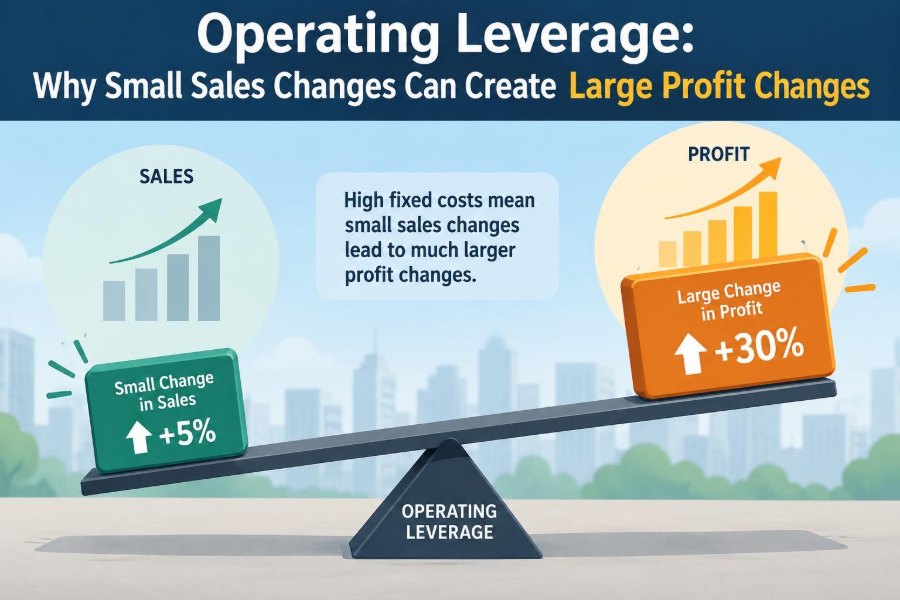
When fixed costs are high, a change in sales can produce a larger percentage change in operating profit. Sales growth can be highly rewarding once fixed costs are covered, but a sales decline can be equally painful.
The term concerns operations, not borrowing. It focuses on costs such as salaries, facilities, technology, production capacity, and marketing commitments before considering interest payments and taxes.
🧱 The Cost Structure Behind the Effect
A company’s cost structure is the pattern of costs it must bear to deliver goods or services. Operating leverage is embedded in that pattern rather than created by an accounting trick.
Businesses with substantial committed costs often have high operating leverage. Businesses that can scale spending down quickly when demand drops generally have lower operating leverage.
Neither structure is automatically better. The appropriate choice depends on demand stability, competitive conditions, available capital, customer expectations, and the organization’s ability to use its capacity well.
🏢 Fixed Costs: Commitments That Do Not Move Much
Fixed costs remain broadly unchanged within a relevant range of activity over a particular period. Rent, property insurance, salaried leadership, software subscriptions, and equipment depreciation are common examples.
“Fixed” does not mean permanent. A lease eventually expires, salaries can change, and subscriptions can be cancelled. It means the cost does not usually rise or fall with each additional unit sold in the short run.
A factory may pay the same monthly building cost whether it produces 10,000 or 12,000 units. That commitment creates pressure when orders weaken, but it can also support profitable growth when orders increase.
🔄 Variable Costs: Expenses That Follow Activity
Variable costs change in total as sales or production volume changes. Materials, shipping, sales commissions, payment fees, and hourly labor are frequent examples.
A retailer selling one more item may incur the product’s wholesale cost, packaging, and a payment fee. If it does not sell the item, it avoids most of those costs. This makes variable costs more flexible than fixed costs.
Some costs are mixed. A delivery operation may pay a fixed monthly vehicle lease plus fuel that rises with miles driven. Separating the fixed and variable portions produces a more useful view of operating leverage.
🧮 Contribution Margin Is the Starting Point
Contribution margin is the revenue left after variable costs are deducted. It “contributes” first to fixed costs and then, once fixed costs are covered, to operating profit.
The basic calculation is:
Contribution margin = Sales revenue − Variable costsIf a product sells for $100 and has $40 of variable cost, it provides a $60 contribution margin. That $60 is not automatically profit; the business must still pay its fixed operating costs.
Contribution margin is central because extra sales generate profit only through the portion that remains after the incremental costs of serving those sales.
🚦 The Break-Even Point Changes the Story
The break-even point is the sales level at which total contribution margin exactly covers fixed costs. Operating profit is zero at that point.
Below break-even, each lost sale can deepen an operating loss, while each additional sale reduces it. Above break-even, contribution from additional sales increasingly becomes operating profit, assuming prices and unit costs hold.
This is why a business close to break-even deserves special attention. A small demand shift may change the headline result from loss to profit, or from profit to loss, even though revenue did not move dramatically.
📈 Why Profit Can Rise Faster Than Sales
Suppose a hypothetical design studio has $100,000 in monthly sales, $40,000 in variable costs, and $50,000 in fixed costs. Its contribution margin is $60,000, leaving $10,000 in operating profit.
If sales rise 10% and the variable-cost ratio stays the same, sales become $110,000 and variable costs become $44,000. Contribution margin is then $66,000. Because fixed costs remain $50,000, operating profit becomes $16,000.
Revenue rose 10%, but operating profit rose 60%. The additional $6,000 of contribution did not need to fund more fixed costs in this simplified example. That is operating leverage at work.
📉 Why Profit Can Fall Faster Than Sales
Use the same hypothetical studio, starting with $10,000 in operating profit. If sales fall 10%, revenue drops to $90,000 and variable costs fall to $36,000.
Contribution margin becomes $54,000. Fixed costs still total $50,000, so operating profit falls to $4,000. A 10% sales decline has caused a 60% profit decline.
The lesson is symmetrical in direction but not always in practical consequence. A gain can be welcome; a sharp drop in a thin profit cushion can threaten cash flow, staffing plans, and lender confidence.
📐 Calculating the Degree of Operating Leverage
The degree of operating leverage, often abbreviated DOL, estimates profit sensitivity at a specific sales level. One common formula is:
DOL = Contribution margin ÷ Operating profitIn the design-studio example, contribution margin is $60,000 and operating profit is $10,000. Its DOL is 6. A rough interpretation is that a 1% change in sales could correspond to about a 6% change in operating profit, under the formula’s assumptions.
DOL is a snapshot, not a permanent company label. It changes as sales, prices, costs, and capacity change.
⚠️ Why the Ratio Can Mislead Near Break-Even
When operating profit is very small, dividing contribution margin by operating profit produces a very large DOL. At exact break-even, operating profit is zero, so the calculation is undefined.
This does not mean the business has discovered a precise forecasting tool. It means profit is extremely sensitive around that point, and percentage comparisons become unstable when the starting profit is close to zero.
Managers should pair DOL with actual currency scenarios: “If volume falls by this amount, what happens to profit and cash?” That question is often more decision-useful than a dramatic ratio.
🧾 A Simple Comparison of Two Businesses
Consider two hypothetical businesses with the same $200,000 sales revenue and the same $20,000 operating profit. Their risk profiles can still differ sharply.
| Item | Business A: Higher fixed costs | Business B: Higher variable costs |
|---|---|---|
| Variable costs | $80,000 | $140,000 |
| Contribution margin | $120,000 | $60,000 |
| Fixed costs | $100,000 | $40,000 |
| Operating profit | $20,000 | $20,000 |
| DOL | 6 | 3 |
Business A has more operating leverage. Its larger contribution margin can make growth profitable, but its larger fixed-cost base makes a sales shortfall more consequential.
🏭 High Operating Leverage in Asset-Heavy Businesses
Manufacturers, airlines, hotels, utilities, and large entertainment venues often carry significant fixed operating commitments. Facilities, equipment, specialized staff, maintenance, and regulatory requirements may be needed before the next customer arrives.
When unused capacity exists, an extra sale can add meaningful contribution with relatively modest incremental cost. A hotel room that would otherwise be empty, for example, may create contribution after costs such as cleaning and booking fees.
Capacity has limits, however. Once a factory is full or a venue is sold out, serving more demand may require a new shift, facility, or asset. Costs can then jump in steps rather than remain fixed.
💻 High Operating Leverage in Digital Businesses
Many software and digital-content businesses invest heavily before serving their next customer. Product development, platform infrastructure, cybersecurity, and specialized employees can be substantial fixed or semi-fixed costs.
Once the service is built, the cost of adding another user may be relatively low, though it is rarely zero. Customer support, cloud usage, commissions, marketing, and data processing can rise with scale.
This model can create attractive economics after a business reaches sufficient volume. It can also create losses for longer than expected when customer acquisition is expensive or demand fails to reach the scale assumed in a plan.
🧑💼 Professional Services Have a Different Pattern
Consulting firms, law practices, agencies, and accounting firms often have significant payroll commitments. Salaried professionals represent capacity that must be productively utilized to generate strong margins.
When a team has unused hours, winning additional client work can improve profit quickly because existing staff absorb the work. When utilization approaches capacity, the firm may need to hire, use contractors, or pay overtime.
As a result, service businesses may experience operating leverage in waves. Profit improves as utilization rises, then may flatten temporarily when new staffing is required.
🪜 Costs Often Move in Steps, Not Straight Lines
Simple examples assume fixed costs never change, but real operations are more complicated. A business may add a supervisor, machine, warehouse zone, or customer-support team only after activity crosses a threshold.
These are step-fixed costs: fixed within a range, then higher at the next level of capacity. Their presence means a forecast based on one sales level may not remain valid at a much larger one.
A useful planning model identifies capacity bands. Ask how much output current facilities and staff can support, what triggers new spending, and how much sales volume is needed to justify it.
🎯 Price Changes Affect Leverage Too
Operating leverage is not only about selling more units. A price increase, discount, or change in product mix can alter contribution margin and therefore profit sensitivity.
If a company raises price without losing much volume, each sale may contribute more toward fixed costs and profit. If it discounts heavily to fill capacity, volume may rise while contribution per unit falls.
A discount can be rational when incremental contribution is positive and unused capacity exists. It is less attractive when it displaces full-price sales, trains customers to wait for promotions, or fails to cover the additional costs it creates.
🧩 Product Mix Can Change the Result
Companies rarely sell one perfectly uniform product. Different offerings may have different prices, variable costs, demand patterns, and use of scarce resources.
For example, a retailer might gain sales by promoting a low-margin item. Revenue rises, but profit may not improve much if that item contributes little after variable costs. A shift toward a higher-contribution product could have the opposite effect.
Managers should examine contribution by product, customer segment, channel, or contract where practical. Total sales alone can conceal whether growth is strengthening or weakening the economics of the business.
🕒 The Time Horizon Matters
A cost that is fixed this month may be adjustable next year. A company might renegotiate a lease, redesign a process, outsource an activity, or change its staffing model over time.
Operating leverage is therefore partly a question of planning horizon. In the short term, management may have little flexibility. In the longer term, it can reshape the cost base—though often with contractual, operational, and cultural trade-offs.
Good analysis states the period clearly. Treating every cost as permanently fixed or instantly variable creates unrealistic forecasts.
💵 Profit Is Not the Same as Cash Flow
Operating leverage is usually discussed using operating profit, but profit sensitivity does not automatically reveal cash sensitivity. Cash collections, inventory purchases, capital spending, debt payments, and taxes matter too.
A growing company can report stronger operating profit while consuming cash if it must build inventory, extend customer credit, or invest in equipment. Conversely, depreciation affects operating profit but is not a current cash payment.
For decisions involving survival or financing, pair profit scenarios with a cash-flow forecast. Operating leverage explains part of the picture, not the entire liquidity position.
🔗 Operating Leverage Is Different From Financial Leverage
Operating leverage comes from fixed operating costs. Financial leverage comes from using debt or other fixed financing obligations, such as interest payments.
A business can have high operating leverage, high financial leverage, both, or neither. When both are high, a sales downturn may affect operating profit and still leave fixed interest obligations to be paid.
This distinction matters when comparing companies. Two firms with similar debt levels may face different business risk if one has much more rigid operating costs.
🔍 Operating Leverage Is Not a Measure of Quality
High operating leverage is sometimes described as desirable because it can produce rapid profit growth. That interpretation is incomplete. It is a description of sensitivity, not a verdict on management quality.
A well-run business may deliberately accept fixed costs to deliver faster service, better reliability, product consistency, or scale advantages. Another well-run business may preserve flexibility because its demand is seasonal or uncertain.
The key question is whether the fixed-cost commitment matches the company’s strategy and realistic demand range.
🌦️ Demand Stability Determines How Much Risk It Creates
Fixed costs are easier to carry when demand is predictable, customers are retained, and the business has enough margin of safety above break-even. They become more hazardous when sales are cyclical, seasonal, concentrated in a few clients, or exposed to rapid shifts.
Management should test more than an average forecast. Consider plausible slow months, a lost major customer, delayed product launches, supply disruptions, and competitor pricing actions.
Scenario planning does not eliminate uncertainty. It reveals whether the organization has enough financial and operational room to absorb it.
🛟 Margin of Safety Provides Context
The margin of safety is the amount by which actual or expected sales exceed break-even sales. A wide margin generally means the business can withstand a larger sales decline before it begins reporting an operating loss.
A company with high operating leverage can still be resilient if it is comfortably above break-even and has stable demand. A lower-leverage company can still be vulnerable if margins are thin and sales are already weak.
Use both measures together: DOL shows sensitivity around the current level, while margin of safety shows distance from the loss threshold.
🗺️ Building a Useful Scenario Model
A practical model need not be complicated. Begin with a base case that reflects expected volume, average selling price, variable cost per unit, and fixed costs for the planning period.
- Estimate sales under a few plausible volume and price scenarios.
- Apply variable costs that move with each scenario.
- Identify fixed costs and capacity thresholds that may change.
- Calculate contribution margin, operating profit, and expected cash effects.
- Discuss actions that would be triggered if a downside scenario occurs.
The goal is not to predict the future exactly. It is to make assumptions visible before commitments become difficult to reverse.
📊 Use Sensitivity Analysis Instead of One Forecast
A single budget often gives a false sense of precision. Sensitivity analysis changes one assumption at a time—such as sales volume, price, material cost, or wage rate—to show how results respond.
For a high-leverage business, small shifts deserve attention because they can materially affect operating profit. A manager may discover that pricing discipline or retention of a key customer matters more than a broad, expensive growth initiative.
When assumptions are related, use combined scenarios as well. A downturn may reduce volume and force discounting at the same time, producing a worse result than either change alone.
🧭 Managing High Operating Leverage
Managing operating leverage does not mean eliminating fixed costs. It means making commitments deliberately and building options around them.
- Match capacity additions to credible demand signals rather than optimistic targets alone.
- Use flexible staffing, supplier, or technology arrangements where they do not undermine service quality.
- Maintain enough liquidity for slower sales periods and ramp-up delays.
- Track utilization, contribution margin, and break-even sales alongside revenue.
- Protect pricing and prioritize work or products that use scarce capacity well.
Flexibility may cost more per unit, while fixed capacity may cost less at scale. The right balance is a strategic choice, not a universal formula.
🚫 Common Mistake: Treating Revenue Growth as Profit Growth
Revenue is easy to see and often celebrated, but it does not reveal the cost of generating it. A sales increase can be unprofitable if it requires deep discounts, expensive fulfillment, high commissions, or additional capacity.
Likewise, a sales decline does not always mean profit declines proportionately. If the lost sales had low contribution or if variable spending falls rapidly, the damage may be smaller than the revenue change suggests.
Ask two questions for every material sales movement: What contribution does it create or remove, and what fixed costs change because of it?
🚫 Common Mistake: Misclassifying Costs
Cost classification requires judgment. A salary may be fixed for a quarter but variable over a year if staffing follows demand. Cloud costs may contain both a base subscription and usage charges.
Overstating fixed costs can exaggerate leverage; treating committed costs as variable can understate risk. Historical accounting categories do not always match the economics relevant to a decision.
Review costs with the people who operate the business. They often know which expenses actually change, when they change, and what cannot be cut without damaging performance.
🚫 Common Mistake: Assuming Capacity Is Free Forever
Unused capacity can make incremental sales appealing, but it is finite. A business may eventually need another shift, new equipment, more support staff, or a larger facility.
Managers should distinguish a short-term “accept this order” decision from a long-term pricing or expansion decision. The first may use spare capacity; the second may require new fixed commitments.
Ignoring that difference can lead to prices that look profitable initially but cannot support the business once growth requires expansion.
🧠 Questions Managers Should Ask Regularly
Operating leverage becomes actionable when it is built into routine management conversations. Useful questions include:
- What is our current break-even sales level?
- Which costs are truly committed for the next month, quarter, and year?
- How much contribution does each major product or customer group provide?
- Where are the next capacity thresholds?
- What happens to profit and cash if sales fall or rise by a realistic amount?
- Which decisions would make our cost base harder to adjust?
These questions turn a finance concept into an operating discipline shared by sales, operations, and leadership.
🎓 The Core Principle to Remember
Operating leverage explains why businesses with significant fixed costs can experience amplified changes in operating profit when sales change. Above break-even, extra contribution can flow rapidly to profit. Near or below break-even, lost contribution can quickly damage results.
The effect depends on the current sales level, contribution margin, capacity, cost flexibility, and time horizon. It should be interpreted with scenario analysis, cash-flow awareness, and an honest view of uncertainty.
Most importantly, operating leverage is a trade-off: fixed commitments can create scale and stronger margins, but they also increase the consequences of being wrong about demand.
Small sales changes matter most when fixed costs are large relative to current profit, so the smartest managers plan for both the upside and the downside. 📊⚖️