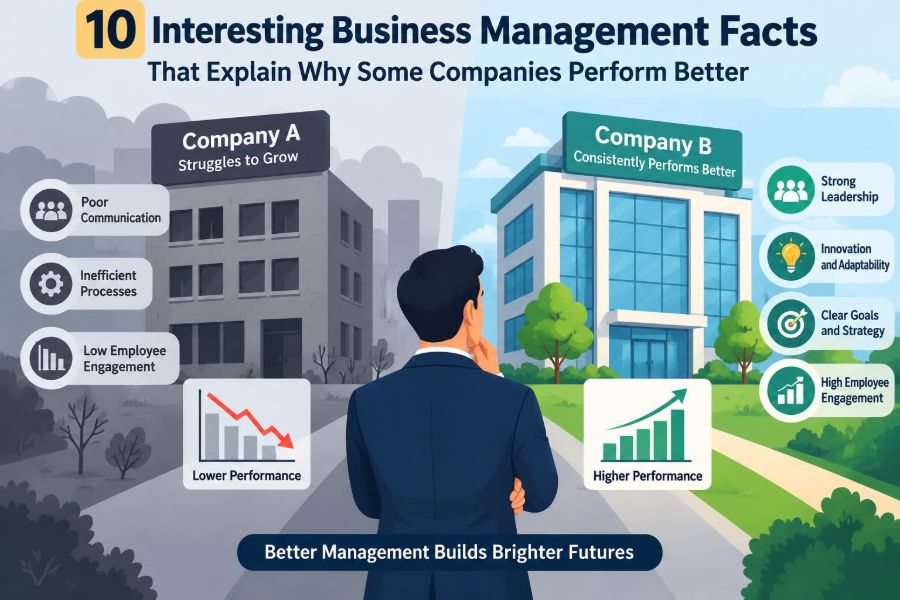

Two companies can sell similar products, hire capable people, and operate in the same market—yet one steadily improves while the other struggles with missed deadlines, frustrated customers, and constant firefighting.
The difference is not always a brilliant idea or a larger budget. Often, it lies in the less visible work of business management: deciding what matters, designing reliable processes, sharing information, and helping people make good decisions under pressure.
These choices shape everyday experiences. They determine whether a customer complaint becomes useful feedback, whether a promising employee stays, and whether a small problem is fixed before it becomes expensive.
The following facts explain why management quality has such a powerful effect on company performance. They are not universal rules or shortcuts; every organization has different constraints. But together, they reveal the practical systems behind sustained performance.
🎯 Fact 1: Strategy Is a Set of Choices, Not a Slogan
A strategy is sometimes mistaken for a broad ambition such as “be the best” or “grow quickly.” Those statements may be motivating, but they do not tell employees what to do differently tomorrow.
A useful strategy makes choices about where to compete, whom to serve, and what not to do. A small café, for example, cannot simultaneously optimize for the lowest price, a luxury experience, and an enormous menu without difficult trade-offs.
Companies often perform better when teams understand those trade-offs. Clear choices reduce conflicting priorities and prevent resources from being spread across too many unrelated projects.
🧭 Clear Priorities Reduce Hidden Work
When priorities are vague, people create work to protect themselves: extra approvals, parallel reports, unnecessary meetings, and projects that sound useful but do not advance a goal. This hidden work consumes time without improving results.
Good managers translate strategy into a short set of current priorities. They also explain the reason behind them. “Improve repeat purchasing” gives a customer-service team a more practical direction than “increase revenue.”
Priorities must be revisited when conditions change. Clarity is not stubbornness; it is the ability to adjust deliberately rather than letting every urgent request redefine the business.
📏 Fact 2: What Gets Measured Shapes Behavior
Metrics do more than report performance. They influence what people pay attention to and how they make decisions. If a call center measures only call length, employees may rush customers off the phone even when the issue remains unresolved.
That is why a measure should reflect the outcome the organization truly wants. A more balanced view might include resolution quality, repeat contacts, customer feedback, and cost—not simply speed.
A metric is a signal, not the full reality. Managers need to ask what behavior a target encourages and whether employees can improve the number by damaging something else.
⚖️ Balanced Measures Limit Metric Gaming
Metric gaming occurs when someone improves a reported number without creating the intended value. It is not always dishonest; it can be a predictable response to an incomplete target.
For instance, a warehouse rewarded solely for items shipped may send orders quickly but make more picking errors. Pairing speed with accuracy and returns creates a fuller picture.
| Single measure | Potential distortion | Useful balancing measure |
|---|---|---|
| Sales volume | Discounting or unsuitable sales | Margin and customer retention |
| Production output | Quality problems or excess inventory | Defect rate and inventory levels |
| Project completion | Rushed, low-value delivery | User adoption and outcome quality |
Balanced measurement does not mean measuring everything. Too many dashboards create noise. It means choosing a few indicators that expose meaningful trade-offs.
🔄 Fact 3: Processes Usually Beat Heroics
Many organizations admire the employee who rescues a crisis at the last minute. That effort can be valuable, but a company that depends on constant rescue work is usually carrying an unstable process.
A process is simply a repeatable way of turning inputs into an outcome. Clear handoffs, checklists, decision rules, and ownership make quality less dependent on memory or a particular individual.
Consider a restaurant that repeatedly runs out of popular ingredients. A heroic manager may make emergency purchases. A better management response examines forecasting, reorder points, supplier reliability, and communication between kitchen and purchasing staff.
🧩 Standardization Creates Capacity for Improvement
Standardization can sound restrictive, especially in creative or professional work. In practice, it is most valuable for routine, high-risk, or frequently repeated tasks.
When the routine parts of work are consistent, people have more mental capacity to handle unusual cases. A standardized onboarding checklist, for example, does not remove human judgment; it ensures that access, training, and essential introductions are not forgotten.
The danger is over-standardizing work that requires adaptation. Strong managers distinguish between activities that need consistency and those that benefit from experimentation.
👥 Fact 4: Psychological Safety Supports Better Information
Psychological safety describes a shared belief that people can raise questions, admit mistakes, or challenge an idea without being humiliated or punished unfairly. It does not mean avoiding accountability or accepting poor performance.
Its management value is straightforward: leaders cannot solve problems they do not hear about. If staff fear blame, bad news travels slowly, risks stay hidden, and decisions are made with incomplete information.
A manager can encourage openness by asking, “What might we be missing?” and by responding calmly when someone reports an error. The response to the first bad news often determines whether people share the next piece of bad news.
🗣️ Disagreement Is Useful When It Has Rules
High-performing teams do not necessarily agree more often. They can disagree earlier, more specifically, and with less personal conflict.
Useful disagreement focuses on assumptions, evidence, customer impact, and alternatives. It avoids turning a proposal into a judgment about the person proposing it.
- State the decision that needs to be made.
- Separate facts from assumptions and preferences.
- Invite relevant dissent before the decision is final.
- Record the reasoning so the team can learn later.
Once a decision is made, teams still need commitment. Endless debate is not healthy challenge; it is unresolved ownership.
🚪 Fact 5: Frontline Employees Often See Problems First
People closest to customers, equipment, deliveries, or daily operations notice friction that senior leaders may not see. A service representative hears recurring customer confusion. A technician recognizes a small fault before a machine fails.
Organizations perform better when that local knowledge can move upward and lead to action. This requires more than an anonymous suggestion box. Employees need a clear route for raising issues and evidence that worthwhile concerns receive a response.
Frontline insight is still partial. Managers should combine it with data, customer patterns, and broader strategic context rather than treating any one observation as conclusive.
🧠 Fact 6: Decision Quality Depends on Decision Design
Businesses often focus on whether a leader is decisive. Yet speed alone is not quality. The better question is whether the decision process matches the size, reversibility, and uncertainty of the choice.
Some decisions are easy to reverse, such as testing a revised email subject line. Others, such as entering a long-term lease or changing a safety procedure, deserve more analysis and consultation.
A helpful distinction is between reversible decisions, which can be tested and adjusted, and hard-to-reverse commitments. Treating both with identical caution either slows the organization or creates avoidable risk.
⏱️ Faster Decisions Need Clear Boundaries
Delegation works when employees know the outcome they own, the limits of their authority, and when to escalate. Without these boundaries, managers become bottlenecks because every small exception returns to them.
For example, a purchasing coordinator may be authorized to approve routine substitutions within a stated budget but required to escalate changes affecting product safety, major suppliers, or contractual terms.
Boundaries are not bureaucracy for its own sake. They let people act quickly while protecting decisions that carry larger consequences.
🌱 Fact 7: Retention Is Often a Management System Issue
Pay matters, but employees also evaluate workload, growth, fairness, clarity, recognition, flexibility, and the quality of their direct manager. A company can offer attractive benefits and still lose capable people if daily work feels chaotic or disrespectful.
Frequent turnover has costs beyond recruitment. Teams lose practical knowledge, customers encounter inconsistency, and remaining staff may carry heavier workloads.
Managers should avoid assuming that every departure has one cause. Exit conversations, stay conversations, workload data, promotion patterns, and manager feedback can reveal patterns that a single explanation misses.
🧑🏫 Coaching Makes Expectations Observable
“Be more strategic” or “communicate better” is too vague to guide improvement. Effective coaching turns a broad expectation into observable behavior.
A manager might say: “Before the weekly meeting, send a one-page summary of the decision needed, the options, and the risks.” That gives an employee something concrete to practice and discuss.
Coaching should include feedback on strengths as well as gaps. The goal is not to script every action, but to build judgment and confidence over time.
💬 Fact 8: Communication Fails More Often Through Ambiguity Than Silence
A message can be frequent and still unclear. “We need to improve customer experience” leaves open basic questions: Which customers? What problem? Who owns the next step? By when?
Strong management communication identifies the decision, owner, deadline, success measure, and known constraint. This is especially important when work crosses departments with different vocabulary and incentives.
Written summaries are valuable because memory changes after a meeting. A short record prevents teams from acting on competing versions of what was agreed.
🔁 Closed Loops Turn Communication Into Execution
A closed-loop communication process confirms that a message was understood and shows what happened next. It is more than sending information.
For a project handoff, the receiving team can restate the deliverable, flag missing inputs, and confirm the next milestone. That small step detects misunderstandings before they become delays.
This approach is particularly useful for operational changes, customer commitments, and work involving safety or compliance. It may feel slower at first, but it often prevents rework later.
📚 Fact 9: Learning Requires More Than Training Courses
Training can build knowledge, but it does not automatically change daily behavior. People need an opportunity to apply a skill, receive feedback, and see whether it improves results.
Organizations learn when they examine outcomes rather than merely completing activities. After a product launch, for example, a team can compare its assumptions with customer behavior and decide what to preserve, change, or stop.
A useful review asks: What did we expect? What happened? Why was there a difference? What will we do differently? This turns experience into organizational knowledge.
🔍 Small Experiments Reduce the Cost of Being Wrong
When uncertainty is high, a limited experiment can be more informative than prolonged argument. A retailer might trial a new store layout in a few locations before making an expensive network-wide change.
A good experiment has a clear hypothesis, a defined group or setting, a practical measure of success, and a review date. Without these elements, a “pilot” can become an unstructured trial that teaches little.
Not every idea can be tested cheaply. Regulatory obligations, brand risks, and customer harm may limit experimentation. Managers must decide where learning is safe and ethical.
🛠️ Fact 10: Continuous Improvement Is Usually Incremental
Business improvement is often imagined as a major transformation. Large changes can matter, but many performance gains come from repeated small fixes: fewer approval steps, clearer forms, better scheduling, simpler returns, or fewer handoff errors.
This approach is often associated with continuous improvement—the disciplined practice of finding waste, variation, delays, and defects in everyday work. It depends on observation rather than assumptions.
A small reduction in recurring rework can free hours every week. Over time, that capacity can be redirected toward customers, innovation, or staff development.
🧯 Treat Root Causes, Not Just Symptoms
When the same issue returns, the immediate fix may be treating a symptom. If invoices are repeatedly late, reminding staff to work faster may help briefly but does not explain the pattern.
Managers should trace the workflow: Are required details missing? Is one approval stage overloaded? Is the software difficult to use? Are responsibilities unclear? The answer may involve several causes.
Root-cause analysis should remain practical. The goal is not a perfect explanation of every failure, but a change that lowers the chance of recurrence.
💰 Financial Literacy Improves Everyday Choices
Financial management is not only the finance department’s responsibility. Operational managers make choices about staffing, inventory, pricing, equipment, credit, and service levels that affect cash flow and profitability.
Understanding the difference between revenue, profit, and cash is especially useful. A business can report sales while still facing cash pressure if customers pay late or inventory absorbs too much money.
Managers do not need to become accountants. They do need enough financial literacy to recognize that a decision with higher sales may also bring lower margins, greater risk, or a delayed cash benefit.
📦 Inventory Reveals Trade-Offs Between Service and Cash
Holding more inventory can reduce stockouts and protect customer service. It can also tie up cash, require storage, and create a risk that products become obsolete or damaged.
Holding too little inventory creates a different cost: missed sales, emergency shipping, production interruptions, and disappointed customers. The appropriate level depends on demand uncertainty, supplier reliability, product life, and the cost of running out.
This is why simple rules such as “always minimize inventory” can mislead. Management involves choosing a sensible balance for the business model.
🤝 Collaboration Needs Shared Incentives
Departments can all work hard and still undermine one another. Sales may pursue customization, operations may seek stability, and finance may prioritize cost control. Each goal can be reasonable in isolation.
Problems arise when performance measures reward local success while ignoring the overall customer or business outcome. A sales promise that operations cannot reliably deliver is not a win.
Cross-functional goals, shared planning, and visible trade-offs help. The point is not to eliminate departmental expertise but to connect it to the larger system.
🏗️ Organizational Structure Shapes Information Flow
Structure determines who reports to whom, who approves what, and how specialists coordinate. It can clarify accountability, but it can also create silos when information must pass through too many layers.
A growing company may need more defined roles than it had in its early informal stage. Yet adding layers without clarifying decisions can slow work and leave employees uncertain about who owns an outcome.
There is no universally best structure. The appropriate design depends on size, geographic spread, regulation, product complexity, and how much coordination the work requires.
⚠️ Risk Management Is Part of Normal Management
Risk management is not simply a crisis document stored in a folder. It is the routine practice of identifying what could disrupt objectives, judging likely impact, and deciding what controls or contingency plans are worthwhile.
Risks can include supplier concentration, cybersecurity weaknesses, cash shortages, equipment failure, regulatory change, reputational damage, and dependence on one key employee.
Trying to eliminate every risk would be impractical and may prevent worthwhile opportunities. The management task is to understand exposure and make conscious choices about what the organization can accept, reduce, transfer, or prepare for.
🧭 Ethics Protect Long-Term Decision Quality
Ethical management is not separate from performance. Misleading customers, ignoring conflicts of interest, or pressuring staff to conceal problems can create short-term gains while weakening trust and increasing long-term risk.
Ethical pressure often appears in ordinary decisions: whether to disclose a limitation, how to treat customer data, how to evaluate a supplier, or whether a target encourages unsafe behavior.
Leaders influence norms through what they reward, tolerate, and investigate. A written code is useful, but employees pay closest attention to how difficult cases are actually handled.
🌍 External Conditions Can Overwhelm Good Internal Management
Management quality matters, but it is not the only explanation for business performance. Economic conditions, new competitors, supply disruptions, technological shifts, regulation, and unexpected events can reshape results quickly.
This is an important limitation when comparing companies. A firm may look highly successful because it operates in a favorable market, while a well-managed firm in a difficult sector may show weaker short-term numbers.
Good management cannot control the external environment. It can improve the organization’s ability to notice change, respond sensibly, and avoid making conditions worse through panic or denial.
🔭 Long-Term Performance Requires Short-Term Discipline
Long-term goals are achieved through near-term choices: maintaining equipment, developing people, protecting quality, reviewing customer feedback, and declining opportunities that do not fit the strategy.
Pressure for immediate results can tempt managers to defer maintenance, cut training, overload staff, or use discounts that damage margins. These actions may improve a current report while creating a larger future problem.
The strongest management systems connect today’s actions with tomorrow’s capabilities. They ask not only, “Did we hit the target?” but also, “What did it cost us to hit it?”
🧪 A Practical Management Review Routine
Students and working professionals can apply these facts without redesigning an entire organization. Start with one recurring outcome: late deliveries, slow approvals, customer complaints, or high rework.
- Define the outcome and why it matters.
- Map the basic process and identify the people involved.
- Choose a small number of balanced measures.
- Ask frontline participants where friction occurs.
- Test one realistic change and review the result.
- Standardize the improvement if it works, or revise it if it does not.
This routine combines strategy, measurement, learning, communication, and process thinking. It also makes improvement visible rather than leaving it as a vague aspiration.
🏁 The Core Principle Behind Better-Performing Companies
The ten facts point to one central idea: organizations perform better when their management systems help ordinary people make sound decisions repeatedly. That means clear choices, useful information, workable processes, accountable ownership, and room to learn.
Exceptional individuals can create momentum, especially in a crisis. Sustainable performance, however, comes from systems that do not require exceptional effort for every routine task.
Management is therefore not just planning at the top of an organization chart. It is the daily design of work, decisions, relationships, and feedback loops that turns effort into reliable value.
Companies tend to perform better when strategy, people, processes, and measures reinforce one another instead of pulling in different directions. That is a demanding standard, but it is also a practical one: improve the way work is managed, and better results become easier to repeat. 📊🧭🌱