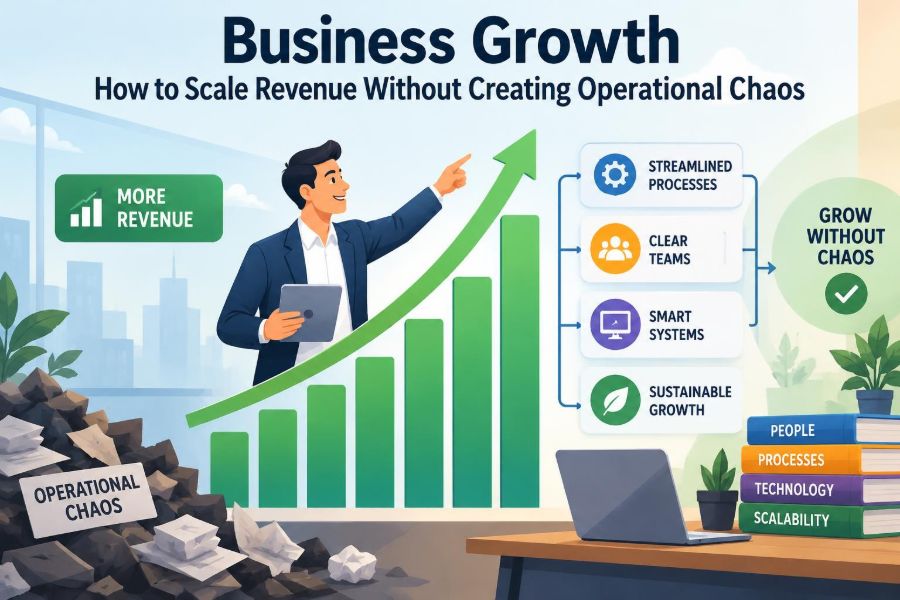

A small business wins a major client, demand rises, and revenue finally starts moving in the right direction. At first, the growth feels like proof that every hard decision was worthwhile.
Then the strain appears. Customer emails wait too long for replies. Employees create their own workarounds. Leaders approve exceptions all day, while stock shortages, missed handoffs, and inconsistent service quietly multiply.
This is a familiar business paradox: growth can expose weaknesses that were harmless at a smaller size. More sales do not automatically mean a stronger company; they can simply put more pressure on a fragile operating system.
Scaling well means increasing revenue while preserving the ability to deliver reliably, make sound decisions, and learn from problems. The goal is not to make a business more complicated. It is to build enough structure for complexity to remain manageable.
📈 Growth Is Not the Same as Scale
Growth means the business becomes larger: more customers, orders, people, locations, or revenue. Scale means it can handle that increase without costs, errors, delays, or management effort rising at the same rate.
A consulting firm that adds one consultant for every new client is growing. It begins to scale when reusable methods, clear account ownership, and effective tools allow each consultant to serve more value without reducing quality.
🧭 Define What Healthy Growth Looks Like
Revenue alone is an incomplete target. A company can increase sales by accepting unprofitable work, discounting heavily, or overloading its delivery team. Those choices may create a larger top line while weakening cash flow and customer trust.
Set a balanced definition of success that includes revenue, margin, retention, delivery time, quality, employee capacity, and cash. The right mix varies by model, but it should reveal whether the business is becoming more capable rather than merely busier.
🔎 Identify the Constraint Before Accelerating
Every business has a limiting factor: the point that restricts how much value it can deliver. It may be qualified leads, production capacity, onboarding, approvals, technical support, or a founder who must personally resolve every exception.
Adding demand before fixing the constraint pushes work into a queue. That queue then becomes late deliveries, frustrated staff, or lost customers. Map the journey from customer request to completed service and ask where work waits, returns, or requires escalation.
🗺️ Map the End-to-End Customer Journey
Departments often optimize their own tasks while customers experience one continuous journey. Marketing may generate leads quickly, for example, while operations discovers that promised delivery dates cannot be met.
Document the major stages: discovery, sale, contracting, onboarding, delivery, support, renewal, and referral. For each stage, name the owner, inputs, outputs, systems used, expected timing, and common failure points. This makes cross-functional gaps visible.
🎯 Choose a Clear Growth Focus
Trying to grow every product, customer segment, and channel at once spreads attention thin. Different offerings often require different sales approaches, staffing profiles, service levels, and inventory patterns.
Choose where growth should come from before investing in capacity. A useful decision considers:
- Which customers are profitable and likely to remain loyal
- Which offerings can be delivered consistently
- Which channel produces demand the business can realistically support
- What capabilities the chosen path requires next
Focus is not a refusal to pursue opportunity. It is a way to sequence opportunity.
💰 Protect Unit Economics
Unit economics describe the revenue and costs associated with one unit of business, such as an order, subscriber, project, patient visit, or customer account. They show whether additional volume creates contribution or simply additional work.
Track direct costs, fulfillment effort, refunds, support needs, acquisition spending, and the time required to serve each type of customer. A high-revenue contract can be unattractive if it consumes disproportionate senior time or creates costly custom work.
🏷️ Standardize the Core Offer
Customization can win early customers, but unchecked variation turns each sale into a new operational puzzle. Teams must remember special pricing, unusual terms, one-off features, and exceptions that no system was designed to handle.
Create a standard offer with defined scope, pricing logic, delivery steps, and service expectations. Keep a deliberate path for premium customization, but price it appropriately and assess whether it can actually be supported. Standardization protects both margin and reliability.
⚙️ Turn Repeatable Work into Processes
A process is not a thick manual. It is an agreed, repeatable way to complete work with known inputs, decisions, outputs, and accountability. Good processes reduce dependence on memory and make training faster.
Start with work that happens often, carries risk, or creates customer frustration when done poorly. Capture the minimum viable process first: what triggers the task, who performs it, what “done” means, and when an issue should be escalated.
📚 Document Decisions, Not Just Tasks
Checklists help with routine actions, but scaling also requires people to make consistent judgments. A support employee may know how to issue a refund but still need guidance on when a refund is appropriate.
Document decision rules, approval limits, examples of acceptable exceptions, and the reasoning behind important policies. This prevents every non-routine issue from travelling to the same manager. It also makes policy updates easier when conditions change.
👥 Design Roles Around Outcomes
In a small company, people naturally cover many jobs. As volume increases, vague ownership creates duplicated work and silent gaps. Two people may assume the other person will contact a customer, or neither may own the final quality check.
Define roles by the outcome each person owns, not only by a collection of activities. For example, an onboarding lead may own “customers reach first value within the agreed period,” coordinating sales, implementation, and support where necessary.
🧑💼 Reduce Founder Dependency
Founders often hold product knowledge, customer context, and decision authority that no one else has. Their involvement can be valuable early on, but it becomes a bottleneck when routine questions cannot move without them.
Delegation works best when it transfers authority as well as tasks. Set clear boundaries: what a team member may decide, what requires consultation, and what must be escalated. Review outcomes regularly instead of reclaiming every decision.
🪜 Build a Sensible Management Layer
More employees do not automatically require many management titles. However, a growing team does need accessible coaching, coordination, performance feedback, and problem resolution.
Promote or hire managers when the work has become too broad for informal supervision. The strongest choice is not always the best individual contributor. Look for people who can clarify expectations, develop others, surface risks, and improve systems without creating unnecessary hierarchy.
🤝 Hire for Capacity and Capability
Hiring only after a crisis usually produces rushed decisions. Conversely, hiring far ahead of demand can create avoidable fixed costs. Workforce planning is an ongoing estimate, not a one-time prediction.
Distinguish between a temporary capacity gap and a missing capability. Temporary peaks may be handled through scheduling, contractors, or automation. A recurring weakness in finance, operations, engineering, or people management may justify a permanent role.
🎓 Make Onboarding Repeatable
When new hires learn solely by shadowing a few experienced colleagues, quality varies and those colleagues lose productive time. This approach also preserves hidden knowledge rather than making it available to the organization.
Create a structured onboarding path with role outcomes, essential systems, process practice, examples of good work, and checkpoints. It should teach the reason behind key procedures, not merely the clicks required in a software tool.
🧰 Automate Stable, High-Volume Work
Automation is most useful when a process is frequent, predictable, and already understood. Examples include routing standard requests, sending status updates, reconciling routine data, or prompting a customer to complete a missing step.
Automating a broken process simply makes mistakes happen faster. First simplify the workflow, remove needless approvals, and define exceptions. Then choose technology that supports the intended process rather than forcing staff to work around it.
🔌 Integrate Systems Deliberately
As companies grow, separate tools for sales, finance, service, inventory, and reporting can create conflicting versions of the truth. Employees then spend time copying data and disputing which spreadsheet is current.
Decide which system is the source of record for each critical data type, such as customer details, contracts, stock, or invoices. Integrate only where the value is clear, and assign ownership for data quality. A sophisticated tool cannot compensate for unclear definitions.
📊 Use Metrics That Drive Decisions
Dashboards become noise when they contain every measurable number. Leaders need a small set of metrics connected to operational decisions: demand, conversion, capacity, delivery performance, customer experience, cash, and profitability.
Pair outcome metrics with leading indicators. Revenue is an outcome; a growing sales pipeline may be a leading indicator. Customer churn is an outcome; unresolved support issues or poor adoption may signal risk earlier. Metrics should prompt a question and an action.
🚦Create Operating Cadences
An operating cadence is a predictable rhythm for reviewing work and making decisions. Without it, problems emerge only in urgent messages, and meetings become broad status updates with no clear purpose.
A practical rhythm may include brief team coordination, weekly operational review, periodic financial review, and less frequent strategic planning. Each meeting should have a defined audience, inputs, decisions, and owner for follow-up. Cancel meetings that do not produce coordination or decisions.
🗣️ Keep Communication Channels Clear
Rapid growth increases the number of conversations, not necessarily the quality of information. Important decisions can disappear in chat threads, while employees receive conflicting instructions from different leaders.
Use different channels for different purposes: immediate coordination, documented decisions, project updates, customer records, and company-wide announcements. The objective is not to control every conversation; it is to make essential information easy to find and reliable.
🛡️ Build Quality Into the Workflow
Inspecting quality only at the end is expensive because errors have already travelled through the system. Where possible, build checks into the point where a mistake is easiest to detect and correct.
For example, a services firm might use a project kickoff checklist to confirm scope before work begins, rather than discovering misunderstandings at the final review. Track recurring defects by cause, then improve the process rather than blaming individuals for predictable failures.
📦 Plan Capacity Before the Rush
Capacity includes more than staff. It can include machine time, warehouse space, supplier availability, software limits, approval time, and leadership attention. A business can have enough employees yet still fail because one shared resource is overloaded.
Use demand scenarios rather than a single forecast. Ask what happens if demand is lower than expected, roughly on plan, or materially higher. For each case, identify the trigger that tells you when to add shifts, limit new sales, adjust lead times, or secure outside support.
🏦 Manage Cash Alongside Profit
A profitable sale can still create cash pressure. Inventory may need to be purchased before payment arrives, staff may be hired before projects are billed, or long payment terms may leave the business funding customer work.
Maintain a rolling view of expected cash inflows and outflows. Review collection practices, deposit requirements, payment terms, and supplier commitments as part of growth planning. Cash discipline gives leaders options when forecasts are wrong or opportunities arrive unexpectedly.
⚠️ Treat Risk Management as Operating Discipline
Risk management is not only for large corporations. Growth introduces practical exposures: supplier concentration, security weaknesses, contract obligations, regulatory requirements, customer concentration, and reliance on a few key employees.
List the risks that could materially disrupt delivery or cash flow, assess their likely impact, and assign an owner. Plans do not need to predict every event. They should establish practical responses, such as alternative suppliers, access controls, documented handovers, or escalation procedures.
🔄 Pilot Changes Before Full Rollout
Growing businesses often replace a system, launch a service, and reorganize teams simultaneously. When results worsen, nobody knows which change caused the problem.
Use pilots when feasible. Test a new workflow with one region, team, customer group, or product line; define success measures; collect frontline feedback; and revise before expanding. Pilots are especially useful where failure would affect customers, compliance, or core revenue operations.
🧪 Separate Experimentation From Core Delivery
Innovation needs room, but customers should not become unplanned testers of essential operations. A business can explore new pricing, channels, or features while keeping its core delivery model stable.
Create clear boundaries for experiments: budget, hypothesis, owner, duration, and stop criteria. This encourages learning without allowing every promising idea to interrupt established priorities. The discipline is knowing when evidence supports expansion and when it supports ending the test.
🌱 Preserve Culture Through Behaviors
Culture is often described through broad values, but employees experience it through repeated behaviors: how mistakes are discussed, whether bad news travels upward, how leaders handle customer pressure, and who receives recognition.
As a company grows, make these expectations concrete. Reward people who improve handoffs, surface risks early, help colleagues learn, and protect customer trust. A culture of heroic rescue may feel energetic, but it can hide the process failures that cause repeated emergencies.
🚫 Avoid the Most Common Scaling Traps
Operational chaos usually comes from a collection of reasonable-looking decisions rather than one dramatic mistake. Teams react to immediate demand, add exceptions, and postpone process work until the system becomes difficult to untangle.
- Hiring without role clarity: more people create more coordination work.
- Chasing every customer request: the offer becomes hard to price and deliver.
- Buying software before defining the workflow: confusion becomes digitized.
- Measuring activity instead of outcomes: busy teams can still miss the goal.
- Waiting for failure before planning capacity: recovery costs more than preparation.
🧩 Use a Phased Scaling Roadmap
A roadmap converts broad ambition into a manageable sequence. It should reflect the company’s real constraint rather than a generic checklist.
- Stabilize: fix urgent delivery failures, clarify ownership, and protect cash.
- Standardize: define the core offer, document repeatable work, and establish baseline metrics.
- Strengthen: add targeted people, systems, controls, and management routines.
- Expand: increase demand only when capacity and quality indicators support it.
- Review: revisit constraints as volume, customers, and market conditions change.
The sequence may overlap, but it prevents growth initiatives from outpacing operational readiness.
🧠 Know When to Slow Down
Slowing sales, pausing a launch, or narrowing a service area can feel uncomfortable when demand is strong. Yet a temporary constraint may protect long-term reputation and economics.
Warning signs include rising rework, missed commitments, weakening margins, increasingly frequent leadership escalations, and employees relying on personal favors to get work completed. These signals do not always require stopping growth, but they do require an explicit decision about what the business can reliably promise.
🏁 The Core Principle: Build Capacity to Keep Promises
Well-managed scale is not about adding bureaucracy for its own sake. It is about creating just enough clarity, repeatability, information, and accountability for people to do good work as volume rises.
Revenue growth becomes durable when sales, operations, finance, technology, and people practices develop together. The business does not need to eliminate every exception; it needs to recognize exceptions, manage them deliberately, and prevent them from becoming its default way of operating.
The most sustainable businesses scale by increasing their ability to keep promises—not merely their ability to win more orders. That discipline turns growth from a source of operational chaos into a platform for lasting performance. 📊🌱🚀