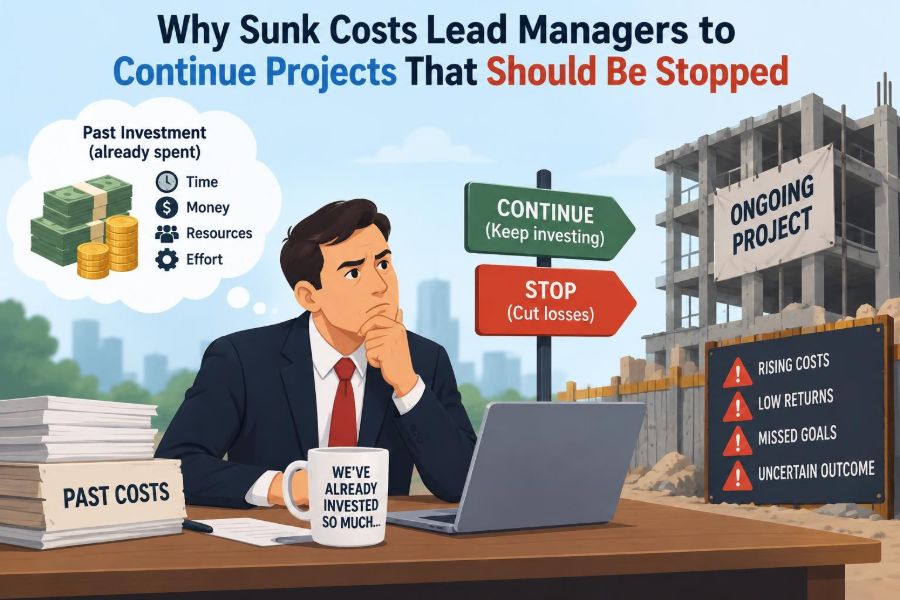

A product team has spent nine months building a new customer portal. The launch date keeps moving, the budget has doubled, and early users find it confusing. Yet when someone proposes ending the project, the room goes quiet: “We have already invested too much to walk away now.”
That reaction is understandable. Ending a project can feel like admitting failure, wasting money, disappointing colleagues, or damaging a manager’s credibility. Continuing feels more active and more hopeful, even when the evidence has changed.
But money, time, and effort already spent cannot be recovered by spending more. A good decision asks what should happen from this point forward, not what would make the past feel less painful.
This is the management challenge created by sunk costs: recognizing when commitment has become a reason to avoid reality rather than a reason to create value.
🧾 What a sunk cost actually is
A sunk cost is a resource already spent that cannot be recovered through the decision now being considered. It may be cash paid to a vendor, salaries spent on development, executive attention, training time, or months of opportunity cost.
The central feature is not that the expenditure was large. It is that it is irreversible. A decision today cannot change the fact that last year’s budget was used.
For example, a firm that has paid for custom software cannot recover that payment merely by continuing to build features. The relevant question is whether the future benefits of continuing exceed the future costs.
🧭 The forward-looking decision rule
Managers should compare the expected value of the available choices from today onward. Past spending is useful for learning, accountability, and forecasting, but it should not determine whether additional resources are committed.
A practical question is: If we had not started this project, would we choose to start it today with the resources still required? If the answer is no, continuing needs a very strong new justification.
This does not mean every troubled project should be stopped. A project may still have a positive future case. The point is that its past cost is not evidence that its future case is sound.
🧠 Why the bias feels so persuasive
Sunk-cost thinking is emotionally compelling because people naturally connect effort with deserved outcomes. After working hard, a team wants the project to succeed; after funding it, leaders want the investment to be validated.
That intuition works in some settings. Persistence can improve a skill, repair a customer relationship, or overcome a temporary obstacle. The mistake is assuming persistence creates value when the underlying business case has weakened.
The bias becomes especially strong when decisions are public. Stopping may look like a visible loss, while continuing can postpone the moment when that loss must be acknowledged.
🎯 Escalation of commitment
Escalation of commitment occurs when decision-makers increase support for a failing course of action because of prior investments. It is the organizational form of “throwing good money after bad.”
Escalation often happens gradually. A manager approves one more month, then a modest redesign, then a specialist contractor, then an expanded launch. Each step appears small in isolation, while the total commitment grows.
The danger is not commitment itself. Projects need commitment to survive normal uncertainty. The danger is commitment that becomes detached from current evidence, alternatives, and customer value.
🪞 Self-justification and identity
Managers may see a project as evidence of their judgment, leadership, or expertise. If they originally championed it, stopping can feel personally threatening rather than commercially sensible.
This creates self-justification: people search for information that supports their earlier decision and discount signals that challenge it. The issue is rarely deliberate dishonesty. It is often a protective response to discomfort.
Organizations reduce this pressure when they frame cancellation as disciplined resource allocation, not as a moral verdict on the person who proposed the work.
🏆 The fear of admitting failure
Many workplaces reward leaders for confidence, delivery, and visible wins. If careers appear to depend on never being wrong, managers have a reason to defend weak projects longer than they should.
A healthier culture distinguishes between a poor decision process and an unfavorable outcome. A well-reasoned experiment can fail because markets, technology, or customer needs change.
Stopping promptly after learning something material may be a sign of competence. The real failure is often refusing to update a decision after the original assumptions no longer hold.
📈 Loss aversion changes the frame
People generally experience losses more intensely than equivalent gains. In project decisions, cancellation makes a past loss visible, while continuation can feel like preserving the possibility of recovery.
That framing is misleading. The loss may already exist economically. Continuing does not erase it; it simply adds a new decision about whether further spending is worthwhile.
Leaders can reframe the choice by asking, “Which option limits future loss and creates the most future value?” This moves attention away from emotionally recovering the past.
🧱 Project momentum can hide weak logic
Projects develop routines: weekly meetings, reports, staffing plans, steering committees, and delivery rituals. Once these exist, continuation can seem like the default, even when the strategic rationale has faded.
Momentum is useful when it removes friction from valuable work. It is harmful when process becomes proof that the work deserves to continue.
Periodically ask whether the project would still exist if its team, calendar, and reporting structure disappeared tomorrow. If its case is hard to restate clearly, momentum may be doing more work than strategy.
👥 Group dynamics make stopping harder
A team may be reluctant to challenge a project that senior leaders support. Junior staff may fear being seen as negative, while peers may avoid conflict because the project employs colleagues or affects their own goals.
Groups can also mistake agreement for evidence. When nobody states concerns openly, decision-makers may conclude that the project has broad support.
Structured dissent helps. Assigning someone to present the strongest case for stopping gives concerns a legitimate place in the discussion without requiring a personal confrontation.
🗂️ The role of ownership and incentives
A manager responsible for delivering a project may be evaluated on completion, budget use, or milestones. Those measures can unintentionally reward continuation even if the project’s expected value is declining.
Ownership can also fragment decisions. One department bears the current cost while another expects a possible future benefit, making it difficult to see the full organizational trade-off.
Good governance aligns incentives with outcomes such as customer adoption, operating impact, strategic fit, and learning—not merely activity or completion.
🔍 Selective evidence and confirmation bias
Once leaders want a project to continue, they may emphasize favorable metrics: a positive pilot comment, a promising sales conversation, or a technical milestone. Negative evidence is labeled temporary, unrepresentative, or fixable.
This is confirmation bias: the tendency to seek and interpret information in ways that support existing beliefs. It can make reports look balanced while still being tilted toward optimism.
Counter it by requiring teams to identify disconfirming evidence. What observation would show that the project’s central assumption is false? Who is responsible for finding it?
📊 Metrics can conceal as much as they reveal
Projects often report outputs, such as features completed, campaigns launched, or staff trained. These can show effort and progress without showing whether the project is producing its intended outcome.
A new platform may be technically complete but unused. A marketing initiative may generate leads that never convert. A process redesign may be deployed but make frontline work slower.
Use a small set of outcome measures alongside delivery metrics. The right measures depend on the project, but they should show whether customers, employees, costs, risks, or revenues are changing in the expected direction.
🧪 Distinguishing normal setbacks from terminal problems
Not every delay, defect, or disappointing early result justifies cancellation. Innovation and transformation regularly involve uncertainty, and some worthwhile projects need adjustment before they work.
The key question is whether the setback is diagnosable and recoverable. A clear technical issue with a credible fix differs from repeated evidence that customers do not need the offering or that the economics cannot work.
Managers should specify what has changed, why it changed, what response is proposed, and what evidence would show that the response worked. Vague optimism is not a recovery plan.
🚦 Predefined stop criteria create discipline
The best time to decide how a project might end is before people become deeply invested. At approval, leaders can define conditions that trigger a review, pause, redesign, or shutdown.
Useful criteria might include:
- Customer demand remains below a stated threshold after a defined test period.
- Required spending rises beyond an approved range without a revised value case.
- A regulatory, technical, or market assumption proves false.
- A better alternative emerges and changes the opportunity cost.
Criteria should guide judgment, not replace it. Their purpose is to prevent the team from renegotiating every warning sign after it appears.
⏸️ A pause is different from avoidance
Pausing a project can be a sensible middle option when crucial information is missing. It preserves the ability to learn or reconsider without automatically committing more resources.
However, a pause becomes avoidance when no one defines what must be learned, who owns the review, or when a decision will be made. Dormant projects can quietly consume maintenance effort and management attention.
A useful pause has a purpose, a deadline, and a decision owner. At its end, the project should restart under a revised case, pivot, transfer, or close.
🔄 Pivoting only works with a new case
A pivot changes a project’s target customer, value proposition, technology, channel, or operating model. It can be valuable when learning reveals a more promising path than the original plan.
But “pivot” is sometimes used to avoid cancellation. Changing direction does not make old spending recoverable, and a pivot should not receive automatic approval because the team has already invested heavily.
Treat it as a new investment proposal: define the new problem, expected benefits, required resources, key risks, and testable assumptions. The original project’s history may provide learning, not entitlement to more funding.
💼 A hypothetical software example
Imagine a retailer building a loyalty app. After significant development, testing shows that customers prefer using the existing website and staff struggle to support the app’s complicated offers.
The sunk-cost response is to add more features because the company has “come too far.” A forward-looking review compares the remaining development, support, and marketing cost with likely incremental customer value.
The company might stop the app, retain reusable components, and improve the website instead. That decision does not make the earlier expense disappear, but it can prevent a larger future loss and preserve useful learning.
🏭 Capital projects face the same trap
Sunk costs are not limited to digital work. Construction, equipment, product development, acquisitions, and expansion programs can all escalate after assumptions about demand, cost, or timing change.
Capital-intensive projects are particularly difficult because stopping may leave a visible unfinished asset. Leaders can feel pressure to complete it simply because it is physically present.
Yet an incomplete facility is not a reason to complete an unneeded facility. The decision should compare completion, sale, conversion, mothballing, or closure using realistic future cash flows and risks.
🧮 Opportunity cost is the missing comparison
Every additional dollar and hour committed to a weak project cannot be used elsewhere. This sacrificed alternative is the opportunity cost of continuing.
Opportunity cost is often invisible because it does not appear as an invoice. A team may be unable to improve a profitable service, respond to a competitor, reduce a known risk, or pursue a stronger opportunity because it is tied to a failing initiative.
Reviewing alternatives makes trade-offs concrete. Ask what the same people, funding, and leadership attention could achieve in the next period if released.
🧾 Separate accounting from economic judgment
Accounting treatment and management decisions serve different purposes. Financial statements may recognize costs over time or classify expenditures in particular ways, but those entries do not determine whether future investment is sensible.
Similarly, a project can appear financially attractive if prior costs are excluded from a narrow report, yet still be strategically weak because the remaining work is risky or better options exist.
Finance teams can help by presenting both views clearly: what has been spent, what remains to be spent, what can be recovered, and what future benefits are realistically expected.
🕵️ Independent reviews reduce attachment
People outside a project are less likely to be attached to its original story. An independent reviewer can test assumptions, challenge estimates, and ask questions insiders may no longer notice.
Independence does not mean hostility. Reviewers need enough context to understand constraints and enough distance to avoid defending earlier choices.
Useful reviewers may include finance partners, customer-facing leaders, technical specialists, or an internal investment committee. Their role is to improve the decision, not simply to approve or reject it.
🗓️ Stage gates make reassessment routine
A stage gate is a formal decision point between phases of work. Before moving from research to build, build to pilot, or pilot to rollout, leaders review evidence and decide whether to proceed.
Effective gates are not ceremonial presentations. They require a refreshed case, an explanation of changed assumptions, an honest risk assessment, and explicit options to continue, modify, pause, or stop.
The table below shows how a gate can shift attention from past effort to future choice.
| Question | Weak review | Disciplined review |
|---|---|---|
| Progress | How much have we completed? | What value is now likely from remaining work? |
| Cost | How much have we spent? | What additional cost and exposure are required? |
| Risk | Can the team solve the issues? | What evidence supports that belief, and what could disprove it? |
| Choice | How do we finish? | Continue, pivot, pause, or stop—which is best now? |
🗣️ Questions that improve difficult meetings
Decision quality improves when leaders use questions that expose assumptions rather than invite reassurance. The language of a meeting can either reinforce escalation or make reassessment acceptable.
- What would we decide if this were proposed for the first time today?
- Which benefits are evidenced, and which are still assumptions?
- What is the smallest next investment that would resolve our biggest uncertainty?
- What alternative use of these resources has the strongest case?
- What would make us recommend stopping?
These questions do not guarantee a comfortable answer. They make the basis for the answer visible.
🧑🤝🧑 Protect teams when projects close
A poorly handled shutdown can make employees fear future experimentation. People may conclude that joining an ambitious project is career risk, especially if leaders publicly assign blame after the fact.
Close projects respectfully. Explain the decision in terms of current evidence and resource priorities, recognize useful work, and redeploy people thoughtfully where possible.
Teams should also preserve assets that retain value: documented lessons, reusable code, supplier knowledge, prototypes, research, and customer insights. Stopping the project need not mean discarding everything it produced.
📚 Turn cancellation into organizational learning
A short post-project review can identify what the organization learned and what it should change next time. The aim is not to create a courtroom record; it is to improve future choices.
Useful topics include whether the original assumptions were reasonable, which early signals were missed, whether incentives encouraged optimism, and whether stop criteria were clear enough.
Capture lessons while memories are fresh. Over time, organizations that learn from stopped projects become better at setting experiments, estimating uncertainty, and reallocating resources sooner.
⚠️ Common mistakes when confronting sunk costs
One mistake is treating every cancellation as proof that planning failed. Some uncertainty cannot be eliminated before work begins, especially in new markets or complex change programs.
Another is overcorrecting by cancelling at the first difficulty. That can reward short-term caution and destroy projects that needed time, iteration, or a specific fix.
A third mistake is using sunk costs as a slogan without analysis. “Ignore the past” does not mean ignore contractual obligations, reputational effects, safety concerns, employee commitments, or recoverable assets. Those factors may affect future consequences and deserve consideration.
🌱 Building a culture of intelligent abandonment
Intelligent abandonment means ending, pausing, or redirecting work when evidence indicates that resources can create more value elsewhere. It is not indifference to commitments; it is disciplined stewardship of limited resources.
Leaders build this culture by praising clear evidence, inviting challenge, separating people from proposals, and making resource reallocation visible. When a stopped project frees capacity for a stronger one, communicate that connection.
The organization then learns that stopping is not the opposite of ambition. It is part of choosing where ambition belongs.
✅ The core principle for managers
Sunk costs lead managers to continue weak projects because past investments create emotional pressure, reputational concerns, momentum, and a desire to avoid visible loss. These forces are human, but they are not reliable guides to future value.
The corrective is simple in principle and demanding in practice: evaluate the remaining costs, expected benefits, risks, alternatives, and evidence as they exist now. Use stage gates, independent challenge, outcome measures, and predefined criteria to make that evaluation routine.
A manager’s job is not to make every past decision look successful. It is to make the best possible decision with the information and resources available today.
When a project no longer earns its next investment, stopping it can be the most responsible way to protect value and redirect effort. 📊🧭🌱