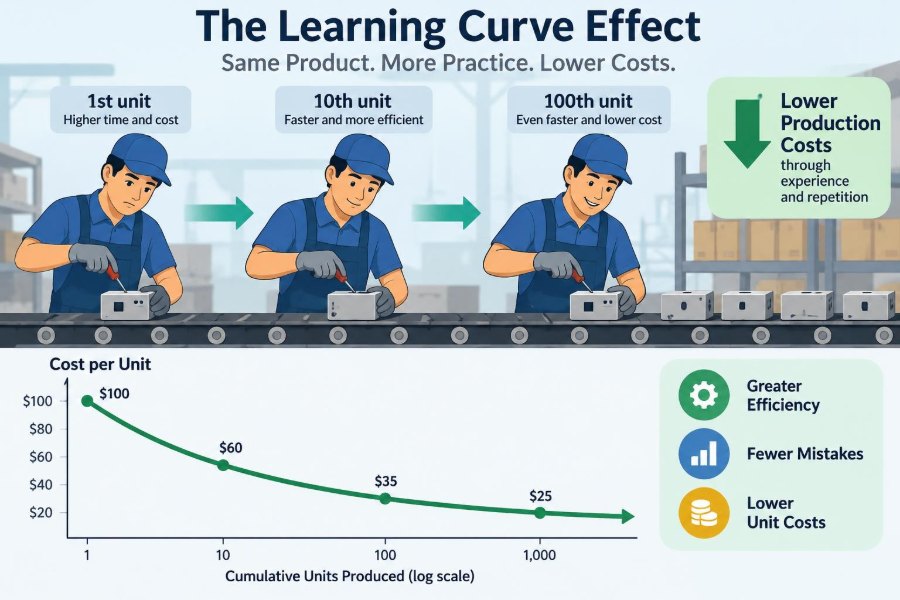

Think about the first time a café adds a new drink to its menu. Staff may need to reread the recipe, search for ingredients, and remake an order when the presentation is wrong. A few weeks later, the same drink can often be prepared quickly, consistently, and with less waste.
The equipment has not necessarily changed. The product may be exactly the same. What changed is the knowledge built through repetition: people learned the sequence, noticed common errors, refined handoffs, and found better ways to use time and materials.
Businesses experience this pattern in factories, service teams, software operations, hospitals, warehouses, and project work. It helps explain why an unfamiliar activity can be expensive at first but become cheaper as capable teams repeat it.
This pattern is known as the learning curve effect. Understanding it helps managers set realistic budgets, plan production, price new offerings, and avoid assuming that early costs will remain permanent.
📈 What the Learning Curve Effect Means
The learning curve effect describes the tendency for the cost, time, or labour required per unit to decline as an organization gains cumulative experience producing that unit. Put simply, repeated work creates opportunities to perform the work better.
“Unit” can mean a manufactured item, a customer case resolved, a construction task completed, or a transaction processed. The key is not merely that time passes; it is that comparable work is repeated and lessons can be applied.
🧩 Learning Is Different From Simple Repetition
Repetition alone does not guarantee improvement. A team can repeat an inefficient process indefinitely if nobody observes results, identifies problems, or changes the method.
A true learning curve emerges when experience produces useful knowledge. Employees may memorize a sequence, engineers may alter a fixture, or managers may remove an approval step that adds delay without protecting quality.
🏭 Where the Idea Comes From
The idea is closely associated with production planning. Early analyses of aircraft manufacturing observed that direct labour hours often declined as more similar aircraft were built. The insight later became useful far beyond factories.
Modern businesses apply learning-curve thinking to onboarding, claims handling, food preparation, call-centre work, logistics, and other repeatable activities. The underlying question remains the same: what will experience change about the resources needed for the next unit?
🔁 Cumulative Output Is the Key Measure
Learning curves normally focus on cumulative output, meaning the total number of units produced over time. A team that makes its hundredth unit has a different level of experience from a team making its tenth, even if both are currently producing at the same weekly rate.
This distinction matters because a busy month does not automatically create learning if the work is highly varied. Experience transfers most reliably when tasks, tools, and conditions have meaningful similarities.
⏱️ Why Early Units Often Cost More
Early production includes discovery work. Employees consult instructions, supervisors answer questions, tools may need adjustment, and defects reveal assumptions that were wrong. These activities consume labour and sometimes materials.
Initial units can also carry one-time setup costs, such as writing procedures or creating templates. Managers should separate these costs from recurring unit costs; otherwise, they may overstate the expense of mature operations.
🧠 Individual Skill Builds Through Practice
At the individual level, people learn by recognizing patterns and reducing hesitation. An experienced technician knows which measurements matter, while a new technician may check every detail with equal intensity.
This does not mean experienced workers should skip controls. Rather, skill helps them direct attention toward likely risks, complete routine actions efficiently, and recognize when a case is unusual enough to require extra care.
🤝 Teams Learn Through Better Coordination
Many cost reductions come from collective learning rather than one person working faster. Teams clarify responsibilities, improve shift handovers, and anticipate what another function needs before being asked.
For example, a warehouse picker and packer may agree on a bin-labeling convention that prevents repeated questions. Neither worker is simply “trying harder”; the work system has become easier to coordinate.
⚙️ Process Improvements Remove Friction
Repeated production exposes friction: unnecessary movement, unclear instructions, duplicated data entry, awkward layouts, and frequent waits for decisions. Small changes to these obstacles can reduce time per unit without lowering standards.
This is why managers should treat frontline observations as operational data. The people doing the work often see failure points before performance reports reveal their full cost.
🛠️ Tools and Fixtures Support Learning
As knowledge grows, organizations often develop better tools, checklists, templates, jigs, or automated checks. These improvements make correct performance easier and reduce dependence on memory alone.
Some cost reduction therefore comes from learning about the process, not just learning within it. A redesigned workstation can preserve the gains of experienced employees and help new employees reach competence sooner.
📉 How Learning Curves Are Expressed
A learning curve is often expressed as a relationship between cumulative volume and average labour time or cost. The exact mathematical model varies, but the broad pattern is a downward-sloping curve that usually becomes flatter over time.
In planning discussions, a stated learning rate commonly describes how average performance is expected to change when cumulative output doubles. It is a forecasting assumption, not a universal law or a promise of a particular saving.
🔢 A Simple Hypothetical Example
Imagine a small manufacturer assembling a new device. Its first batch takes substantial labour because workers are learning the assembly order and engineers are correcting instructions. After several batches, average assembly time per device falls.
The decline may continue as the team improves material placement and testing steps. Eventually, the easy improvements are exhausted, and the curve flattens. This example is hypothetical, but it shows why early unit costs should not automatically be used as long-term cost estimates.
🧮 Average Cost and Marginal Cost Are Not the Same
Average cost is total cost divided by total units. Marginal cost is the additional cost of producing one more unit. A learning curve may lower both, but they answer different managerial questions.
Averages are useful for long-range estimates and pricing reviews. Marginal cost is more useful when deciding whether an additional order can be accepted using available capacity. Mixing the two can lead to poor decisions.
🏷️ Learning Curves and Economies of Scale
Learning curves are often confused with economies of scale. Both can reduce unit cost as output rises, but their mechanisms differ.
| Concept | Main source of lower unit cost | Typical example |
|---|---|---|
| Learning curve | Experience, improved methods, fewer mistakes | Staff complete a familiar task faster |
| Economies of scale | Fixed costs spread across more units or bulk purchasing | One machine supports more production |
They can occur together. A growing business may spread overhead over more units while its people also become more efficient, making it important to identify the real drivers of change.
🏢 Fixed Costs Need Separate Treatment
Rent, salaried management, software subscriptions, and major equipment may not fall because workers learn. These are often fixed or step-fixed costs: they remain stable within a capacity range, then rise when the business needs another facility, supervisor, or machine.
Learning-curve analysis is strongest when applied to the variable elements affected by repetition, such as labour time, rework, consumables, and handling effort.
🧪 Quality Can Improve Alongside Speed
A well-managed learning curve is not a race to work faster. Repeated production can reduce defects because teams recognize recurring problems, standardize effective practices, and improve inspection points.
However, speed that is achieved by skipping tests, documentation, or safety checks is not productive learning. It simply shifts cost into returns, rework, incidents, or damaged trust. Quality measures must sit beside time and cost measures.
🧯 Rework Is a Hidden Learning-Curve Signal
Rework is work performed again because the first attempt did not meet requirements. High rework often signals unclear specifications, weak training, unsuitable equipment, or a poor process design.
Tracking why work is redone can reveal where learning is needed. If the same error repeatedly occurs, management should improve the system rather than merely urging employees to be more careful.
💼 Service Businesses Have Learning Curves Too
Learning curves are not limited to physical goods. A payroll team may process a new type of employee change slowly at first, then create a checklist that shortens later cases. A consulting team may develop reusable research structures and quality-review routines.
Services are often less standardized than factory products, so comparison requires care. The goal is to compare similar cases rather than pretending every customer request is identical.
💻 Digital Work Creates Its Own Form of Experience
In digital operations, learning may appear as better troubleshooting, clearer support articles, improved monitoring, or less manual data correction. A software team can also learn through repeated release cycles, although changing requirements may interrupt comparability.
Automation can amplify learning when it captures a stable, proven task. Automating a poorly understood process too early may simply make errors happen faster and at greater scale.
📦 Product Design Influences the Curve
Design choices affect how easily people can learn production. Fewer unnecessary parts, consistent fasteners, accessible test points, and clear assembly sequences can reduce opportunities for confusion and mistakes.
This is why operations staff should contribute early in product development. A design that performs well in theory but is difficult to assemble, inspect, repair, or package can create avoidable long-term costs.
🗺️ Standard Work Makes Gains Repeatable
Standard work is a documented best-known method for completing a task safely and reliably. It may include a sequence of steps, expected materials, quality checks, and escalation rules.
Standardization does not prohibit improvement. It provides a stable baseline so that a proposed change can be tested against the current method. Without that baseline, useful lessons may remain trapped in individual habits.
🎓 Training Changes the Shape of the Curve
Training can reduce the costly trial-and-error phase. Demonstrations, supervised practice, simulations, and concise job aids help employees begin with proven methods rather than rediscovering them from scratch.
Yet training has a cost and should fit the risk of the work. A brief visual guide may suit a simple task, while regulated, safety-critical, or technically complex work may require formal competence assessment.
📊 Measuring Progress Without Misleading Yourself
Useful measures may include labour hours per comparable unit, first-pass quality, rework hours, material scrap, cycle time, and on-time completion. No single metric tells the whole story.
Managers should define the unit clearly, use consistent time recording, and note major changes in product design, workforce, tools, or demand. Otherwise, a chart may appear to show learning when it is really reflecting a changed mix of work.
🧾 Using Learning Curves for Cost Estimates
When estimating a new project, planners can use experience from similar work to create a range of likely labour needs. Early estimates should state their assumptions, especially the expected level of repetition, staffing stability, and product maturity.
It is safer to update estimates as real production data arrives than to defend an early forecast after conditions change. A learning curve is a decision aid, not a substitute for monitoring.
💰 Pricing Requires Caution
A company may choose to price an early contract knowing that its internal cost should decline as it gains experience. That strategy can be reasonable, but it creates risk if expected volume does not arrive or if the product remains unstable.
Pricing should also cover more than direct production labour. Warranty exposure, support, capacity constraints, overhead, cash flow, and the customer value of the offer all matter. Lower future cost does not automatically justify a low current price.
📅 Production Scheduling Can Capture Learning
Keeping similar work together can help teams retain knowledge, reduce changeovers, and solve recurring problems before they are forgotten. For this reason, a schedule that groups related tasks may sometimes outperform one that constantly switches between unrelated jobs.
There is a trade-off. Large batches can increase inventory and delay feedback. The practical aim is not maximum batching; it is enough continuity to learn while preserving responsiveness and quality.
🚧 When the Curve Can Flatten or Reverse
Improvement is not endless. Mature processes reach a point where remaining gains require expensive redesign, new technology, or a different operating model. The curve then flattens.
Performance can also worsen. Staff turnover, long pauses between production runs, rushed hiring, supplier changes, product complexity, and weak documentation can cause organizations to lose hard-won knowledge. This is sometimes described as organizational forgetting.
🧑🤝🧑 Staff Turnover Creates Knowledge Risk
If critical know-how lives only in experienced employees’ memories, departures can sharply raise costs and defects. This risk is especially high in specialized roles where work is infrequent or difficult to observe.
Cross-training, clear procedures, mentoring, and structured handovers preserve capability. These practices may take time now, but they protect the business from repeatedly paying the cost of relearning later.
⚠️ Common Misuses of Learning-Curve Assumptions
Managers can misuse the concept by treating every cost decline as learning or by demanding improvement targets with no evidence that the work is repeatable. They may also assume past learning will continue despite major redesigns or staffing changes.
- Applying one curve to products with substantially different complexity.
- Ignoring quality, safety, and customer experience while chasing faster output.
- Using early improvements to justify unrealistic future budgets.
- Failing to distinguish learning from scale, supplier discounts, or accounting changes.
- Keeping useful lessons informal instead of documenting them.
🔍 A Practical Improvement Cycle
Businesses can deliberately support learning instead of waiting for it to happen. Begin by observing the work where it occurs, collecting a small set of reliable measures, and asking employees where time, effort, and errors are concentrated.
- Define a comparable unit of work and the required quality level.
- Record baseline time, defects, delays, and rework.
- Identify one likely cause of friction and test a controlled change.
- Check whether quality and safety were maintained or improved.
- Standardize the successful method, train the team, and continue monitoring.
Small, disciplined cycles create evidence. They are more useful than broad claims that people simply need to become more efficient.
🧭 Questions Managers Should Ask
Before building plans around expected learning, managers should ask: Is the task genuinely repeatable? What will employees learn, and how will that knowledge be captured? Which costs should decline, and which will not?
They should also ask what could interrupt the curve. A realistic answer includes product changes, capacity limits, turnover, customer variability, and the possibility that quality requirements will become more demanding.
🌱 The Core Takeaway: Experience Must Become Capability
The learning curve effect explains why repeated production can gradually reduce cost: people gain skill, teams coordinate better, processes lose friction, and successful methods become embedded in tools and standards.
Its value lies in disciplined use. Measure comparable work, separate learning from scale effects, protect quality, and treat forecasts as assumptions to test. The most durable cost reduction comes when individual experience becomes organizational capability.
Repeated production becomes less costly not because repetition is magical, but because a business converts each cycle of work into better knowledge and a better system. 📊⚙️🌱