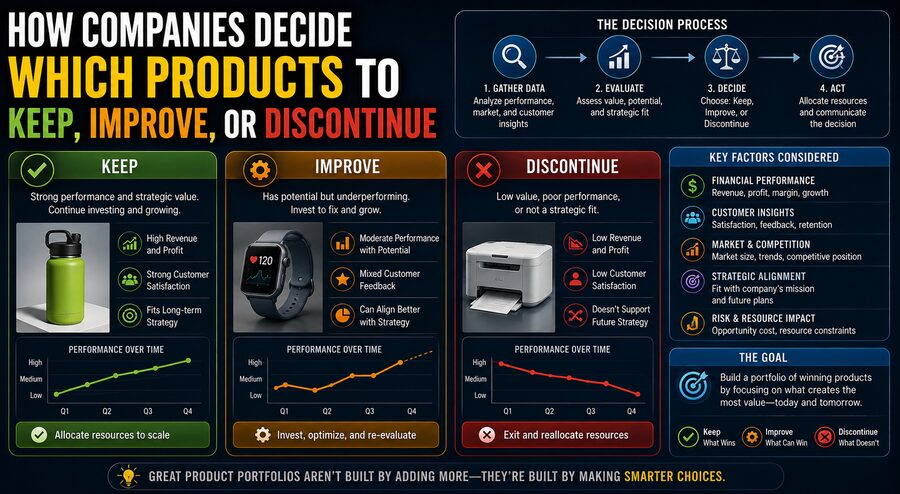

Companies rarely keep every product forever. Some products become bestsellers and receive continued investment. Others sell reasonably well but need new features, better pricing, improved packaging, or a clearer market position. Some gradually lose customers, become too expensive to support, or no longer fit the company’s strategy and are eventually discontinued. 📉📈
Behind these decisions is a process often known as product portfolio management.
A product portfolio is the collection of products or services that a company offers. Managing that portfolio means deciding how much money, staff, marketing, manufacturing capacity, and management attention each product deserves.
The basic question is simple:
Should we keep this product, improve it, reposition it, or discontinue it?
The answer is rarely based on sales alone.
Companies usually examine a combination of factors, including:
- Revenue
- Profit margins
- Growth rate
- Customer demand
- Strategic importance
- Competitive position
- Cost of support
- Future market potential
- Product lifecycle stage
- Opportunity cost
A product can generate high revenue and still be a poor business. Another product may currently be small but deserve heavy investment because its market is growing rapidly.
Understanding these trade-offs is essential for managing a healthy product portfolio. 🧠💼
📊 Revenue Is the Starting Point, Not the Final Answer
One of the first metrics companies examine is revenue.
If Product A produces $50 million per year while Product B produces $2 million, Product A initially appears much more valuable.
But revenue alone can be misleading.
Suppose:
Product A revenue: $50 million
Product A costs: $48 million
while:
Product B revenue: $20 million
Product B costs: $8 million
Product B may actually contribute much more profit despite generating less revenue.
Companies therefore look beyond top-line sales and examine how much economic value each product creates.
💰 Profitability Matters More Than Sales Volume
A common metric is gross margin.
Gross margin measures how much money remains after subtracting the direct cost of producing a product.
For example:
Selling price: $100
Direct production cost: $60
Gross profit: $40
The gross margin is:
$40 ÷ $100 = 40%
Higher-margin products give companies more room to pay for marketing, research, administration, distribution, and profit.
A product with weak margins may still be kept if it serves a strategic purpose, but persistent low profitability can make discontinuation more likely.
Companies may also calculate contribution margin, which estimates how much each sale contributes toward fixed costs and profit after variable expenses.
📈 Growth Rate Reveals Future Potential
A product’s direction can matter as much as its current size.
Consider two products:
Product X: $100 million in annual sales, declining 15% per year.
Product Y: $20 million in annual sales, growing 60% per year.
Product X currently generates much more revenue, but Product Y may have greater long-term potential.
Management therefore asks:
Is the product growing, stable, or shrinking?
A rapidly growing product may receive:
🚀 More engineering resources
📣 More marketing
🏭 More production capacity
🌍 Expansion into new markets
A declining product may instead enter maintenance mode or become a candidate for restructuring.
🧭 Where Is the Product in Its Lifecycle?
Many products move through a product lifecycle.
A simplified lifecycle includes:
Introduction ➡️ Growth ➡️ Maturity ➡️ Decline
🌱 Introduction
The product has recently launched.
Sales may be low because the market is still learning about it.
The company may tolerate losses while trying to establish product-market fit.
🚀 Growth
Demand increases rapidly.
The company invests to expand distribution, production, marketing, and features.
🏆 Maturity
Growth slows, but the product may generate strong and predictable profits.
Management often focuses on efficiency and differentiation.
📉 Decline
Demand begins falling.
New technologies, changing consumer behavior, or stronger competitors may reduce sales.
The company must decide whether to refresh, reposition, harvest, or discontinue the product.
Lifecycle stage helps explain why management may treat two equally profitable products very differently.
🎯 Strategic Fit Can Keep a Product Alive
Some products are important even if they do not generate large profits directly.
Imagine a software company offering a free mobile application.
The app itself may produce little revenue, but it could bring millions of users into the company’s ecosystem.
Those users may later purchase:
- Cloud storage
- Premium subscriptions
- Hardware
- Advertising services
- Enterprise products
The free product therefore serves a strategic role.
Similarly, a manufacturer may keep a low-volume product because it helps win major corporate contracts.
Companies ask:
Does this product support our broader strategy?
If the answer is yes, modest financial performance may be acceptable.
🧲 Some Products Drive Sales of Other Products
Products are often connected economically.
A printer may be less profitable than the ink cartridges used with it.
A game console may help generate revenue from games and subscriptions.
A coffee machine may create ongoing demand for capsules.
A cloud platform may attract customers who later purchase additional services.
This is sometimes referred to as a razor-and-blades model, where one product creates demand for another.
Management therefore evaluates the total customer relationship, not just the isolated profitability of each item.
Discontinuing a seemingly weak product could accidentally damage sales elsewhere.
👥 Customer Importance Can Change the Decision
Companies often segment customers by value.
Suppose only 5% of customers buy a particular industrial component.
At first, discontinuing the component might seem reasonable.
But what if those customers are among the company’s largest and most profitable accounts?
Removing the product could put entire customer relationships at risk.
Companies therefore examine questions such as:
- Who buys this product?
- How valuable are those customers?
- What else do they purchase?
- Would they leave if this product disappeared?
- Is the product essential to a complete solution?
This prevents management from making decisions based only on product-level averages.
🏁 Competitive Position Matters
Companies also evaluate how strongly each product competes in its market.
Important questions include:
Is the product a market leader?
Is it losing market share?
Does it have a strong brand?
Can competitors easily copy it?
Does the company have a cost advantage?
Does the product offer unique features?
A product operating in an attractive market may still deserve discontinuation if the company has no realistic way to compete effectively.
Conversely, a company may keep investing in a difficult market if it has a distinctive advantage.
🧩 The BCG Growth-Share Matrix
One classic portfolio-management framework is the BCG Growth-Share Matrix, developed by the Boston Consulting Group.
It divides products into four broad categories based on market growth and relative market share.
⭐ Stars
High market share in a high-growth market.
Stars often receive significant investment because they may become major future profit generators.
🐄 Cash Cows
High market share in a mature or slow-growing market.
Cash cows often generate strong cash flow without requiring huge investment.
❓ Question Marks
Low market share in a high-growth market.
These products may become stars—or fail.
Management must decide whether to invest heavily or exit.
🐕 Dogs
Low market share in a low-growth market.
These products are often candidates for restructuring, harvesting, or discontinuation.
The framework is simple and imperfect, but it encourages companies to think about products as a portfolio rather than in isolation.
🔧 When Companies Choose to Improve a Product
A weak product is not automatically discontinued.
Sometimes the problem can be fixed.
Management may choose to improve a product when:
- Customers still want the core solution
- The market remains attractive
- Competitors reveal clear improvement opportunities
- Profitability can be increased
- Technology allows meaningful upgrades
Product improvement can involve:
🎨 Better design
⚙️ New functionality
📦 Improved packaging
💵 Revised pricing
🔋 Longer battery life
🚚 Better distribution
📱 Easier user experience
🛡️ Higher reliability
The key question is whether the improvement is likely to generate enough additional value to justify the investment.
💬 Customer Feedback Helps Identify What to Fix
Companies gather customer feedback through:
- Surveys
- Reviews
- Support tickets
- Interviews
- Sales conversations
- Usage analytics
- Product returns
- Social media
Suppose a product has strong sales but unusually high return rates.
That could indicate:
Demand exists, but quality is poor.
In that case, improving reliability may be better than discontinuing the product.
Similarly, software users may adopt a platform but rarely use one feature.
Management may simplify or remove that feature while continuing to invest in the broader product.
📊 Usage Data Is Especially Important for Digital Products
Software companies can measure exactly how customers use different parts of a product.
They may examine:
- Daily active users
- Monthly active users
- Feature adoption
- Retention
- Churn
- Time spent
- Conversion rates
- Subscription upgrades
Suppose a company maintains 100 features but discovers that 90% of users rely on only 20 of them.
The rarely used features may consume engineering resources without creating much customer value.
Removing or consolidating them can reduce complexity.
This process is sometimes called product rationalization.
🧮 Cost-to-Serve Can Reveal Hidden Problems
Some products are expensive to maintain after the sale.
For example, a business software product might generate $5 million in annual revenue but require:
- A dedicated support team
- Frequent security patches
- Expensive servers
- Specialized engineers
- Custom integrations
If those costs are unusually high, the product may be less attractive than it appears.
Companies therefore measure cost-to-serve.
For physical products, this may include:
- Warehousing
- Shipping
- Returns
- Repairs
- Spare parts
- Retail support
For software, it can include infrastructure, support, engineering maintenance, and compliance.
🏭 Manufacturing Complexity Can Influence Portfolio Decisions
Physical-product companies face another issue: every additional product can complicate manufacturing.
A factory producing 200 variations of a product may need:
- More inventory
- More tooling
- More supplier relationships
- More changeovers
- More quality-control procedures
- More warehouse space
Some low-volume products may therefore create disproportionately high operational complexity.
A company might discontinue several weak variations even while keeping the main product.
For example:
Keep: top-selling sizes and colors
Discontinue: rarely purchased configurations
This allows the company to reduce complexity without abandoning the market entirely.
⏳ Opportunity Cost Is Crucial
Resources are limited.
Every engineer assigned to an old product cannot simultaneously build a new one.
Every dollar spent advertising a declining product cannot be spent launching a promising one.
This is known as opportunity cost.
Management asks:
What else could we do with these resources?
A product may still be profitable but deserve discontinuation if the same resources could create much more value elsewhere.
This is one of the hardest ideas in portfolio management.
The decision is not simply:
“Is Product A profitable?”
It is:
“Is Product A the best use of our limited resources?” 🧠
🧹 What Does It Mean to “Harvest” a Product?
Sometimes companies do not improve or immediately discontinue a declining product.
Instead, they harvest it.
Harvesting means reducing investment while continuing to sell the product as long as it generates acceptable cash flow.
The company might:
- Reduce advertising
- Stop major feature development
- Limit new markets
- Simplify the product line
- Maintain only essential support
The product continues producing revenue without receiving significant new investment.
This strategy is common with mature products approaching the end of their lifecycle.
🛑 Why Companies Discontinue Products
Companies may discontinue products for many reasons.
Common causes include:
📉 Declining demand
💸 Persistent losses
⚙️ High maintenance costs
🏭 Manufacturing inefficiency
📦 Supply-chain problems
🧱 Obsolete technology
🏁 Stronger competitors
🧭 Poor strategic fit
⚖️ Regulatory changes
🔒 Security or compliance concerns
🚀 Better replacement products
Sometimes the product itself is not terrible.
It simply no longer fits the company’s future.
😟 Discontinuation Can Anger Loyal Customers
Even low-volume products may have passionate users.
A company that suddenly discontinues a product can damage customer trust.
For this reason, responsible product retirement often involves planning.
Companies may:
- Announce the change in advance
- Offer replacement products
- Provide migration tools
- Continue warranty support
- Maintain spare parts
- Honor existing contracts
- Offer discounts for upgrades
For software products, companies may define an end-of-life date and an end-of-support date.
Giving customers time to adapt can preserve long-term relationships.
🔄 Cannibalization Can Be Healthy
Companies sometimes launch a new product that reduces sales of an older one.
This is called cannibalization.
At first, cannibalizing your own product may seem undesirable.
But if customers are moving toward a superior technology anyway, it may be better for the company to replace its own product before a competitor does.
For example:
Old product: $500 revenue per customer
New product: $400 revenue per customer
The new product may generate less revenue initially, but if the old product is becoming obsolete, migration may protect the customer relationship.
Strategic self-cannibalization can therefore be a sign of innovation rather than failure.
🧪 Companies Often Test Before Making a Major Decision
Portfolio decisions do not always happen instantly.
Companies may run experiments first.
For example, they might:
- Increase the price
- Reduce the product range
- Change marketing
- Introduce a new version
- Test a different sales channel
- Bundle the product with another offering
If performance improves, the product may deserve continued investment.
If not, discontinuation becomes easier to justify.
This helps management avoid abandoning a potentially valuable product because of a problem that could have been fixed.
📝 A Simple Product Portfolio Scorecard
Companies can create a scorecard for each product.
For example:
Financial performance: 8/10
Market growth: 6/10
Customer importance: 9/10
Strategic fit: 8/10
Competitive position: 7/10
Cost-to-serve: 4/10
Future potential: 8/10
Management can then compare products using a more balanced framework.
However, numerical scoring should support judgment rather than replace it.
A single strategic fact can sometimes matter more than a calculated average.
🧭 A Practical Keep, Improve, or Discontinue Framework
Companies can simplify the decision into three broad paths.
✅ Keep
A product is likely to be kept when it:
- Generates healthy profits
- Has stable or growing demand
- Fits company strategy
- Retains loyal customers
- Requires reasonable support costs
🔧 Improve
A product is likely to be improved when:
- Demand exists
- Customers identify fixable problems
- The market remains attractive
- Better features or pricing could improve economics
🛑 Discontinue
A product becomes a stronger discontinuation candidate when:
- Demand is consistently declining
- Margins are poor
- Support costs are excessive
- Technology is obsolete
- Strategic fit is weak
- Resources have better alternative uses
These decisions are strongest when based on multiple forms of evidence rather than one metric.
🏁 Conclusion
Deciding which products to keep, improve, or discontinue is one of the most important responsibilities in business management. 📦📊
Companies cannot invest equally in everything.
Some products deserve more resources because they are growing rapidly.
Others should be maintained because they generate reliable cash flow.
Some need improvement because customers want them but the current version is underperforming.
And some should be retired because they consume more resources than the value they create.
The decision usually combines:
Revenue + profitability + growth + customer value + strategic fit + competitive position + future potential + opportunity cost
A product with declining sales may still be strategically important.
A popular product may still be unprofitable.
A small product may become the company’s next major growth engine.
And a profitable mature product may still be discontinued if its resources are better invested elsewhere.
Strong companies therefore manage products as a portfolio, continuously shifting attention and capital toward the opportunities with the greatest long-term value. 🧠💼
The core question is not simply:
“Is this product selling?”
It is:
“Does this product deserve more of our limited resources than the alternatives?”
Answering that question well helps companies simplify their operations, invest in stronger opportunities, protect profitable products, and avoid spending years supporting offerings that no longer make strategic sense. 🚀📈