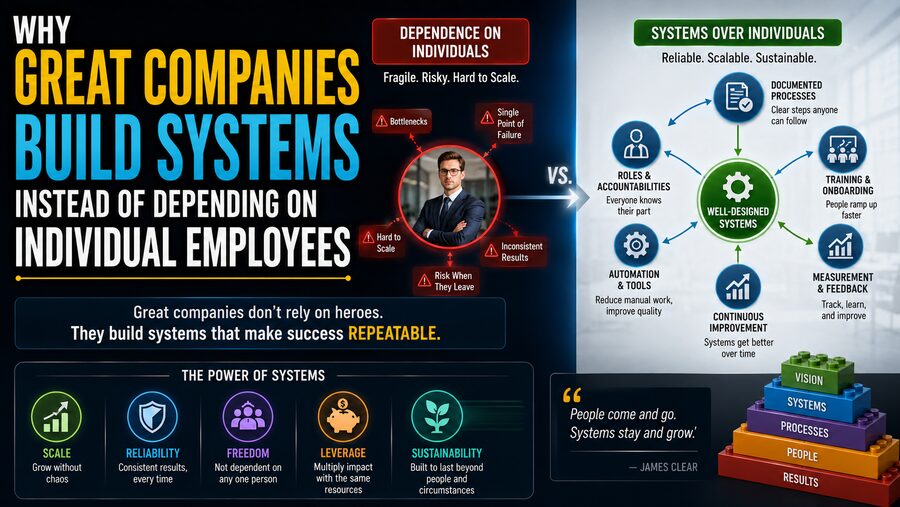

Every successful company depends on talented people. Employees solve problems, serve customers, develop products, make decisions, and create the knowledge that allows an organization to grow. 👩💼👨💻
But there is an important difference between valuing great employees and building a company that can function only because certain individuals hold everything together.
Strong organizations try to avoid becoming dangerously dependent on one person.
Instead, they build systems.
A business system is a repeatable way of getting important work done. It may include documented processes, software, training, checklists, decision rules, quality controls, communication routines, performance metrics, and clearly defined responsibilities.
When these systems are designed well, talented employees become even more effective because they do not need to reinvent routine work every day.
The goal is not to make people unimportant.
It is to make organizational knowledge shared, repeatable, measurable, and resilient. ⚙️📈
👤 The Problem With the “Indispensable Employee”
Imagine a company where only one employee knows how to prepare a critical monthly report.
Another employee is the only person who understands a major customer account.
A third employee is the only one who knows how to repair an important production machine.
Everything may appear fine while those people are available.
But what happens if someone:
- Goes on vacation
- Becomes sick
- Changes jobs
- Gets promoted
- Retires
- Is suddenly unavailable
The company may discover that essential knowledge existed only inside one person’s head.
This situation is known as key-person dependency.
The problem is not that the employee was too skilled. The problem is that the organization failed to convert that skill into a capability that other people could understand and use.
🧠 Companies Need Organizational Memory
Employees accumulate enormous amounts of knowledge.
They learn:
- Which customers require special handling
- Which suppliers are reliable
- Which problems occur repeatedly
- Which software settings matter
- Which shortcuts are dangerous
- Which approval steps are necessary
- Which mistakes were made in the past
If none of this knowledge is documented or transferred, it can disappear when employees leave.
Great companies therefore create organizational memory.
This may exist in:
- Standard operating procedures
- Internal knowledge bases
- Training materials
- Project documentation
- Customer relationship systems
- Maintenance records
- Decision logs
Instead of remembering only who knows the answer, the company begins remembering the answer itself. 🧠📚
⚙️ What Does It Mean to Build a System?
A system does not need to be complicated.
Suppose a company receives customer complaints.
Without a system, each employee might handle complaints differently.
One person responds immediately.
Another waits three days.
Someone offers a refund.
Another sends the issue to a manager.
A basic customer-service system could define:
Complaint received → Categorize issue → Assign owner → Respond within target time → Resolve → Record outcome → Review recurring problems
The company has now created a repeatable workflow.
Employees still use judgment, empathy, and expertise, but the surrounding structure improves consistency.
📋 Standard Operating Procedures Make Work Repeatable
One common business system is the Standard Operating Procedure, or SOP.
An SOP explains how a recurring activity should normally be performed.
Examples include:
- Opening a retail location
- Processing a customer refund
- Inspecting a manufactured product
- Onboarding a new employee
- Approving an invoice
- Responding to a cybersecurity alert
Good SOPs reduce ambiguity.
They help employees understand:
What needs to happen, who is responsible, what standards apply, and what to do when something goes wrong.
This becomes particularly valuable as organizations grow.
🚀 Systems Make Scaling Possible
A founder can personally supervise ten employees.
Supervising 1,000 people the same way is impossible.
Growing companies therefore need processes that allow work to expand without requiring the founder or senior managers to personally approve every action.
Imagine a restaurant with one location.
The owner personally teaches each cook how to prepare every dish.
That might work initially.
Now imagine opening 100 locations.
The company needs:
- Standardized recipes
- Supplier specifications
- Kitchen procedures
- Training programs
- Food-safety controls
- Inventory systems
- Quality inspections
Without these systems, each location would effectively become a different business.
Systems allow the organization to reproduce successful operations at much greater scale. 📈
🎯 Consistency Creates Customer Trust
Customers generally expect a company to deliver a predictable experience.
If a bank processes the same transaction differently depending on which employee is working, customers lose confidence.
If a manufacturer produces excellent products on Monday and defective ones on Friday, the business has a quality problem.
Systems help create consistency.
They can define:
- Product specifications
- Service standards
- Response times
- Quality checks
- Approval requirements
The objective is not absolute uniformity in every situation.
It is to ensure that critical standards do not depend purely on individual memory or mood.
✅ Checklists Protect Against Human Error
Even highly skilled professionals can forget things.
Pilots, surgeons, engineers, technicians, and operators often use checklists precisely because expertise does not eliminate human fallibility.
A checklist externalizes memory.
Instead of relying on:
“I think I remembered everything.”
the process becomes:
“Every critical step has been verified.”
Businesses can use checklists for:
- Closing accounts
- Shipping products
- Equipment maintenance
- Hiring
- Security reviews
- Regulatory compliance
The best systems support human expertise rather than trying to replace it.
🤝 Systems Improve Employee Onboarding
A company without documented processes often trains new employees through informal explanations.
A new hire may hear:
“Ask Sarah about that.”
Then:
“Only David knows how this works.”
Then:
“You’ll learn it eventually.”
This creates slow and inconsistent onboarding.
A systematized company can provide:
Role expectations → Training modules → Process documentation → Practice tasks → Feedback → Certification or review
New employees become productive faster because they do not need to reconstruct the job from scattered conversations.
🔄 Good Systems Make Employee Turnover Less Disruptive
Some employee turnover is inevitable.
People move cities, change careers, retire, or pursue new opportunities.
A company with strong systems can transfer responsibilities with less disruption.
Suppose a salesperson leaves.
If all customer details are stored only in personal notes, the company may lose important information.
If the organization uses a CRM containing:
- Customer history
- Previous conversations
- Pricing
- Contract details
- Upcoming tasks
another employee can continue the relationship much more effectively.
Systems therefore create business continuity. 🔄
📊 Measurement Turns Work Into a Manageable Process
Strong systems usually include measurement.
Consider a delivery operation.
Managers might track:
- On-time delivery rate
- Average delivery time
- Failed deliveries
- Cost per delivery
- Customer complaints
Without measurement, managers may rely on impressions.
With measurement, they can identify patterns.
For example:
Delivery delays increase → Analyze route data → Find warehouse bottleneck → Change process → Measure improvement
This creates a feedback loop.
Systems do not simply standardize work; they can help organizations continuously improve it.
🔍 Systems Make Problems Easier to Diagnose
When every employee performs a task differently, identifying the cause of failure becomes difficult.
Was the problem caused by:
- The employee?
- The training?
- The supplier?
- The software?
- The procedure?
- The equipment?
Standardized processes create a baseline.
If a consistent process still produces poor results, managers can investigate the system itself.
This encourages an important management shift:
Instead of always asking,
“Who made the mistake?”
leaders can also ask,
“What allowed this mistake to happen?”
That question often leads to better long-term improvements.
🛡️ Systems Help Manage Risk
Businesses face many forms of risk:
- Financial risk
- Cybersecurity risk
- Quality failures
- Safety incidents
- Fraud
- Legal problems
- Regulatory violations
Depending only on individual judgment for every critical control can be dangerous.
Companies therefore build systems such as:
Approval limits → Audit trails → Access controls → Reconciliation → Automated alerts → Independent review
For example, a company might require two approvals before transferring a large amount of money.
That is a system designed to reduce the consequences of error or fraud.
🔐 Systems Reduce Dangerous Concentrations of Authority
Key-person dependency can involve authority as well as knowledge.
Suppose one employee can:
- Create a supplier.
- Approve an invoice.
- Send payment.
That creates unnecessary risk.
Strong organizations separate sensitive duties.
One employee might create the supplier.
Another approves the transaction.
A separate payment system processes the money.
This principle is known as segregation of duties.
The organization becomes safer because no single person controls the entire process.
🤖 Automation Can Turn Processes Into Systems
Software can automate repetitive parts of business operations.
Imagine employees manually copying order details between three applications every day.
A software integration might move that information automatically.
Automation can help with:
- Invoice processing
- Scheduling
- Reporting
- Notifications
- Data synchronization
- Customer onboarding
- Inventory updates
However, automating a bad process simply makes the bad process run faster.
Companies should first understand the workflow, simplify it, and then decide which parts deserve automation. 🤖⚙️
🧑💼 Systems Free Talented People for Higher-Value Work
Some people assume systems create bureaucracy.
Poorly designed systems certainly can.
But good systems accomplish the opposite.
They remove unnecessary decision-making from routine work.
If a highly skilled engineer must spend two hours every week manually formatting the same report, that is not a productive use of expertise.
If a system generates the report automatically, the engineer can spend those hours solving difficult engineering problems.
Systems allow people to focus on work requiring:
- Judgment
- Creativity
- Strategy
- Relationships
- Problem-solving
Automation and standardization should handle predictable repetition whenever practical.
🌟 Great Employees Become More Valuable Inside Good Systems
Systemization does not mean treating employees like interchangeable machines.
The most capable companies combine strong people with strong systems.
A skilled employee working inside a poor system may waste enormous effort fixing preventable problems.
The same employee inside a well-designed system can concentrate on improvement and innovation.
Consider two customer-service agents.
Agent A spends half the day searching through emails for customer histories.
Agent B has a well-organized support platform showing every interaction instantly.
Even if their abilities are identical, Agent B has a much better operating environment.
Good systems amplify talent. 📈
🧑🎨 Creativity Should Not Be Standardized Everywhere
Not every activity should become a rigid procedure.
Creative work often benefits from flexibility.
Examples include:
- Product design
- Research
- Strategy
- Writing
- Negotiation
- Complex problem-solving
The objective is to systematize the repeatable infrastructure around creative work, not necessarily the creative thinking itself.
For example, a design team might standardize:
- How projects are requested
- Where files are stored
- How feedback is collected
- How final versions are approved
But designers still have freedom over the creative solution.
Great systems provide structure without unnecessarily removing autonomy.
🧩 Processes Should Handle the Normal Case—and Exceptions
Rigid systems often fail when reality does not match the procedure.
A well-designed system therefore specifies both:
Normal workflow and exception handling.
For example:
If an invoice is below $5,000, one approval may be enough.
If it is above $5,000, a second approval may be required.
If there is a suspected fraud issue, the process escalates to finance leadership.
Systems should help people recognize when ordinary rules apply and when human judgment is necessary.
📚 Documenting Processes Is Only the Beginning
A company can create hundreds of procedure documents and still have weak systems.
Why?
Because nobody may use them.
A functioning system requires more than documentation.
It may need:
- Clear ownership
- Employee training
- Accessible tools
- Monitoring
- Feedback
- Regular updates
Documentation becomes outdated as software, customers, regulations, and workflows change.
Companies therefore need processes for maintaining the processes themselves. 🔄
👑 Leaders Should Build Institutions, Not Personal Empires
In some companies, managers gain importance by becoming the only people who understand a process.
They may unintentionally become information bottlenecks.
A stronger leadership philosophy is different.
Great managers try to make their teams increasingly capable of operating without constant managerial intervention.
They:
- Delegate decisions
- Develop employees
- Document knowledge
- Clarify responsibilities
- Create feedback mechanisms
A manager who can take a vacation without the department collapsing has usually built a healthier organization than one who must approve everything personally.
🚧 Bottlenecks Often Reveal Missing Systems
Suppose every customer discount requires the CEO’s approval.
When the company is small, this might be manageable.
As sales volume increases, the CEO becomes a bottleneck.
The solution may be a pricing system such as:
Discount under 5% → Sales representative can approve
5–15% → Sales manager approval
Above 15% → Executive approval
The company has converted repeated executive judgment into a scalable decision framework.
The CEO remains involved where the decision is truly important.
🔁 Systems Create Feedback Loops
Great business systems are not static.
They learn.
Consider a manufacturing quality process:
Produce → Inspect → Record defects → Analyze patterns → Improve process → Produce again
The feedback loop turns operational experience into organizational improvement.
Without a system, the same mistakes may repeat because employees solve them individually but the organization never learns.
Companies become stronger when local lessons become shared knowledge.
🧠 The Goal Is to Capture Tacit Knowledge
Some employee knowledge is difficult to document.
This is called tacit knowledge.
For example, an experienced technician may recognize an equipment problem from a subtle sound.
A veteran salesperson may know how to approach a certain type of customer.
Companies cannot always convert tacit knowledge into a simple checklist.
But they can transfer more of it through:
- Mentoring
- Apprenticeship
- Recorded demonstrations
- Case studies
- Shadowing
- Communities of practice
The objective is to reduce the amount of valuable knowledge that exists in only one place.
🌍 Systems Support Geographic Expansion
A company opening offices in new cities or countries needs ways to reproduce its operating model.
Without systems, every new location may develop different procedures.
This creates inconsistent quality and makes management difficult.
Standardized operating systems can define:
- Core processes
- Brand standards
- Financial controls
- Technology
- Training
- Reporting
Local teams can then adapt where necessary.
This balance between global standards and local flexibility is central to scaling many businesses.
🏭 Franchises Demonstrate Extreme Systemization
Franchise businesses offer a clear example of system-driven growth.
A successful franchise does not simply sell a logo.
It provides an operating model.
That may include:
- Store layout
- Supplier relationships
- Recipes or service procedures
- Training
- Marketing
- Technology
- Quality controls
The objective is for customers to receive a reasonably consistent experience regardless of which location they visit.
The underlying asset is not just the product.
It is the system for repeatedly delivering the product.
💻 Technology Companies Build Systems Too
Software businesses also depend heavily on systemization.
Consider how software gets released.
A weak process might depend on one senior engineer remembering dozens of manual deployment steps.
A mature process might use:
Code review → Automated tests → Security checks → Staging environment → Controlled deployment → Monitoring → Rollback capability
The engineer’s expertise remains valuable, but the organization no longer depends entirely on memory.
This reduces errors and allows more people to participate safely.
🏥 High-Reliability Industries Depend on Systems
Industries where mistakes can have serious consequences rely heavily on structured systems.
Examples include:
- Aviation ✈️
- Healthcare 🏥
- Nuclear power
- Banking
- Manufacturing
- Transportation
These organizations often use:
- Checklists
- Multiple verification steps
- Standard procedures
- Incident reporting
- Training simulations
- Audits
They recognize that even excellent professionals work more reliably when critical tasks are supported by robust systems.
📉 Systems Reduce Variability
Suppose five employees perform the same process.
Their success rates are:
Employee A: 99%
Employee B: 91%
Employee C: 95%
Employee D: 88%
Employee E: 97%
A better system might help everyone achieve consistently high performance.
This is one of the biggest benefits of process design.
Instead of depending on heroic individual performance, the company raises the baseline.
Customers experience fewer random differences depending on who happens to handle their request.
💰 Systems Increase the Value of a Business
A company heavily dependent on its founder or a handful of employees is often riskier.
Imagine buying a business where:
- The owner handles every major customer.
- Only one employee understands pricing.
- No procedures are documented.
- Supplier relationships exist only through personal contacts.
If those individuals leave, significant business value may disappear.
A more systematized organization can be easier to:
- Expand
- Manage
- Transfer
- Acquire
- Integrate
Because its capabilities exist in the company itself rather than exclusively in particular individuals.
⚠️ Over-Systemization Can Become Bureaucracy
Systems are not automatically good.
Too many rules can make a company slow.
Warning signs include:
- Endless approvals
- Forms nobody uses
- Meetings without clear purpose
- Rules that solve outdated problems
- Employees unable to make obvious decisions
The purpose of a business system is to reduce friction and risk, not create unnecessary complexity.
Companies should periodically ask:
Does this process still create value?
If the answer is no, it should be simplified or removed.
🎯 Standardize What Should Be Standardized
A useful principle is to separate work into categories.
🔁 Repeatable, Low-Variation Work
Usually a strong candidate for standardization and automation.
Examples:
- Data entry
- Routine approvals
- Invoice processing
🧠 High-Judgment Work
Needs guidelines but more employee discretion.
Examples:
- Complex customer disputes
- Hiring decisions
- Negotiations
🎨 Creative Work
Needs clear objectives and constraints but often substantial autonomy.
Examples:
- Strategy
- Design
- Research
This prevents companies from creating rigid procedures where flexibility is more valuable.
📈 Systems Allow Continuous Improvement
Once a process is visible and measurable, it can be improved systematically.
Consider order fulfillment.
A company may discover:
Average processing time: 48 hours
After analyzing the workflow, it eliminates duplicate approval steps.
Processing falls to:
30 hours
Then automation reduces manual data entry.
Processing falls to:
18 hours
Systems make improvement measurable rather than anecdotal.
This idea is central to operational excellence.
🛠️ How a Small Company Can Start Building Systems
A company does not need a huge operations department to begin.
A practical approach is:
1. Identify recurring critical tasks.
2. Document how the best current employee performs them.
3. Remove unnecessary steps.
4. Define ownership and decision boundaries.
5. Create a checklist, workflow, or software process.
6. Train another employee to perform it.
7. Measure the result.
8. Improve the process based on feedback.
The test is simple:
Can someone else perform this work successfully without constantly asking the original expert what to do?
If yes, organizational capability is beginning to form.
🔍 The “Bus Factor” Reveals Dependency
Software teams sometimes use an informal concept known as the bus factor.
It asks:
How many people could suddenly become unavailable before the project becomes impossible to continue?
Despite the dramatic name, the concept highlights knowledge concentration.
A project with a bus factor of one is highly vulnerable because one person’s absence could stop progress.
Companies can improve resilience through:
- Shared ownership
- Documentation
- Code reviews
- Cross-training
- Pairing
- Rotation of responsibilities
The same principle applies far beyond software.
🤝 Cross-Training Creates Human Redundancy
Not every problem needs a software solution.
Sometimes the best system is simply ensuring that multiple people understand important responsibilities.
Cross-training means teaching employees to perform more than one role or process.
For example:
Primary employee + trained backup
This provides resilience during:
- Vacation
- Illness
- Turnover
- Unexpected workload
Cross-training can also improve collaboration because employees understand how their work affects other departments.
🌟 Systems and Culture Work Together
Companies cannot operate purely through written processes.
Culture influences how people behave when rules do not provide an answer.
A strong organization often combines:
Systems for predictable situations + Values for ambiguous situations
For example, a customer-service procedure might describe refund rules.
But a cultural principle such as:
“Resolve customer problems fairly and quickly”
helps employees make judgment calls when an unusual situation appears.
Systems provide structure.
Culture provides direction when the structure is incomplete.
🚀 From Founder-Dependent to Organization-Driven
Many businesses begin as founder-dependent organizations.
The founder:
- Approves expenses
- Handles customers
- Hires employees
- Solves technical problems
- Sets priorities
That can work at the beginning.
Growth eventually requires the founder to transfer decision-making into the organization.
This may involve:
Founder judgment → Policy
Founder relationships → CRM
Founder knowledge → Documentation
Founder approvals → Delegated authority
Founder monitoring → Dashboards
The company becomes capable of operating as an institution rather than as an extension of one person.
✅ Final Thoughts
Great companies build systems because long-term organizational performance cannot safely depend on a handful of individuals remembering everything, approving everything, and personally solving every recurring problem. 🏢⚙️
Talented employees remain essential.
But strong organizations capture their knowledge, support their decisions, and make successful practices repeatable.
They use processes, documentation, training, technology, checklists, metrics, automation, cross-training, and clear responsibility structures to transform individual expertise into organizational capability.
The difference can be summarized simply:
Person-dependent company:
“Everything works because Maria knows how to do it.”
System-driven company:
“Maria helped us develop an excellent way to do it, and the organization can now perform, measure, teach, and improve that process.”
The second company is more resilient when employees leave, easier to scale when demand increases, and better positioned to maintain consistent quality.
Most importantly, systems should not eliminate human judgment.
The best systems remove unnecessary repetition and confusion so people can spend more time doing the work humans are especially good at: thinking, creating, improving, collaborating, and solving unusual problems. 🧠✨
That is why some of the strongest companies are not built around indispensable employees.
They are built around great people continuously creating better systems—and better systems continuously helping great people perform at their best. 🚀📈