
A great product is important, but it is not always enough to create a successful business.
Customers do not experience a company only through the product they buy. They also experience the website they visit, the sales process, the packaging, the delivery, the support they receive, the way complaints are handled, the ease of making a return, and even the tone of the emails they receive.
Together, all of these interactions form the customer experience, often abbreviated as CX.
Customer experience can sometimes become even more important than the product itself because people do not judge a purchase only by what they receive. They also judge how easy, pleasant, trustworthy, and emotionally satisfying the entire journey feels.
Two companies may sell products of similar quality, yet customers may strongly prefer one because it is easier to buy from, more responsive, more reliable, or more respectful when something goes wrong.
That difference can influence loyalty, word-of-mouth, repeat purchases, and long-term business growth. 📈✨
🧠 What Is Customer Experience?
Customer experience is the overall impression a person forms from every interaction with a company.
It begins long before the purchase.
A customer may first encounter a company through:
- 🔎 A search result
- 📱 A social media post
- 📢 An advertisement
- 🌐 A website
- 🗣️ A recommendation
- 🏪 A physical store
The experience continues through the buying process and often lasts long after payment.
For example, a customer may evaluate:
- How easy the product was to understand
- How quickly they received answers
- Whether checkout was simple
- Whether delivery was on time
- Whether instructions were clear
- Whether customer support was helpful
- Whether returns were easy
- Whether the company kept its promises
All of these moments contribute to the customer’s perception of the brand.
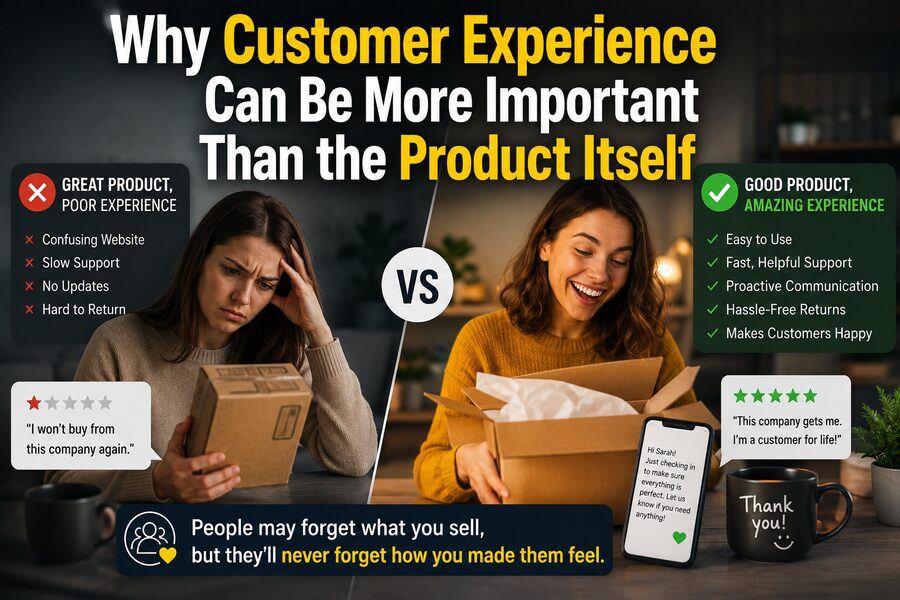
📦 A Good Product Can Still Create a Bad Experience
Imagine buying an excellent laptop.
The hardware is fast, the screen is beautiful, and the battery life is impressive.
But suppose:
- The website was confusing
- Delivery was delayed
- The box arrived damaged
- Setup instructions were unclear
- Customer support took four days to reply
- Returning a defective charger required several forms and phone calls
The product itself may still be excellent.
Yet the overall experience could leave the customer frustrated.
Now imagine a competing laptop with similar specifications but:
- Easy ordering
- Accurate delivery updates
- Simple setup
- Fast support
- Hassle-free replacements
Many customers would prefer the second company even if the products were nearly identical.
That is the power of customer experience. 💻🤝
❤️ Customers Remember How a Company Makes Them Feel
Purchasing decisions are not purely rational.
People also remember emotions.
A customer may forget the exact wording of a support conversation, but they often remember whether they felt:
- Respected
- Ignored
- Reassured
- Frustrated
- Valued
- Confused
This emotional memory can shape future buying behavior.
A customer who feels appreciated may return even if a small problem occurred.
A customer who feels dismissed may leave even if the product itself works well.
This is why excellent service can sometimes recover a difficult situation more effectively than a flawless product experience.
🚨 Problems Reveal the True Quality of the Experience
Interestingly, customers often learn the most about a company when something goes wrong.
Any business can look good when everything works perfectly.
The real test comes when:
- A package is lost
- A payment fails
- A product arrives damaged
- An app crashes
- A booking is incorrect
- A refund is required
If the company responds quickly, takes responsibility, communicates clearly, and solves the issue fairly, the customer may remain loyal.
In some cases, a well-handled problem can even strengthen trust.
On the other hand, a small problem can become a major source of frustration if support is slow or unhelpful.
🔄 Customer Experience Drives Repeat Purchases
Acquiring a new customer can require significant marketing and sales effort.
Keeping an existing customer is often much more efficient.
A positive experience increases the likelihood that customers will:
- Buy again
- Renew subscriptions
- Upgrade
- Try additional products
- Recommend the company
This makes customer experience directly connected to retention.
A company that constantly replaces dissatisfied customers may spend heavily on advertising just to maintain the same revenue.
A company with loyal customers can often grow more efficiently.
🗣️ Word-of-Mouth Can Be More Powerful Than Advertising
People frequently trust recommendations from friends, family, colleagues, and online reviewers.
A strong customer experience can therefore become a form of marketing.
Satisfied customers may:
- Post positive reviews
- Recommend the brand
- Share unboxing experiences
- Mention the company on social media
- Refer colleagues
This creates word-of-mouth growth.
The opposite is also true.
A poor experience can spread quickly through negative reviews and social media.
One unhappy customer may influence many future buyers.
That makes customer experience a reputation-management issue as well as a service issue.
🏆 Products Become Easier to Copy Than Experiences
In many industries, product features can be copied.
A competitor may reproduce:
- Similar specifications
- Similar pricing
- Similar packaging
- Similar software features
But recreating a great customer experience is harder.
Customer experience depends on:
- Company culture
- Employee training
- Internal processes
- Technology systems
- Leadership
- Communication
- Service standards
These elements take time to build.
A business that develops a reputation for effortless service may therefore create a competitive advantage that is harder to imitate than a single product feature.
🛒 Convenience Has Become Part of the Product
Modern customers often value convenience almost as much as the product itself.
Consider two online retailers selling the same item.
One offers:
- Fast search
- Transparent pricing
- One-click checkout
- Accurate delivery estimates
- Easy returns
The other has:
- Confusing navigation
- Hidden fees
- Long forms
- Poor delivery tracking
- Complicated returns
Even if both sell identical products, the first retailer provides greater value.
In this sense, convenience becomes part of what the customer is actually buying.
📱 Digital Experience Matters More Than Ever
For many businesses, the website or mobile app is the primary customer interface.
Customers may never speak to an employee.
That means digital design can heavily influence perception.
Important factors include:
- Page speed
- Mobile usability
- Search quality
- Clear navigation
- Accessible design
- Simple checkout
- Secure payments
- Helpful error messages
A slow or confusing interface can damage trust.
A smooth digital experience communicates competence and reliability.
🤖 Automation Can Help—but It Can Also Hurt
Automation has transformed customer service.
Chatbots, automated emails, self-service portals, and AI assistants can make support faster and more scalable.
However, automation can become frustrating when customers cannot reach a human when necessary.
Good automation should eliminate unnecessary effort.
Bad automation traps customers in endless menus or repetitive conversations.
A strong customer experience balances efficiency with empathy.
The goal is not simply to reduce support costs.
The goal is to make it easier for customers to get what they need.
🧑💼 Employees Shape Customer Experience
Customer experience is not created only by the marketing department.
Employees across the company contribute to it.
Sales teams influence expectations.
Product teams influence usability.
Operations teams influence delivery.
Finance teams influence billing.
Support teams influence problem resolution.
If these departments do not work together, the customer may experience contradictions.
For example, sales may promise a feature that support later says does not exist.
A company with strong internal alignment creates a more consistent external experience.
🎯 Expectations Matter
Customer satisfaction depends heavily on expectations.
If a company promises delivery in two days and arrives in four, the customer may be disappointed.
If it promises delivery in five days and arrives in four, the same outcome may feel positive.
This does not mean businesses should intentionally set poor expectations.
It means they should make realistic promises and consistently meet them.
Trust grows when:
Promise → Delivery → Experience
remain aligned.
💬 Personalization Can Improve the Experience
Customers often appreciate relevant, personalized interactions.
Examples include:
- Remembering preferences
- Recommending appropriate products
- Providing relevant support
- Sending useful reminders
- Offering location-based information
However, personalization must be handled carefully.
Customers may become uncomfortable if personalization feels intrusive.
The best personalization usually feels helpful rather than invasive.
📊 Measuring Customer Experience
Companies can measure customer experience using several methods.
😊 Customer Satisfaction
Customer Satisfaction, or CSAT, often asks customers to rate a recent interaction.
For example:
“How satisfied were you with your support experience?”
📈 Net Promoter Score
Net Promoter Score, or NPS, generally asks how likely someone is to recommend the company.
🧩 Customer Effort Score
Customer Effort Score measures how difficult it was for a customer to complete a task.
For example:
“How easy was it to resolve your issue?”
Low effort is especially important.
Customers generally do not want support interactions to feel heroic.
They want problems solved quickly.
🔍 Customer Journey Mapping
Businesses often create a customer journey map.
This visualizes the different stages a customer goes through.
A typical journey might include:
- Awareness
- Research
- Purchase
- Setup
- Usage
- Support
- Renewal
- Referral
At each stage, teams identify:
- Customer goals
- Questions
- Frustrations
- Emotions
- Opportunities for improvement
This helps companies identify weak points that might otherwise be invisible.
🛠️ Small Frictions Can Create Large Problems
A customer journey may contain many tiny inconveniences.
For example:
- Re-entering the same information twice
- Searching for a hidden support link
- Waiting too long for a confirmation email
- Using an unclear password reset
- Calling multiple departments
Each problem may seem minor internally.
Together, they create frustration.
Removing these small frictions can sometimes improve satisfaction more than adding another product feature.
💎 Premium Brands Often Sell Experience
Luxury brands demonstrate how customer experience can increase perceived value.
Customers may pay more because of:
- Beautiful stores
- Personalized service
- Elegant packaging
- Exclusive access
- Strong after-sales support
The physical product still matters.
But the complete experience helps justify the higher price.
This principle also applies outside luxury markets.
Even low-cost businesses can create strong experiences through simplicity, speed, friendliness, and reliability.
⚖️ Product Quality Still Matters
Customer experience should not be used to hide a bad product.
A wonderful sales process cannot permanently compensate for software that constantly crashes or a product that breaks after a week.
Product quality and customer experience reinforce each other.
A useful way to think about it is:
Product quality creates value.
Customer experience determines how easily and positively that value is received.
The strongest companies invest in both.
🚀 Customer Experience Can Accelerate Growth
A strong customer experience can create a positive cycle.
A satisfied customer returns.
They recommend the company.
New customers arrive through referrals.
Marketing costs fall.
Revenue increases.
The company gains more resources to improve service.
This creates a powerful growth engine.
Poor customer experience can create the opposite cycle:
Complaints increase.
Customers leave.
Negative reviews spread.
Marketing becomes more expensive.
Support workload increases.
Growth becomes harder.
🧪 How Companies Can Improve Customer Experience
Improving CX usually begins by understanding where customers struggle.
Companies can:
- Interview customers
- Analyze complaints
- Study reviews
- Measure support response times
- Observe how people use products
- Track abandonment during checkout
- Test onboarding
- Review refund processes
The goal is to identify friction and remove it.
Sometimes the best improvements are surprisingly simple.
A clearer email, faster response, simpler form, or better explanation can make a significant difference.
🧠 Customer Experience Is a Business Strategy
Customer experience should not be treated only as a customer-service issue.
It influences:
- Brand reputation
- Revenue
- Retention
- Marketing efficiency
- Pricing power
- Employee workload
- Customer trust
This makes CX a strategic business decision.
Companies that compete only on product features may eventually face price pressure.
Companies that compete on trusted relationships and effortless experiences can build stronger loyalty.
🌟 Final Thoughts
Customers do not buy products in isolation.
They buy complete experiences.
A product may deliver the core functionality, but every interaction surrounding that product influences how the customer evaluates the company.
The ordering process, communication, delivery, onboarding, support, refunds, and after-sales service all become part of the perceived value. 🤝
That is why customer experience can sometimes matter more than the product itself.
In competitive markets, several companies may offer products that are technically similar.
The winner may be the company that makes customers feel understood, respected, confident, and supported.
A great customer experience reduces effort, builds trust, encourages loyalty, and turns satisfied customers into advocates.
The strongest businesses therefore ask more than:
“Is our product good?”
They also ask:
“What does it feel like to be our customer?”
That second question can reveal problems and opportunities that product specifications alone will never show.
A product may attract the first purchase.
But a consistently excellent customer experience is often what brings people back. 🌟🛍️💬