
Every organization depends on thousands of decisions made by employees every day.
A salesperson decides whether to push a customer toward a product that genuinely fits their needs. A factory manager decides whether to stop production when quality slips. A software engineer decides whether to fix a difficult technical problem now or postpone it. A customer-service representative decides whether to spend extra time solving an unusual complaint.
Companies cannot write a rule for every possible situation. Instead, they often use incentives to influence how employees make decisions. 💼
An incentive is anything that changes the rewards or consequences associated with a particular action. It may involve money, promotions, recognition, autonomy, career opportunities, team status, or even the avoidance of penalties.
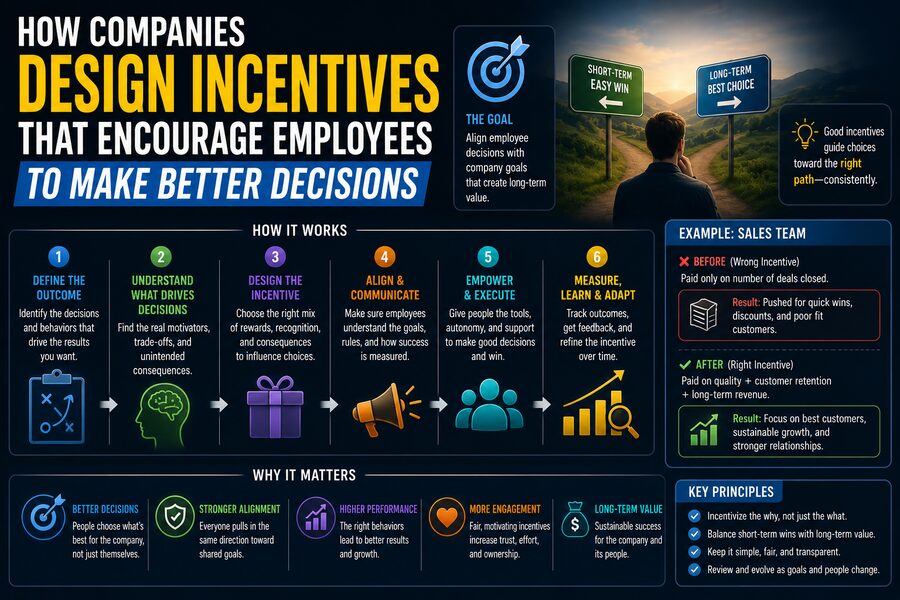
Well-designed incentives help align an employee’s choices with the organization’s long-term goals.
Poorly designed incentives can do the opposite.
If a company rewards the wrong metric, employees may become extremely effective at improving that metric—even while damaging the actual business.
That is why incentive design is a central problem in economics, management, organizational psychology, and corporate governance.
🧭 The Core Problem: Employees and Companies Do Not Always Have Identical Goals
A company might want:
High-quality work + satisfied customers + sustainable profits + low risk
An individual employee may also care about those things, but they have additional personal objectives:
- Salary
- Bonuses
- Job security
- Promotion
- Recognition
- Workload
- Career development
- Personal reputation
Usually, these interests overlap—but not perfectly.
Economists often describe this as a principal-agent problem.
The principal is the person or organization that wants something accomplished.
The agent is the person making decisions on the principal’s behalf.
For example, shareholders may want a company to create long-term value, but senior executives may be tempted to make decisions that maximize their own short-term bonuses.
Good incentive systems attempt to narrow this gap. 🤝
💰 Why Companies Use Performance-Based Pay
One of the most obvious incentives is money.
Suppose a salesperson earns a fixed salary regardless of performance.
The company may worry that there is little direct financial motivation to pursue additional customers.
It could therefore introduce a sales commission:
More sales → Higher compensation
This creates a clear link between employee effort and reward.
Performance-based compensation can be powerful because employees understand exactly what behavior is being encouraged.
However, the simplicity that makes an incentive powerful can also make it dangerous.
If the company rewards only sales volume, employees may pursue sales that are unprofitable, misleading, or unsuitable for customers.
The metric becomes the target.
📊 Goodhart’s Law: When a Measure Becomes a Target
A famous idea often summarized as Goodhart’s Law says:
“When a measure becomes a target, it ceases to be a good measure.”
Imagine a customer-support department whose managers are judged only on average call duration.
Management wants faster service, so employees receive bonuses for keeping calls under four minutes.
What happens?
Employees may rush customers off the phone.
Calls become shorter, so the metric improves. 📉
But unresolved issues may increase.
Customers call back repeatedly.
Satisfaction falls.
The company has successfully optimized the measurement while making the actual service worse.
This is why sophisticated incentive systems rarely depend on only one metric.
⚖️ Balanced Incentives Reduce Unwanted Behavior
Companies can reduce gaming by combining several measures.
Instead of rewarding customer-service workers only for speed, a company might consider:
- Resolution rate
- Customer satisfaction
- Call duration
- Repeat contacts
- Quality audits
Now an employee cannot maximize compensation simply by ending calls quickly.
They need to balance efficiency with actual problem solving.
The same logic applies in many jobs.
A salesperson might be measured on revenue and customer retention.
A factory might track production volume and defect rates.
A manager might be judged on profit and employee turnover.
Balanced scorecards are designed around this idea. ⚖️
🎯 Reward Outcomes Employees Can Actually Influence
An incentive works best when employees have meaningful control over the result.
Imagine giving a store manager a bonus based entirely on the company’s global stock price.
The manager’s daily decisions have almost no visible effect on that price.
The incentive may therefore feel arbitrary.
Instead, the company could reward metrics the manager can influence directly, such as:
- Store profitability
- Customer satisfaction
- Inventory accuracy
- Team retention
- Local sales growth
This creates a stronger connection between effort and reward.
Employees are more motivated when they understand:
“If I make better decisions, I can improve this outcome.”
🕒 Short-Term Incentives Can Damage Long-Term Results
One of the hardest problems in incentive design is time horizon.
Suppose executives receive large bonuses based only on this year’s profit.
They may be tempted to:
- Delay maintenance
- Cut research spending
- Reduce training
- Push excessive sales
- Postpone necessary investments
These actions can increase current profit while weakening the company later.
To counter this problem, organizations sometimes use long-term incentives.
For senior executives, compensation might include equity that vests over several years.
This encourages leaders to care about the future value of the company, not merely next quarter’s financial results. 📈
🏦 Why Stock-Based Compensation Is Common
Many companies give executives and some employees shares or stock options.
The reasoning is straightforward:
If employees own part of the company, they benefit when the company becomes more valuable.
This can help align employee and shareholder interests.
However, stock-based incentives are not perfect.
Employees may have little control over broad market movements.
Executives may also be tempted to prioritize stock-price movements over other objectives.
Therefore, equity incentives are often combined with vesting periods, performance conditions, and restrictions on immediate selling.
The details matter enormously.
🔐 Deferred Rewards Encourage Long-Term Thinking
Another technique is deferred compensation.
Instead of paying an entire bonus immediately, the company may delay part of it.
Suppose a bank employee earns a bonus for profitable trading.
If the trades later produce large losses, the company might reduce or reclaim some deferred compensation.
This creates an incentive to avoid strategies that look profitable today but contain hidden risks.
Deferred rewards are especially important in industries where the consequences of decisions may not become visible for months or years.
↩️ Clawbacks Discourage Reckless Decisions
A clawback allows a company to reclaim compensation under certain conditions.
For example, a senior executive may receive a performance bonus.
Later, the company discovers that financial results were materially misstated.
A clawback policy can require the executive to return some of that compensation.
Clawbacks help discourage employees from maximizing short-term rewards through decisions that create hidden future costs. ⚠️
They are particularly relevant in finance, executive compensation, and regulated industries.
👥 Individual vs. Team Incentives
Not every job can be measured individually.
Suppose a software product succeeds because designers, engineers, marketers, and operations teams all cooperate.
Rewarding only individual output may encourage competition rather than collaboration.
A company may instead introduce team incentives.
For example:
Team hits product reliability target → Everyone receives a bonus
This encourages employees to help one another.
But team incentives create another problem called free riding.
Some employees may contribute less because they receive the same reward as stronger performers.
Companies therefore often combine:
Individual performance + team performance + company performance
This creates several layers of accountability.
🤝 Why Cooperation Sometimes Matters More Than Competition
Aggressive internal competition can produce impressive short-term results.
But it can also cause employees to:
- Hoard information
- Avoid helping colleagues
- Compete for credit
- Hide mistakes
- Undermine teammates
If the company depends on collaboration, these behaviors are destructive.
In such environments, incentives should reward knowledge sharing, mentoring, and collective outcomes.
The best incentive system depends heavily on how work is actually performed.
A commission-heavy individual incentive might work for independent sales territories but fail badly in a tightly integrated product-development team.
🧠 Intrinsic Motivation Matters Too
Not every incentive is financial.
People may work hard because they value:
- Mastery
- Purpose
- Autonomy
- Recognition
- Professional pride
- Helping customers
- Interesting challenges
These are forms of intrinsic motivation.
Companies sometimes make the mistake of assuming every behavior can be improved simply by attaching more money to it.
In certain situations, excessive financial incentives can even weaken intrinsic motivation.
For example, an employee who once took pride in mentoring colleagues may begin viewing mentoring only as a paid task.
Good organizations therefore combine financial rewards with meaningful work, autonomy, recognition, and development opportunities. 🌱
🏆 Recognition Can Be a Powerful Incentive
Public recognition costs relatively little but can strongly influence behavior.
A company might recognize employees for:
- Excellent customer service
- Mentoring
- Innovation
- Safety
- Teamwork
- Process improvement
Recognition signals what the organization values.
If promotions and awards consistently go to employees who collaborate and make sound decisions, others notice.
This creates a cultural incentive.
Employees learn not only from written policies, but from watching who gets rewarded.
🚦 Promotions Send Strong Signals
Promotion criteria may be one of the most powerful incentive systems in an organization.
Imagine a company publicly says:
“We value teamwork.”
But managers who aggressively maximize their own department’s numbers receive the fastest promotions.
Employees will quickly understand the real incentive.
Likewise, if leaders who develop strong teams and make responsible long-term decisions are promoted, employees learn that those behaviors matter.
Organizations therefore need alignment between:
What they say they value and what they actually reward.
🧮 Incentives Should Account for Risk
Suppose two investment managers each earn a 10% return.
Manager A took moderate risk.
Manager B took enormous risk and was fortunate.
If both receive identical bonuses, the incentive system may encourage excessive risk taking.
Companies can therefore use risk-adjusted performance measures.
Instead of rewarding raw profit alone, they may consider:
- Volatility
- Capital usage
- Probability of loss
- Compliance
- Downside exposure
This is particularly important in banking, insurance, energy trading, and other risk-sensitive industries.
🛡️ Safety Incentives Need Careful Design
Safety programs provide a classic example of unintended consequences.
Suppose a factory gives employees a bonus if they report zero accidents for three months.
That sounds reasonable.
But workers may become reluctant to report minor injuries because reporting one would cost everyone the bonus.
The company sees fewer reported incidents while actual safety may not improve.
A better system might reward:
- Hazard reporting
- Corrective actions
- Safety training
- Preventive inspections
- Verified improvements
The goal should be safer behavior, not merely better-looking statistics. 🦺
🧪 Reward Learning, Not Just Success
Innovation creates another challenge.
If employees are punished whenever an experiment fails, they will avoid experimentation.
That can destroy innovation.
Some companies therefore distinguish between:
Intelligent failure — a thoughtful experiment that did not work.
and:
Careless failure — poor execution, negligence, or ignoring known risks.
Teams may be rewarded for running disciplined experiments, documenting results, and learning quickly—even if every experiment is not successful.
This encourages calculated risk-taking without rewarding recklessness. 🔬
💡 Innovation Incentives Must Tolerate Uncertainty
Imagine a research team exploring ten new technologies.
Only one eventually succeeds commercially.
If the organization evaluates researchers solely on immediate financial returns, employees will avoid uncertain projects.
Instead, innovation programs may measure:
- Quality of experimentation
- Technical milestones
- Knowledge generated
- Patents
- Prototypes
- Customer validation
Later, commercial performance can become more important.
Different stages of work often require different incentives.
📏 Avoid Metrics Employees Can Easily Manipulate
A metric is dangerous if employees can improve it without creating real value.
Suppose recruiters receive bonuses based solely on the number of people hired.
They may lower standards to increase hiring volume.
Suppose engineers are rewarded for the number of software features released.
They may produce many low-value features.
Suppose doctors are paid based only on the number of procedures performed.
They may face incentives to perform unnecessary procedures.
Before adopting a metric, companies should ask:
Can someone improve this number while making the underlying outcome worse?
If the answer is yes, safeguards are needed.
🗣️ Employees Need Clear Feedback
An incentive system cannot influence behavior effectively if employees do not know how they are performing.
Imagine a bonus based on a metric that employees see only once per year.
By the time they receive the result, it is too late to adjust their decisions.
Frequent feedback helps employees connect actions with outcomes.
Dashboards, coaching sessions, regular reviews, and clear performance reports can make incentives more effective.
The feedback should be understandable and actionable.
🧩 Incentives Should Be Simple Enough to Understand
Complex compensation systems can fail even when theoretically sophisticated.
Imagine an employee’s bonus depends on 27 metrics, each with different weights and adjustment formulas.
The employee may have no idea which decisions actually improve the reward.
When incentives become too complicated, they lose motivational power.
A good system balances sophistication with clarity.
Employees should be able to explain:
What matters, why it matters, and how their decisions affect the result.
🌍 Company-Wide Profit Sharing
Some organizations use profit-sharing plans.
When the company performs well, employees receive a share of the financial gains.
This can strengthen the connection between employees and overall business performance.
It may also encourage people to think beyond their individual roles.
However, in very large companies, an individual employee may feel that their contribution has almost no effect on total profit.
Profit sharing is therefore often more effective when combined with local or team-based measures.
📉 Avoid Incentives With Sharp Thresholds
Suppose an employee receives:
$0 bonus at 99 sales
but:
$10,000 bonus at 100 sales
That sudden threshold creates a strong incentive to manipulate timing.
An employee might move next month’s sale into this month or offer an excessive discount just to reach the target.
Smoother reward curves can reduce this behavior.
For example, bonuses might gradually increase as performance improves rather than suddenly jumping at one arbitrary cutoff.
🎯 Use Relative Performance Carefully
Some companies compare employees with one another.
For example, the top 10% receive large bonuses.
This can encourage effort.
But it can also create harmful competition.
If employees know that helping a colleague makes that colleague more likely to outrank them, collaboration may decline.
Relative rankings may work in some independent roles, but they should be used cautiously when employees rely heavily on teamwork.
⚙️ Incentives Work Best With Good Systems
Not every performance problem is an incentive problem.
Imagine employees are rewarded for fast customer service, but the company’s software is extremely slow.
Increasing the bonus may not solve anything.
Similarly, an employee cannot make good decisions without:
- Training
- Accurate information
- Adequate tools
- Clear authority
- Reliable processes
Incentives should complement good operational systems, not substitute for them.
🧭 Decision Rights Matter
Employees make better decisions when they have appropriate authority.
Suppose a customer-service employee is rewarded for customer satisfaction but needs manager approval for every small refund.
The incentive says:
“Solve customer problems.”
The system says:
“You are not allowed to.”
Good organizational design aligns incentives with decision rights.
If employees are held responsible for outcomes, they need enough autonomy to influence those outcomes.
📚 Training Helps Employees Respond to Incentives Correctly
Even a well-designed incentive can produce poor decisions if employees do not understand the business.
Suppose a salesperson is told to prioritize profitable customers.
They need to understand which products actually have strong margins and which customers create high servicing costs.
Education and transparent information make incentives more effective.
People cannot optimize what they do not understand.
🕵️ Monitoring Still Matters
Incentives do not eliminate the need for oversight.
Companies may still use:
- Audits
- Quality reviews
- Compliance checks
- Peer review
- Manager supervision
- Data analytics
Monitoring discourages manipulation and helps identify unintended consequences.
The objective is not to monitor every action obsessively, but to ensure that rewarded outcomes genuinely reflect desirable behavior.
🤖 Data and AI Are Changing Incentive Design
Modern companies can analyze much more detailed performance information than before.
Data systems may track:
- Customer outcomes
- Sales quality
- Project delivery
- Productivity
- Retention
- Error rates
- Service response times
AI tools can help detect unusual patterns or identify where incentives are producing unexpected behaviors.
However, detailed monitoring creates privacy, fairness, and governance concerns.
An algorithmic performance score can be harmful if employees do not understand how it is calculated or cannot challenge incorrect data.
More measurement does not automatically mean better management.
⚖️ Fairness Is Crucial
Employees constantly compare rewards.
If two people perform similar work but receive dramatically different outcomes without a clear explanation, trust can collapse.
Perceived unfairness can reduce motivation even when the absolute compensation is high.
Effective incentive systems therefore need:
- Consistent rules
- Transparent criteria
- Reasonable opportunities to succeed
- Accurate measurement
- Appeals or review mechanisms where appropriate
Fairness is not merely an ethical issue.
It directly affects whether people accept and respond to the incentive system.
🔄 Companies Must Review Incentives Regularly
An incentive system that works today may fail later.
Markets change.
Jobs change.
Technology changes.
Employees learn how metrics work.
Once people discover ways to game a system, the incentive may become less useful.
Companies should therefore regularly examine:
What behaviors is this system actually producing?
rather than merely:
Are the target numbers improving?
This distinction is essential.
🧠 A Practical Framework for Better Incentive Design
A company designing an incentive system can work through several questions.
1. What behavior do we actually want?
Not merely what metric is easiest to measure.
2. Which outcomes can employees control?
Rewards should reflect meaningful influence.
3. What could employees do to game the metric?
Imagine unintended shortcuts before implementation.
4. Are we balancing short-term and long-term results?
Avoid rewarding behavior that creates future damage.
5. Do individual incentives harm teamwork?
Use team measures where collaboration matters.
6. Are risk, quality, and ethics included?
Revenue alone may not capture real value.
7. Can employees understand the system?
Complexity reduces effectiveness.
8. Are the rewards meaningful but proportionate?
Extremely large incentives can encourage extreme behavior.
9. How will we detect unintended consequences?
Monitor the real-world effects.
10. Can the system evolve?
Review and adjust incentives as conditions change.
🚨 The Wells Fargo Example and the Danger of Misaligned Targets
A widely discussed example of poor incentive design involved aggressive sales targets in retail banking.
When employees face intense pressure to hit narrow numerical targets, some may look for ways to satisfy the measurement rather than the underlying customer need.
The broader lesson extends far beyond banking.
Whenever an organization creates a strong reward for one measurable outcome while ignoring quality, ethics, or customer value, it creates opportunities for distorted behavior.
The stronger the incentive, the more carefully the target must be designed.
🌱 Culture and Incentives Reinforce Each Other
Formal bonuses are only one part of organizational behavior.
Culture creates informal incentives.
Employees observe:
Who gets promoted?
Who gets praised?
Who gets punished?
Which mistakes are tolerated?
Which behaviors are ignored?
A company may have perfectly designed compensation formulas but still create harmful incentives through its culture.
For example, if managers repeatedly celebrate revenue wins without asking how those sales were generated, employees receive a powerful message.
Culture is therefore an incentive system even when no spreadsheet formally describes it.
🏆 The Best Incentives Align Value Creation With Personal Benefit
The ideal incentive is one where an employee can improve their own outcome mainly by doing something that genuinely improves the organization.
For example:
A salesperson earns more because customers stay longer.
A manager earns more because their team improves productivity without sacrificing quality.
An executive gains wealth because the company creates sustainable value over several years.
An engineer earns recognition for eliminating recurring failures.
When this alignment is strong, less monitoring is required because the employee’s natural response to the incentive also benefits the company. 🎯
✅ The Bottom Line
Companies design incentives to influence how employees make decisions when managers cannot directly supervise every action.
The simplest incentive says:
“Do more of X and receive more of Y.”
But effective systems go much further.
They consider:
- What employees can control
- How metrics can be manipulated
- Short-term versus long-term outcomes
- Individual versus team performance
- Quality and risk
- Intrinsic motivation
- Fairness
- Feedback
- Organizational culture
A poorly designed incentive can cause employees to optimize the wrong objective with remarkable efficiency.
A well-designed incentive makes the desirable decision personally rewarding.
That is the central challenge of incentive design:
Do not merely reward what is easy to count. Reward the behaviors and outcomes that create genuine, sustainable value. 🎯💼
When incentives, information, authority, culture, and business goals all point in the same direction, employees do not need instructions for every possible situation.
They can make better decisions because the system encourages them to think like owners rather than simply chase a number.