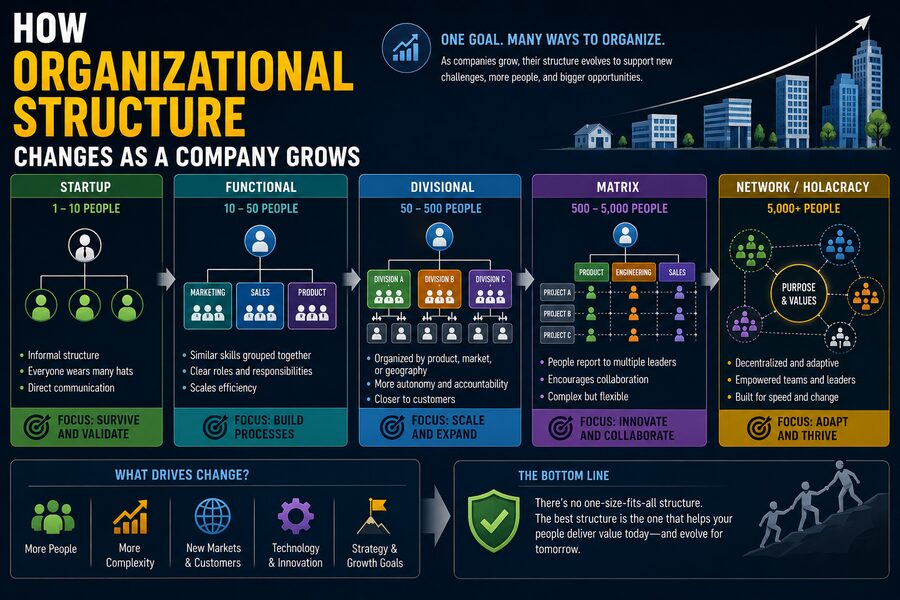

Every company begins with some form of organizational structure, even if nobody has formally designed one. In a tiny startup, the structure may be nothing more than a founder making most decisions while a small team handles whatever needs to be done. As the company grows, however, that informal arrangement becomes harder to sustain.
More employees mean more projects, more customers, more departments, more decisions, and more opportunities for confusion. Responsibilities that were once obvious may begin to overlap. Managers may become overwhelmed. Communication can slow down, and employees may no longer know who has authority over a particular issue.
For this reason, organizational structure usually evolves as a company grows. 📈
The transition does not happen only because the company becomes larger. Structure changes because the organization needs new ways to coordinate people, distribute decision-making authority, maintain accountability, and preserve efficiency.
Understanding this evolution helps explain why a 10-person startup operates very differently from a company with 10,000 employees.
🌱 Stage 1: The Founder-Centered Startup
In the earliest stage of a company, the organizational structure is usually extremely simple.
A founder or small founding team often sits at the center of nearly every important activity. They may participate directly in:
- Product development
- Sales
- Marketing
- Hiring
- Finance
- Customer service
- Operations
- Strategic planning
Employees typically have broad roles rather than narrowly defined job descriptions.
A software engineer might also talk to customers. A marketer might help with recruiting. The founder might personally approve expenses, negotiate contracts, and review product designs.
This structure can be highly effective when the company is small. 🚀
Communication is fast because everyone knows each other. Decisions can be made quickly, and employees can adapt without navigating complex procedures.
The structure is often described as flat because there are very few management layers between employees and the founder.
However, this flexibility has limits.
As the organization grows, the founder becomes a bottleneck. If every important decision requires one person’s approval, the company’s ability to scale begins to decline.
👥 Stage 2: Early Specialization Begins
Once the company starts hiring more people, specialization becomes increasingly valuable.
Instead of asking every employee to perform many unrelated tasks, the company begins creating recognizable functional roles.
For example:
- Engineers focus on product development
- Salespeople focus on acquiring customers
- Marketers focus on demand generation
- Finance staff manage accounting and budgets
- HR professionals handle recruiting and employee operations
This is the beginning of a functional organizational structure.
The company may appoint its first department leaders, such as:
- Head of Engineering
- Head of Sales
- Head of Marketing
- Finance Manager
- Operations Manager
Now, employees begin reporting to managers with expertise in their functional area.
This change helps the organization become more efficient because people can develop deeper expertise. 🎯
At the same time, the company starts moving away from a purely informal system.
🧭 Stage 3: Management Layers Appear
As employee numbers continue increasing, a single executive cannot effectively manage everyone.
Imagine a founder directly managing 50 employees. Even if the founder spent only 20 minutes per week with each employee, individual management alone would require more than 16 hours.
That does not include strategy, customer meetings, fundraising, hiring, or other responsibilities.
Companies therefore introduce additional management layers.
Instead of:
CEO → Employees
the organization may become:
CEO → Department Heads → Managers → Employees
This introduces a concept known as span of control.
Span of control refers to the number of employees who report directly to one manager.
If managers supervise too many people, employees may receive insufficient guidance. If managers supervise too few people, the organization may become unnecessarily bureaucratic.
Companies try to find an appropriate balance. ⚖️
🏗️ Stage 4: Functional Departments Become More Formal
During the next stage of growth, departments become increasingly structured.
An early-stage company may simply have an “engineering team.” Later, engineering itself may be divided into:
- Backend engineering
- Frontend engineering
- Mobile development
- Infrastructure
- Cybersecurity
- Quality assurance
- Data engineering
Marketing may similarly develop specialized teams for:
- Content marketing
- Advertising
- Brand management
- Product marketing
- Social media
- Public relations
- Marketing analytics
Finance may develop separate functions for accounting, treasury, financial planning, tax, and internal controls.
The organization becomes more specialized because complexity increases with scale. 🧩
The benefit is expertise and efficiency.
The challenge is coordination.
When departments become highly specialized, employees may begin focusing primarily on their own team’s objectives instead of the company’s broader goals. This can create organizational silos.
🧱 The Problem of Organizational Silos
A silo occurs when one department operates too independently from others.
For example, the sales team might promise customers a feature that engineering has not planned to build.
Marketing might launch a campaign without informing customer support about the expected increase in inquiries.
Finance might reduce spending in a way that unintentionally disrupts operations.
Each department may be acting rationally from its own perspective, but the overall organization suffers from poor coordination.
Growing companies therefore need mechanisms that connect departments.
These may include:
- Cross-functional meetings
- Shared goals
- Company-wide metrics
- Project teams
- Integrated planning systems
- Clear escalation processes
- Collaboration software
Organizational design is therefore not simply about creating departments. It is also about ensuring those departments can work together effectively. 🔗
🌍 Stage 5: Divisional Structures May Emerge
As a company becomes significantly larger, a purely functional structure may become difficult to manage.
Suppose a business sells several very different product lines.
Instead of organizing primarily around functions, it may create separate divisions.
For example:
Consumer Products Division
Enterprise Products Division
Cloud Services Division
Each division may have its own marketing, sales, operations, and product teams.
This is called a divisional structure.
Companies can organize divisions around several factors, including:
- Products
- Customer types
- Geographic regions
- Industries
- Brands
A global company, for example, might create divisions for North America, Europe, Asia-Pacific, and Latin America. 🌎
The advantage is that each division can respond more quickly to its specific market.
The disadvantage is duplication. Multiple divisions may each maintain their own HR teams, finance staff, or marketing departments.
🔀 Stage 6: Matrix Structures Can Develop
Some large organizations require employees to coordinate across both functions and projects.
This can lead to a matrix organizational structure.
In a matrix organization, an employee may effectively have more than one reporting relationship.
For example, an engineer could report to:
- An engineering manager for technical development
- A product manager for a specific project
The matrix structure can increase flexibility because employees with specialized skills can contribute to multiple initiatives.
However, it can also create confusion. 🤔
Questions may arise such as:
- Which manager has final authority?
- Which project receives priority?
- Who conducts performance evaluations?
- Who controls the budget?
Successful matrix organizations therefore require clearly defined responsibilities and strong communication.
🧑💼 Stage 7: Senior Leadership Becomes More Specialized
Leadership roles also change dramatically as companies grow.
In a small company, the CEO may personally oversee nearly everything.
In a larger organization, responsibilities are distributed among executives such as:
- Chief Financial Officer (CFO)
- Chief Operating Officer (COO)
- Chief Technology Officer (CTO)
- Chief Marketing Officer (CMO)
- Chief Human Resources Officer (CHRO)
- Chief Information Officer (CIO)
- General Counsel
These executives manage increasingly complex areas that require specialized expertise.
For example, managing payroll for 20 employees is relatively simple compared with managing compensation, benefits, labor regulations, pensions, and workforce planning for 20,000 employees.
Growth creates managerial complexity, and specialization becomes necessary at the executive level as well. 📊
📋 Processes Become More Formal
Small organizations often depend heavily on personal communication.
An employee may simply ask the founder whether they can purchase new equipment.
As the company grows, informal decisions become difficult to track.
Organizations therefore introduce formal processes.
These can include:
- Budget approval procedures
- Hiring processes
- Performance reviews
- Procurement rules
- Expense policies
- Security standards
- Project management frameworks
- Compliance procedures
These systems can feel slower than startup-style decision-making, but they help maintain consistency and accountability. ✅
The challenge is avoiding excessive bureaucracy.
If processes become too complicated, employees may spend more time navigating internal procedures than serving customers.
Strong organizations continually balance control and flexibility.
🎯 Decision-Making Becomes More Distributed
A major structural challenge for growing companies is determining where decisions should be made.
Early-stage organizations are often highly centralized because founders make most major decisions.
As the organization expands, this becomes impractical.
Companies therefore begin delegating authority.
A regional manager might be authorized to approve certain expenses. A product leader may control the roadmap for a particular product. Department managers may receive responsibility for hiring decisions.
This process is known as decentralization.
Decentralization can improve speed because decisions are made closer to the people who understand the situation.
However, excessive decentralization can create inconsistency.
Different divisions might use incompatible systems or pursue conflicting strategies.
Large organizations therefore develop rules that distinguish between:
Centralized decisions — decisions that should remain consistent across the entire organization.
Decentralized decisions — decisions that local teams can make independently.
Finding this balance is one of the most important challenges in organizational design. ⚙️
📡 Communication Becomes More Complex
Communication complexity increases dramatically as organizations grow.
In a five-person company, information can spread naturally through conversation.
In a 5,000-person company, that becomes impossible.
Management must create structured communication channels, including:
- Company-wide meetings
- Management meetings
- Internal newsletters
- Team dashboards
- Employee portals
- Collaboration platforms
- Reporting systems
Managers also become increasingly important as information bridges between leadership and frontline employees.
Poor communication can create duplication, confusion, and slow execution.
Effective organizational structures therefore define not only who reports to whom, but also how information moves across the company. 📣
📊 Data and Metrics Become More Important
As companies grow, senior leaders become increasingly distant from everyday operations.
A startup founder may personally know nearly every customer.
The CEO of a multinational corporation cannot.
Larger organizations therefore rely heavily on metrics and reporting systems.
Executives may monitor:
- Revenue
- Profit margins
- Customer retention
- Employee turnover
- Production efficiency
- Sales pipeline
- Customer satisfaction
- Operational risk
Dashboards allow leaders to understand performance without directly observing every activity.
This represents a significant change in management style.
Small companies often manage through direct involvement.
Large organizations increasingly manage through systems, delegation, and measurable indicators. 📈
🌐 Geographic Expansion Changes Structure
International growth adds another layer of complexity.
A company operating in multiple countries must deal with differences in:
- Laws
- Taxes
- Languages
- Consumer behavior
- Labor practices
- Business culture
- Currency
- Supply chains
A centralized headquarters may not understand every local market.
Companies therefore often create regional leadership structures.
For example:
Global Headquarters
⬇️
Americas Region
Europe Region
Asia-Pacific Region
Regional leaders may receive authority over sales, marketing, hiring, and operations while still following global corporate policies.
The organization’s structure becomes a balance between global consistency and local adaptation. 🌍
🏛️ Governance Becomes More Important
As businesses become larger, governance requirements usually increase.
Boards of directors, audit committees, compliance teams, risk managers, and internal auditors become increasingly important.
Public companies may face particularly extensive governance and reporting obligations.
Leadership can no longer rely solely on trust and informal oversight.
Formal systems are required to monitor:
- Financial reporting
- Regulatory compliance
- Cybersecurity
- Operational risks
- Ethical conduct
- Executive accountability
Governance helps ensure that organizational growth does not outpace managerial control. 🛡️
💡 Culture Changes Along With Structure
Organizational structure and organizational culture are closely connected.
In a small startup, employees often feel close to founders and understand the company’s mission directly.
As the company expands, new employees may never meet senior executives.
Multiple offices and management layers can weaken the sense of shared identity.
Growing organizations therefore invest more deliberately in culture through:
- Leadership communication
- Values
- Training
- Employee recognition
- Onboarding programs
- Internal events
- Management expectations
Culture becomes less something that happens automatically and more something that leadership must intentionally reinforce. 🤝
⚠️ The Risk of Over-Structuring
Growth does not mean that more hierarchy is always better.
Organizations can become too complicated.
Signs of over-structuring include:
- Too many approval layers
- Excessive meetings
- Slow decision-making
- Confusing reporting relationships
- Duplicate management roles
- Unnecessary paperwork
When this happens, companies may restructure.
They might remove management layers, combine departments, decentralize authority, or simplify procedures.
This process is sometimes described as delayering or organizational flattening.
The objective is usually to restore speed and accountability. ✂️
🔄 Why Companies Reorganize Repeatedly
Organizational structure is rarely permanent.
Companies reorganize when their strategies change.
A business entering international markets may create regional divisions.
A company shifting toward digital products may strengthen technology leadership.
A business acquiring another organization may combine overlapping departments.
Reorganizations can also happen when leadership believes the existing structure has become inefficient.
Successful organizational design therefore requires continuous adjustment.
The structure that works for 50 employees may fail at 500 employees, and the structure that works at 500 may become inappropriate at 50,000.
🎯 Final Takeaway
As companies grow, organizational structure usually evolves from informal and founder-centered arrangements toward more specialized, layered, and coordinated systems.
Early-stage companies often rely on broad roles, direct communication, and centralized leadership. As the workforce expands, companies introduce departments, managers, formal processes, specialized executives, divisional structures, reporting systems, and stronger governance.
Eventually, large organizations may combine functional, divisional, geographic, and matrix structures to manage enormous complexity. 🏢📊
The central challenge is balance.
Too little structure creates confusion, overload, and unclear accountability. Too much structure creates bureaucracy, slow decisions, and organizational rigidity.
The most effective companies continuously redesign their structures so that authority, communication, accountability, and expertise remain aligned with the company’s size and strategy.
Organizational growth is therefore not simply about hiring more people. It is about building a management system capable of helping those people work together effectively at a much larger scale. 🚀