
Every company that sells a physical product eventually faces an important operational question: Should we manufacture this ourselves, or should we pay another company to make it for us? 🤔🏭
This decision is known as the make-or-buy decision.
A manufacturer might ask whether it should produce an electronic component internally or purchase it from a supplier. A food company may decide whether to operate its own packaging facility or hire a contract manufacturer. An automobile company may produce engines internally while buying tires, batteries, sensors, and thousands of other components from specialized suppliers.
At first glance, the decision may seem simple: choose whichever option costs less.
In reality, businesses must consider far more than the quoted price. Quality, production capacity, intellectual property, supply-chain risk, flexibility, investment requirements, workforce expertise, delivery reliability, and long-term strategy can all influence the answer.
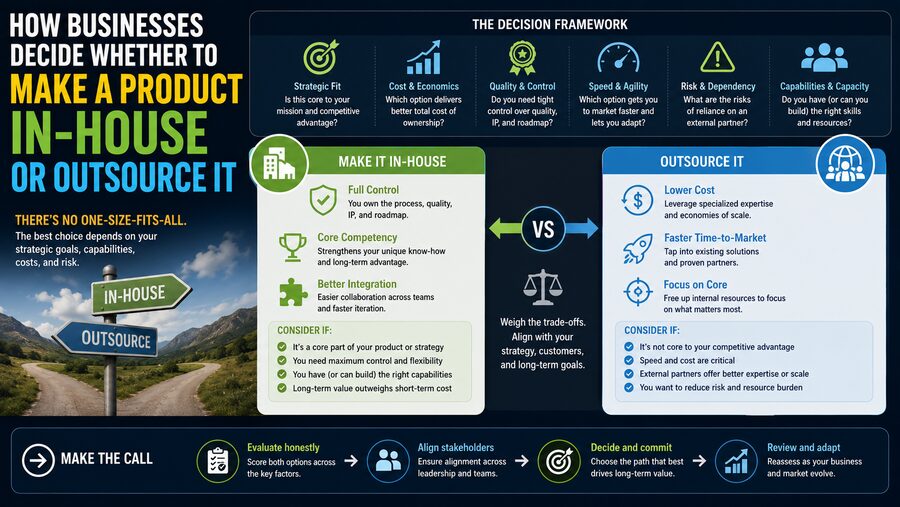
The best option is therefore not necessarily the cheapest one today. It is the option that gives the company the best combination of cost, control, capability, risk, and strategic advantage over time. 📊⚙️
🧩 What Does “Make In-House” Mean?
Making a product in-house means the company performs the relevant manufacturing process using its own facilities, employees, equipment, and management systems.
For example, a furniture company could purchase machinery, hire production workers, acquire raw materials, and manufacture wooden tables inside its own factory.
The company controls activities such as:
- production scheduling,
- quality inspection,
- workforce training,
- equipment maintenance,
- process improvement,
- inventory management.
This provides significant control, but it also requires investment and operational responsibility.
🤝 What Does Outsourcing Mean?
Outsourcing means hiring an external supplier or contract manufacturer to perform some or all of the production work.
Instead of purchasing manufacturing equipment, the furniture company might send its designs to a specialized factory that already has the machinery and workers needed to produce the tables.
The supplier manufactures the product according to agreed specifications and charges the customer.
Outsourcing can apply to:
- individual components,
- subassemblies,
- packaging,
- complete finished products,
- specialized manufacturing operations.
Many modern supply chains combine internal production and outsourcing rather than choosing only one approach.
💰 Cost Is Usually the Starting Point
One of the first questions businesses ask is:
Which option costs less?
But comparing costs requires more than comparing a supplier’s quotation against the cost of raw materials.
If production is brought in-house, the business may need to pay for:
- machinery,
- factory space,
- electricity,
- maintenance,
- production employees,
- supervisors,
- insurance,
- quality systems,
- inventory,
- waste and scrap.
Some of these expenses are fixed costs, meaning they remain even if production volume falls.
Others are variable costs, meaning they increase as more units are produced.
Outsourcing often converts many fixed costs into variable costs because the company simply pays the supplier based on production volume. 💵
🧮 A Simple Make-or-Buy Example
Suppose a company needs 100,000 components every year.
A supplier offers them for:
$8 per component
The annual outsourcing cost would therefore be:
100,000 × $8 = $800,000
The company estimates that internal production would require:
Annual fixed manufacturing costs = $300,000
and:
Variable production cost = $4 per component
Internal production would cost:
$300,000 + (100,000 × $4)
which equals:
$700,000 per year
Based only on these numbers, making the component internally appears to save:
$100,000 per year
However, this is only the beginning of the analysis.
If producing the component requires a $2 million equipment investment, additional engineers, regulatory approvals, or significant operational risk, outsourcing might still be preferable.
📈 Production Volume Can Change the Answer
Manufacturing economics depend heavily on volume.
Internal manufacturing often requires high fixed investment but may offer lower unit costs once production reaches a large scale.
Outsourcing may involve little upfront investment but a higher price per unit.
Imagine:
Internal production
Fixed cost = $500,000
Variable cost = $3 per unit
Supplier
Purchase price = $8 per unit
At low production volumes, outsourcing may be cheaper because the business avoids the $500,000 fixed expense.
At high production volumes, internal manufacturing may become more economical.
Businesses can calculate a break-even volume where both options cost approximately the same.
Below that quantity, buying may be better.
Above it, making may become more attractive. 📊
🏗️ Does the Company Have Enough Capacity?
Sometimes a company knows how to manufacture a component but does not have enough factory capacity.
Its machines may already be running near their limits.
Management then has several choices:
- purchase more machinery,
- expand the factory,
- add another work shift,
- improve productivity,
- outsource part of production.
Expanding internal capacity can require significant capital and time.
Outsourcing may allow the company to increase output almost immediately without constructing another production line.
This can be particularly valuable when demand suddenly increases. 🚀
🎯 Core Competency Matters
An important strategic question is:
Is this manufacturing activity something our company should be exceptionally good at?
Companies usually want to retain strong control over activities that create their main competitive advantage.
For example, if a company’s reputation depends on a proprietary manufacturing technique, outsourcing that process could weaken its advantage.
On the other hand, there may be little strategic benefit in producing standardized screws, packaging materials, or generic cables internally when specialized suppliers can make them efficiently.
This leads to a common principle:
Keep strategically important capabilities close; consider outsourcing standardized activities where suppliers have greater expertise or scale.
🔐 Intellectual Property Can Influence the Decision
Outsourcing may require sharing:
- engineering drawings,
- formulas,
- manufacturing methods,
- software,
- prototypes,
- proprietary specifications.
This can create intellectual-property risk.
If a supplier learns how a company’s most innovative product is manufactured, there may be concerns about:
- information leakage,
- imitation,
- supplier competition,
- unauthorized subcontracting.
For highly proprietary technology, businesses may choose internal production even if it costs more.
They may also divide manufacturing among several suppliers so that no single external company receives complete knowledge of the product. 🔐
✅ Quality Control Can Favor Internal Production
Quality is another major consideration.
When production is internal, managers can directly oversee:
- raw-material selection,
- machine settings,
- inspection procedures,
- worker training,
- corrective actions.
Problems may be identified and corrected quickly.
With outsourcing, the company depends on the supplier’s quality-management system.
A strong contract manufacturer may actually provide better quality because it specializes in a particular manufacturing process.
However, weak supplier quality can lead to:
- defective products,
- customer returns,
- warranty claims,
- production interruptions,
- reputational damage.
Businesses therefore evaluate suppliers carefully through audits, samples, certifications, and performance monitoring. 🔍
🧠 Supplier Expertise Can Be Extremely Valuable
Specialized suppliers often develop skills that would be expensive for customers to recreate internally.
For example, a supplier specializing in precision casting may operate advanced machinery, employ experienced metallurgists, and manufacture millions of similar parts every year.
A company requiring only 20,000 cast parts annually might find it inefficient to build the same capability itself.
By outsourcing, the customer gains access to:
- specialized equipment,
- experienced workers,
- technical expertise,
- established processes,
- economies of scale.
This is one of the strongest reasons companies buy rather than make.
🏭 Economies of Scale Give Suppliers an Advantage
A supplier serving many customers can spread its fixed costs across a much larger production volume.
Suppose a specialized factory manufactures ten million electronic connectors per year for dozens of customers.
Because it purchases materials in huge quantities and runs its equipment continuously, its cost per connector may be extremely low.
A single customer manufacturing only 100,000 connectors internally may struggle to achieve the same efficiency.
This advantage is called economies of scale. 📉
Outsourcing frequently makes sense when suppliers have significantly greater scale than the purchasing company.
🔄 Flexibility Is Another Important Factor
Demand rarely remains constant.
A company’s sales might change because of:
- seasonal demand,
- economic conditions,
- new competitors,
- product launches,
- changing consumer preferences.
Internal factories create fixed capacity.
If demand falls dramatically, expensive machinery and employees may sit idle.
Outsourcing can provide greater flexibility because production orders can sometimes increase or decrease as demand changes.
However, suppliers may impose:
- minimum order quantities,
- long lead times,
- capacity reservations,
- cancellation fees.
Businesses must compare these limitations with the flexibility of internal manufacturing.
⚠️ Outsourcing Introduces Supply-Chain Risk
A low-cost supplier is not necessarily a low-risk supplier.
External manufacturing creates dependence on another organization.
Production could be disrupted by:
- factory breakdowns,
- labor strikes,
- supplier bankruptcy,
- transportation delays,
- natural disasters,
- geopolitical conflicts,
- trade restrictions,
- shortages of raw materials.
If the supplier is located overseas, additional risks may include customs delays, currency changes, shipping disruptions, and longer transportation routes. 🚢
Companies increasingly evaluate supply-chain resilience alongside price.
🌍 Offshore Outsourcing vs. Local Suppliers
Historically, many companies moved manufacturing to countries with lower labor costs.
This strategy is often called offshoring.
The savings can be substantial, particularly for labor-intensive products.
However, offshore production may introduce longer lead times and greater complexity.
A company may instead choose nearshoring, where manufacturing is moved to a nearby country, or reshoring, where production returns to the company’s home country.
The decision may involve trade-offs among:
Labor cost ↔ Transportation cost ↔ Speed ↔ Risk ↔ Control
A slightly more expensive local supplier can sometimes produce better overall economics if shipping and inventory requirements are significantly lower.
🚚 Lead Time Affects Inventory
Suppose a domestic supplier can deliver components within five days, while an overseas supplier requires eight weeks.
The offshore supplier may charge less per component.
However, the business may need to carry significantly more inventory to protect against delays.
More inventory means:
- additional warehouse space,
- more cash tied up in stock,
- insurance costs,
- risk of obsolescence.
These costs form part of the total cost of ownership.
Businesses should therefore avoid comparing supplier prices without considering logistics and inventory.
📦 Total Cost of Ownership Gives a Better Comparison
A comprehensive make-or-buy decision examines all relevant economic effects.
For outsourcing, the real cost may include:
Supplier price + freight + tariffs + inspection + inventory + administration + expected disruption costs
For in-house manufacturing, costs may include:
Materials + labor + equipment + maintenance + utilities + management + factory space + capital cost
This broader calculation is called total cost of ownership, or TCO.
A supplier with the lowest quotation may not have the lowest total cost. 📊
💳 Capital Investment Can Make Outsourcing Attractive
Manufacturing equipment can be expensive.
A company may need millions of dollars for:
- robots,
- machining centers,
- molds,
- tooling,
- production buildings.
That money could potentially be invested elsewhere in:
- product development,
- marketing,
- sales,
- research,
- acquisitions.
Outsourcing allows companies to use a supplier’s existing capital equipment instead of purchasing their own.
For startups and rapidly growing businesses, avoiding large manufacturing investments can preserve valuable cash. 💰
👷 Labor Availability Matters
A company may want to manufacture internally but struggle to hire workers with the necessary skills.
Specialized production can require:
- machinists,
- welders,
- engineers,
- technicians,
- quality specialists.
If these skills are scarce locally, internal production may be difficult or costly.
A specialist supplier may already employ the required workforce.
Labor availability can therefore influence sourcing decisions just as strongly as wages.
⏱️ Speed to Market Can Favor Outsourcing
Imagine a company developing a new consumer product.
Building an internal factory might require 18 months.
An experienced contract manufacturer could begin production within several months.
If the market opportunity is moving quickly, the lost sales from waiting may be much more important than manufacturing cost differences.
Outsourcing can therefore help companies launch products faster. 🚀
This is especially valuable in industries with short product life cycles, such as consumer electronics.
🤝 Supplier Relationships Become Strategic
Outsourcing is not always a simple buyer-seller transaction.
Some companies build long-term partnerships with key suppliers.
A strategic supplier may participate in:
- product design,
- material selection,
- cost reduction,
- prototyping,
- manufacturing engineering.
The supplier’s expertise can improve the product itself.
Automotive manufacturing is a good example. Vehicle manufacturers rely on extensive networks of specialized suppliers that often contribute engineering expertise, not merely production capacity. 🚗
🧪 New Products Create Extra Uncertainty
Companies often outsource early production when they do not yet know how successful a product will become.
Suppose demand could range from 20,000 to 500,000 units.
Building a dedicated factory before demand is proven would be risky.
Contract manufacturing allows the business to test the market without committing as much capital.
If demand later becomes large and predictable, the company may decide to bring production in-house.
This means the make-or-buy decision can change during a product’s lifecycle. 🔄
🏗️ Businesses Often Use a Hybrid Strategy
The choice does not have to be all-or-nothing.
A company might manufacture 70% internally and outsource 30%.
This approach can provide both control and flexibility.
For example:
Internal factory → predictable base demand
External supplier → seasonal peaks and unexpected growth
A business might also use two or more suppliers for the same part.
This technique, known as dual sourcing or multiple sourcing, reduces dependence on one supplier.
🛡️ Supply-Chain Resilience Has Become More Important
Businesses increasingly ask:
What happens if our primary supplier suddenly stops delivering?
A company optimized entirely for the lowest possible cost may become fragile.
Resilient sourcing strategies can include:
- multiple suppliers,
- geographic diversification,
- safety stock,
- backup tooling,
- internal emergency capacity.
These measures may increase normal operating costs slightly but reduce the financial impact of major disruptions.
Risk management is therefore an important part of modern make-or-buy decisions. 🛡️
🌱 Sustainability Can Influence Sourcing
Environmental objectives increasingly affect manufacturing decisions.
Companies may consider:
- energy consumption,
- carbon emissions,
- transportation distances,
- renewable energy use,
- waste generation,
- supplier labor practices.
A distant low-cost supplier may create more transportation-related emissions than a regional manufacturer.
Alternatively, a highly efficient specialist supplier may use resources more effectively than a small internal facility.
Sustainability must therefore be evaluated across the entire production system. 🌍🌱
📋 A Practical Make-or-Buy Decision Framework
Businesses can organize the analysis around several questions:
1. What is the true total cost?
Compare more than the supplier’s quoted price.
2. Is the capability strategically important?
Core technologies may deserve internal control.
3. Do we have the necessary expertise?
Consider workers, equipment, and technical knowledge.
4. How much investment is required?
Evaluate capital expenditure and alternative uses of cash.
5. What are the quality implications?
Determine which option offers better process control.
6. How stable is demand?
Uncertain volumes can favor outsourcing.
7. What are the supply-chain risks?
Evaluate geography, suppliers, logistics, and disruptions.
8. How quickly must production begin?
Speed to market can change the economics.
9. How valuable is flexibility?
Consider future increases or decreases in demand.
10. What protects long-term competitive advantage?
Intellectual property and proprietary skills may justify internal production.
🧠 The Decision Is Strategic, Not Just Financial
A spreadsheet can calculate manufacturing costs, but it cannot completely determine a sourcing strategy.
Imagine two alternatives:
Option A: Internal production costs $10.20 per unit.
Option B: Outsourcing costs $9.80 per unit.
The supplier appears cheaper by $0.40.
But suppose the component contains the company’s most important proprietary technology and a supply interruption would halt the entire business.
Management might reasonably choose internal manufacturing despite the higher unit cost.
Alternatively, a standardized component may cost slightly less internally, but producing it consumes factory capacity needed for a more profitable proprietary product.
In that situation, outsourcing may still be the better choice.
The relevant question is therefore not simply:
“Which option has the lowest unit cost?”
It is:
“Which option creates the most value for the business after considering cost, opportunity, risk, and strategy?”
🏭 Make What Matters, Buy What Others Can Do Better
The make-or-buy decision is one of the fundamental choices in operations and supply-chain management.
Producing internally can provide greater control, protect proprietary knowledge, improve coordination, and become highly economical at sufficient scale. 🏭
Outsourcing can reduce capital requirements, provide access to specialized expertise, increase flexibility, accelerate product launches, and take advantage of supplier economies of scale. 🤝
Neither strategy is universally better.
The correct decision depends on production volume, cost structure, available capacity, quality requirements, intellectual property, supplier reliability, workforce skills, lead times, strategic priorities, and risk tolerance.
Many successful businesses ultimately use a combination of both approaches.
They keep activities that define their competitive advantage under close control while relying on capable suppliers for areas where external specialists can operate more efficiently.
The central principle is:
A good make-or-buy decision does not simply ask who can manufacture the product for the lowest quoted price—it asks which sourcing choice gives the business the best long-term balance of economics, control, flexibility, capability, and risk. 📊🏭🤝
That broader perspective is what turns a simple purchasing calculation into a strategic business decision.