
A growing business can look successful on paper and still run out of money.
Sales may be rising. New customers may be arriving. Employees may be busy. Revenue forecasts may look strong. Yet the company can still struggle to pay suppliers, salaries, rent, taxes, or loan payments on time.
The reason is often working capital. 📊
Working capital represents the short-term financial resources a business uses to operate from day to day. It connects the timing of money coming into the company with the timing of money going out.
When a business grows, it often has to spend cash before it receives cash from customers. It may need to buy more inventory, hire more workers, pay suppliers, expand facilities, or provide customers with longer payment terms.
If that timing gap becomes too large, even a profitable company can experience a cash crisis.
This is why working capital management is one of the most important financial disciplines for a growing business.
🧮 What Is Working Capital?
A common definition of working capital is:
Working Capital = Current Assets − Current Liabilities
Current assets are resources expected to become cash or be used within roughly one year.
Examples include:
- 💵 Cash
- 📄 Accounts receivable
- 📦 Inventory
- Short-term investments
- Certain prepaid expenses
Current liabilities are obligations generally due within roughly one year.
Examples include:
- 🧾 Accounts payable
- 💳 Short-term debt
- Payroll obligations
- Taxes payable
- Other near-term expenses
If a company has:
Current assets = $800,000
and:
Current liabilities = $550,000
then:
Working capital = $250,000
Positive working capital generally means the company has more short-term assets than short-term obligations.
However, this number alone does not tell the entire story.
A company may have large amounts of inventory and receivables but very little actual cash in the bank.
That distinction is crucial.
💡 Profit Is Not the Same as Cash
One of the most important concepts in business finance is that profit and cash flow are different.
Suppose a company sells $100,000 of products to a customer today.
Accounting rules may allow the company to recognize the revenue immediately.
But if the customer has 60 days to pay, the company may not receive the cash for two months.
Meanwhile, the company may already have paid for:
- Raw materials
- Shipping
- Employee wages
- Manufacturing costs
- Sales commissions
The company can therefore report a profit while its bank account is shrinking.
This is why fast-growing businesses are often especially vulnerable to working-capital problems.
Growth increases activity, but activity frequently consumes cash before it generates cash.
🚀 Why Growth Can Create a Cash Shortage
Imagine a wholesaler that normally sells $500,000 worth of goods each month.
A major new customer increases monthly sales to $900,000.
That sounds excellent.
However, to fulfill the additional orders, the wholesaler must purchase more inventory immediately.
Suppliers require payment within 30 days.
The new customer pays invoices in 75 days.
The business therefore has to finance approximately 45 days of the operating gap itself.
As sales rise, the amount of money trapped in that gap becomes larger.
This creates one of the strange realities of business:
A company can grow itself into a cash crisis. 📈⚠️
Working capital management is designed to prevent that outcome.
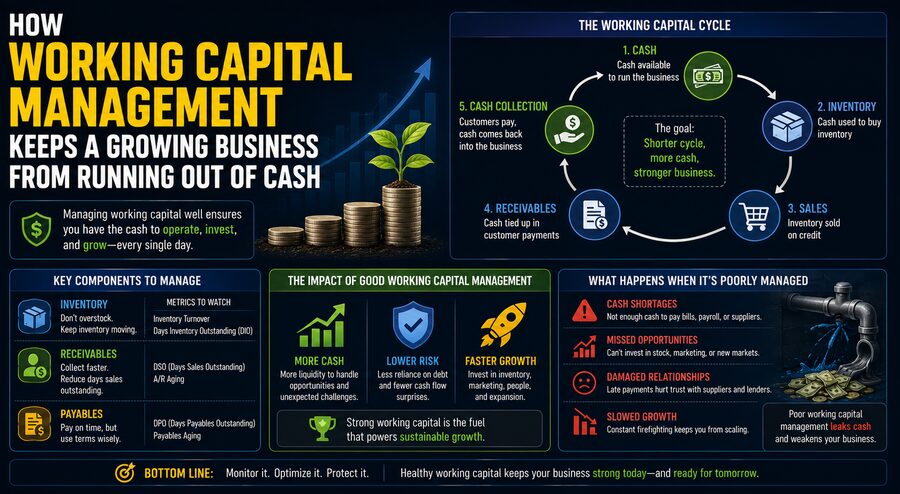
🔄 The Working Capital Cycle
The movement of money through a business is often described as the working capital cycle.
A simplified cycle looks like:
Cash → Inventory → Sale → Accounts Receivable → Cash
The company first spends cash to obtain inventory or produce a service.
It then sells the product.
If the sale is made on credit, the company records a receivable.
Eventually, the customer pays.
Only then does the business receive cash again.
The faster this cycle operates, the less cash the business usually needs to finance day-to-day operations.
⏱️ The Cash Conversion Cycle
A common measure of working-capital efficiency is the Cash Conversion Cycle (CCC).
It estimates how long a company’s cash remains tied up in operations.
A simplified formula is:
CCC = Days Inventory Outstanding + Days Sales Outstanding − Days Payables Outstanding
These three components measure different parts of the operating cycle.
📦 Days Inventory Outstanding
Days Inventory Outstanding (DIO) estimates how long inventory remains in the business before being sold.
If a company holds too much inventory, cash becomes trapped in unsold goods.
For example, a retailer may have $2 million worth of inventory but only $100,000 in cash.
The inventory has value, but it cannot directly pay employees or suppliers until it is sold.
Reducing unnecessary inventory can therefore release cash.
However, inventory should not be cut excessively.
Too little inventory can cause:
- Stockouts
- Lost sales
- Production interruptions
- Customer dissatisfaction
Good inventory management balances cash efficiency with operational reliability.
📄 Days Sales Outstanding
Days Sales Outstanding (DSO) estimates how long customers take to pay invoices.
If a business invoices customers today but does not receive payment for 60 days, those sales create accounts receivable rather than immediate cash.
Higher DSO generally means more money is tied up in receivables.
Businesses can improve collections by:
- Sending invoices promptly
- Offering electronic payment
- Setting clear payment terms
- Following up on overdue accounts
- Checking customer creditworthiness
- Requiring deposits where appropriate
Reducing collection time by even a few days can release substantial cash in a large company.
🧾 Days Payables Outstanding
Days Payables Outstanding (DPO) estimates how long a business takes to pay suppliers.
Longer supplier payment terms can help preserve cash.
For example, receiving materials today but paying the supplier 60 days later gives the company more time to sell products and collect from customers before cash leaves the business.
However, companies should not simply delay payments irresponsibly.
Paying suppliers late can damage:
- Supplier relationships
- Credit terms
- Supply reliability
- Business reputation
The goal is to negotiate appropriate terms and use the full agreed payment period strategically.
🔁 A Simple Cash Conversion Example
Suppose a manufacturer has:
Inventory days = 45
Receivable days = 50
Payable days = 30
Its cash conversion cycle is:
45 + 50 − 30 = 65 days
This means cash is effectively tied up in operations for about 65 days.
If management reduces inventory days to 35 and receivable days to 40 while extending supplier terms to 40 days, the new cycle becomes:
35 + 40 − 40 = 35 days
The business has reduced its cash conversion cycle by 30 days.
That improvement can release a significant amount of cash without increasing sales or borrowing more money. 💰
📦 Inventory Management Protects Cash
Inventory is often one of the largest working-capital investments in product-based businesses.
Growing companies may over-order because they fear running out of stock.
This can create warehouses full of slow-moving goods.
Cash becomes trapped in products that may take months to sell.
Better inventory management involves understanding:
- Sales velocity
- Lead times
- Reorder points
- Seasonal demand
- Safety stock
- Obsolete inventory
Businesses can use forecasting systems to determine how much stock is genuinely necessary.
Slow-moving products may be discounted or discontinued.
The objective is to maintain enough inventory to serve customers without unnecessarily locking up capital.
🧾 Accounts Receivable Management
Revenue is valuable only when customers eventually pay.
A company with weak collection procedures can build a large receivables balance while cash becomes scarce.
Good receivable management begins before the sale.
Companies should decide:
- Which customers receive credit
- How much credit they receive
- When payment is due
- What happens when invoices become overdue
Some businesses require deposits for large orders.
Others offer small discounts for early payment.
Automated invoicing systems can also send reminders immediately when payments are late.
These practices shorten the time between making a sale and receiving cash.
🤝 Managing Supplier Payments Strategically
Accounts payable can function as a form of short-term operating financing.
Suppose a supplier offers 60-day payment terms.
If a company pays after 10 days without receiving any discount, it gives up 50 days of free supplier financing.
That may not be the best use of cash.
On the other hand, if a supplier offers a significant early-payment discount, paying sooner could make financial sense.
Working capital management therefore requires comparing:
Cash preservation vs. available discounts
Good businesses also communicate with suppliers.
As a company grows, it may be able to negotiate:
- Longer payment terms
- Higher credit limits
- Volume discounts
- Staged payments
These agreements can significantly reduce pressure on cash flow.
📈 Why Rapid Sales Growth Uses Working Capital
Suppose a company earns a 20% gross margin.
To generate an additional $1 million of sales, it may need to spend approximately $800,000 on goods or production costs.
If most customers pay later, the company must finance a large portion of that $800,000 before receiving revenue.
The faster sales grow, the larger the financing requirement becomes.
This means business owners should ask not only:
“How much can we sell?”
but also:
“How much growth can our cash position support?”
Growth that cannot be financed can destabilize an otherwise healthy business.
🧮 Forecasting Working Capital Needs
A growing company should prepare a cash flow forecast.
This forecast estimates when cash will enter and leave the business.
A useful forecast may include:
- Expected customer collections
- Supplier payments
- Payroll
- Rent
- Taxes
- Loan repayments
- Inventory purchases
- Capital expenditures
Forecasting helps management identify future shortages before they occur.
For example, the company may discover that a large tax payment and inventory purchase will happen in the same month.
Management can then act in advance rather than reacting after the bank account is nearly empty.
🗓️ Weekly Cash Forecasts
For businesses experiencing rapid growth, monthly forecasts may not provide enough detail.
A 13-week cash flow forecast is commonly used because it provides a rolling view of near-term liquidity.
Each week, management updates expected:
- Cash receipts
- Cash payments
- Ending cash balance
This gives the company early warning of pressure points.
It is particularly useful for businesses with:
- Seasonal sales
- Large customer invoices
- Irregular supplier payments
- Tight cash reserves
Cash forecasting turns liquidity management from guesswork into a structured process. 📊
🏦 Working Capital Financing
Sometimes operational improvements are not enough.
A rapidly expanding company may still need external financing.
Common working-capital financing options include:
- Business lines of credit
- Revolving credit facilities
- Invoice financing
- Factoring
- Inventory financing
- Short-term bank loans
A revolving credit line can be especially useful because the business borrows when cash needs increase and repays the balance when customers pay.
However, financing should support a healthy operating cycle rather than permanently hide poor collections or excessive inventory.
💳 Invoice Financing and Factoring
Companies with substantial accounts receivable can sometimes convert invoices into cash early.
With invoice financing, the company borrows against outstanding receivables.
With factoring, receivables may be sold to a financing provider.
This can improve cash availability quickly.
However, fees and financing costs can reduce profitability.
Businesses should therefore compare the cost of financing with the benefit of accessing cash earlier.
⚠️ Warning Signs of Working Capital Trouble
Management should watch for signals that liquidity is becoming strained.
Potential warning signs include:
- Cash balance declining despite rising sales
- Increasing overdue receivables
- Frequent supplier payment delays
- Growing inventory faster than revenue
- Increasing reliance on overdrafts
- Difficulty making payroll
- Customers consistently paying later
- Emergency borrowing becoming routine
Any one indicator may be manageable.
Several occurring together can signal a serious working-capital problem.
📊 Working Capital Ratios
Financial ratios can help management monitor short-term liquidity.
One common measure is the current ratio:
Current Ratio = Current Assets ÷ Current Liabilities
If current assets are $600,000 and current liabilities are $400,000:
Current ratio = 1.5
Another measure is the quick ratio, which excludes inventory because inventory may not convert to cash quickly.
These ratios are useful, but they should not replace cash flow forecasting.
A company can have acceptable liquidity ratios while still facing timing problems.
🏭 Different Industries Need Different Working Capital
Working-capital needs vary dramatically across industries.
A software subscription company may receive annual payments in advance.
That can create favorable working capital because customers provide cash before most expenses occur.
A manufacturer may need to buy raw materials months before customers pay.
That creates a much larger financing requirement.
Construction companies may wait for milestone payments.
Retailers may build inventory before holiday seasons.
Understanding the industry’s normal cash cycle is essential when evaluating working-capital performance.
📅 Seasonality Can Create Cash Pressure
Seasonal businesses face unique challenges.
A retailer may purchase inventory several months before its peak sales season.
Cash falls before revenue rises.
If management focuses only on annual profitability, this temporary cash requirement may be underestimated.
A seasonal working-capital plan should forecast:
- Inventory build-up
- Supplier payment dates
- Expected customer receipts
- Payroll requirements
- Minimum cash reserves
Financing can then be arranged before the seasonal cash low point.
🧠 Growth Decisions Should Include Cash Impact
Before launching a major growth initiative, management should estimate its working-capital requirement.
Suppose a company plans to enter a new market.
The financial model should include more than projected revenue and profit.
It should also estimate:
- Additional inventory
- New receivables
- Supplier payment timing
- Hiring costs
- Marketing expenses
- Tax obligations
A project might eventually be highly profitable but still create a large short-term cash deficit.
Knowing this in advance allows the company to secure financing or adjust its growth speed.
🧯 Why Cash Reserves Matter
Efficient working capital does not eliminate uncertainty.
Customers can pay late.
Equipment can fail.
Demand can fall unexpectedly.
Suppliers can increase prices.
Businesses therefore need a liquidity buffer.
A cash reserve provides flexibility when actual events differ from forecasts.
The appropriate reserve depends on:
- Revenue stability
- Customer concentration
- Fixed costs
- Industry volatility
- Access to credit
Companies with highly unpredictable cash flows generally need more liquidity.
🤖 Technology Improves Working Capital Management
Modern accounting and financial systems can automate much of the working-capital process.
Software can monitor:
- Invoice aging
- Customer payment behavior
- Inventory turnover
- Supplier obligations
- Cash balances
- Forecast accuracy
AI and predictive analytics can help estimate when invoices are likely to be paid or which products are becoming slow-moving.
Automated dashboards allow finance teams to see cash risks much earlier.
This is especially important as transaction volumes increase during business growth. 💻
🔄 Working Capital Is a Company-Wide Responsibility
Working capital is not only the finance department’s responsibility.
Sales teams influence payment terms.
Procurement teams negotiate supplier contracts.
Operations teams determine inventory levels.
Customer-service teams may resolve disputes delaying invoices.
Senior management controls growth spending.
Poor decisions in any of these areas can increase cash requirements.
Successful companies therefore treat working capital as a cross-functional operating discipline.
📌 A Practical Working Capital Strategy
A growing company can improve liquidity by focusing on several practical actions:
- Collect receivables faster without damaging important customer relationships.
- Reduce unnecessary inventory while maintaining service levels.
- Negotiate appropriate supplier terms and use them efficiently.
- Forecast cash frequently rather than relying only on profit statements.
- Maintain access to backup financing before a crisis occurs.
- Measure cash-cycle performance using DSO, DIO, and DPO.
- Model the cash impact of growth before committing to expansion.
These actions can release substantial cash without requiring additional equity investment.
🌱 Efficient Working Capital Can Fund Growth Internally
One of the most powerful benefits of working-capital improvement is that it can create cash from within the business.
Suppose a company reduces receivables by $300,000 and excess inventory by $200,000.
That can release approximately:
$500,000 of cash
without selling more products or taking on additional debt.
The company can then use that cash for:
- Hiring
- Marketing
- Equipment
- Expansion
- Product development
Improving working capital can therefore become a source of growth financing.
⚖️ Avoid Optimizing Too Aggressively
Working capital should be optimized, not simply minimized.
A company could preserve cash by reducing inventory dramatically, demanding immediate customer payment, and delaying every supplier invoice.
But this could create serious business problems.
Customers may leave.
Suppliers may stop offering favorable terms.
Products may go out of stock.
The correct objective is to find the best balance between:
Liquidity + growth + customer service + supplier stability
That balance differs from one business to another.
✨ Conclusion
Working capital management keeps a growing business from running out of cash by controlling the timing of money moving through day-to-day operations.
Growth often creates a hidden financing requirement. Companies purchase inventory, pay employees, and cover operating expenses before customers settle their invoices.
The resulting gap can consume cash surprisingly quickly.
Effective working capital management focuses on three major areas:
Inventory, receivables, and payables.
By selling inventory faster, collecting customer payments sooner, and using supplier payment terms intelligently, a company can shorten its cash conversion cycle and reduce the amount of capital trapped in operations.
Regular cash forecasting, adequate reserves, and appropriate financing provide additional protection.
The most important lesson is simple:
A profitable business can still fail if it does not have enough cash at the right time. 💵⚠️
For a growing company, managing working capital is therefore not merely an accounting exercise. It is a core operating strategy.
When managed well, working capital allows a business to pay its obligations, invest confidently, withstand unexpected disruptions, and continue expanding without being strangled by its own success. 📈🚀