
A company can invest in faster machines, hire more employees, improve software, and optimize dozens of departments—yet still see very little improvement in its overall output.
Why?
Because the performance of an entire operation is often constrained by just one limiting step.
That limiting step is called a bottleneck. 🚧
A bottleneck is the part of a process that has less capacity than the demand placed on it. Work arrives faster than the bottleneck can handle it, causing queues, delays, excess inventory, missed deadlines, and frustrated employees.
The surprising lesson is that improving areas that are not bottlenecks may do almost nothing for total company output. If one stage can process only 100 units per day, making every other stage capable of processing 500 units per day will not automatically raise production above 100.
This is why bottleneck management is so powerful.
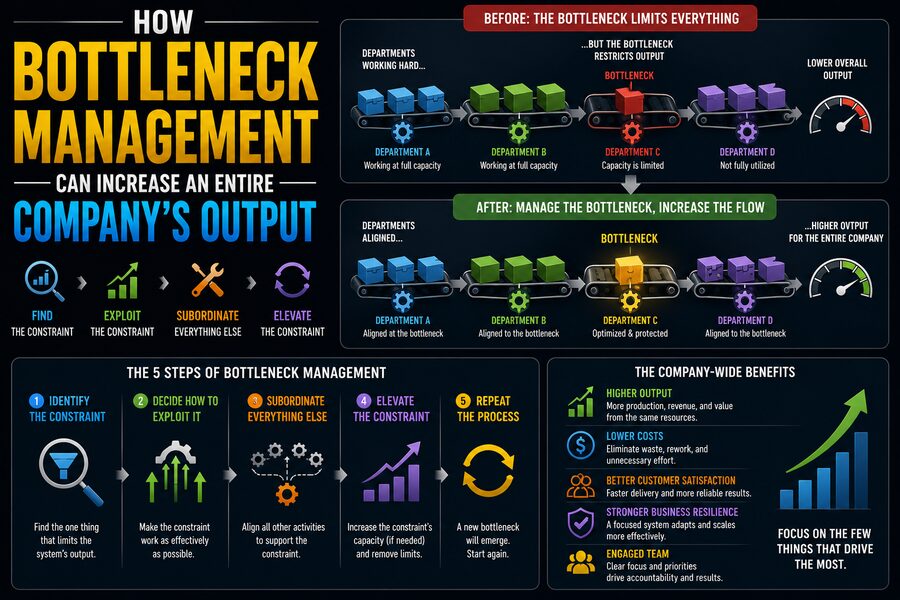
Instead of trying to optimize everything equally, managers identify the constraint that limits the whole system, protect it, improve it, and then repeat the process when the bottleneck moves elsewhere. Done correctly, this approach can increase throughput without requiring the entire company to work faster. ⚙️📈
🔍 What Is a Bottleneck?
The term comes from the shape of a bottle.
A bottle may have a large body capable of holding a large amount of liquid, but the rate at which liquid leaves is limited by the narrow neck.
A business process works similarly.
Imagine a factory with four stages:
Cutting → Drilling → Painting → Packaging
Their capacities are:
- Cutting: 300 units/day
- Drilling: 280 units/day
- Painting: 120 units/day
- Packaging: 250 units/day
Even though most stages can process more than 250 units daily, painting can handle only 120.
Therefore, the maximum output of the entire line is approximately:
120 units per day
Painting is the bottleneck. 🎨🚧
Making the cutting department 20% faster would create more unfinished work waiting for painting, but the plant would still ship only about 120 units per day.
📈 Throughput Depends on the Constraint
This leads to a fundamental operations principle:
The throughput of a system is limited by its constraint.
Suppose the painting department is improved from 120 units per day to 160 units per day.
If no other stage becomes the new bottleneck, the entire plant can now potentially produce:
160 units per day
That is a 33% increase in system output.
Notice what happened.
Only one part of the operation was improved, yet the benefit appeared across the entire business.
This is why bottleneck management can produce disproportionately large results. 🚀
🧠 Local Efficiency vs. System Efficiency
Organizations often measure each department independently.
Managers might be rewarded for:
- Keeping machines busy
- Maximizing employee utilization
- Producing large batch sizes
- Reducing idle time
- Meeting departmental quotas
These measures can create a dangerous behavior: every department tries to maximize its own output.
But a company is a system, not a collection of unrelated departments.
If a non-bottleneck department produces faster than the bottleneck can process, the extra output becomes waiting inventory.
That may create:
- More storage requirements
- Longer lead times
- Greater work-in-progress
- More handling
- Greater risk of damage or obsolescence
A department can look highly efficient while making the overall company worse. ⚠️
True optimization focuses on the performance of the entire system.
🏭 A Simple Manufacturing Example
Imagine a furniture company making tables.
The process contains five steps:
- Cutting wood
- Machining components
- Assembly
- Finishing
- Inspection
Suppose each step can process the following number of tables per hour:
- Cutting: 20
- Machining: 18
- Assembly: 10
- Finishing: 16
- Inspection: 22
Assembly is the bottleneck at 10 tables per hour.
If cutting increases from 20 to 25 tables per hour, nothing important changes.
More wooden parts simply pile up before assembly.
But if assembly improves from 10 to 13 tables per hour, total plant throughput can increase by roughly 30%, assuming finishing can handle the additional flow.
This illustrates why identifying the correct constraint matters more than improving random parts of the process. 🔧
🧭 Step 1: Identify the Bottleneck
The first task is finding the true constraint.
Common signs include:
- Large queues forming before one process
- Employees constantly waiting for one department
- Work-in-progress accumulating in one location
- Customers repeatedly waiting on the same step
- One machine operating near maximum capacity
- Frequent overtime in one team
- One approval delaying many projects
- A specialized employee becoming overloaded
The bottleneck is not always a physical machine.
It can be:
- A person 👤
- A department
- A software system 💻
- A supplier
- A policy
- A regulatory approval
- A managerial decision
- A market constraint
Finding the actual constraint requires observing how work flows through the organization.
⏱️ Measure Flow, Not Just Activity
One useful way to identify bottlenecks is to measure:
- Processing time
- Waiting time
- Queue length
- Capacity
- Utilization
- Throughput
- Lead time
Suppose a document requires only 30 minutes of legal review but sits in the legal team’s queue for six days.
The processing time is small.
The waiting time is enormous.
That suggests legal review may be a bottleneck.
Looking only at how long a task takes while actively being worked on can hide the real problem.
Managers need to observe total flow time. 📊
⚙️ Step 2: Exploit the Existing Bottleneck
Once the constraint is identified, the next question should not immediately be:
“What expensive equipment should we buy?”
First ask:
“Are we using the existing bottleneck as effectively as possible?”
This is sometimes called exploiting the constraint.
Suppose a critical machine produces 100 units per hour but spends two hours each day waiting for raw materials.
Before buying another machine, ensure materials arrive on time.
Other improvements might include:
- Reducing setup time
- Scheduling maintenance outside peak production
- Assigning the most skilled operators
- Preventing unnecessary interruptions
- Ensuring quality inputs reach the bottleneck
- Eliminating administrative delays
If the bottleneck is expensive or scarce, every minute of lost capacity matters. ⏰
🛡️ Protect the Bottleneck From Bad Work
Imagine a bottleneck machine spends 10% of its time processing defective components that later have to be discarded.
That wasted time reduces total company throughput.
A better approach may be to inspect quality before the bottleneck.
Only good work should consume scarce bottleneck capacity.
Similarly, if a senior engineer is the constraint in a product-development process, their time should not be consumed by routine administrative work that another employee could perform.
Protect the bottleneck from tasks that do not require its unique capability. 🛡️
🔄 Step 3: Subordinate Everything Else
This idea can initially sound strange.
If the bottleneck can handle 100 units per hour, upstream departments should not necessarily produce 200 units per hour continuously.
Why?
Because the extra 100 units simply become inventory.
Other processes should be coordinated around the bottleneck’s pace.
This concept is often called subordination.
Non-bottleneck resources should support the constraint instead of independently maximizing their own utilization.
That may mean some employees or equipment appear idle at certain times.
But idle time at a non-bottleneck may be cheaper than creating unnecessary inventory that cannot flow through the system.
📦 Why Excess Work-in-Progress Can Hurt Performance
When upstream processes produce more than the bottleneck can handle, unfinished work accumulates.
High work-in-progress can lead to:
- Longer lead times
- Harder scheduling
- More floor-space usage
- Increased tracking complexity
- Hidden quality problems
- Greater capital tied up in inventory
Managers sometimes interpret large piles of unfinished work as evidence that the organization is productive.
In reality, it may indicate poor flow.
The goal is not to keep every resource busy.
The goal is to move valuable work through the complete system and into the hands of customers. 📦➡️👥
🚀 Step 4: Elevate the Bottleneck
After using the existing constraint efficiently, the company can increase its capacity.
This is often called elevating the constraint.
Possible actions include:
- Buying another machine
- Hiring additional specialists
- Adding another shift
- Outsourcing part of the work
- Automating repetitive activities
- Redesigning the process
- Increasing software capacity
- Training additional employees
For example, if one packaging machine limits production, management might install a second unit.
If one specialized engineer must approve every technical change, the company might train two additional engineers to perform approvals.
The key is that investment is directed at the part of the system where increased capacity produces the greatest total benefit. 💰📈
🔄 Step 5: Find the New Bottleneck
A successful bottleneck improvement often causes the constraint to move.
Return to our furniture example.
Initially:
- Cutting: 20/hour
- Machining: 18/hour
- Assembly: 10/hour
- Finishing: 16/hour
- Inspection: 22/hour
Suppose assembly improves to:
17/hour
Now finishing, at 16 per hour, becomes the bottleneck.
The company should shift its attention there.
This creates a continuous improvement cycle:
Identify → Exploit → Subordinate → Elevate → Repeat
🔄
The objective is not to eliminate bottlenecks permanently.
Every finite system eventually has a limiting factor.
The goal is to continuously manage the current constraint.
🧠 The Theory of Constraints
This approach is closely associated with the Theory of Constraints, or TOC, popularized by management thinker Eliyahu M. Goldratt.
TOC emphasizes that relatively few constraints determine the performance of an entire organization.
Rather than spreading improvement resources everywhere, management should focus attention on the system’s limiting factor.
The famous five focusing steps are broadly:
- Identify the constraint.
- Exploit the constraint.
- Subordinate everything else.
- Elevate the constraint.
- Repeat when the constraint moves.
This framework has been applied well beyond manufacturing.
💻 Bottlenecks in Software Companies
Imagine a software company developing new features.
The process is:
Design → Coding → Code Review → Testing → Deployment
Suppose developers can complete 50 features each month, but the testing team can validate only 25.
Testing is the bottleneck.
Hiring more developers might make the problem worse.
More features would simply accumulate while waiting for testing.
Better improvements might include:
- Automated testing
- Earlier quality checks
- More test engineers
- Improved test environments
- Smaller releases
- Better developer self-testing
By increasing testing capacity, the company can increase the throughput of the entire product-development system. 💻⚙️
👥 Bottlenecks Can Be People
Sometimes the constraint is a particular employee.
Imagine every customer contract requires approval from one executive.
As sales grow, contracts begin waiting several days for signatures.
The executive has become a bottleneck.
Possible solutions include:
- Delegating approval authority
- Creating standard contract terms
- Automating low-risk approvals
- Setting approval thresholds
- Training additional reviewers
The goal is not to make that employee work indefinitely longer.
It is to redesign the process so scarce expertise is used only where it creates value. 👤
📝 Policy Bottlenecks
Some bottlenecks are created by rules rather than physical capacity.
Imagine a company requires five executives to approve every purchase above $500.
Most purchases are routine.
The approval process may become slower than the purchasing work itself.
The real constraint is the policy.
Changing the threshold or creating automatic approval rules may remove the bottleneck without purchasing any equipment.
This illustrates an important lesson:
Not every capacity problem requires more resources.
Sometimes the process itself is the problem. 📋
🛒 Bottlenecks in Retail and E-Commerce
An e-commerce business may have enormous website capacity but limited warehouse packing capacity.
During a holiday sale:
- Website accepts 50,000 orders/hour
- Payment systems handle 60,000/hour
- Warehouse can pack only 15,000/hour
The warehouse is the constraint.
Increasing advertising could actually make customer experience worse because orders would pile up faster.
Better investments might include:
- Additional packing stations
- Pre-positioned inventory
- Automated sorting
- Improved picking routes
- Temporary labor
Once warehouse capacity increases, another constraint—such as shipping carrier capacity—may emerge. 📦🚚
🏥 Bottleneck Management in Healthcare
Hospitals also contain process constraints.
A patient’s flow might involve:
Registration → Examination → Imaging → Diagnosis → Treatment
Suppose imaging equipment has limited capacity.
Patients may wait hours for scans even though physicians are available.
Adding more examination rooms would not solve the delay.
Improving imaging throughput might.
Possible actions include:
- Extending operating hours
- Reducing equipment changeover time
- Prioritizing urgent cases
- Improving scheduling
- Adding another machine
The same system logic applies even though the output is patient care rather than manufactured products. 🏥
🍽️ Restaurant Bottlenecks
A restaurant provides an intuitive example.
Suppose:
- Servers can take 100 orders/hour
- Kitchen can cook 60 meals/hour
- Cashiers can process 120 payments/hour
The kitchen is the bottleneck.
Hiring more servers may result in more orders waiting in the kitchen.
Increasing kitchen capacity could improve the entire restaurant’s throughput.
That might involve:
- Better workstation design
- Menu simplification
- Pre-preparation
- Additional cooking equipment
- More kitchen staff
The goal is to increase meals completed, not simply orders taken. 🍽️
📊 Throughput, Inventory, and Operating Expense
Constraint-based management often pays close attention to three broad measures:
💰 Throughput
The rate at which the system generates value through completed sales or output.
📦 Inventory
Money or resources tied up in things the system intends to sell or process.
⚙️ Operating Expense
The money spent turning inventory and resources into throughput.
A company can appear busy while throughput remains low.
Bottleneck management focuses on increasing the rate at which completed value emerges from the system.
🥁 Drum-Buffer-Rope Scheduling
A scheduling concept associated with the Theory of Constraints is called Drum-Buffer-Rope.
🥁 Drum
The bottleneck establishes the pace of the system.
Like a drum setting marching speed, it determines how quickly work should flow.
🛡️ Buffer
A controlled amount of work is kept before the bottleneck so it does not run out of tasks.
🪢 Rope
Upstream work is released according to the bottleneck’s needs.
This prevents excessive work-in-progress from entering the system.
The idea is to keep the constraint busy without flooding the entire operation with unnecessary inventory.
🛡️ Why a Buffer Can Be Useful
Although excessive inventory is undesirable, having zero inventory before a bottleneck can also be risky.
Imagine the bottleneck machine processes 100 units per hour.
If an upstream delivery is delayed for 30 minutes, the machine may sit idle.
Because every lost minute at the bottleneck reduces system output, companies often maintain a carefully sized buffer ahead of it.
The goal is not maximum inventory.
It is enough protection to prevent normal variability from starving the constraint.
📉 Why 100% Utilization Everywhere Is Dangerous
Managers often assume every resource should operate at 100% utilization.
In a variable system, that can create huge queues.
Suppose a department can process exactly 100 requests per day and receives an average of 100 requests daily.
Any variation—such as 110 requests one day—creates a backlog.
If the department has no spare capacity, it may never catch up.
Therefore, non-bottleneck resources often need some capacity cushion.
Unused capacity can provide flexibility rather than representing waste.
💰 Bottleneck Improvements Can Have Exceptional ROI
Suppose a factory generates $100 profit contribution per finished unit.
Its bottleneck produces:
1,000 units per week
An improvement raises capacity by only:
50 units per week
That appears small.
But the company may now generate:
50 × $100 = $5,000
additional contribution every week.
If the improvement cost only $20,000, the payback can be rapid.
This is why tiny improvements at a bottleneck can be worth more than large improvements elsewhere. 📈
⚠️ Common Bottleneck Management Mistakes
Organizations often make several mistakes.
One is confusing the busiest resource with the true constraint.
Another is improving a department simply because its manager complains the loudest.
Companies may also automate non-bottlenecks because automation appears impressive, while ignoring the actual limiting step.
Another mistake is solving yesterday’s bottleneck and continuing to optimize it long after the constraint has moved somewhere else.
Effective bottleneck management requires continuous system-level measurement.
🔍 Temporary vs. Structural Bottlenecks
Not every bottleneck is permanent.
A temporary constraint might appear because:
- An employee is absent
- Equipment breaks
- Demand suddenly spikes
- A supplier misses a shipment
A structural bottleneck persists because capacity is fundamentally lower than the rest of the process.
Distinguishing between these matters.
A temporary problem may require short-term scheduling changes.
A structural constraint may justify significant investment.
🤖 Automation and Bottleneck Management
Automation can be extremely powerful when applied to the correct constraint.
Suppose a finance department processes invoices.
Employees spend most of their time manually entering invoice data.
Automated document extraction could increase processing capacity dramatically.
But if invoice approval by department managers is actually the bottleneck, faster data entry will simply create a larger approval queue.
Before automating, ask:
Which step actually limits completed output? 🤖
Technology should target the constraint, not merely the easiest task to automate.
🌍 Bottlenecks Across the Supply Chain
Sometimes the constraint exists outside the company.
A manufacturer might have enough production capacity but depend on a supplier capable of delivering only 10,000 specialized components each month.
That supplier limits total output.
Possible responses include:
- Helping the supplier improve
- Finding another supplier
- Redesigning the product
- Increasing safety stock
- Producing the component internally
Supply-chain bottlenecks can constrain entire industries, particularly when critical components have few alternative sources. 🌐
🧠 Bottleneck Management Changes How Managers Think
Traditional optimization often asks:
“How can every department become more efficient?”
Constraint-based thinking asks:
“What is preventing the entire company from producing more value?”
That difference is profound.
It shifts management attention from isolated efficiency metrics toward overall flow.
Instead of rewarding every machine for maximum utilization, managers focus on completed customer value.
Instead of spreading investment equally, they put resources where one additional unit of capacity produces the greatest system-wide benefit.
✅ Conclusion
Bottleneck management can increase an entire company’s output because the performance of a connected process is often determined by its most constrained step. 🚧📈
If one department, machine, approval process, employee, supplier, or software system can handle only 100 units per day, increasing capacity everywhere else may simply create larger queues.
The most effective strategy is therefore to identify the constraint, use its existing capacity more effectively, coordinate other processes around it, and then increase its capacity when justified.
Once that bottleneck improves, another part of the organization may become the new constraint.
The cycle begins again:
Identify → Exploit → Subordinate → Elevate → Repeat. 🔄
This approach can apply to factories, hospitals, software teams, restaurants, warehouses, financial departments, supply chains, and almost any organization where work moves through a sequence of dependent activities.
The central lesson is simple:
A company does not become faster because every part works faster. It becomes faster when the part limiting the entire system gets better. ⚙️🚀
By concentrating improvement efforts where they matter most, organizations can increase throughput, shorten lead times, reduce unnecessary inventory, improve customer service, and achieve much larger returns from the same resources.