
It is 8:40 on a Monday morning. A manager has a staffing gap, an unhappy customer escalation, a project that is slipping, and three dashboards offering slightly different versions of the truth. Before the first meeting begins, the manager must decide what deserves attention now and what can wait.
Many managers already use software to track work, budgets, service levels, and performance. An AI assistant adds a different possibility: it can turn scattered information into a summary, suggest questions to ask, draft options, and help prepare a response in minutes rather than hours.
That possibility matters because daily management is rarely about finding one perfect answer. It is about making a series of timely, defensible decisions with incomplete information, competing priorities, and real consequences for people.
AI can make that work easier, but it can also make weak assumptions look polished and persuasive. The value of an assistant depends less on its ability to generate text than on the manager’s ability to frame decisions, test outputs, and remain accountable. 🤖
🧭 1. What daily decision-making really involves
Managerial decisions range from routine choices, such as approving a schedule change, to ambiguous choices, such as whether a team needs more capacity or clearer priorities. Most sit somewhere in between.
In practice, a manager must identify the issue, gather relevant facts, consider constraints, involve the right people, choose an action, and review what happened. An AI assistant can support several of these steps, but it does not remove them.
Good management is not fast answer production. It is sound judgment applied at an appropriate speed.
⚙️ 2. Where AI assistants fit in
An AI assistant is software that can interpret prompts and produce language-based outputs such as summaries, drafts, classifications, plans, or suggested questions. Some assistants can also work with approved business data, documents, calendars, and analytical tools.
For managers, the most useful role is often that of a decision-support partner. It can reduce administrative effort and widen the range of options considered, while the manager retains ownership of the decision.
This distinction is essential. Supporting a decision is different from authorising an action that affects employees, customers, finances, or compliance.
📥 3. Start with information overload
Managers commonly receive information through meetings, messages, spreadsheets, reports, customer feedback, and informal conversations. Important signals may be buried among routine updates.
An assistant can consolidate a defined set of inputs into a brief that highlights deadlines, changes, risks, unresolved questions, and apparent dependencies. This can make preparation more consistent before a meeting or decision point.
However, a summary is only as reliable as the information it was given. Missing context, outdated reports, and one-sided inputs can produce a neat but misleading picture.
🔎 4. Use AI to clarify the decision first
A surprising number of poor decisions begin with a poorly stated problem. “Improve team performance” is too broad to guide action, whereas “reduce delayed handovers without increasing overtime” creates a clearer decision frame.
An assistant can help turn a vague concern into a structured problem statement. Ask it to identify the decision owner, the deadline, stakeholders, constraints, evidence needed, and the consequences of acting or not acting.
A clear question is often more valuable than an immediate recommendation. It prevents the team from solving an easier but irrelevant problem.
🗂️ 5. Summarise meetings without losing accountability
Meeting notes are a practical use case. An assistant can turn a transcript or manager-approved notes into decisions, actions, owners, due dates, risks, and open questions.
The manager or meeting owner should review the output before sharing it. Automated notes may confuse a proposal with a decision, misattribute a comment, or miss the significance of disagreement.
Useful review questions
- Was a decision actually made, or was it only discussed?
- Is each action assigned to a named owner?
- Are deadlines explicit and realistic?
- Does the summary capture unresolved concerns?
This use reduces follow-up friction while preserving the human responsibility to confirm the record. 📝
📊 6. Turn data into questions, not just charts
Managers often have access to more metrics than they can interpret quickly. AI can describe trends, flag unusual movements, and translate technical reports into plain language.
Its better contribution is to generate investigative questions: What changed during this period? Which teams or customer segments are affected? Is the pattern large enough to matter operationally? What information would challenge the initial explanation?
A manager should avoid treating generated commentary as analysis in itself. Correlation, incomplete data, seasonality, and measurement changes can all create patterns that require expert interpretation.
🧩 7. Generate options before choosing one
Under pressure, people often settle too quickly on the first workable option. AI can widen the option set by proposing alternatives based on different priorities, such as cost, speed, employee impact, customer experience, or risk reduction.
For example, a manager facing a backlog might ask for options involving process redesign, temporary workload reallocation, clearer intake rules, training, or phased automation. The point is not to accept every suggestion; it is to avoid false choices.
Ask for each option’s likely benefits, trade-offs, assumptions, dependencies, and implementation questions. This makes the output more useful than a generic list of ideas.
⚖️ 8. Compare trade-offs explicitly
Many decisions do not have a universally best answer. They involve choosing which drawbacks are acceptable in light of organisational priorities.
| Decision support task | What an AI assistant can contribute | What the manager must judge |
|---|---|---|
| Prioritising work | Organise tasks by stated criteria and deadlines | Strategic importance and stakeholder impact |
| Choosing a response | Draft multiple options and surface assumptions | Feasibility, ethics, and accountability |
| Reviewing performance | Summarise patterns in approved information | Context, fairness, and appropriate action |
| Planning change | Outline steps, risks, and communication drafts | Readiness, sponsorship, and human consequences |
A simple comparison framework can make values visible. If customer continuity matters more than short-term convenience, the decision record should say so rather than pretending the choice was purely technical.
🚦 9. Improve prioritisation with transparent criteria
AI can help managers sort requests using criteria they specify, such as urgency, impact, legal or contractual commitments, effort, dependency, and reversibility. It can also create a concise rationale for a proposed sequence.
But criteria are not neutral. A model that prioritises only revenue, for instance, may overlook employee wellbeing, safety, fairness, long-term capability, or obligations to smaller customers.
Managers should define criteria openly and revisit them when circumstances change. Transparent prioritisation is easier to explain and improve.
🧪 10. Test assumptions and challenge first impressions
A valuable prompt does not ask only, “What should I do?” It also asks, “What assumptions am I making, and how could they be wrong?”
An assistant can play a constructive challenger by identifying missing evidence, alternative explanations, affected stakeholders, and possible unintended consequences. It can also create a pre-mortem: an exercise that imagines a plan has failed and explores plausible reasons.
This does not guarantee better judgment, but it can interrupt overconfidence. Managers should encourage challenge from people as well, especially those close to the work or affected by the outcome.
⏱️ 11. Make routine decisions more consistent
Some managerial decisions are repeated frequently: assigning incoming work, responding to common customer issues, preparing status updates, or checking whether a request meets an agreed process. Consistency can improve service and reduce avoidable delay.
An assistant can provide checklists, draft templates, and structured decision trees for these repeatable tasks. The manager can set boundaries for cases that need escalation.
Routine does not mean consequence-free. A process should include exceptions for unusual circumstances, sensitive cases, and situations where rules conflict with common sense.
👥 12. Keep people decisions human-led
Hiring, promotion, performance conversations, workload allocation, discipline, pay, and redundancy decisions affect dignity, opportunity, and trust. They carry legal, ethical, and cultural implications that cannot be reduced safely to generated recommendations.
AI may help prepare neutral questions, organise manager-provided notes, or suggest development-plan structures. It should not replace direct observation, meaningful dialogue, documented evidence, and accountable human review.
Managers must be especially alert to historical bias in data and language. A confident output can reproduce patterns of unfairness without revealing that it has done so.
🗣️ 13. Prepare better conversations
Management decisions are often implemented through conversation. A technically sensible plan can fail if the manager cannot explain the reasoning, listen to concerns, or adapt the approach.
An assistant can help draft an agenda, anticipate questions, simplify jargon, or rehearse alternative ways of explaining a change. It can be useful for preparing a difficult conversation without scripting it rigidly.
The actual discussion needs empathy and attention. Employees can tell the difference between a manager who is using a tool to prepare carefully and one who is hiding behind generic language.
✍️ 14. Draft communications, then add judgment
AI-generated drafts can save time on updates, proposals, briefings, and follow-up messages. They are particularly helpful when a manager needs a first structure rather than a finished statement.
Before sending, check facts, tone, promises, audience needs, and confidential details. Also remove language that sounds certain where the situation remains uncertain.
A useful rule is to treat generated text as a drafting surface, not an approved communication. The manager’s name on the message signals ownership of every claim in it.
🔐 15. Protect confidential and sensitive information
Decision support may involve employee information, customer records, financial plans, operational incidents, or commercially sensitive documents. Managers should know which tools are approved, what information may be entered, where it is processed, and who can access it.
Do not assume a tool is appropriate merely because it is convenient or available. Follow organisational data-handling rules and seek guidance when the classification of information is unclear.
Where possible, remove unnecessary identifiers and use fictional or aggregated examples when exploring a problem. Privacy-conscious habits are part of competent management.
✅ 16. Verify facts, calculations, and citations
AI assistants can produce inaccurate statements, invented details, faulty calculations, or plausible but unsupported explanations. This is sometimes called hallucination, but the practical management issue is simpler: outputs require checking.
Verify important claims against authoritative internal records, subject-matter experts, original documents, and approved analytical systems. Recalculate material figures independently or with validated tools.
Managers should apply more scrutiny when a decision is high impact, difficult to reverse, regulated, or likely to be challenged later.
🧠 17. Avoid automation bias
Automation bias occurs when people place excessive trust in a system’s suggestion, especially when it appears objective, detailed, or efficient. It can lead a manager to overlook evidence that conflicts with the output.
Counter this by asking what evidence supports the suggestion, what data was unavailable, and what a reasonable critic would say. Compare the output with independent views rather than using it as the only source.
A useful team norm is that disagreement with an AI-generated recommendation is not resistance to innovation. It may be responsible professional judgment.
🪞 18. Watch for bias and uneven impact
AI outputs reflect patterns in their training and the instructions, examples, and data used around them. That can create stereotypes, omit relevant perspectives, or recommend actions that distribute burdens unevenly.
Managers should ask who benefits, who may be disadvantaged, and whether the same recommendation would seem acceptable if applied to different groups. In people-related matters, review should include someone with appropriate expertise where possible.
Fairness is not solved by asking a tool to “be unbiased.” It requires deliberate criteria, evidence, oversight, and opportunities for people to question decisions.
🧾 19. Create an auditable decision record
For significant decisions, record the problem, available evidence, options considered, criteria used, decision owner, consultation undertaken, and review date. If AI contributed, note its role at a practical level.
This is not paperwork for its own sake. A decision record helps explain reasoning, support continuity when roles change, and identify whether the organisation learned from the result.
Documentation is particularly valuable when decisions affect resources, customers, employee outcomes, safety, compliance, or strategic commitments.
🎯 20. Match oversight to the level of risk
Not every use case needs the same approval process. Drafting a meeting agenda is different from recommending a supplier, reallocating a budget, or influencing an employment decision.
A sensible approach considers the potential impact of error, the sensitivity of data, the reversibility of the decision, and the degree of human review available. Higher-risk uses need stronger controls and clearer escalation paths.
The more consequential the decision, the less acceptable it is to rely on unverified automation.
🧭 21. Design practical human-in-the-loop controls
Human-in-the-loop does not mean a person clicks “approve” without review. It means a qualified person has enough context, authority, and time to assess the output and override it.
Controls can include required evidence checks, second-person review, thresholds for escalation, restricted actions, and regular sampling of decisions. The right design depends on the task and its consequences.
Managers should also ensure that people know how to report questionable outputs. A control that exists only in a policy document will not protect day-to-day decisions.
📚 22. Build AI literacy across the team
Managers do not need to become machine-learning specialists to use AI responsibly. They do need practical literacy: what the tool can and cannot do, how prompts shape results, when to check outputs, and what data must stay protected.
Team learning should include examples drawn from real work, including mistakes and near misses. Discussing a flawed output is often more educational than celebrating a polished one.
Training should also clarify that employees remain responsible for their professional judgment. AI competence includes knowing when not to use AI.
🛠️ 23. Use stronger prompts for better support
Vague instructions produce vague support. A manager can improve an output by stating the business context, decision objective, known facts, constraints, audience, desired format, and limits on what the assistant should assume.
A practical prompt structure
- Context: Describe the situation without unnecessary sensitive information.
- Task: State whether you need a summary, options, risks, questions, or a draft.
- Criteria: Specify priorities and non-negotiable constraints.
- Challenge: Ask for uncertainties, counterarguments, and missing information.
- Format: Request a short table, checklist, briefing, or action plan.
Prompt quality improves clarity, but it does not turn unverified output into evidence.
🔄 24. Pilot small, learn quickly, improve carefully
Rather than introducing AI across every management process at once, start with a bounded use case. Meeting summaries, project status preparation, or standard communication drafts can offer manageable places to learn.
Define what good looks like before the pilot begins. This may include time saved, quality of preparation, accuracy of outputs, user confidence, rework required, and any privacy or fairness concerns.
Review results with the people who use the process and those affected by it. A pilot should reveal where the assistant adds friction as well as where it adds value.
📈 25. Measure decision quality, not only speed
Time savings are visible and important, but they are not the whole case for AI assistance. A faster decision can still be poorly framed, unfairly implemented, or based on incorrect information.
Managers can assess whether the tool improves the quality of inputs, range of options, clarity of reasoning, follow-through on actions, and learning after decisions. Qualitative feedback can be as useful as operational measures.
Look for unintended effects too: reduced discussion, generic communication, overreliance on templates, or exclusion of frontline knowledge. Good evaluation includes both benefits and trade-offs.
🌱 26. Preserve managerial capability
If an assistant always writes the summary, develops the options, and drafts the explanation, managers may gradually lose practice in core skills. These include analysis, prioritisation, communication, coaching, and ethical reasoning.
Use AI to strengthen capability rather than substitute for it. For example, compare your own initial assessment with the assistant’s, ask it to challenge your logic, or use it to practise explaining a decision to different audiences.
The goal is a more capable manager with better support, not a manager who cannot act thoughtfully when the tool is unavailable.
🌟 27. The core principle: augment judgment, do not outsource it
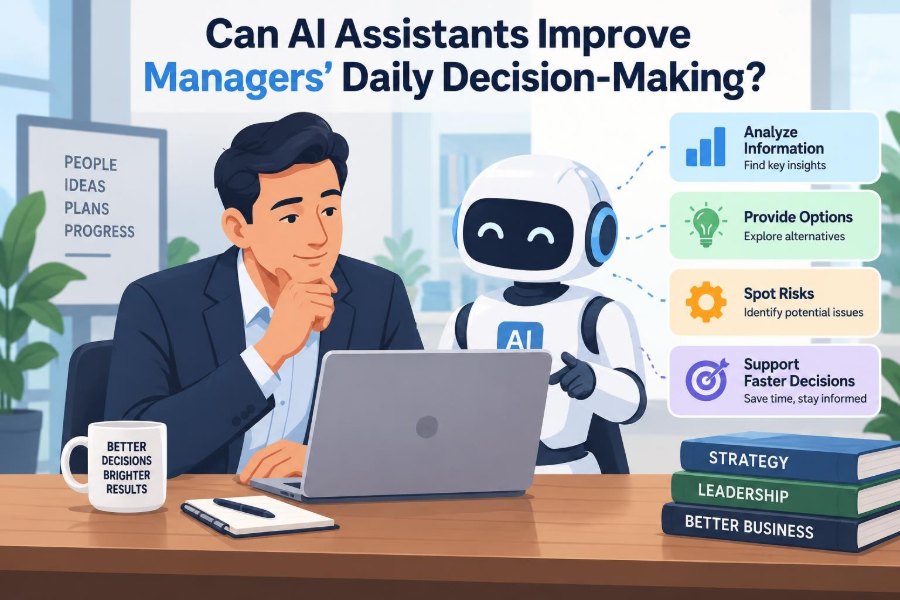
AI assistants can improve daily decision-making when they reduce information friction, structure thinking, generate alternatives, and support clear communication. Their greatest value comes from making managers more prepared to exercise judgment.
They cannot own organisational values, understand every local relationship, accept accountability, or guarantee that an apparently reasonable answer is correct. Those responsibilities remain human.
Use AI to make the decision process more informed, transparent, and reflective—not to transfer responsibility for the decision. 🤝🧠