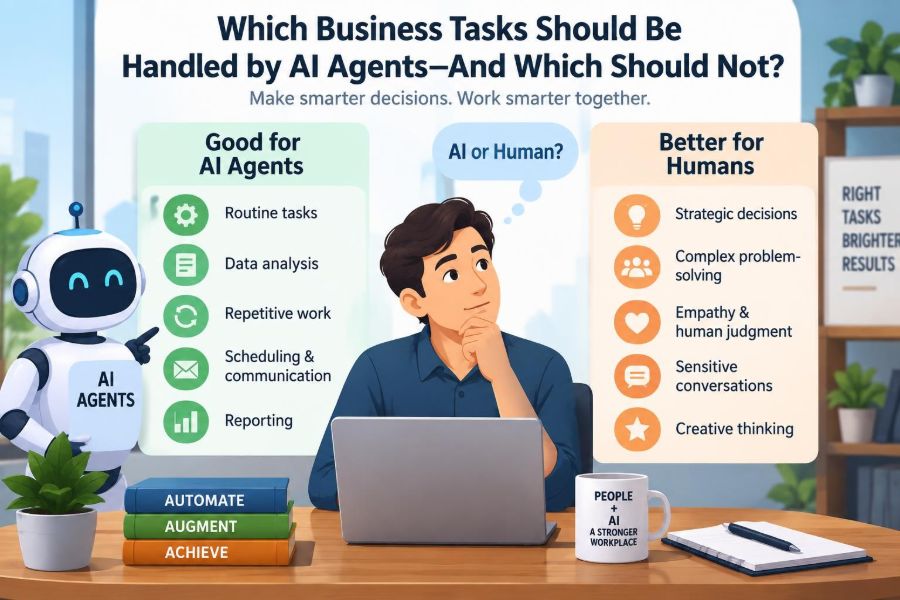

A customer message arrives at 8:45 a.m. A manager is preparing a weekly report, a sales representative is updating a CRM system, and an operations team is trying to find the cause of a delayed order. Each task consumes time. Each also seems like something an AI agent might handle.
But “might” is not the same as “should.” An AI agent can draft, search, summarize, classify, and trigger actions at remarkable speed. It can also misunderstand context, expose sensitive information, or make a polished recommendation that is wrong.
The useful management question is not whether a business should use AI. It is where AI can improve a process without creating unacceptable risk, loss of judgment, or damage to trust.
Making that decision well requires more than listing repetitive tasks. It requires looking at the task, the data, the consequences of an error, and the human responsibility that remains after automation begins.
🧠 Start With What an AI Agent Actually Is
An AI agent is software that can pursue a defined goal through several steps. Unlike a basic chatbot that only responds to a prompt, an agent may retrieve information, use approved tools, update a system, send a message, or request a decision from a person.
For example, an agent might read incoming supplier emails, identify invoice numbers, compare them with purchase records, and route exceptions to an accounts payable employee. Its value comes from combining language understanding with actions inside a workflow.
That capability also raises the stakes. Once a system can act rather than merely suggest, managers need clear boundaries around what it may do independently.
🎯 Separate Automation From Decision-Making
Many business processes contain both routine actions and meaningful decisions. These should not be treated as one package.
Scheduling a meeting, copying data between systems, and preparing a first draft are usually actions with limited judgment. Choosing who receives a discount, approving a refund outside policy, or deciding which employee to promote involves values, trade-offs, and accountability.
A practical rule is to automate the mechanical portion of a process first. Keep the consequential decision with a qualified person unless the decision rules are stable, transparent, and tightly controlled.
🔁 Look for Repetition, but Do Not Stop There
Repetition is a useful starting signal because repeated work often consumes attention without requiring much new thinking. Common examples include categorizing support tickets, extracting fields from documents, drafting routine follow-ups, and checking whether required information is present.
However, a task can be repetitive and still unsuitable for autonomous AI. A repeated legal review or a repeated safety inspection may have serious consequences if a subtle exception is missed.
Ask not only, “How often does this happen?” but also, “What must be true for the answer to be safe every time?”
📏 Assess How Clear the Task Rules Are
AI performs more reliably when a task has a clear objective, recognizable inputs, and defined acceptable outputs. It is easier to triage a request into known categories than to decide what an organization’s brand should stand for.
A task is a stronger candidate when employees can explain the process in plain language: what information to use, what conditions matter, what action follows, and when to escalate.
If experienced employees regularly say, “It depends,” that does not automatically rule out AI. It does mean the hidden conditions need to be identified before an agent is given authority.
🧩 Map the Workflow Before Introducing an Agent
Teams often buy a tool before understanding the work. That can automate confusion rather than improve performance.
Map the current workflow from trigger to outcome. Note the systems involved, the handoffs, delays, judgment calls, exceptions, approvals, and rework. A simple process map frequently reveals that the best opportunity is smaller than the original task.
For instance, a recruitment team may not want an agent to choose candidates. It may benefit from an agent that checks whether applications contain required documents and prepares a structured summary for recruiters.
⚖️ Use the Cost-of-Error Test
Every proposed use should be judged by what happens when the system is wrong. A typo in an internal meeting summary is usually easy to correct. Sending inaccurate payment instructions or denying a customer access to a vital service is not.
Consider direct financial loss, reputational harm, operational disruption, customer impact, regulatory exposure, and the time needed to detect and repair an error.
Low-cost errors are appropriate places to experiment. High-cost errors demand stronger controls, human approval, or a decision not to automate at all.
🚦 Match Autonomy to Risk
AI adoption does not have to be a choice between full autonomy and no use. Most organizations can use levels of authority.
| Level | What the agent does | Suitable example |
|---|---|---|
| Assist | Creates information for a person to use | Drafting a meeting summary |
| Recommend | Suggests an action with reasons | Prioritizing service tickets |
| Act with review | Takes action that is checked afterward | Updating standard CRM fields |
| Act independently | Completes bounded, low-risk actions | Sending approved status updates |
Start at the lowest useful level. An agent that recommends well can later earn a broader role if its performance and controls justify it.
🗂️ Check Whether the Input Data Is Trustworthy
An agent cannot create reliable outcomes from unclear, outdated, contradictory, or poorly governed information. It may sound confident even when it has been given incomplete context.
Before deployment, identify the source of truth. If customer records differ between systems, decide which record governs. If policies change frequently, make sure the agent retrieves the current approved version rather than relying on old examples.
Data quality work may feel less exciting than automation, but it often determines whether an AI project helps or frustrates employees.
🔒 Protect Sensitive and Confidential Information
Tasks involving personal data, employee records, financial details, trade secrets, or confidential negotiations need extra scrutiny. The question is not simply whether an AI system can process the information; it is whether it should receive it and under what safeguards.
Managers should clarify access permissions, retention practices, approved vendors, data locations, audit records, and rules for sharing information externally. Requirements differ by organization and jurisdiction, so legal, privacy, security, and compliance specialists may need to review the design.
Limit an agent to the minimum data required for its job. Narrow access reduces the potential impact of mistakes or misuse.
🪪 Keep Identity, Permission, and Authority Separate
When an agent uses business systems, it should not simply inherit unlimited access from the person who configured it. Its permissions should match its specific purpose.
An agent that creates draft purchase orders does not need authority to approve payments. A support agent that reads order status may not need access to full customer financial histories.
This principle, often called least-privilege access, is basic operational discipline. It also makes audits and incident investigation far more manageable.
🧭 Preserve Human Judgment Where Values Matter
Some decisions cannot be reduced to pattern matching because they involve fairness, empathy, competing interests, or an organization’s values. These include disciplinary action, hiring decisions, layoffs, sensitive customer complaints, and decisions affecting vulnerable people.
AI can help organize evidence, identify missing information, or draft options. It should not become a convenient shield that lets leaders avoid responsibility for difficult choices.
A useful question is: if this decision harms someone, who can explain and defend the reasoning? If the answer is unclear, human oversight is not optional.
💬 Treat Customer Conversations Differently From Back-Office Tasks
Internal administrative work and customer-facing communication have different risks. A flawed internal draft can be corrected quietly. A misleading customer reply may create confusion, promises the company cannot keep, or lasting distrust.
AI agents are often suitable for answering straightforward questions from approved knowledge bases, such as store hours, order tracking steps, or password-reset instructions. They are less suitable for complex disputes, emotionally charged issues, or exceptions requiring negotiation.
Customers should have an easy path to a person. Escalation is not a failure of automation; it is part of good service design.
🛠️ Give the Agent Narrow Tools, Not Open-Ended Power
An agent becomes more useful when it can use tools, but every tool expands the possible damage from a bad instruction or faulty interpretation. A broad command such as “manage customer accounts” is difficult to control.
Break authority into specific actions: retrieve an order status, create a draft reply, apply a pre-approved shipping update, or flag a mismatch. Set limits on amounts, locations, message recipients, and the types of records it can change.
Bounded tools make behavior easier to test, monitor, and reverse.
🧪 Test With Realistic Exceptions
A demonstration often uses neat examples. Real operations contain incomplete forms, duplicate names, unusual requests, conflicting policies, and messages written in unclear language.
Test an agent against representative edge cases before expanding its role. Include situations where it should decline to act, ask for clarification, or escalate to a human.
- Missing or contradictory customer details
- Requests outside policy
- Urgent language that tries to bypass normal controls
- Outdated or conflicting source documents
- Cases involving sensitive personal information
The goal is not to make the agent handle everything. It is to make its limits predictable.
🧾 Require Traceability for Meaningful Actions
When an agent affects a customer, employee, transaction, or operational record, managers should be able to answer basic questions afterward. What information did it use? What action did it take? Which rule, source, or approval supported that action?
Logs do not make a system correct, but they make review possible. They also help teams identify recurring failures, improve instructions, and resolve disputes without relying on memory.
For high-impact workflows, recordkeeping requirements may be formal. Even in lower-risk work, traceability is a practical management habit.
🔄 Design a Clear Escalation Path
An agent needs more than a success path. It needs instructions for uncertainty and failure.
Define triggers for escalation: low confidence, missing information, policy exceptions, sensitive language, unusually high values, or requests from protected accounts. Identify who receives the case and what context they need to resolve it quickly.
A good handoff includes the original request, relevant records, the agent’s attempted reasoning, and the unresolved question. This prevents employees from having to repeat the agent’s work from the beginning.
👥 Consider the Effect on Employee Work
AI changes jobs unevenly. It may remove tedious copying and searching while increasing the need for review, exception handling, customer empathy, and process improvement.
Managers should discuss these changes openly. Employees often understand exceptions better than anyone because they work around broken processes every day. Involving them in design produces more realistic workflows and reduces the risk that automation simply shifts burdens elsewhere.
Training should cover both how to use the agent and when not to trust it.
📈 Measure More Than Time Saved
Time savings matter, but they are not enough to evaluate an AI agent. A fast process that creates customer complaints, more rework, or hidden compliance risk is not efficient in a meaningful sense.
Choose measures that reflect the purpose of the workflow. These may include completion time, error correction, escalation volume, customer satisfaction signals, policy adherence, and employee effort required to supervise the agent.
Review outcomes over time. Early success can fade if source data changes, policies evolve, or users find ways to exploit weak controls.
🧮 Compare Total Process Cost, Not Just Labor Cost
An agent may reduce manual work while introducing setup, integration, monitoring, security, training, and exception-management costs. These are normal parts of operating an automated process, not temporary inconveniences to ignore.
Estimate the whole picture: the current workload, expected volume, reliability needs, cost of errors, and the effort needed to maintain the workflow. A small manual process may remain cheaper and safer than a sophisticated automation.
The best candidate is often a high-volume task with stable rules and a costly manual bottleneck—not merely the task that looks most impressive in a presentation.
🧠 Avoid Using AI as a Substitute for a Broken Process
If approvals are unclear, policies conflict, or ownership is uncertain, an AI agent will inherit those weaknesses. It may even make them harder to notice because actions happen faster.
Use automation projects as a reason to simplify the process first. Remove unnecessary steps, clarify responsibility, standardize inputs, and decide what a good outcome looks like.
Think of AI as a capable new team member. Giving that team member an incoherent procedure does not turn it into a coherent procedure.
🗣️ Watch for Hallucinations and False Confidence
Generative AI systems can produce plausible but inaccurate statements, sometimes called hallucinations. This is particularly risky when an agent summarizes policies, answers questions from incomplete information, or generates explanations for decisions.
Reduce this risk by connecting the agent to approved, current sources; requiring it to cite the internal source in its work record where appropriate; and restricting it from filling gaps with guesses. Human review remains valuable when accuracy is critical.
Fluent language should never be mistaken for verified knowledge.
🧱 Distinguish Rules-Based Work From Ambiguous Work
Some tasks are governed by explicit criteria: if a form lacks a required field, return it; if an invoice number does not match a purchase order, flag it. AI can help interpret messy inputs, while the final action follows a known rule.
Other work is inherently ambiguous: setting strategy, resolving a conflict between two valuable customers, judging the credibility of a partner, or inventing a new market position. AI can inform these tasks, but it cannot remove the need for accountable human judgment.
The distinction is not “simple versus difficult.” It is bounded and verifiable versus open-ended and consequential.
📬 Use AI Carefully in Sales and Marketing
Agents can prepare account research, personalize first drafts, organize lead information, and identify follow-up tasks. These uses can reduce administrative friction for sales teams.
They should not send unchecked claims, imply contractual commitments, invent product capabilities, or pressure prospects through insensitive automated messages. Brand reputation is built in small interactions, including routine outreach.
Provide approved messaging, clear review rules, and limits on audience selection. Especially for new campaigns, test small and inspect the actual customer experience.
💰 Put Firm Boundaries Around Financial Actions
Financial workflows deserve conservative design because a single incorrect payment, account change, or fraudulent instruction can be difficult to reverse. AI can assist with reconciliation, anomaly detection, document extraction, and preparing summaries.
Payments, bank-detail changes, credit decisions, pricing exceptions, and material journal entries generally require defined authorization controls and appropriate review. The exact controls depend on the organization, but the underlying principle is stable: do not give an agent authority that bypasses financial accountability.
Segregating duties—having different people or systems initiate, approve, and reconcile an action—remains useful even when AI is involved.
⚙️ Choose a Pilot That Teaches You Something
A strong pilot is narrow enough to control but meaningful enough to reveal real operational issues. It should have a clear owner, a defined group of users, measurable outcomes, and a straightforward way to stop or roll back the change.
Good pilot questions include: Does the agent handle standard cases correctly? Which exceptions occur most often? Does review take less time than the original task? Are users relying on outputs too readily?
A pilot is not merely a showcase. It is an opportunity to learn whether the workflow is truly suitable.
🔍 Review Agent Performance Continuously
Business environments change. Product details, policies, customer language, systems, and fraud patterns can all shift after launch. An agent that worked well in one quarter may become unreliable if its sources or assumptions are no longer current.
Assign an accountable business owner who reviews performance, approves important changes, and coordinates with technical, security, and compliance teams where needed. Periodic sampling of completed work is often more practical than trying to inspect every action.
Automation needs operations management, not a one-time installation.
🧑⚖️ Keep Accountability With People
Organizations sometimes describe an AI outcome as though the system itself made the decision. In management terms, that language can blur responsibility.
People choose the goal, data, instructions, tools, limits, and approval model. Leaders also decide whether a process is acceptable for automation. Those choices create accountability even when the agent performs the immediate action.
Clear ownership encourages better design: someone is responsible for asking whether the agent is still helping the business achieve its intended outcome.
📝 Use a Practical Go/No-Go Checklist
Before handing a task to an AI agent, gather the process owner, frontline users, and relevant risk specialists. Then ask a focused set of questions.
- Is the task frequent enough to justify setup and oversight?
- Are inputs, rules, and acceptable outputs sufficiently clear?
- Can errors be detected and corrected quickly?
- What is the worst plausible consequence of a mistake?
- Does the agent need sensitive information or powerful system access?
- Can it escalate uncertain or exceptional cases?
- Is there an accountable human owner and a way to audit actions?
Several “no” answers do not always end the project. They may indicate that the agent should assist rather than act autonomously.
🌱 Build Capability Gradually
The most durable approach is usually progressive. Begin with information gathering, drafting, classification, and other low-risk support. Improve data and workflows. Add limited actions only after the organization understands where failures occur and how people respond.
This gradual approach also builds employee confidence. Teams are more likely to use an agent productively when they can see its boundaries, correct its errors, and understand how it supports rather than replaces sound judgment.
Speed matters in business, but unexamined speed can amplify a weak process.
🏁 The Core Principle: Automate Work, Not Responsibility
AI agents are well suited to work that is repetitive, bounded, observable, and reversible. They can reduce administrative load, surface information faster, and help employees focus on problems that require experience and relationships.
They are poor substitutes for accountability in decisions that are ambiguous, high-impact, value-laden, sensitive, or difficult to undo. In those situations, AI may still be useful as an assistant, but the decision and its consequences must remain visibly human-owned.
The strongest AI strategy is not to hand over every possible task. It is to assign each task to the combination of technology and human judgment that produces reliable, responsible results.
Use AI agents to extend disciplined business processes—not to avoid the careful thinking, oversight, and accountability that good management requires. 🤖🧭📈