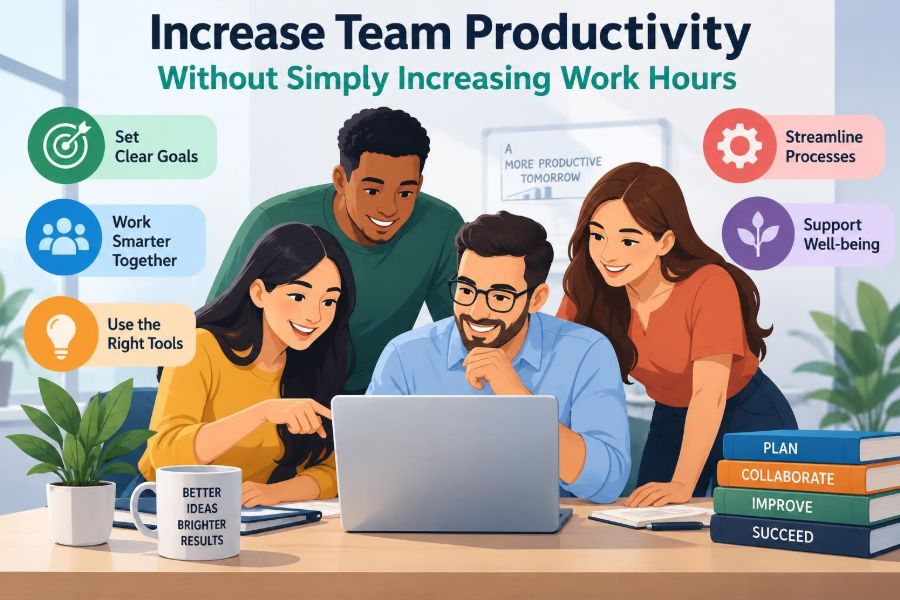

It is late afternoon, deadlines are approaching, and the same response appears in the team chat: “We may need to work longer this week.” It can feel responsible, even inevitable. Yet when extended hours become the default answer, mistakes rise, energy drops, and important work is pushed aside by urgent noise.
Most teams do not have a pure effort problem. They have a system problem: unclear priorities, overloaded workflows, slow decisions, interruptions, missing information, or work that must be redone.
Productivity is not the number of hours people appear busy. It is the ability to turn limited time, attention, and resources into useful outcomes without exhausting the people responsible for them.
A better approach asks a more revealing question: what is making valuable work take longer than it should? Once leaders look for friction rather than simply demanding more effort, practical improvements become visible.
🎯 Start With the Meaning of Productivity
Team productivity should be defined as valuable output produced with sustainable effort. Output might mean resolved customer cases, accurate reports, completed software features, qualified sales opportunities, or safer operations. The right measure depends on the team’s purpose.
This definition matters because activity is easy to see but value is harder to assess. A person can answer many emails, attend many meetings, and still make little progress on work that moves the organization forward.
🧭 Separate Outcomes From Activity
Teams often track what is convenient: tasks closed, calls made, or hours logged. These measures can be useful signals, but they are not automatically evidence of progress.
For example, a customer-support team may close tickets quickly by giving short replies, while customers continue to contact the company because their problems remain unresolved. A stronger outcome measure could include resolution quality and repeat-contact patterns, not just ticket volume.
🔍 Diagnose Friction Before Adding Pressure
Before changing targets or schedules, identify where work slows down. Ask team members to describe a recent task that took far longer than expected. Their answers often reveal delays that dashboards miss.
- Waiting for approval or a decision
- Searching for files, data, or previous conversations
- Clarifying vague requests after work has begun
- Switching repeatedly between unrelated tasks
- Correcting errors caused by rushed handoffs
These are not minor irritations. They consume capacity every week and can make talented people appear less productive than they are.
🧱 Find the Real Bottleneck
A bottleneck is the point in a workflow that limits the pace of everything behind it. If every proposal needs one manager’s sign-off, speeding up proposal writing will not meaningfully increase the number of approved proposals.
Look for queues: work waiting in an inbox, a review column, a shared folder, or an informal list. The longest and most persistent queue often points to a constraint. Improve that point first, then reassess; the bottleneck may move elsewhere.
📌 Make Priorities Concrete
“Everything is urgent” is not a priority system. When people cannot tell which work has the greatest value, they usually respond to whoever asks most loudly or most recently.
Translate broad goals into a small, visible set of current priorities. Each item should have an intended result, an owner, a time frame, and a reason it matters. This makes it easier to decline, defer, or redirect work that does not fit.
🚦Limit Work in Progress
Starting more work than a team can finish creates hidden costs. Each unfinished item requires memory, follow-up, coordination, and status checking. This is often called work in progress, or WIP.
Setting a WIP limit means agreeing that the team will finish or deliberately pause current work before opening too many new items. It may feel slower at first, but fewer half-complete tasks usually produce faster delivery and clearer status.
🧩 Break Large Deliverables Into Finishable Pieces
Large, vague assignments invite delay because no one can see a practical first step. Break a deliverable into pieces that can be reviewed, tested, or used independently where possible.
For instance, instead of assigning “improve onboarding,” a team might first map the new employee journey, identify the three most confusing stages, rewrite one guide, and test it with a small group. Smaller pieces create feedback sooner and reduce the risk of discovering problems only at the end.
🗺️ Clarify Ownership and Decision Rights
Many delays are really ownership delays. Several people assume someone else will act, or everyone contributes opinions but no one has authority to decide.
For recurring work, clarify who does the task, who makes the final decision, who must be consulted, and who simply needs an update. The goal is not to create bureaucracy. It is to prevent work from circling through unnecessary approval loops.
📝 Improve the Quality of the Request
A poor request creates a poor starting point. “Can you prepare something for the client?” forces the recipient to guess at audience, purpose, format, deadline, and what good looks like.
A useful request states the desired outcome, relevant background, constraints, source material, decision maker, and due date. It also distinguishes a genuine deadline from a preferred date. Better inputs reduce rework before it begins.
🔄 Design Better Handoffs
Work rarely stays with one person. It passes among departments, shifts, roles, or specialist teams. A handoff is weak when the next person must reconstruct context from messages, attachments, and memory.
Use a consistent handoff note that answers: what has been completed, what remains, what decisions were made, what risks exist, and what the recipient needs to do next. This is especially valuable when work is time-sensitive or distributed across locations.
🗂️ Create One Reliable Source of Truth
When plans live in one spreadsheet, comments in chat, files in several folders, and decisions in meetings, people spend time reconciling versions instead of moving work forward.
Choose a clearly defined home for each type of information: the current task status, approved document, project decision, and operating procedure. The best tool is not necessarily the most elaborate one; it is the one the team can maintain consistently.
🔕 Protect Focused Work
Complex work needs uninterrupted attention. Frequent interruptions do not only take the seconds needed to answer a message; they also create a mental switching cost as a person rebuilds their understanding of the original task.
Teams can protect focus by setting response-time expectations, using status indicators honestly, grouping non-urgent questions, and reserving blocks for concentrated work. This is not a reason to ignore customers or colleagues. It is a way to distinguish urgent coordination from habitual interruption.
📅 Reduce Meetings That Do Not Move Work
A meeting earns its place when discussion, alignment, problem solving, or a decision genuinely needs people together. It is a poor substitute for a written update, a shared tracker, or a decision that one accountable person can make.
Before scheduling, ask what must be different by the meeting’s end. If there is no specific answer, use another method. For necessary meetings, send context in advance, invite only needed participants, and end with named actions and decisions.
⏱️ Use Short Check-Ins for Coordination
Brief check-ins can be highly useful when they expose blockers early. The problem begins when they become lengthy reports to a manager rather than coordination among people doing interdependent work.
A practical format is simple: what changed since the last check-in, what is next, and what is blocked? Issues requiring deep discussion can be taken offline with the people who can resolve them. The group gains visibility without turning every update into a meeting.
🧠 Match Work to Energy and Skill
Not all hours have equal value. Analytical, creative, or high-stakes tasks often require more mental energy than routine administrative work. Asking people to do their hardest work when they are depleted produces slower, less reliable results.
Where schedules allow, help people identify when they do their best concentrated work and protect that time. Also consider skill fit. A task assigned solely because someone is available may take longer than one assigned to a person with relevant experience.
🎓 Build Capability Instead of Repeated Rescue
When the same person is always called in to solve a problem, the team may deliver in the short term but become dependent on a narrow point of expertise. That person becomes a bottleneck and may eventually burn out.
Document recurring solutions, pair experienced employees with colleagues, and create opportunities to practice important skills. Training has an upfront time cost, but it can reduce future waiting, errors, and escalation.
🤖 Automate Repetition Carefully
Automation can remove repetitive steps such as copying data, routing standard requests, generating routine reminders, or applying simple checks. It is most useful when the process is stable and the rules are clear.
Do not automate confusion. If a process has unclear ownership or poor-quality inputs, automation may spread errors faster. First simplify the workflow, then decide whether a tool, template, integration, or script can reliably handle part of it.
📋 Standardize Routine Work Without Stifling Judgment
Checklists, templates, and standard operating procedures reduce the need to reinvent predictable steps. They are particularly helpful for work that has quality, safety, compliance, or customer-service consequences.
Standardization should guide routine decisions, not eliminate professional judgment. A useful procedure explains when to follow the normal path and when to escalate an exception. Rigid rules can be as inefficient as no rules when unusual cases require thoughtful action.
✅ Define Quality Before Work Starts
Rework is one of the largest hidden drains on productivity. It occurs when a deliverable is technically complete but does not meet the expectations of the person receiving it.
Agree on acceptance criteria before work begins. These are observable conditions that indicate the work is ready: required data is included, calculations are checked, the client’s question is answered, or the feature works in agreed situations. Clear quality standards reduce subjective review cycles.
🛠️ Treat Errors as Process Signals
When an error occurs, it is tempting to focus only on who made it. Individual accountability matters, but a productive review also asks what in the system allowed the mistake to pass through.
Was the instruction ambiguous? Was there a missing check? Did a deadline encourage rushing? Was the information unavailable? Fixing these conditions makes repetition less likely without creating a culture where people hide problems.
💬 Create Psychological Safety for Early Warnings
Psychological safety means people can raise concerns, admit uncertainty, and ask questions without expecting humiliation or retaliation. It does not mean avoiding accountability or lowering standards.
Teams need this safety because small warnings are valuable. A junior analyst who says, “I do not understand this assumption,” may prevent an expensive error. Leaders shape the climate by responding to bad news with curiosity first: what happened, what is needed now, and what should change?
📈 Measure Flow, Quality, and Capacity Together
One metric can distort behavior. Measuring only speed can encourage rushed work; measuring only quality can encourage endless refinement; measuring only utilization can leave no capacity for improvement or unexpected issues.
| Dimension | Useful question | Possible signal |
|---|---|---|
| Flow | How smoothly does work move? | Time from request to completion; items waiting |
| Quality | Does the output solve the intended problem? | Rework, defects, repeat requests, review feedback |
| Capacity | Can the team sustain the pace? | Workload patterns, absence, overtime, blocked work |
Measures should prompt investigation, not automatic judgment. Context matters: a longer cycle may be appropriate for a complex, high-risk case.
🧪 Run Small Improvement Experiments
Large productivity programs can create change fatigue. A smaller experiment is easier to understand and evaluate. Choose one friction point, change one or two conditions, decide what you will observe, and set a review date.
For example, a marketing team might test a single intake form for two weeks instead of accepting requests by email, chat, and hallway conversation. The question is not whether the new form feels modern; it is whether fewer requests require clarification and whether important work starts sooner.
📊 Review Work at the Right Cadence
Daily review is useful for rapidly changing operational work. A monthly review may suit a project with slower milestones. Too little review lets issues remain hidden; too much review turns tracking into work of its own.
Use a predictable rhythm to examine priorities, queues, risks, workload, and decisions needed. The purpose is to adjust the system while there is still time to act, not to create a retrospective explanation after a deadline has passed.
⚖️ Distinguish Healthy Stretch From Chronic Overload
Occasional intense periods can be part of real work: a launch, an incident, a seasonal peak, or an unexpected customer need. The concern is when emergency pace becomes normal operating practice.
Chronic overload reduces the time available for planning, learning, quality checks, and recovery. It can also cause people to optimize for visible short-term completion rather than durable solutions. Sustainable productivity requires capacity for both delivery and improvement.
🚫 Avoid the Productivity Traps
Some responses look decisive but usually worsen the underlying problem. Common traps include adding meetings to solve communication overload, introducing new software before simplifying the process, and measuring individual output where results depend on teamwork.
- Micromanagement: creates approval queues and discourages initiative.
- Constant reprioritization: leaves work half done and makes planning unreliable.
- Blanket automation: can scale flawed decisions or bad data.
- Hero culture: rewards last-minute rescue while ignoring preventable causes.
These approaches may create a temporary appearance of control. They rarely build a team that can perform well over time.
🤝 Give Managers the Right Job
A manager’s role is not to keep every person visibly occupied every minute. It is to create the conditions in which the team can do valuable work: direction, resources, decisions, feedback, coordination, and protection from unnecessary distractions.
That may mean challenging an unrealistic request, resolving conflict between priorities, or removing an approval layer. These actions can be less visible than working late alongside the team, but they often have a larger effect on collective output.
🌱 Make Improvement Part of Normal Work
Productivity improvements disappear when they are treated as a one-time initiative. Teams need a regular way to notice friction, test changes, retain what works, and discard what does not.
Reserve modest time for this work. A team that uses every available minute on immediate delivery has no room to improve the system that creates its workload. Continuous improvement is not endless change; it is disciplined learning about how work actually happens.
🏁 Build a Sustainable High-Performance System
Increasing productivity without increasing hours is not about asking people to move faster at all costs. It is about reducing wasted motion, concentrating effort on meaningful priorities, and designing work so that good decisions and good handoffs are easier.
The strongest starting points are usually straightforward: make priorities visible, locate bottlenecks, limit unfinished work, protect focus, define quality, and listen when people describe recurring obstacles. Each improvement may seem modest, but together they change the pace and reliability of the whole system.
When a team has clarity, capable people, workable processes, and room to recover, extra hours become an exception rather than the engine of performance.
Lasting team productivity comes from better work design, not from expecting people to give more hours than the system deserves. 📊🌱🤝