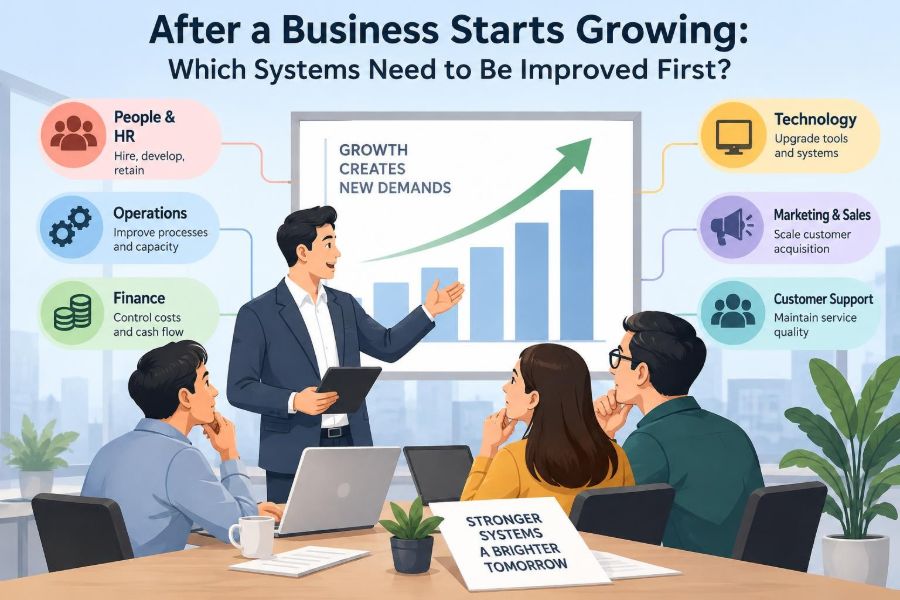

A business can feel healthy right up until the moment it becomes hard to run. Orders are increasing, new customers are arriving, and the team is busier than ever. Yet invoices go out late, stock counts do not match reality, customers repeat the same questions, and the owner becomes the person every decision waits for.
This is a common growth transition. The problem is not that the business has become “too successful.” It is that informal ways of working, which were sensible when the company was small, no longer carry the volume, complexity, and handoffs now involved.
Growth exposes systems that were previously invisible. A spreadsheet maintained by one person, a verbal approval, or a founder’s memory may work for ten transactions a week. At one hundred, those same habits can create delays, errors, and avoidable stress.
The right response is not to automate everything or buy the most sophisticated software available. It is to improve the systems that protect customers, cash, quality, and decision-making first—and to build them in an order the business can actually absorb.
🌱 Recognize the Shift From Effort to Systems
In an early-stage business, individual effort often compensates for missing processes. A committed owner can check each order, answer each customer, and solve problems as they appear. That flexibility is valuable, but it does not scale indefinitely.
A system is a repeatable way of producing a reliable result. It includes the steps, people, information, decisions, and tools involved. As volume grows, outcomes should depend less on who happens to be available and more on a process that is clear and usable.
📈 Understand Why Growth Creates Operational Strain
Growth does not simply mean doing more of the same. More sales can bring more product variations, delivery locations, payment methods, returns, suppliers, employees, and customer expectations. Each adds connections between parts of the business.
Those connections create coordination work. For example, a sales promise affects stock availability, production scheduling, delivery capacity, invoicing, and customer communication. If information moves slowly or inconsistently between those functions, growth magnifies the gap.
🧭 Do Not Start With Software
New software can improve visibility and reduce manual work, but it cannot repair an unclear process. Digitizing a confusing approval route often creates a faster version of confusion.
Before selecting a tool, describe the current workflow in plain language: what triggers it, who does each step, what information is needed, where decisions occur, and what a finished result looks like. This reveals whether the real constraint is technology, capacity, unclear ownership, or poor process design.
🚦 Use Customer Pain and Business Risk to Set Priorities
Not every weak system deserves equal attention. Prioritize based on the damage caused when the system fails, the frequency of failure, and the business’s ability to detect and recover from mistakes.
A useful question is: if this process broke for a week, what would happen first? A delayed internal report may be inconvenient. Incorrect payroll, missing customer orders, or an inability to collect payment can quickly threaten trust and cash flow.
| Priority signal | What it may indicate | Typical first response |
|---|---|---|
| Customers complain repeatedly | A broken service or fulfillment handoff | Map the customer journey and assign ownership |
| Cash is unexpectedly tight | Weak invoicing, collections, pricing, or purchasing control | Improve financial visibility and billing discipline |
| Staff keep asking the same questions | Undocumented decisions or unclear roles | Create simple procedures and decision rules |
| Errors rise as volume rises | Manual re-entry, missing checks, or poor data quality | Standardize inputs before automating |
💵 Stabilize Cash Visibility First
A growing business can be profitable on paper and still struggle to pay suppliers or wages on time. Growth often requires cash before revenue arrives: inventory must be bought, staff hired, and work completed before customers pay.
Improve the basic financial rhythm early. Record sales and costs promptly, issue invoices consistently, track due dates, review overdue payments, and compare expected cash movements with actual bank balances. A short-term cash forecast is not a prediction of certainty; it is a working view of upcoming commitments and likely receipts.
🧾 Make Billing and Collections Reliable
Late invoicing is a quiet drain on working capital. If a completed job waits days or weeks to be billed, the customer’s payment cycle begins late too.
Define a clear trigger for invoicing: completed delivery, signed acceptance, milestone completion, or another agreed event. Ensure customer details, purchase-order requirements, taxes where applicable, and payment terms are checked before work begins. Chasing payment is easier when the original invoice was accurate and expected.
🏷️ Review Pricing Before Volume Locks It In
More sales do not automatically create more margin. A business may be underpricing delivery, customization, support, returns, payment fees, or rush work. These costs can remain hidden when the owner absorbs them personally.
Review whether each offer covers its direct costs and makes a realistic contribution toward shared costs. This does not mean every product needs the same margin. It means leaders should understand the trade-offs before a popular but low-return offering becomes the center of operations.
📦 Build Control Over Orders and Fulfillment
For product businesses, the order-to-delivery process is often the first major operational priority. For service businesses, the equivalent may be inquiry-to-project completion. Either way, customers need accurate promises and dependable follow-through.
Define one source of truth for each order: customer requirements, status, promised date, payment status, and delivery method. Avoid a situation where sales has one version in email, operations has another in a spreadsheet, and the customer receives a third version by message.
🔍 Map the Customer Journey End to End
Customers experience one business, not separate departments. They do not distinguish between a marketing error, a warehouse error, and an accounts error when a delivery is wrong.
Map the journey from first inquiry through purchase, delivery, support, renewal, or return. At each stage, ask what the customer needs to know, what can go wrong, who owns the next action, and how the business confirms completion. This makes handoffs visible.
📞 Create a Consistent Customer Support System
As customer volume rises, support requests can scatter across personal inboxes, social messages, phone calls, and informal conversations. That makes it easy to lose requests and difficult to learn from recurring issues.
Start simply: define support channels, set response expectations, log requests in one place, and categorize common problems. A formal help desk may eventually be useful, but the first improvement is usually consistency rather than complexity.
📚 Turn Repeated Answers Into Usable Knowledge
When staff repeatedly explain the same policy or solve the same setup issue, valuable knowledge is trapped in people’s heads. This slows onboarding and creates different answers for different customers.
Create short internal guides for recurring questions, exceptions, product details, and escalation rules. Keep them easy to update. A ten-page manual nobody opens is less useful than a searchable one-page checklist used at the moment of work.
🏭 Standardize the Core Delivery Process
Every business has a core value-creation process: manufacturing a product, completing a client engagement, preparing food, delivering care, or maintaining equipment. Growth makes variation in that process more visible.
Standardization does not mean removing judgment. It means identifying which steps must be done consistently to protect quality, safety, compliance, timing, or customer expectations. Skilled employees should still have room to handle unusual cases, but they should not need to reinvent routine work.
✅ Put Quality Checks at the Right Points
Quality control is most effective when checks happen close to the point where an error can be corrected. Discovering a wrong address before dispatch is far cheaper than discovering it after a failed delivery.
Use checks where risk is highest: incoming materials, specification confirmation, final review, or handoff to a customer. Too many approvals can slow work without improving outcomes, so focus on failures that are costly, common, or difficult to reverse.
📊 Improve Inventory and Capacity Planning
Growing businesses often face two opposite problems: too little stock or capacity to meet demand, and too much cash tied up in items or resources that move slowly. Both come from weak visibility.
Track what is available, committed, on order, and expected to arrive. For services, track staff availability, skills, project commitments, and realistic delivery time. Forecasts will be imperfect, but a shared view is better than each department making separate assumptions.
🔗 Strengthen Supplier and Partner Coordination
Suppliers, contractors, distributors, and logistics partners become part of the customer experience. A business cannot fully control them, but it can reduce avoidable surprises through clearer communication.
Set expectations for specifications, lead times, order changes, quality issues, and escalation contacts. Avoid relying on one informal relationship for a critical input. Documenting alternatives and lead-time risks supports resilience without requiring every supplier relationship to become bureaucratic.
👥 Clarify Roles Before Hiring More People
Hiring can relieve pressure, but adding people to a confused system can increase coordination problems. New employees need to know what they own, which decisions they can make, and when to involve someone else.
A role description does not need to be elaborate. It should distinguish responsibilities that are often blurred: who receives orders, who confirms feasibility, who approves exceptions, who sends invoices, and who closes the loop with customers.
🧑🏫 Build an Onboarding System
When a small team grows, “learn by sitting next to someone” becomes unreliable. New hires may receive different instructions depending on who trains them, and experienced staff lose time repeating basic explanations.
Build onboarding around the first weeks of real work. Include essential tools, key procedures, product or service knowledge, expected standards, common mistakes, and a named person to ask for help. Update the material whenever a new hire exposes a missing explanation.
🗣️ Establish a Useful Communication Rhythm
More people do not necessarily need more meetings. They need predictable ways to share information that affects their work. Without this, updates live in private chats and important decisions arrive too late.
Create a small rhythm of communication: a brief operational check-in, a regular review of priorities and risks, and a clear route for urgent decisions. Each meeting should have a purpose, an owner, and an outcome. If it produces neither decisions nor useful information, redesign or remove it.
🧩 Define Decision Rights
Bottlenecks often form around founders or senior managers because nobody knows what they are permitted to decide. The result is delay, frustration, and leaders spending time on routine exceptions.
Decision rights specify who can make which choices and within what boundaries. For instance, a service manager may resolve a customer issue up to an agreed cost limit, while larger concessions require review. The aim is not to eliminate oversight; it is to place decisions near the relevant information.
🗂️ Create a Single Source of Truth for Data
Different versions of customer details, prices, employee records, or stock levels create errors that no amount of effort can fully prevent. Teams begin debating whose spreadsheet is correct instead of acting on information.
Choose where each important type of data officially lives. This may be an accounting platform, customer relationship system, inventory tool, or carefully governed spreadsheet. The key principle is clear ownership: people must know where to look and who corrects inaccurate records.
🔐 Protect Access, Records, and Business Continuity
As more staff and tools are added, access control becomes a practical business issue. Shared passwords, former employees retaining access, and unprotected files can lead to disruption or exposure of sensitive information.
Use individual accounts where possible, remove access promptly when roles change, back up important records, and document who can access critical systems. The appropriate safeguards depend on the business and the information involved, but basic discipline is usually more valuable than a complicated security policy nobody follows.
⚖️ Build Compliance Into Routine Work
Requirements involving tax, employment, privacy, safety, licenses, contracts, or industry rules vary by location and sector. Growing businesses should not assume that informal practices remain sufficient as staff, customers, or regulated activities increase.
Identify the obligations that apply and make compliance part of normal workflows rather than an occasional panic task. Because rules and circumstances differ, businesses should seek qualified local advice for legal, tax, and regulatory decisions rather than treating general guidance as a substitute.
📉 Choose Metrics That Lead to Action
Metrics should help a team make decisions, not merely decorate a dashboard. A useful measure connects to a controllable process: overdue invoices, order accuracy, turnaround time, rework, unresolved support requests, or capacity utilization.
Use a limited set of measures with agreed definitions. If one team counts an order when it is requested and another counts it when it is paid, their reports may both be accurate but still impossible to compare. Definitions matter as much as the numbers.
🔄 Create Feedback Loops, Not Just Reports
A report tells you what happened. A feedback loop uses that information to change what happens next. If late deliveries rise, the team should investigate where delays start, test an adjustment, and review whether performance improves.
Keep the loop practical: observe, discuss, decide, try, and review. This turns measurement into operational learning rather than a monthly ritual. Small, repeated improvements are often safer than one large overhaul.
🤖 Automate Stable, High-Volume Tasks
Automation works best when a task is frequent, rule-based, and already reasonably stable. Examples may include invoice reminders, order confirmations, routine data transfer, appointment reminders, or approval notifications.
Automating too early can hide bad assumptions. First remove unnecessary steps, clarify exceptions, and verify data quality. Then automate the routine path while preserving a way for people to handle unusual cases.
🛠️ Document Processes Without Creating Bureaucracy
Process documentation should help someone perform work correctly, not satisfy a desire for paperwork. Begin with the processes that affect customers, money, safety, or frequent errors.
A useful procedure normally includes the trigger, steps, owner, required information, expected output, and what to do when something goes wrong. Screenshots, templates, and checklists are often clearer than long prose. Review documents after real use, because the process on paper may differ from actual practice.
🚫 Avoid the “Fix Everything” Growth Mistake
When pain becomes visible, leaders may launch several major changes at once: a new system, new roles, revised pricing, new reporting, and a reorganization. The team can become overwhelmed, and it becomes difficult to tell which change caused which result.
Sequence improvements. Stabilize a high-risk process, confirm that it works, then move to the next constraint. Some systems are connected, so work cannot always be perfectly isolated, but a clear order protects attention and reduces change fatigue.
🧪 Pilot Changes Before Rolling Them Out
A pilot is a limited test of a new process, tool, or policy before wider adoption. It can reveal missing steps, training needs, and unintended effects while the cost of adjustment is still manageable.
Choose a representative team, product line, or customer segment where possible. Define what success would look like, collect feedback from people doing the work, and revise before expansion. A pilot should test a real operating condition, not an unusually easy case.
🧠 Keep the Founder’s Knowledge From Becoming a Bottleneck
Founders often carry essential context: why customers buy, which suppliers are dependable, how to judge quality, and which promises should never be made. That knowledge is an asset, but it becomes a constraint when every answer requires the founder’s involvement.
Transfer judgment gradually through examples, principles, documented decisions, and coaching. The goal is not to remove the founder from meaningful leadership. It is to free that person from routine clarification so they can focus on direction, relationships, and the next major challenge.
🪜 Use a Practical Order of Improvement
The exact order depends on the business model, but many growing organizations benefit from this sequence:
- Protect cash visibility, invoicing, and payment collection.
- Make customer orders and delivery commitments reliable.
- Standardize the core work that produces the product or service.
- Clarify roles, training, communication, and decision rights.
- Improve shared data, reporting, and carefully chosen automation.
- Strengthen resilience through controls, compliance, and continuous improvement.
This is not a rigid formula. A safety-critical issue, serious data risk, or regulatory obligation may need immediate attention regardless of the sequence. The framework simply helps leaders avoid treating every improvement as equally urgent.
🎯 Focus on the Constraint That Limits Reliable Growth
The central question is not, “What system would look most professional?” It is, “What currently prevents us from serving more customers reliably and profitably?” The answer may be collections, stock accuracy, project handoffs, manager capacity, or unclear decisions.
Improve the systems closest to customer promises and cash first, then build the people, data, and controls that let those systems scale without constant rescue work. Well-designed systems do not make a business rigid; they make dependable performance easier, leaving people more capacity for judgment, improvement, and innovation.
Growth becomes more manageable when the company replaces heroic improvisation with clear, adaptable ways of working. Start with the biggest source of friction, improve it deliberately, and let each stronger system support the next stage of the business. 📊 🌱