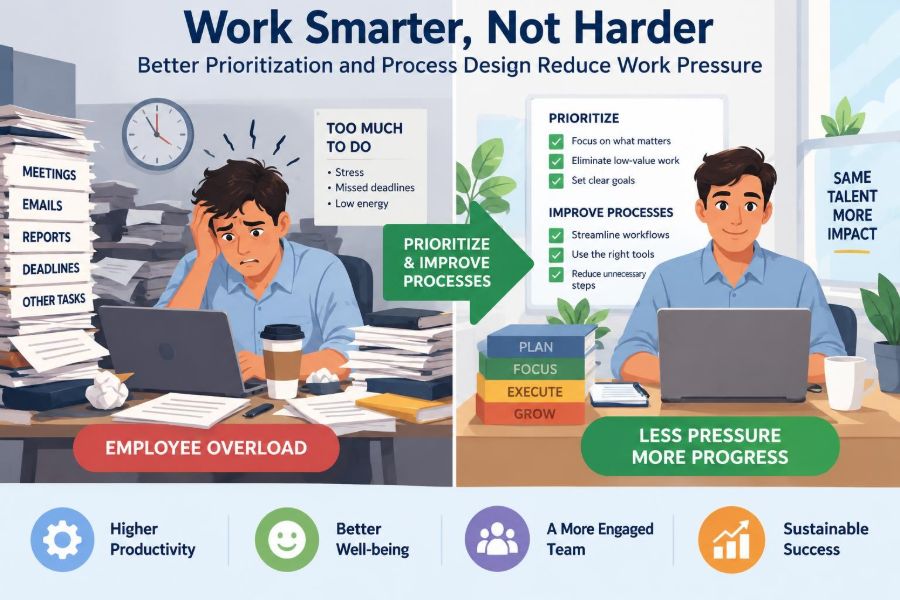

At 9:15 a.m., an employee opens a laptop to finish a report due that afternoon. Before the document loads, there are new chat messages, a meeting invitation, three “quick” requests, and an email marked urgent. By lunch, the report has barely moved.
This is not always a problem of poor effort or weak time management. Often, capable people are working hard inside a system that sends too many signals, assigns unclear priorities, and makes routine work harder than it needs to be.
Employee overload matters because it damages more than individual wellbeing. It slows decisions, increases errors, weakens service, and makes good people feel as if they are constantly failing at work they could otherwise do well.
The practical solution is not simply telling employees to “be more productive.” It is to make deliberate choices about what matters now, what can wait, what should stop, and how work should flow from request to result.
🧭 What Employee Overload Actually Means
Employee overload occurs when the volume, complexity, pace, or emotional demands of work exceed the time, attention, authority, or resources available to handle it reliably. It is broader than having a busy week.
A person may be overloaded even when their calendar contains empty spaces. Constant task switching, unclear expectations, difficult systems, and approval delays can consume attention without appearing as scheduled work.
The key distinction is between high demand and unmanageable demand. A demanding role can be sustainable when priorities are clear and processes support the work. Overload appears when demands collide and no credible method exists for resolving the conflict.
⚖️ Busy Work Is Not the Same as Valuable Work
Teams often confuse activity with contribution. A full inbox, a packed diary, and rapid responses can look productive while the most valuable work remains unfinished.
Value depends on the outcome: solving a customer problem, reducing a material risk, delivering a decision, improving a product, or meeting a meaningful commitment. Not every request carries the same consequence.
When an organization rewards visibility and instant responsiveness more than useful outcomes, employees learn to protect themselves by doing whatever is loudest. Better prioritization corrects this by making the relationship between work and value visible.
🔍 The Many Sources of Pressure
Work pressure rarely has one cause. A team may be understaffed, but it may also be carrying duplicated reports, ambiguous ownership, recurring meetings with no decision purpose, and a stream of unplanned requests.
- Volume pressure: more tasks than available capacity.
- Coordination pressure: work depends on multiple people, systems, or approvals.
- Attention pressure: interruptions make focused work difficult.
- Emotional pressure: conflict, customer distress, or fear of making mistakes adds strain.
- Role pressure: employees receive incompatible expectations from different stakeholders.
Each source needs a different response. Hiring may help volume pressure, but it will not fix a confusing handoff or a manager who gives every request the same urgency.
🚨 Why “Everything Is Urgent” Breaks a Team
Urgency is a scarce management signal. If every task is labelled urgent, employees cannot tell what genuinely requires immediate action. They then rely on status, anxiety, or whoever asks most forcefully.
This creates a harmful loop: important planned work is interrupted, deadlines become harder to meet, and more tasks are marked urgent in response. The team spends its energy reacting rather than progressing.
A useful test is simple: what specific harm occurs if this waits until tomorrow, next week, or the next planned work cycle? If nobody can answer clearly, the request may be important without being urgent.
🎯 Define Priorities as Choices, Not a List
A priority is not every item on a task list. It is a decision to allocate limited attention to one outcome ahead of another. Calling ten projects “top priority” is another way of refusing to choose.
Leaders should state priorities in terms employees can use: the desired result, the deadline, the owner, and the trade-off. For example, “Resolve the payment error before adding new reporting features” gives clearer direction than “focus on customer experience.”
Good priority setting also says what will receive less attention. Without this explicit trade-off, employees must make risky choices privately.
🧱 Separate Strategic, Operational, and Reactive Work
Many workloads feel impossible because different kinds of work are mixed together. Strategic work builds future capability. Operational work keeps current services running. Reactive work responds to incidents, requests, and unexpected changes.
All three may be necessary, but they should not compete invisibly. A service desk, for instance, cannot promise fast incident response while assigning every person to a long-term implementation project.
Classifying work helps managers reserve capacity deliberately. It also reveals whether “emergencies” are truly unpredictable or simply recurring operational work that has never been designed properly.
📥 Create One Visible Intake Route
Work becomes unmanageable when requests arrive through email, chat, corridor conversations, meetings, and personal messages. Employees then become informal traffic controllers, deciding which requests deserve attention and hoping nothing is missed.
A visible intake route creates a shared place for new work. It might be a simple request form, a team board, or a designated queue. The tool matters less than the rule: work should be seen before it is accepted.
The intake should capture enough detail to make an initial decision: requested outcome, deadline, reason, requester, likely effort, and dependencies. This prevents vague requests from becoming silent commitments.
🧰 Use Lightweight Triage Before Work Begins
Triage means sorting incoming work according to its likely urgency, importance, effort, and destination. It does not require a complicated scoring model for every small task.
A manager or rotating team lead can ask four questions: Is this necessary? What is the consequence of delay? Who is best placed to own it? What current work must move if we accept it?
The final question is crucial. Capacity is finite. A request that displaces nothing is usually being added to an already unrealistic workload.
📊 Match Demand to Real Capacity
Capacity is the amount of useful work a team can complete in a period, after allowing for meetings, support, leave, learning, coordination, and inevitable variation. It is not the total number of contracted hours.
Planning as if every hour is available produces fragile schedules. One urgent issue, absence, or delayed decision can then cause widespread slippage.
Teams need a realistic picture of incoming demand and available effort. This does not require minute-by-minute surveillance. Simple estimates and regular review are often enough to expose chronic imbalance.
🪜 Limit Work in Progress
Work in progress, often shortened to WIP, means tasks that have started but are not yet complete. Too much WIP creates queues: people wait for reviews, information, approvals, or their own attention to return.
Limiting WIP encourages a powerful habit: finish meaningful work before starting more. It can feel uncomfortable because fewer tasks appear to be “underway,” but completed work is more valuable than a long list of partial efforts.
For example, a content team may agree that no new campaign enters production while three campaigns are awaiting approval. The constraint makes the approval bottleneck visible instead of hiding it behind more activity.
🔄 Reduce the Hidden Cost of Task Switching
Switching between tasks has a cost beyond the seconds spent opening a new file. People must remember context, recover their place, and decide what to do next. Complex work is especially vulnerable.
Interruptions cannot be eliminated in every role, particularly in customer-facing or safety-critical work. They can, however, be routed, grouped, or shared more thoughtfully.
- Set protected focus periods for work requiring concentration.
- Use a rotating responder for routine questions.
- Batch non-urgent reviews at planned times.
- State which channels are appropriate for genuine emergencies.
The aim is not silence for its own sake; it is to preserve enough uninterrupted attention for work that requires judgment.
🧩 Design Roles Around Clear Ownership
Overload increases when several people assume someone else is responsible, or when one person informally becomes responsible for everything. Both patterns create rework and avoidable follow-up.
Clear ownership identifies who decides, who performs the work, who provides input, and who must be informed. These roles may change by task, but they should not remain implicit.
Ownership is not blame. A named owner gives a task a reliable point of coordination and gives others permission to stop duplicating effort.
🔗 Map the Process, Not Just the Org Chart
An organization chart shows reporting relationships. A process map shows how work actually moves: trigger, steps, handoffs, decisions, systems, exceptions, and completion.
Mapping a common process often exposes surprises. A customer request may be entered twice, reviewed by people with the same authority, or paused because a required piece of information is collected late.
Start with one high-volume or high-friction process rather than attempting to document everything. Follow a real request from beginning to end and ask the people doing the work where it slows, repeats, or fails.
⏳ Find Bottlenecks Before Adding More Work
A bottleneck is the point in a process that limits overall flow. It may be a specialist, a decision maker, an outdated system, a monthly approval meeting, or incomplete information at the start.
Adding more work before a bottleneck usually makes the queue longer. Adding more people upstream can have the same effect if the constrained stage remains unchanged.
Useful responses include simplifying the approval, cross-training staff, improving input quality, automating a routine step, or changing the order of work. The right fix depends on why the bottleneck exists.
🧹 Remove Work That No Longer Earns Its Place
Organizations are good at adding routines and often poor at retiring them. Reports, meetings, checks, and approval steps can continue long after their original purpose has changed.
Review recurring work with direct questions: Who uses this output? What decision does it support? What happens if it stops for a trial period? Is there a simpler source of the same information?
Stopping low-value work is not neglect. It is capacity management. A team that never removes work eventually has no room for new priorities, improvement, or recovery.
🤖 Automate Carefully, Not Automatically
Automation can reduce repetitive manual effort, especially for data transfer, reminders, standard routing, and predictable checks. But automation is not a cure for a poorly understood process.
If a process contains unnecessary approvals or unclear rules, automating it may simply make waste happen faster. It can also create new monitoring, exception-handling, and maintenance work.
Automate after simplifying and standardizing the process. Keep human review where judgment, fairness, context, or unusual cases matter. The goal is to remove drudgery, not to remove accountability.
🗣️ Make Escalation Safe and Specific
Employees need a legitimate way to say, “I cannot complete all of this to the required standard by the requested time.” Without it, people may work excessive hours, quietly lower quality, or delay bad news until the situation becomes harder to solve.
An effective escalation names the conflict and requests a decision: “I can complete the client renewal analysis today or prepare the board pack to the same standard, but not both. Which should take precedence?”
Managers should treat this as useful operational information, not resistance. Punishing early escalation teaches employees to hide capacity problems.
🧑💼 The Manager’s Job Is to Absorb Ambiguity
Managers cannot remove every pressure from a team, but they should reduce unnecessary uncertainty. That means translating broad goals into current priorities, resolving clashes between stakeholders, and protecting employees from unfiltered demand.
A manager who forwards every request without a decision transfers coordination work downward. The employee then carries both the assigned task and the risk of deciding whose expectations to disappoint.
Strong management is visible in the choices a team does not have to make alone.
📅 Make Meetings Serve the Flow of Work
Meetings can coordinate complex work, but they become overload when they provide updates that could be written, include people who cannot contribute, or end without a decision.
Every recurring meeting should have a defined purpose: decide, solve, plan, review, or learn. If it serves none of these purposes, it may be a habit rather than a useful process.
A short agenda, a clear facilitator, and recorded actions can protect time. Just as important, teams should periodically remove meetings that no longer support their current priorities.
📝 Build Better Handoffs
Handoffs occur whenever work moves between people or teams. They are common sources of delay because the receiver lacks context, the sender assumes knowledge, or no one knows whether the transfer is complete.
A practical handoff specifies the required input, the quality standard, the receiving owner, the expected response time, and the way questions will be resolved. Checklists can help where tasks are repeatable.
The purpose is not bureaucracy. It is to prevent an employee from spending time reconstructing information that was available earlier in the process.
🧠 Protect Time for Thinking and Improvement
If every available hour is assigned to delivery, no time remains to fix the causes of recurring overload. Teams then become trapped in reactive mode, repeatedly solving symptoms.
Protected improvement time can be modest: a regular review of the largest source of rework, a focused effort to simplify a form, or a trial of a better queue system. The key is treating improvement as work, not as an optional extra.
Reflection also improves decision quality. Complex choices often need quiet analysis, not another rapid message exchange.
🌱 Build Skills Where the Work Demands Them
Process design and capability are connected. A task may bottleneck because only one employee understands a system, can approve an exception, or knows how to handle a difficult customer case.
Cross-training reduces dependence on individual “heroes” and makes absence less disruptive. Clear documentation supports this, but practical practice and feedback are usually needed for people to use a skill confidently.
Training should target real workflow needs. Generic development can be valuable, yet it will not automatically solve a specific constraint in how work moves.
📏 Measure Flow Without Turning Work Into Surveillance
Measures can reveal overload, but poorly chosen metrics create pressure of their own. Counting emails sent or hours online may reward visible activity rather than useful results.
Better operational indicators often include queue length, age of unfinished work, rework, missed handoffs, turnaround time, and the share of work arriving unexpectedly. These should prompt questions, not automatic blame.
Combine numbers with employee experience. A dashboard may show output is steady while staff report that they are relying on unsustainable effort to maintain it.
🩺 Treat Errors as Process Signals
When errors rise, the first response is often to remind people to be more careful. Care matters, but recurring mistakes may signal interruptions, excessive workload, unclear instructions, poor inputs, or confusing software.
A constructive review asks where the process allowed the error to occur and where it could have been detected earlier. This is different from ignoring individual accountability when someone deliberately bypasses a clear requirement.
The distinction matters. A learning response improves the system; a blame-only response may make future problems harder to see.
🏠 Respect Different Types of Flexible Work
Flexible and hybrid work can help employees manage focused tasks and personal commitments, but it can also create new coordination burdens. Messages may spread across time zones, informal knowledge may become harder to access, and people may feel pressure to be constantly reachable.
Teams need explicit working agreements: response expectations, core collaboration periods, documentation habits, and methods for urgent contact. Flexibility works best when boundaries are designed, not assumed.
The same principle applies in fully on-site teams. Availability should be purposeful rather than unlimited.
⚠️ Avoid Common “Solutions” That Add Pressure
Some interventions look decisive but worsen the problem. A new dashboard, daily status meeting, approval layer, or productivity target can create administrative work without removing any underlying demand.
Be cautious with these common mistakes:
- Adding a tool before defining the process it should support.
- Asking employees to prioritize without giving them authority to defer work.
- Using overtime as the normal answer to predictable demand.
- Launching improvement projects on top of an already overloaded team.
- Measuring speed while ignoring quality, rework, and employee capacity.
Test changes on a manageable scale and ask whether they remove work, clarify work, or merely document work more closely.
🧪 Run Small Process Experiments
Large redesigns can be necessary, but small experiments are often a safer way to learn. A team might trial a single intake queue for two weeks, reduce a recurring meeting, or assign a rotating first responder for interruptions.
State the hypothesis in plain language: “If routine requests enter one queue, fewer will be lost and project work will be interrupted less often.” Then observe what changes, including unintended effects.
Keep what works, adjust what partly works, and stop what does not. This approach gives employees evidence that process improvement is practical rather than another abstract initiative.
🤝 Include Employees in the Redesign
Employees closest to the work often understand its friction best. They know which requests arrive incomplete, which systems create duplicate entry, and which exceptions consume disproportionate time.
Involvement should mean more than asking for complaints. Invite people to help map a process, test a revised handoff, define a quality standard, or identify work that could stop.
Leaders still need to make decisions, especially where priorities conflict. But designs made without operational insight often shift effort rather than reducing it.
🧭 A Practical Weekly Priority Rhythm
Prioritization works best as a repeated practice rather than an annual planning exercise. A short weekly rhythm can keep demand, capacity, and commitments aligned.
- Review completed work, unfinished work, and new demand.
- Confirm the few outcomes that matter most this week.
- Identify capacity constraints, dependencies, and likely interruptions.
- Defer, delegate, simplify, or stop lower-value work.
- Record decisions so the team can explain trade-offs consistently.
This does not eliminate change. It creates a reliable way to respond when change arrives, instead of forcing every employee to renegotiate priorities alone.
🏁 The Core Principle: Design Work People Can Complete Well
Reducing overload is not about squeezing more output from exhausted people. It is about designing a system in which demand is visible, choices are explicit, ownership is clear, and work can move without needless interruption or rework.
Prioritization provides direction: it identifies what deserves attention now. Process design provides the path: it removes friction, exposes bottlenecks, and makes routine coordination easier. Neither is sufficient on its own.
The most sustainable workplaces do not promise that work will never be demanding. They make demands intelligible and manageable, so effort is directed toward results rather than wasted on confusion.
When organizations make clear choices about work and continuously improve how it flows, they reduce pressure while strengthening quality, reliability, and trust. 📊🧭🌱