
A team can look productive on paper while quietly losing energy. Projects are completed, meetings are attended, and customer requests are answered—but people stop offering ideas, avoid difficult conversations, or begin looking elsewhere.
Many managers notice this only after a resignation, a missed deadline, or an employee survey produces disappointing results. By then, the organization has a score, but may not understand the everyday experiences behind it.
Surveys are useful, especially when they give employees a private way to speak honestly. Yet they are snapshots: they depend on question design, timing, response rates, and whether people believe their answers will lead to change.
A stronger approach treats engagement as something to observe, discuss, and improve continuously. That means combining survey feedback with behavioral patterns, work conditions, manager habits, and direct employee voice.
🧭 Start With a Clear Definition of Engagement
Employee engagement is the degree to which people are psychologically invested in their work and connected to the organization’s goals. Engaged employees are more likely to apply discretionary effort: the thoughtful effort they choose to contribute beyond the bare minimum required.
It is not the same as being busy, cheerful, loyal, or unwilling to leave. Someone may enjoy colleagues but lack clarity; another may work long hours because of pressure rather than commitment. Good measurement begins by separating these ideas.
🔍 Know What Surveys Can and Cannot Tell You
Surveys can reveal broad patterns, compare experiences across groups, and provide a structured baseline. They are especially helpful for topics employees may hesitate to raise openly, such as trust in leadership or perceptions of fairness.
However, a survey is a self-reported signal, not a complete diagnosis. A low score does not automatically explain the cause, and a high score does not guarantee that workload, retention, or collaboration are healthy. Use surveys as one source of evidence, not the entire measurement system.
🧩 Build a Balanced Evidence Picture
Measuring engagement without overrelying on surveys means triangulating: comparing several types of evidence so that one imperfect measure does not dominate the conclusion.
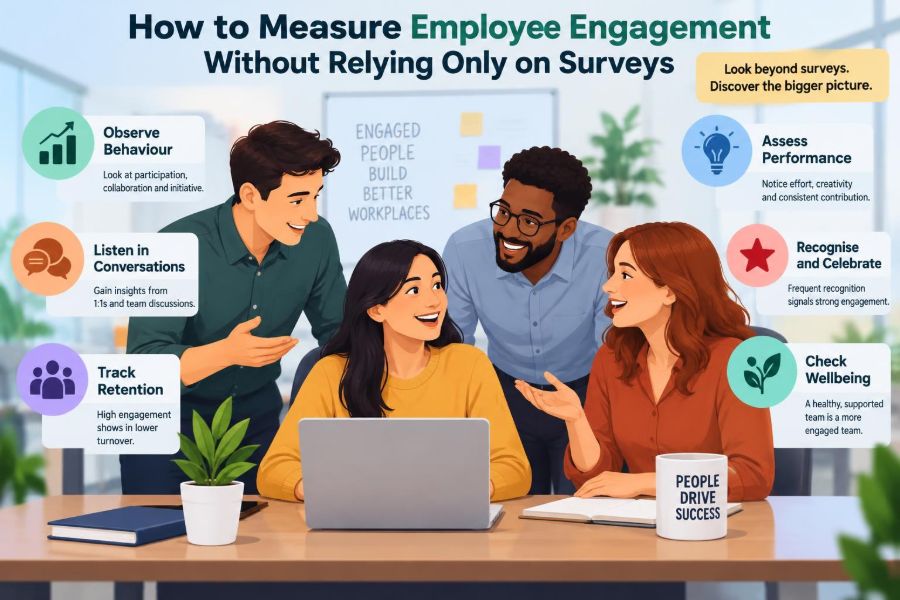
A practical set of evidence includes employee comments, operational data, people data, manager observations, and the quality of day-to-day work. When several signals point in the same direction, leaders can investigate with greater confidence.
- Perception signals: conversations, listening sessions, and surveys.
- Behavioral signals: participation, idea sharing, and collaboration patterns.
- Outcome signals: retention, internal movement, absence, quality, and customer experience.
🎯 Measure the Conditions That Create Engagement
Engagement itself is partly internal; no dashboard can directly read commitment. Organizations can, however, observe the conditions that make sustained engagement more likely.
These usually include meaningful work, role clarity, manageable workload, useful feedback, autonomy, inclusion, growth opportunities, fair treatment, and confidence in leadership. Measuring these conditions gives managers concrete levers to improve rather than merely labeling a team “engaged” or “disengaged.”
💬 Make One-to-Ones a Reliable Listening Channel
Regular one-to-one conversations are among the most valuable sources of qualitative evidence. They work only when they are not treated as status meetings disguised as support.
Managers can ask consistent, open questions: “What is making your work easier or harder?” “Where are you blocked?” “What would make this role more sustainable?” Over time, notes should identify themes, not create a personal surveillance file.
If several people independently describe unclear priorities or a slow approval process, that pattern is more informative than a single engagement score.
🗣️ Listen for Themes, Not Just Loud Opinions
Direct conversations can be distorted by whoever speaks most confidently, has the closest relationship with the manager, or happens to have a recent frustration. Treat individual comments as leads to explore, not automatic proof.
Look for repeated themes across roles, locations, shifts, and tenure groups. Also pay attention to what remains unsaid. If people provide polished answers but never raise concerns, psychological safety—the belief that it is safe to speak up—may itself need attention.
👥 Use Stay Interviews Before People Decide to Leave
A stay interview is a structured conversation with a current employee about what keeps them, what could cause them to leave, and what would improve their experience. Unlike an exit interview, it creates time to respond.
Questions should focus on the work relationship rather than demand personal disclosure. For example: “When do you feel most effective here?” “What talent are we underusing?” and “What might make this job less attractive over the next year?”
Use a common question set across a team, then summarize themes anonymously. A stay interview loses credibility if managers collect answers and never report what they learned or changed.
🚪 Learn Carefully From Exit Interviews
Exit interviews offer a different perspective because departing employees may speak more freely. They can expose recurring issues involving management quality, career limits, workload, pay practices, or team culture.
They are also incomplete evidence. A departing person may be reluctant to be candid, focused on a recent event, or leaving for reasons outside the employer’s control. Review exit themes alongside retention patterns and current employee feedback rather than treating any one account as definitive.
📉 Track Voluntary Turnover With Context
Voluntary turnover can signal weak engagement, but it is not automatically a failure. Some turnover is expected, and employees leave for relocation, career changes, family needs, or opportunities the organization cannot reasonably match.
The useful questions are more specific: Are departures concentrated in one manager’s team? Are capable employees leaving at a particular career stage? Do people leave soon after joining, after a reorganization, or following a promotion decision?
Segmenting data by department, role, tenure, and location often reveals more than one organization-wide number.
🧳 Watch Internal Mobility and Career Movement
People who see credible paths to develop may remain committed even when their current role is demanding. Internal applications, lateral moves, stretch assignments, mentoring participation, and promotion readiness can therefore add useful context.
Low internal movement may indicate limited opportunity, but interpretation matters. A small organization may simply have few openings. The stronger warning sign is when employees repeatedly say they want growth while suitable opportunities are opaque, inconsistently offered, or reserved for a narrow group.
🕰️ Examine Absence Patterns Without Making Assumptions
Unplanned absence, repeated short absences, or rising absence in one work group can point to workload strain, conflict, unsafe conditions, burnout, or poor scheduling. It can also reflect illness, caregiving, seasonal factors, or reporting changes.
For that reason, absence data should trigger supportive inquiry, not suspicion. Avoid using it to diagnose individuals or penalize legitimate leave. Look at aggregate patterns and ask whether workloads, staffing levels, shift design, and manager behavior need review.
⚖️ Distinguish Workload From Commitment
Long hours and fast response times are sometimes mistaken for engagement. They may instead show understaffing, unclear boundaries, or a culture where people fear being seen as uncommitted.
Measure workload through capacity plans, overtime trends, task backlogs, vacation use, handoff delays, and employee accounts of pressure. An engaged team should be able to sustain performance; exhaustion is not a reliable sign of dedication.
🛠️ Observe Friction in Everyday Work
Work friction is the unnecessary effort required to get ordinary tasks done. Repeated approvals, incompatible systems, unclear ownership, duplicated reporting, and constant priority changes drain energy that could go into meaningful work.
Managers can map a common process—such as onboarding a customer or approving an expense—and ask employees where time is wasted. Reducing one recurring obstacle may improve engagement more than a broad morale campaign because it demonstrates that feedback changes work.
💡 Count Ideas, Then Examine What Happens to Them
Suggestion volume can be a useful signal, but a raw count can mislead. Some jobs naturally generate more visible ideas, and employees may stop contributing if suggestions disappear into a black hole.
Track the full path: ideas raised, ideas acknowledged, ideas tested, and reasons proposals were not adopted. A team where people challenge assumptions respectfully and receive thoughtful responses may be healthier than one that submits many low-value suggestions to meet a target.
🤝 Look at Collaboration Quality, Not Meeting Volume
Calendar density is not collaboration. A heavily booked team may be struggling with fragmented decisions, while a quieter team may coordinate effectively through clear roles and well-designed routines.
Useful observations include whether work is handed off smoothly, whether relevant people are included early, whether decisions are documented, and whether teams seek help across boundaries. Anonymous feedback can help reveal collaboration barriers that meeting data cannot explain.
🧠 Assess Psychological Safety Through Behavior
Psychological safety is visible in small moments: whether someone can say “I do not understand,” flag a risk, admit an error, or disagree with a senior colleague without humiliation or retaliation.
Observe who speaks in meetings, whose ideas are credited, how leaders respond to bad news, and whether mistakes lead to learning or blame. These observations should be checked through confidential channels, because silence can look like agreement when people do not feel safe.
📚 Review Learning and Development Access
Training attendance alone says little about engagement. Employees may attend because it is mandatory, while highly motivated people may be unable to participate because deadlines or manager approval get in the way.
Look at access and follow-through: who receives development opportunities, whether employees can apply new skills, whether managers discuss career goals, and whether opportunities are distributed fairly. Unequal access can weaken trust even if the organization offers an impressive training catalog.
🌱 Measure Recognition as a Work Habit
Recognition is most meaningful when it is timely, specific, and connected to real contribution. Generic praise or public awards chosen through opaque processes can feel performative rather than motivating.
Instead of simply counting recognition messages, examine whether good work is noticed across roles, shifts, and less visible functions. Ask employees whether they understand what high-quality performance looks like and whether useful contributions receive acknowledgment.
🧑💼 Evaluate the Manager Experience
Managers shape priorities, feedback, fairness, and daily tone. A broad engagement problem can sometimes be traced to managers who lack time, training, authority, or support—not a lack of personal care.
Assess whether managers hold regular one-to-ones, clarify goals, remove barriers, share information, and address conflict. Combine employee perspectives with manager workload data; expecting good people leadership from someone carrying an unmanageable operational load is unrealistic.
🧭 Check Whether Goals Are Clear and Credible
People find it hard to invest in work when success changes every week. Conflicting objectives, vague priorities, and unexplained decisions create uncertainty and force employees to spend energy guessing what matters.
Review goal-setting artifacts, team plans, and meeting decisions. Can employees explain their top priorities, how their work connects to a wider purpose, and what trade-offs they are allowed to make? If not, engagement may be constrained by management systems rather than attitude.
🏠 Include Remote and Frontline Work Realities
Engagement signals do not look identical across work settings. Remote staff may experience isolation, unclear communication, or meeting overload. Frontline employees may face unpredictable schedules, limited access to leaders, equipment problems, or few chances to share feedback.
Use channels that fit the job: brief shift huddles, mobile-accessible feedback, site visits, small group discussions, and asynchronous check-ins. Measuring only what is convenient for office-based employees creates a distorted picture.
🔐 Protect Privacy and Avoid Surveillance
Digital work tools can generate extensive activity data, but activity is not engagement. Tracking keystrokes, camera time, message counts, or online status can undermine trust and incentivize performative busyness.
Use aggregated, purpose-limited data only when it answers a legitimate work-design question. Be transparent about what is collected, who can see it, how long it is retained, and what decisions it will not be used for. When in doubt, choose conversation over monitoring.
📊 Create a Simple Engagement Indicator Set
A useful dashboard is small enough to discuss and broad enough to challenge assumptions. It should show trends over time, use appropriate comparisons, and include short narrative context from employees and managers.
| Signal | What it may reveal | Question to investigate |
|---|---|---|
| Voluntary departures | Retention pressure or career barriers | Where and when are departures clustering? |
| Absence pattern | Strain, scheduling issues, or workplace conditions | What changed in the affected team? |
| Internal movement | Visibility of opportunity and development | Who has access to growth? |
| Listening themes | Daily barriers and trust concerns | Which themes recur across channels? |
| Process friction | Needless effort and weak operating design | Which obstacle can we remove first? |
No indicator should be assigned a universal “good” target without context. Trends and differences between comparable groups are usually more meaningful than a single threshold.
🧪 Turn Signals Into Testable Questions
Data becomes useful when it produces a question that can be examined. Suppose a team has rising turnover, lower participation in development, and repeated comments about unpredictable priorities. A reasonable hypothesis is that unstable planning is harming both growth and retention.
Then test it through focused conversations, workload analysis, and a review of planning practices. This prevents leaders from jumping from a metric directly to a fashionable solution.
🔄 Close the Feedback Loop Publicly
Employees judge listening by what follows it. After collecting input, share the main themes, explain what the organization will address, identify what cannot be changed immediately, and state why.
Small visible actions matter. If employees report confusing approval rules, simplifying one process and communicating the change builds credibility. If a larger issue needs time, provide milestones rather than letting feedback vanish into a committee.
🚧 Avoid Common Measurement Traps
Several mistakes turn engagement measurement into a compliance exercise rather than a management practice.
- Using a single score to rank teams without considering their work context.
- Rewarding managers only for high scores, which can discourage candor.
- Collecting feedback during a crisis and expecting one intervention to solve everything.
- Confusing tool usage, overtime, or attendance with commitment.
- Publishing detailed data for small groups, which can compromise confidentiality.
- Launching too many actions at once, making it impossible to learn what helped.
The remedy is disciplined interpretation: treat measurements as prompts for dialogue and improvement, not as verdicts on people.
🗓️ Establish a Sustainable Measurement Rhythm
Continuous listening does not mean asking employees for feedback every day. It means choosing a rhythm that matches the pace of work and creates enough time to act on what is learned.
For example, managers might use one-to-ones every few weeks, review team-level operating signals monthly, hold listening sessions around major changes, and run a broader survey periodically. The schedule matters less than consistency, confidentiality, and visible follow-through.
🧭 Make Engagement Measurement an Improvement System
The core principle is simple: engagement is best understood as a pattern of lived work experience, not a single survey result. Surveys add valuable evidence, but conversations, operating data, career signals, leadership behavior, and work friction reveal different parts of that experience.
When leaders combine these signals carefully, protect privacy, and act on the barriers employees identify, measurement becomes a practical management system. The goal is not to chase a flattering number; it is to create conditions in which people can contribute, develop, and speak honestly.
The most credible measure of employee engagement is a consistent pattern of listening, context-aware evidence, and visible improvement in everyday work. 📊🤝🌱