
A team can be busy from morning to evening and still fall behind. Orders wait for approval, customers chase updates, urgent jobs interrupt planned work, and managers respond by asking everyone to work faster.
Yet faster activity in one department does not automatically mean faster results for the business. If one stage cannot keep pace, work simply piles up in front of it. The pile may be physical inventory, unanswered requests, incomplete designs, or a crowded digital queue.
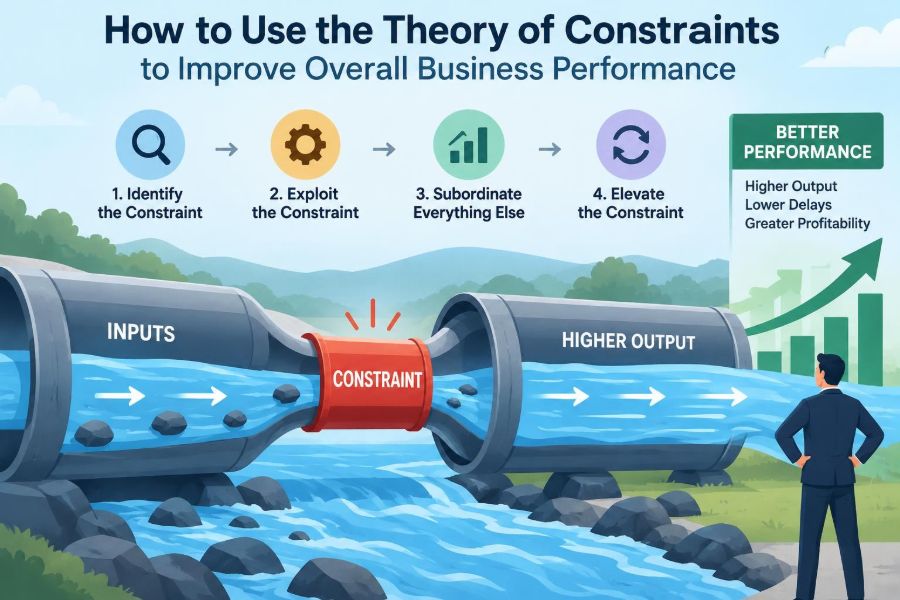
This is the problem addressed by the Theory of Constraints (TOC): every system has a limiting factor that most restricts its ability to achieve its goal. Improve that factor, and overall performance can improve. Improve something else, and the system may only become busier.
For students, this is a useful way to understand operations. For working professionals, it offers a practical alternative to solving every problem at once.
🎯 Start With the System’s Real Goal
TOC begins with a simple but demanding question: what is the system trying to achieve? In a commercial business, the goal is usually sustainable profitability, supported by customer value, cash flow, and long-term capability.
A department may track its own targets, such as utilization, response time, or output. These measures matter, but they are not the final goal. A procurement team that buys large quantities cheaply, for example, may create excess stock and tie up cash if the wider system does not need it.
Before looking for a constraint, define the result that matters: completed orders, reliable service, safe patient care, useful software releases, or another outcome that represents value delivered.
🔗 See the Business as a Connected Flow
A business is not a set of independent departments. It is a flow of work, information, materials, decisions, and money. Each stage depends on the stages around it.
Consider a furniture maker. Sales receives an order, design confirms specifications, purchasing obtains materials, production builds the item, quality checks it, and logistics delivers it. A delay at any critical point affects the customer’s experience of the whole company.
TOC directs attention to these connections. It asks managers to optimize flow through the system, rather than maximize activity within isolated functions.
🚧 Define What a Constraint Is
A constraint is anything that limits a system from achieving more of its goal. In operations, it is often called a bottleneck: a resource whose effective capacity is lower than the demand placed on it.
Constraints are not always machines or people. They can be a market with insufficient demand, a policy requiring too many approvals, limited working capital, a specialist skill, unreliable data, or a rule embedded in software.
The key test is practical: if this factor improved meaningfully, would the overall system produce or deliver more valuable output? If the answer is no, it is probably not the current constraint.
📦 Understand Why Local Efficiency Can Mislead
Local efficiency means a person, team, or machine appears highly productive. System efficiency means the organization produces more of what it needs to deliver. These are different ideas.
If a printing department produces brochures faster than the finishing department can fold and package them, the extra printing creates work-in-progress inventory. It uses paper, space, handling time, and attention without increasing completed brochures.
Keeping every resource busy can therefore be harmful. Some non-constraint capacity is needed to absorb variation, fix defects, and respond when the constraint needs support.
🔍 Identify the Current Constraint
Look first for evidence in the flow of work. Persistent queues, repeated expediting, missed delivery dates, and a resource that is rarely idle are useful signals. So are customer complaints concentrated around one handoff or decision.
Do not rely only on appearances. A crowded area may be caused by a downstream constraint, while a quiet resource may be waiting on poor inputs. Follow a typical item or request from start to finish.
- Where does work wait longest?
- Which resource determines how many finished units leave the system?
- Where do priorities change most often?
- What delay would most reduce output if it became worse?
Use data where available, but combine it with observation. People doing the work often understand the practical causes of lost capacity.
🧭 Distinguish Bottlenecks From Temporary Delays
A late supplier delivery or a one-day staff absence may create a temporary blockage without being the system’s enduring constraint. A true operational constraint repeatedly limits flow under normal conditions.
Likewise, a resource can be overloaded because upstream teams release work in large batches. The lasting issue may be the release policy rather than the apparently overloaded workstation.
Track patterns over enough time to separate normal variation from an unusual event. TOC is most useful when it addresses the condition that repeatedly governs performance.
🪜 Use the Five Focusing Steps
The classic TOC improvement cycle has five steps. It is deliberately sequential: jumping straight to investment can waste money if simpler changes have not been tried.
- Identify the system’s constraint.
- Exploit it: get the most from existing constraint capacity.
- Subordinate other activities to the constraint’s pace and needs.
- Elevate the constraint when more capacity is required.
- Once the constraint moves, repeat the process and avoid inertia.
These steps are not a one-time project. A business changes, and the limiting factor can shift with demand, staffing, technology, product mix, and operating decisions.
⚙️ Exploit the Constraint Before Spending Money
To exploit a constraint means using its existing capacity wisely. Start by removing avoidable lost time rather than immediately buying equipment or hiring more people.
For a constrained specialist, this could mean ensuring complete requests arrive before review, preparing files in advance, assigning administrative work elsewhere, scheduling maintenance outside critical periods, and reducing rework caused by preventable errors.
A machine constraint might lose time to long changeovers, missing materials, poor-quality inputs, or waiting for an operator. Small improvements here can increase total system output because every recovered minute at the constraint matters.
🛡️ Protect Constraint Time From Waste
Constraint time should be treated as a scarce organizational resource. Interruptions, low-value meetings, unnecessary reports, and poorly prioritized urgent work can consume it without improving throughput.
This does not mean the constrained person or asset should never stop. Planned breaks, safety checks, maintenance, and quality verification are necessary. The aim is to remove unproductive loss, not to demand unsustainable intensity.
A useful question is: does this task need the constraint’s unique capability? If not, it may be delegated, automated, simplified, or completed before the work reaches the constrained resource.
🥁 Set the Pace With Drum-Buffer-Rope
Drum-buffer-rope is a TOC scheduling approach. The drum is the constraint’s schedule, which sets the rhythm for the wider system. The buffer is a controlled amount of ready work that protects the constraint from starvation. The rope controls when new work is released upstream.
Imagine a bakery where one oven limits output. The oven schedule is the drum. Prepared dough waiting before the oven is the buffer. The rope prevents the mixing team from producing far more dough than the oven can handle.
The approach reduces the temptation to release every available job immediately. More released work is not the same as more completed work.
📍 Place Buffers Where They Reduce Risk
A buffer is not simply excess inventory or spare time everywhere. It is deliberate protection against predictable variation at points where disruption would damage delivery performance.
Common buffers include ready work before the constraint, a time allowance before a promised due date, and a small stock of critical materials. Their size depends on uncertainty, replenishment time, quality reliability, and the cost of delay.
Too little buffer leaves the constraint idle when problems occur. Too much hides issues, lengthens lead times, and consumes cash. Review buffer status regularly instead of treating it as fixed forever.
🧩 Subordinate the Rest of the System
Subordination means aligning non-constraint resources with the needs and pace of the constraint. It is often the most difficult TOC step because it challenges familiar performance measures.
An upstream team may need to delay release of work even though it has available capacity. A downstream team may need to keep enough flexibility to process items coming from the constraint quickly. Both choices can make local utilization look lower while improving overall flow.
This is coordinated work, not idleness by default. Non-constraints can use spare capacity for training, preventive maintenance, quality improvement, cross-training, and preparing high-quality inputs.
⬆️ Elevate the Constraint When Capacity Is Still Insufficient
If better scheduling and waste reduction do not create enough capacity, elevate the constraint. Elevation means making a more substantial change to increase its capability or reduce demand on it.
Options may include adding a shift, training additional staff, outsourcing selected work, redesigning a product, purchasing equipment, automating a repetitive task, or changing service rules. Each option has costs and risks, so it should be evaluated against the extra valuable output it enables.
Adding capacity is not always the right answer. If demand is volatile, a flexible arrangement or policy change may be safer than a large fixed investment.
🔄 Expect the Constraint to Move
When one constraint is improved, another part of the system may become the new limiting factor. This is a sign that the previous improvement worked, not proof that TOC failed.
For example, after a call center reduces its approval backlog, the constraint may shift to the technical team handling complex cases. The company should then reassess the flow rather than continue applying old solutions automatically.
The fifth focusing step warns against inertia: yesterday’s bottleneck may become today’s excess capacity. Measures, schedules, and staffing assumptions need regular review.
📊 Measure Throughput, Inventory, and Operating Expense
TOC commonly evaluates decisions through three system-level measures. Throughput is the rate at which the organization generates value through completed sales or delivered outcomes. Inventory includes money tied up in items intended for sale or transformation. Operating expense is the money spent turning inventory into throughput.
The exact interpretation should fit the organization. A public service or nonprofit may focus on completed, mission-relevant outcomes rather than sales revenue, while still monitoring resources consumed and work waiting in the system.
The central question is whether a change improves completed value without creating disproportionate cost, risk, or unnecessary inventory.
🧮 Use Metrics That Support Flow
Traditional measures can unintentionally encourage harmful behavior. A manager rewarded for keeping a machine fully utilized may produce items that are not yet needed. A team judged only on speed may pass incomplete work downstream.
Pair local measures with flow measures such as lead time, on-time delivery, buffer health, first-pass quality, and completed work. The right mix depends on the business, but it should discourage output that cannot become a finished result.
| Measure | Helpful question | Potential misuse |
|---|---|---|
| Utilization | Is scarce capacity available when needed? | Keeping every resource busy regardless of demand |
| Throughput | Are more valuable outcomes being completed? | Ignoring quality or long-term customer impact |
| Lead time | How long does work take end to end? | Speeding easy work while hard work waits |
| On-time delivery | Are promises being met reliably? | Padding every promise rather than fixing flow |
🏭 Apply TOC in Manufacturing
In manufacturing, constraints are often visible: a heat-treatment oven, a skilled inspection station, a packaging line, or a limited material supply. The basic logic is especially clear because physical queues reveal where work accumulates.
Suppose a plant’s finishing booth is the constraint. Running upstream cutting machines at maximum output creates unfinished parts. A better plan is to schedule releases around finishing capacity, ensure parts arrive defect-free, and make color changes or cleaning routines as efficient as safely possible.
Quality is essential. Sending defects to the constraint wastes the capacity that governs total output.
💻 Apply TOC in Knowledge Work
In offices and digital teams, work is less visible but constraints still exist. A legal reviewer, senior developer, product owner, or decision-making committee can become the point that limits completed work.
A software team may have many developers but only one person able to approve architecture decisions. Starting more features will not solve the delay. Limiting work in progress, preparing decisions clearly, and delegating routine approvals may help more.
Visual boards can make hidden queues visible. The purpose is not surveillance; it is to see where work waits, returns, or becomes blocked.
☎️ Apply TOC in Services and Customer Operations
Service businesses often face variable demand and time-sensitive customer expectations. The constraint may be peak-hour staff availability, appointment slots, diagnostic capability, or a slow exception-handling process.
For a hypothetical repair company, routine jobs might be scheduled to protect capacity for urgent work, while technicians receive complete customer information before travel. If one senior technician approves all complex estimates, training another person may remove a critical delay.
Service constraints require care because reducing queues should not mean reducing empathy, safety, or service quality. A faster but confusing customer process can create more rework later.
📣 Recognize Market Constraints
Sometimes the organization has enough operational capacity but insufficient demand for its offering. In that case, the market is the constraint. Adding production capacity will not improve overall results.
The response may involve improving the offer, reaching qualified customers, shortening sales cycles, strengthening retention, or adjusting the product mix. These are commercial decisions, but TOC still applies: concentrate effort on the factor limiting valuable throughput.
Demand generation should remain honest and economically sensible. Chasing unprofitable sales or promising service the business cannot deliver simply moves the problem elsewhere.
📜 Challenge Policy Constraints
Policies can become constraints when they outlive the problem they were designed to solve. Examples include mandatory signatures for low-risk purchases, batch reporting rules, rigid job classifications, or a rule that every request must follow the same route.
Policy constraints are easy to miss because they feel normal. Ask why the rule exists, what risk it controls, and whether a simpler control could achieve the same purpose.
Changing a policy should not be careless. Some approvals protect compliance, safety, financial control, or fairness. The aim is to distinguish necessary safeguards from avoidable delay.
🧠 Address Behavioral Constraints With Respect
People may avoid reporting problems when blame is likely. Teams may hoard work because being busy feels safer than appearing underused. Managers may resist subordination because their local metrics or status are tied to departmental output.
These are behavioral constraints: patterns of incentives, fear, habits, or communication that reduce flow. They cannot be solved simply by drawing a process map.
Leaders can help by making the goal visible, sharing system-level data, asking for practical input, and treating bottlenecks as design issues rather than personal failures. Respectful problem solving produces better information than pressure alone.
🗺️ Map the Flow Before Redesigning It
A simple flow map clarifies how work actually moves, not how the procedure manual says it should move. Include major steps, handoffs, waiting points, rework loops, approvals, and information needed at each stage.
Walk one real order, case, or project through the process. Note when work is touched and when it waits. In many systems, waiting time exceeds active processing time by a wide margin, even if each individual task is quick.
Do not overcomplicate the first map. Its purpose is to generate useful questions and establish a shared view of the work.
🧪 Run Small, Reversible Experiments
TOC works well with short experiments. Instead of redesigning an entire operation, test one change: a clearer intake checklist, a protected hour for the constrained resource, smaller transfer batches, or a new priority rule.
Define what you expect to improve and how you will observe it. Watch for unintended consequences, such as extra work shifting to another team or a buffer becoming too thin.
Small tests reduce disruption and teach the organization how its system behaves. They also create evidence that is more useful than assumptions during larger decisions.
🚨 Manage Quality at and Before the Constraint
A defect found after the constraint may consume scarce capacity twice: once to process the flawed item and again to correct or replace it. That makes quality control especially valuable before constrained stages.
Pre-checks should be proportionate. An elaborate inspection process can become a new constraint itself. Focus on defects that are frequent, costly, or likely to waste the limiting resource’s time.
When errors recur, investigate the source rather than relying only on final inspection. Clear specifications, better training, error-proofing, and feedback loops often protect flow more effectively.
⚠️ Avoid Common Theory of Constraints Mistakes
TOC is straightforward in principle, but implementation can go wrong when teams apply slogans instead of diagnosis.
- Calling every busy resource a constraint: the system usually has one dominant limiting factor at a time.
- Building inventory everywhere: buffers should protect specific risks, not hide poor flow.
- Ignoring demand and product mix: extra capacity has little value if it supports low-value work.
- Using TOC to overwork people: sustainable capacity includes safety, learning, and recovery.
- Making one improvement and stopping: constraints move, so management must keep observing.
The method is disciplined prioritization, not a license to simplify complex human work into one number.
🤝 Connect TOC With Lean, Agile, and Continuous Improvement
TOC can complement other improvement approaches. Lean emphasizes removing waste and improving flow; TOC helps identify where waste removal will have the greatest system impact. Agile methods limit work in progress and expose blocked work, which can support constraint-focused management.
These approaches are not identical. Lean may examine waste across a value stream, while TOC deliberately concentrates attention on the limiting factor. Six Sigma-style analysis may be useful when variation or defects are damaging the constraint.
The practical lesson is to choose tools based on the problem. Do not force every challenge into a preferred methodology.
👥 Build Ownership Across Functions
A constraint rarely belongs to only one department. Sales may influence demand patterns, operations may control scheduling, finance may approve investment, and IT may manage the information needed to release work.
Create shared ownership around the flow. People need to understand how their decisions affect the constraint and why a locally sensible choice may hurt overall delivery.
Regular, brief cross-functional reviews can focus on buffer status, blocked work, upcoming demand changes, and recurring causes of lost constraint time. This is more productive than using meetings to assign blame after deadlines are missed.
🗓️ Create a Practical 30-Day Starting Plan
A first TOC effort does not need expensive software or a major reorganization. It needs a clear scope and consistent observation.
- Choose one value stream, such as order fulfillment or customer onboarding.
- State the outcome that defines success for that flow.
- Map the current path and identify queues, rework, and waiting.
- Confirm the likely constraint using observations and available data.
- Remove one or two obvious causes of lost constraint time.
- Set a visible buffer or work-in-progress limit where appropriate.
- Review results weekly and look for the next limiting factor.
Keep the initial scope manageable. A visible improvement in one flow builds the understanding needed for broader application.
🌟 The Core Principle: Improve What Limits the Whole
The Theory of Constraints changes the question from “How can everyone do more?” to “What most limits the outcome we need, and what should the whole system do about it?” That shift prevents scattered improvement efforts from competing with one another.
Identify the constraint, use its time well, align the rest of the system, add capacity only when justified, and then look again. The goal is not maximum motion, maximum utilization, or maximum inventory. It is reliable movement of valuable work from beginning to completion.
When teams understand this distinction, they can make better trade-offs: fewer simultaneous projects, smarter buffers, clearer priorities, and investments aimed at the point that truly governs performance.
Business performance improves most when people manage the flow of the whole system, not just the productivity of its individual parts. 📊🔗🚀