
Picture a manager who starts every morning with a full inbox, a queue of approval requests, and five employees waiting for feedback. By lunchtime, a customer escalation arrives. By the end of the day, the manager has solved problems but has not coached anyone, improved a process, or planned ahead.
Now picture the opposite problem: a department where several managers supervise only a few people each. Employees spend more time reporting upward, decisions pass through extra layers, and people wonder who is actually accountable.
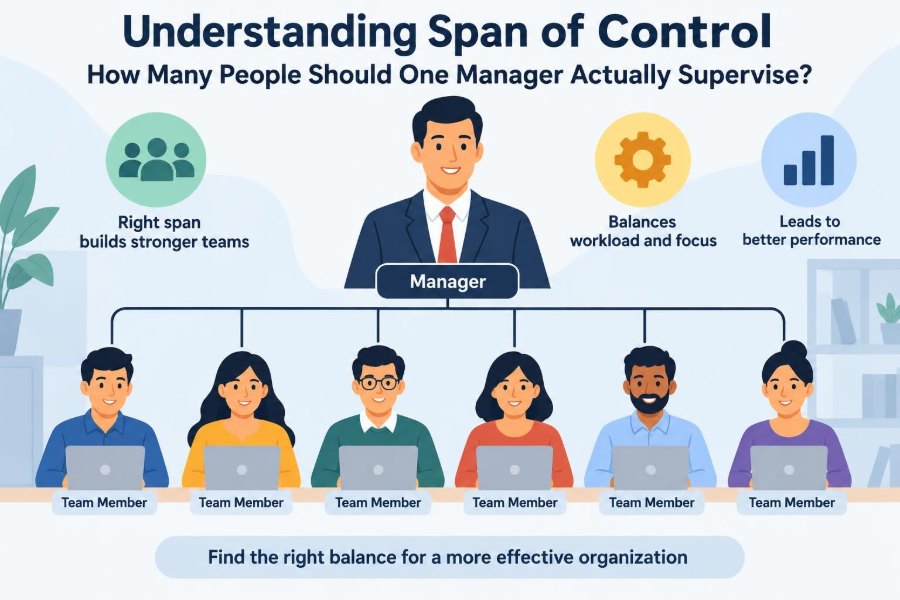
Both situations are questions of span of control: the number of direct reports a manager is responsible for supervising. It sounds like a simple headcount decision, but it shapes communication, morale, speed, cost, customer service, and the quality of day-to-day work.
The useful question is not whether a manager should have a “wide” or “narrow” span. It is whether that manager has enough time, authority, information, and support to help a particular group perform well.
📏 What Span of Control Means
Span of control is the number of employees who report directly to one manager. A supervisor with four direct reports has a narrow span; a manager with fifteen direct reports has a wide span.
The term concerns direct reporting relationships, not everyone in a department. A senior director may indirectly lead hundreds of people through other managers while directly supervising only six.
🧭 Why This Design Choice Matters
Reporting lines determine where employees turn for decisions, feedback, prioritisation, and help. If the span is too wide for the work, managers become bottlenecks. If it is too narrow, the organisation may add costly layers without improving decisions.
Span also affects employees’ experience. People need different amounts of direction depending on their role, confidence, task complexity, and the consequences of mistakes.
↔️ Wide and Narrow Spans at a Glance
| Feature | Wide span | Narrow span |
|---|---|---|
| Direct reports | Many | Few |
| Management layers | Often fewer | Often more |
| Manager attention per person | More limited | Usually greater |
| Best fit | Routine, stable, capable teams | Complex, changing, high-support work |
| Main risk | Overloaded manager and weak coaching | Slow hierarchy and over-supervision |
Neither model is automatically better. The right structure depends on the work rather than a universal ideal number.
🔢 Why There Is No Magic Number
You may hear rules of thumb such as five, seven, or ten reports per manager. Such figures can be useful prompts, but they are not reliable prescriptions. Two teams of eight can create radically different management demands.
A manager overseeing eight experienced payroll specialists using a stable process may manage effectively. The same manager supervising eight new employees handling urgent, ambiguous client cases may struggle even with strong personal skills.
🧩 Start With Task Complexity
Complex work requires more judgement, coordination, and problem-solving. Employees may need regular access to a manager when priorities conflict or when decisions carry financial, operational, or reputational consequences.
Routine work can support a wider span when procedures are clear and exceptions are limited. This does not mean routine employees deserve less respect; it means the work requires less continuous managerial intervention.
🌪️ Consider How Often Work Changes
A team can handle a broad reporting span when its goals, tools, and processes are stable. Repeated tasks become familiar, and employees learn when to act independently.
During a system rollout, merger, product launch, or major policy change, the same team may need a narrower span temporarily. Change creates questions, training needs, and inconsistencies that consume management attention.
🧠 Assess Employee Capability and Experience
Experienced employees with sound judgement generally need less instruction than people new to a role. They can identify routine issues, use established escalation paths, and make decisions within agreed boundaries.
New hires, career changers, and employees taking on unfamiliar responsibilities may need frequent feedback. A large span can leave them guessing, which can turn small misunderstandings into avoidable rework.
🤝 Factor in Team Interdependence
Some employees can complete work mostly independently. Others depend on each other’s handoffs, shared equipment, shared customers, or specialised knowledge. High interdependence creates coordination work that the manager often has to facilitate.
For example, a team of independent field representatives may be easier to oversee than an equally sized product-development group whose designers, engineers, analysts, and operations staff must align daily.
⚠️ Weigh the Consequences of Errors
When mistakes are easy to spot and correct, employees can often operate with more autonomy. When an error could affect safety, compliance, privacy, or a critical customer relationship, closer oversight may be appropriate.
Closer oversight should not become constant checking. Strong controls, clear training, peer review, and automated safeguards can reduce risk without forcing every decision through one manager.
🗺️ Distance Changes the Management Load
Geography and time zones can make supervision harder, particularly when employees need real-time support. A manager leading people across locations may spend more effort building trust, sharing context, and ensuring information reaches everyone.
Remote work does not automatically require a narrow span. Well-documented processes, predictable meetings, and effective collaboration tools can make distributed teams easier to lead. The crucial issue is whether communication remains clear and accessible.
💬 Communication Design Can Expand Capacity
A manager should not be the only route for every answer. Shared dashboards, decision logs, team channels, knowledge bases, and clear meeting rhythms reduce repetitive questions while keeping people informed.
Good communication design is not simply adding more messages. It gives employees a reliable place to find priorities, standards, decisions, and escalation routes.
🛠️ Systems and Processes Matter
Standard operating procedures, checklists, workflow software, and useful performance data can support a wider span. They make expectations visible and help managers notice exceptions rather than manually tracking every detail.
However, technology cannot compensate for unclear goals or unresolved conflict. A dashboard can show late work; it cannot explain why two teams disagree about ownership unless someone addresses the underlying issue.
👥 The Manager’s Role Is Not Just Supervision
Counting direct reports without considering the manager’s other responsibilities produces misleading designs. Many managers also recruit, budget, plan, manage stakeholders, improve processes, handle customers, and develop future leaders.
A manager with ten reports may have a manageable span if leadership is their main job. The same number may be excessive for a technical expert who is also expected to deliver complex individual work.
⏱️ Think in Terms of Management Time
A practical approach is to estimate recurring demands: one-to-ones, team meetings, performance conversations, approvals, coaching, issue resolution, and planning. Then consider unpredictable work such as absences, escalations, and urgent client requests.
If every week is filled with reactive activity, the span is not truly manageable even if scheduled meetings technically fit on a calendar. Managers need capacity for observation, improvement, and unexpected events.
📈 The Advantages of a Wider Span
A wider span can reduce hierarchy. Fewer layers may shorten the path from frontline information to senior decision-makers and prevent messages from being filtered repeatedly.
- Employees may receive more autonomy and ownership.
- Decisions can move faster when unnecessary approvals disappear.
- Management costs and reporting overhead may be lower.
- Teams may collaborate more directly rather than waiting for managers to relay information.
These advantages appear only when roles, authority, and standards are clear.
🚧 The Risks of a Wider Span
With too many reports, a manager may become visible mainly when something goes wrong. Employees can receive sparse feedback, delayed decisions, and generic coaching because the manager has little time to understand individual work.
Wide spans can also conceal struggling employees. If performance information is weak or the manager only sees outputs, problems may remain unnoticed until deadlines, customers, or colleagues are affected.
🌱 The Advantages of a Narrower Span
A narrower span creates more room for coaching, observation, and development. It can be valuable when employees are learning, work is sensitive, or coordination requires frequent judgement calls.
Managers may also identify workload problems and conflict earlier because they have time to understand how work is actually being done, not just whether targets were met.
🪜 The Risks of a Narrower Span
A narrow span can create too many management layers. Information may travel slowly, employees may seek approval for decisions they could make themselves, and senior leaders can become distant from operational reality.
There is also a risk of micromanagement: excessive control over routine decisions. A small span should enable better support, not justify constant intervention.
🏢 Organisational Layers and the Chain of Command
Span of control influences the number of layers between frontline employees and top leadership. Narrow spans often produce taller structures; wide spans often produce flatter ones.
Flatter structures can be quicker, but they place greater demands on managers and employees to communicate directly. Taller structures can provide specialised supervision, but each additional layer needs a clear purpose rather than merely passing information along.
🎯 Match Decision Rights to the Span
Employees in a broad span need clear decision rights: what they can decide alone, when they should consult others, and what must be escalated. Without this clarity, autonomy becomes uncertainty.
A useful manager does not answer every question personally. They establish boundaries, explain the reasoning behind priorities, and make escalation predictable.
🧪 A Hypothetical Retail Example
Imagine a store manager directly supervising eighteen experienced sales associates who work predictable shifts, use a common point-of-sale system, and have clear policies for returns. That span may work if team leads handle opening routines and routine questions.
Now imagine the same manager also oversees new hires, frequent inventory discrepancies, complex customer complaints, and a store redesign. The headcount has not changed, but the management load has. Temporary team leads, added training support, or a smaller span may be sensible.
💻 A Hypothetical Knowledge-Work Example
Consider a software manager leading six engineers. Six may sound modest, yet the manager could be overloaded if the team is redesigning a critical platform, coordinating with security and operations, and mentoring several junior employees.
Conversely, a manager leading twelve experienced specialists on well-defined maintenance work may succeed if technical leads own day-to-day decisions and work is visible through reliable planning tools. Job title alone does not reveal the appropriate span.
🔍 Warning Signs That a Span Is Too Wide
Look for patterns rather than a single busy week. Repeated symptoms suggest the structure, resources, or management practices need review.
- One-to-ones are repeatedly postponed or reduced to status updates.
- Approvals and decisions wait because only one person can resolve them.
- New employees receive inconsistent guidance.
- Performance issues surface late.
- The manager works constantly in crisis mode.
- Employees do not know priorities or who can make decisions.
🧱 Warning Signs That a Span Is Too Narrow
Too few reports can also create visible friction. Employees may need permission for low-risk choices, meetings multiply, and managers duplicate work that capable staff could own.
Another clue is a proliferation of titles with unclear distinctions. Adding supervisors helps only when they have meaningful responsibility, authority, and enough work to justify the role.
🧮 How to Evaluate Your Current Span
Start with a simple map of reporting lines, team responsibilities, locations, and major dependencies. Then examine what managers actually do during a normal month, not only what their job descriptions say.
- List direct reports and the work each person performs.
- Identify routine work, exceptions, risks, and frequent decisions.
- Review time spent on coaching, coordination, administration, and escalation.
- Ask employees where they wait for help or lack clarity.
- Test whether responsibilities could move to processes, peers, or team leads.
This diagnosis may reveal that the issue is unclear process or weak delegation rather than the numerical span itself.
🧑🤝🧑 Use Team Leads Carefully
Team leads can make a wide span workable by coordinating work, coaching peers, and resolving routine issues. They should have a clearly defined role so employees know whether the lead gives technical guidance, allocates work, evaluates performance, or all of these.
Creating informal leaders without authority can cause confusion. People may receive conflicting instructions or feel that accountability is being shifted without support.
🎓 Build Managers’ Delegation Skills
Some overloaded managers hold too much work because they have never been taught to delegate effectively. Delegation means assigning both responsibility and appropriate authority, while agreeing on outcomes, constraints, checkpoints, and escalation triggers.
It is not abandoning employees. A manager can remain accountable while allowing capable people to decide routine matters and bring forward exceptions.
🔄 Review Span as Work Evolves
Organisation charts should not be treated as permanent. A span that worked during steady operations may fail during growth, restructuring, automation, turnover, or a major shift in strategy.
Reviewing spans periodically helps leaders spot where support is needed before delays and disengagement become entrenched. Adjustments may be temporary, such as extra supervision during onboarding, rather than permanent additions to hierarchy.
⚖️ Avoid Treating Headcount as the Only Cost
Reducing managers can lower visible payroll costs, but an excessively broad span may produce hidden costs: turnover, missed development, quality problems, slow decisions, and manager burnout. Adding management layers can also create hidden costs through bureaucracy and diluted accountability.
A sound decision weighs the full operating model. The aim is not the fewest managers or the most managerial attention; it is reliable performance with sustainable leadership capacity.
🧭 A Practical Design Principle
Ask a concrete question: can this manager reasonably set direction, monitor meaningful outcomes, coach people, coordinate dependencies, make timely decisions, and handle exceptions for this group? If not, identify what must change.
The answer may be a revised span, but it may also be clearer roles, stronger systems, better training, a team lead, less administrative work, or more realistic expectations of the manager’s time.
🏁 The Core Takeaway
Span of control is a design choice about attention and accountability, not a contest to find the smallest or largest number. A manageable span allows employees to act independently within clear boundaries while ensuring they can obtain guidance when complexity or risk demands it.
Strong organisations match reporting relationships to the nature of the work, the readiness of the people, the manager’s real workload, and the systems surrounding the team. They revisit that match when circumstances change.
The best span of control is the one that gives people enough autonomy to perform well and managers enough capacity to lead well. Count the people, but also count the decisions, dependencies, risks, and conversations that make leadership necessary. 📊🤝