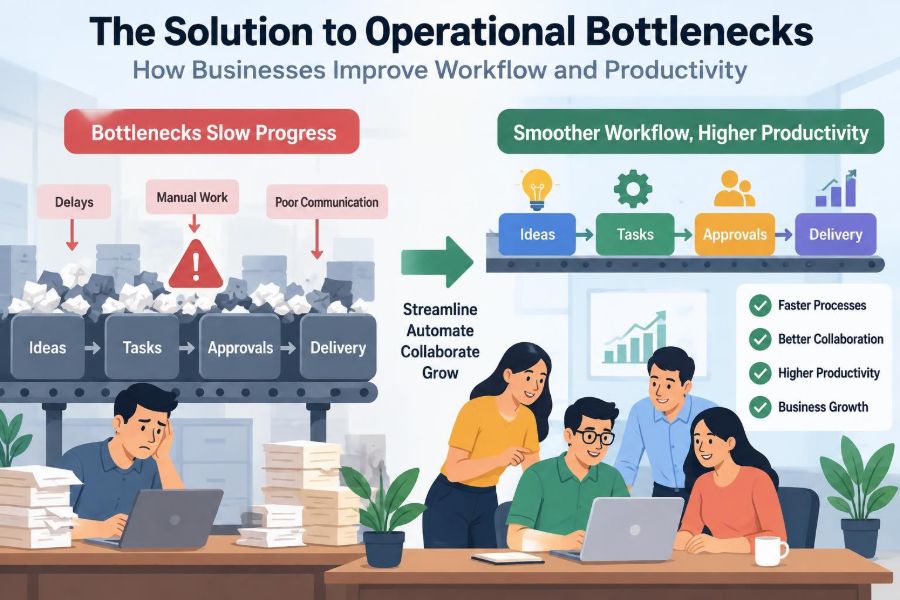

A customer asks for an update, but the person who can answer is waiting for information from another department. Meanwhile, an invoice sits unapproved, a production order cannot start, and a manager spends the afternoon chasing status updates through messages and spreadsheets.
Most organizations recognize this feeling. Work is happening, people are busy, and yet results move more slowly than expected. The problem is often not effort or commitment. It is a blockage in the way work flows.
Operational bottlenecks quietly increase costs, frustrate employees, lengthen customer wait times, and make planning unreliable. They can appear in a factory, a hospital, a retail operation, a professional-services team, or a small online business.
Finding and improving bottlenecks is therefore less about asking people to work faster and more about designing a system in which work can move smoothly, visibly, and predictably.
🚧 What an Operational Bottleneck Actually Is
An operational bottleneck is the step, resource, decision, or rule that limits the amount of work a process can complete. Like the narrow neck of a bottle, it constrains everything behind it, even when other parts of the system have spare capacity.
A bottleneck may be a machine, a specialist, an approval stage, a software system, or an unclear handoff between teams. Its defining feature is not that it looks busy; it is that it restricts the overall flow of work.
🌊 Why Local Busyness Does Not Equal Good Flow
Teams often try to keep every person and asset fully occupied. This can unintentionally make workflow worse. If every stage produces work as quickly as possible, unfinished items pile up before the slowest stage.
Consider a design team that completes proposals faster than a single legal reviewer can assess them. More completed designs do not mean more approved proposals. They create a larger queue and longer waiting times for everyone involved.
Strong operations focus on flow: the steady movement of valuable work from request to completion. Utilization matters, but maximizing utilization everywhere is not the same as maximizing outcomes.
🔍 The Difference Between a Constraint and a Minor Delay
Not every inconvenience is a true bottleneck. A printer that fails once a month may create irritation without setting the organization’s normal output limit. A constraint consistently governs the pace of the wider process.
One practical test is to ask: if this step had more capacity, would the organization reliably complete more work? If the answer is yes, it is likely a meaningful constraint. If work would simply wait somewhere else, another limit is probably more important.
🧭 Map the Workflow Before Changing It
Improvement begins with an accurate picture of the current process. A workflow map traces the path of a request, product, case, or customer from beginning to end, including handoffs, decisions, rework, and waiting periods.
The most useful maps show what actually happens, not only the official procedure. Staff members often rely on informal checks, duplicate data entry, or workarounds that never appear in a formal process document.
- Where does work enter the process?
- Who performs each step and who approves it?
- Where does work wait, return, or get corrected?
- Which systems, forms, and information are required?
- What marks the work as complete?
⏱️ Measure Time in the Right Way
A task can take ten minutes of active effort but remain open for ten days. Separating these measures reveals why customers may experience long delays despite employees working hard.
Processing time is the hands-on time required to perform work. Waiting time is the time work spends in a queue or awaiting information, a decision, or available capacity. Lead time covers the full period from request to delivery.
For many administrative and service processes, waiting rather than hands-on work accounts for most of the lead time. That makes queues a powerful place to investigate.
📚 Watch the Queues
A growing queue is often the most visible sign of a bottleneck. Work accumulates before the constrained step because items arrive faster than that step can handle them.
Look beyond physical piles. A queue may be unread emails, unassigned support tickets, orders marked “pending,” documents waiting in a shared folder, or requests sitting in an approval system.
Queue size alone does not tell the full story. Some work is intentionally batched or scheduled for a specific time. The useful question is whether the queue is stable, visible, and appropriate for the promised turnaround time.
🧮 Use Simple Capacity Thinking
Capacity is the amount of work a resource can complete in a given period under normal conditions. Demand is the amount of work arriving. When demand regularly exceeds effective capacity at one step, the queue will grow unless the process changes.
Effective capacity is lower than theoretical capacity because people need breaks, equipment needs maintenance, cases vary in complexity, and information may be incomplete. Planning as if every hour is perfectly productive creates fragile operations.
| Observation | Likely implication | Useful next question |
|---|---|---|
| Queue grows before one step | That step may lack capacity | What work arrives and leaves each day? |
| Staff repeatedly interrupt a specialist | Specialist time is being fragmented | Which requests truly require expertise? |
| Items return for correction | Quality failure creates hidden load | What information was missing or unclear? |
| Work stalls at approval | Decision rights may be unclear | Can routine decisions be delegated? |
🕵️ Follow a Real Item Through the Process
Dashboards are helpful, but direct observation often uncovers details that reports miss. Follow one real order, application, claim, or project task from start to finish. Note every transfer, search, interruption, and period of inactivity.
This is sometimes called a “walkthrough” of the work. It helps distinguish assumptions from reality and shows where employees compensate for flawed process design.
🧱 Find the Root Cause, Not Just the Symptom
A late delivery is a symptom. The cause may be missing materials, unclear specifications, an overloaded scheduler, repeated corrections, or a customer decision that arrives too late.
Root-cause analysis asks why a problem occurs repeatedly. A simple method is to keep asking “why?” until the answer points to a controllable condition rather than an individual blame target.
For example, “the team misses deadlines” may lead to “requests arrive incomplete,” then “the intake form allows key fields to be skipped.” Improving the form may prevent recurring delay more effectively than reminding people to hurry.
🧑🤝🧑 Include the People Doing the Work
Employees closest to a process usually know where time is lost. They see exceptions, confusing instructions, customer misunderstandings, and system limitations long before those problems reach a management report.
Involving them does not mean adopting every suggestion without review. It means treating practical knowledge as evidence. Ask what creates rework, what information arrives too late, and what rules force unnecessary effort.
A blame-free approach matters. People are more likely to describe failures honestly when improvement is about fixing the system rather than identifying someone to punish.
🧾 Fix Weak Inputs at the Source
Many bottlenecks begin before the visible constrained step. Incomplete customer requests, ambiguous project briefs, incorrect order details, and missing documentation force downstream teams to stop, clarify, and redo work.
Better intake can include required fields, clear examples, validation checks, and an early review for complex requests. The aim is not to create bureaucracy; it is to ensure work enters the process ready for the next person.
It is often cheaper to prevent one flawed request than to correct it after several teams have touched it.
🔄 Reduce Rework and Error Loops
Rework consumes capacity without creating new value. When a contract, product, report, or service case returns for correction, it competes with new work at the same constrained resource.
Common sources include unclear standards, inconsistent training, rushed handoffs, manual transcription, and quality checks placed too late. A well-designed process puts feedback close to the point where an error can be prevented.
Checklists can help with repeatable high-risk tasks, but they should be short and relevant. A long checklist that people mechanically click through is not meaningful quality control.
✂️ Remove Steps That Do Not Add Value
Some activities are necessary for compliance, safety, or control even if customers never see them. Others exist only because “that is how it has always been done.” The difference matters.
Review approvals, reports, duplicate entries, meetings, and file transfers. For each, ask whether it changes the decision, reduces a real risk, meets a defined requirement, or improves the customer outcome.
Eliminating low-value steps frees capacity, but simplification should be tested carefully. Removing a control without understanding its purpose can move risk elsewhere.
✅ Redesign Approval Paths
Approval bottlenecks are common because decisions concentrate with a few senior people. The result is delayed work, interrupted managers, and employees who lack authority to resolve routine matters.
A useful redesign separates decisions by risk. Low-risk, repeatable choices can often follow predefined rules or be delegated to trained staff. Higher-risk exceptions should remain visible to the appropriate decision-maker.
Clear decision rights are essential. People need to know what they can approve, what evidence is required, and when escalation is necessary.
📦 Control Work in Progress
Work in progress, often shortened to WIP, is work that has started but is not finished. Too much WIP makes priorities unclear, extends lead times, and hides the age of individual items.
Setting a WIP limit means starting fewer items so the team can finish existing work before pulling more into the process. This can feel counterintuitive when demand is high, yet it often exposes the actual constraint and reduces costly multitasking.
A team might use a visible board with columns such as “ready,” “in progress,” “review,” and “done,” then agree on how many items may occupy each active stage.
🎯 Prioritize by Value and Urgency
When everything is labelled urgent, the bottleneck receives constant interruptions and no reliable order of work. A simple prioritization policy helps protect flow.
Useful criteria may include customer commitment, safety impact, legal deadlines, revenue significance, dependency on other work, and the cost of delay. The right criteria vary by organization, but they should be explicit and consistently applied.
Priority rules need review. An item that was urgent on Monday may no longer deserve to displace work on Friday if circumstances change.
🧠 Protect the Constrained Resource
Once a true constraint is identified, protect its time. Do not assign it avoidable administration, unnecessary meetings, or work that another trained person can complete.
For example, if a quality engineer is the limiting resource in a product-release process, colleagues can prepare complete documentation before review. The engineer should focus on decisions and assessments that genuinely require that expertise.
- Schedule maintenance and breaks predictably.
- Provide complete, prioritized work at the constraint.
- Keep essential tools and information available.
- Assign support tasks away from the constraint where appropriate.
⚙️ Balance Work Around the Constraint
Other stages should support the bottleneck rather than overwhelm it. Sending large batches to a constrained reviewer may create a queue while starving other work of attention.
Upstream teams can release work at a pace the constraint can absorb. Downstream teams can be ready to receive completed items quickly. This coordinated rhythm is sometimes more effective than trying to make every department operate at its individual maximum.
🧩 Standardize Repeatable Work
Standard work documents the best known method for a recurring task. It may specify sequence, required information, expected quality checks, and handoff conditions.
Standardization reduces variation, shortens training time, and makes problems easier to spot. It should not remove professional judgment where cases differ materially or where staff must respond to customer needs.
The strongest standards are living tools. Teams revise them when evidence shows a safer, clearer, or more efficient method.
🤖 Automate Carefully, Not Automatically
Automation can remove repetitive copying, routing, reminders, calculations, and status updates. It is particularly useful where rules are stable and information is structured.
However, automating a flawed workflow may make mistakes travel faster. Before investing in software, simplify the process, define exceptions, and establish who owns data quality.
A practical starting point is a small automation that handles a frequent, low-risk task while retaining human review for unusual or high-impact cases.
🔗 Improve Handoffs Between Teams
Many delays occur between departments rather than within them. A sales team may promise a delivery date without checking operations; operations may send a query without explaining what information is needed; finance may receive an invoice without a purchase reference.
Good handoffs have a clear sender, receiver, standard information set, expected response time, and visible ownership. Service-level expectations can help, but they should describe a realistic working agreement rather than become a substitute for collaboration.
💬 Make Work Visible
Visibility reduces the need for status-chasing. A shared workflow board, ticketing system, production schedule, or dashboard can show what is waiting, who owns it, and what is blocking progress.
The goal is useful transparency, not surveillance. Measures should help teams make decisions: which queue needs attention, which item is aging, and whether a change improved flow.
A dashboard full of metrics that no one can act on creates noise. Start with a small set connected to customer outcomes and operational decisions.
📈 Track a Balanced Set of Measures
No single metric captures operational health. Speed without quality can increase rework; low cost without resilience can leave a process unable to handle variation.
A balanced view often includes lead time, backlog age, throughput, first-pass quality, on-time completion, customer feedback, and employee workload. Definitions must be consistent so that trends mean something.
Use measurement as a learning tool, not merely a performance scorecard. A worsening metric may reveal a growing demand surge, an upstream issue, or a new process weakness worth investigating.
🧪 Test Changes on a Small Scale
Large process redesigns carry risk because they affect customers, employees, systems, and compliance obligations at once. Where possible, test an improvement in a limited area, with a defined hypothesis and review period.
A hypothetical customer-support team might trial a new triage form for one request category. It can compare completeness, transfer rates, and resolution time before extending the change more widely.
Small tests do not eliminate uncertainty, but they reduce the cost of discovering that an appealing idea has unintended effects.
🛡️ Build Capacity for Variation
Demand and task complexity are rarely perfectly steady. A process designed to operate at its limit every day has little room for absences, urgent cases, equipment problems, or seasonal peaks.
Resilience can come from cross-training, flexible staffing, backup equipment, sensible inventory buffers, documented procedures, and realistic schedules. These measures involve cost, so the right level depends on the consequences of delay.
Not every buffer is waste. In a volatile environment, a carefully chosen buffer can protect customers and prevent a small disruption from becoming a system-wide backlog.
👥 Cross-Train Without Diluting Expertise
Cross-training enables more than one person to perform an important task. It reduces dependence on a single employee and can help work continue during leave, turnover, or demand spikes.
It is not a reason to assume everyone can perform every job at the same level. Complex technical, clinical, financial, or legal tasks may require formal qualifications, supervision, or limits on delegation.
Documenting competence, providing practice time, and reviewing quality are essential if cross-training is meant to relieve a bottleneck safely.
🚨 Avoid the “Work Harder” Trap
Overtime and individual heroics can temporarily clear a backlog, especially during a genuine emergency. As a long-term solution, they often conceal the underlying constraint and increase fatigue, errors, and employee turnover risk.
Similarly, adding people to a process does not always increase output. New staff may require training, increase coordination needs, or compete for the same approvals, tools, and information.
Before adding effort, identify what prevents work from moving. The solution may be clearer intake, fewer handoffs, better scheduling, or a targeted capacity increase at one specific step.
🧯 Common Improvement Mistakes
Operational improvement can fail when leaders change too much at once, rely only on averages, or announce a solution before understanding the problem. Average turnaround times, for instance, can hide a small number of severely delayed cases.
- Buying technology before mapping the process.
- Measuring activity instead of completed outcomes.
- Moving a bottleneck without checking where it reappears.
- Ignoring quality and customer impact while pursuing speed.
- Imposing changes without consulting people who do the work.
- Stopping measurement once the initial backlog falls.
Improvement is iterative. A process is a connected system, so changing one part may create a new constraint elsewhere.
🗺️ Create a Practical Improvement Plan
A useful plan turns diagnosis into a small number of owned actions. It should name the problem, describe the evidence, define the desired outcome, identify responsible people, and set a review date.
- Choose one process with a meaningful customer or business impact.
- Map the real workflow and collect basic timing and queue information.
- Identify the likely constraint and its root causes.
- Select one or two changes that address those causes.
- Test, measure, learn, and adjust before scaling.
Clarity matters more than a complicated project template. People should understand what will change, why it is changing, and how success will be assessed.
🔁 Make Continuous Improvement Part of Operations
Bottlenecks shift as demand, products, staffing, technology, and customer expectations change. A one-time project may solve an immediate issue, but it cannot keep a process healthy forever.
Regular operational reviews create a habit of noticing queues, exceptions, rework, and recurring customer complaints before they become crises. Short team discussions can be enough when they focus on evidence and action rather than lengthy reporting.
Leaders support this culture by making it safe to raise problems and by following through on reasonable improvements.
🌟 The Core Principle: Improve the System, Not Just the Pace
The most effective response to operational bottlenecks is systematic. Understand the flow of work, locate the true constraint, protect and improve it, and then observe how the whole process responds.
That approach recognizes that productivity is not simply a measure of personal effort. It is a property of the system: its information, decisions, capacity, tools, standards, handoffs, and ability to handle variation.
When businesses reduce unnecessary waiting, rework, and confusion, employees can spend more of their time on useful work and customers receive more reliable service.
Lasting productivity gains come from making work easier to complete correctly, not from expecting people to compensate indefinitely for a poorly designed process. 📊⚙️