
A business can look busy from the outside and still be moving in the wrong direction. Sales calls are being made, orders are arriving, and the team is working late—yet cash remains tight, customers leave, and profit never seems to catch up.
This often happens because leaders focus on one visible number: revenue. Revenue matters, but it is only one part of the growth picture. A company can grow sales while losing money, or protect profit so aggressively that it drives good customers away.
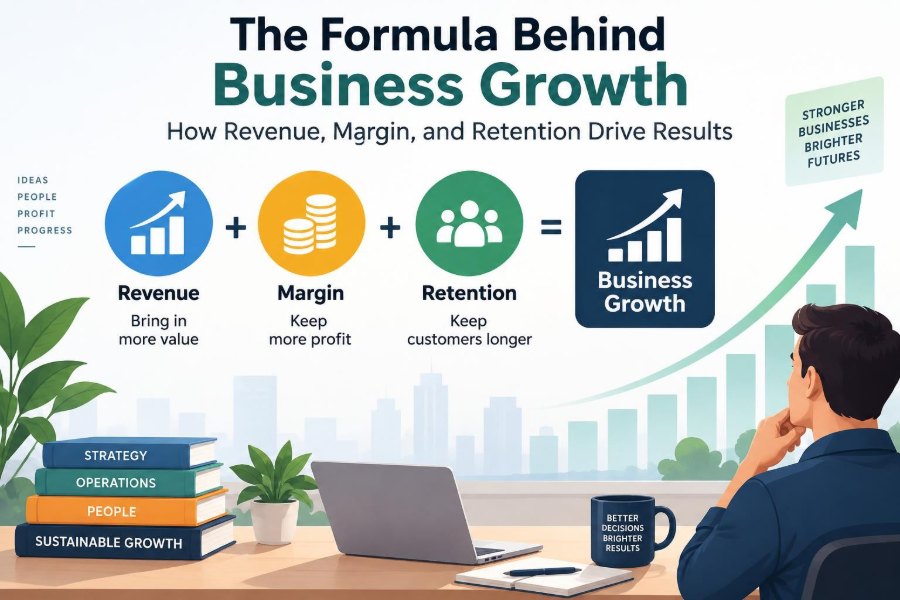
Real business growth is a balancing act between bringing in money, keeping enough of it after costs, and earning the right to keep serving customers over time. These three forces—revenue, margin, and retention—are closely connected.
Once you can see how they work together, financial reports become less intimidating. More importantly, you can make better decisions about pricing, marketing, staffing, customer service, and investment.
🧩 The simple growth formula
A useful way to think about sustainable growth is:
Business growth = revenue growth × healthy margins × customer retention.
This is not a formal accounting equation. It is a management model that highlights three questions: Are we selling enough? Are those sales profitable? Will customers continue buying from us?
If any one factor is weak, it limits the others. Strong sales with poor margins create strain. Excellent margins with shrinking demand limit scale. High retention without new demand can lead to stagnation.
💵 Revenue is the money earned from sales
Revenue is the total amount a business earns by selling goods or services before subtracting costs. A bakery that sells $10,000 of bread and cakes in a month has $10,000 in revenue, even if its ingredients, rent, and wages cost most of that amount.
Revenue is commonly called the “top line” because it appears near the top of an income statement. It shows market activity, but it does not tell the full story about financial health.
Managers should ask where revenue comes from: new customers, repeat customers, price increases, additional products, or a larger average order. Each source has different costs and risks.
📈 Revenue growth is more than selling more units
Revenue can increase in several ways. A company may gain more customers, sell more often to existing customers, raise prices, or persuade buyers to choose higher-value products.
- Volume growth: selling more units or serving more clients.
- Price growth: earning more per unit sold.
- Mix growth: shifting sales toward higher-priced offerings.
- Expansion growth: entering a new market, channel, or customer segment.
These routes are not equally attractive. Discounting may quickly lift volume but weaken profitability, while a carefully designed premium service may improve both revenue and margin.
🧾 Why revenue can be misleading
Imagine a retailer increases sales by offering deep discounts and free delivery. Revenue rises, which may look like a success in a monthly report. But if the discount removes most of the profit and delivery costs increase, the business may be worse off.
Revenue also says little about payment timing. A business can record a sale today but wait weeks or months for the customer to pay. That gap can create cash-flow pressure, especially in businesses that must pay suppliers quickly.
Revenue is therefore a starting point, not a final verdict.
🪙 Margin measures what the business keeps
Margin shows how much money remains from sales after certain costs are removed. It is usually expressed as a percentage of revenue, which makes comparisons easier across products, periods, or businesses of different sizes.
A margin of 40% means that for every dollar of revenue, forty cents remain after the costs included in that calculation. Which costs are included depends on the type of margin being discussed.
Margin turns sales activity into economic value. It helps managers see whether growth is creating resources to pay overhead, invest, and eventually generate profit.
🏷️ Gross margin reveals product-level economics
Gross margin is revenue minus the direct costs required to produce or buy what is sold. For a café, direct costs might include coffee beans, milk, food ingredients, and packaging. For a consultant, they may include subcontractor time tied directly to a client project.
The basic calculation is:
Gross margin = (Revenue − cost of goods or services sold) ÷ Revenue
Gross margin helps identify products that look popular but contribute little. A high-selling item with a very low gross margin may still be worthwhile, but it needs a clear strategic reason, such as attracting customers who later buy more profitable items.
🏢 Operating margin shows the cost of running the business
Operating margin goes further by considering operating expenses such as salaries, marketing, rent, technology, and administration. It indicates how much remains from normal business operations before items such as taxes and interest.
A business can have a healthy gross margin yet a weak operating margin if its overhead grows faster than its sales. This is common when a company hires ahead of demand, spends heavily to acquire customers, or carries too much unused capacity.
Looking at both measures prevents a narrow view. Gross margin examines the offer; operating margin examines the operating model.
⚖️ High margin is not always the right goal
It is tempting to treat the highest-margin product or customer as automatically best. However, very high margins may come with limited demand, slow growth, or greater service expectations. Some lower-margin products create traffic, strengthen customer relationships, or help cover fixed costs.
The better question is whether the margin is sufficient for the business model and its strategic role. A low-margin product sold in large, predictable volume may support a viable operation. A high-margin product that rarely sells may not.
Managers need to consider margin alongside volume, repeat purchase patterns, capacity, and cash requirements.
🔍 Contribution margin supports everyday decisions
Contribution margin is the revenue left after variable costs—costs that rise or fall with each sale—are deducted. It contributes toward fixed costs such as rent, core salaries, and insurance.
For example, if a workshop charges $200 per participant and materials, payment fees, and instructor time tied to that participant total $80, the contribution margin is $120. The workshop may still be unprofitable overall if too few people attend to cover fixed costs.
This measure is useful for decisions about promotions, special orders, and capacity. It asks a practical question: does each additional sale help cover costs, or does it make the loss larger?
🧮 A small hypothetical example
Consider a fictional online stationery shop. It earns $100,000 in monthly revenue. Product and shipping-related costs total $55,000, leaving a gross profit of $45,000 and a gross margin of 45%.
Its monthly salaries, advertising, software, and rent total $38,000. The business has $7,000 remaining from operations before other expenses. If it boosts revenue to $120,000 by cutting prices sharply, gross margin might fall enough that operating profit barely changes.
The lesson is not “never discount.” It is to calculate the full effect before treating higher sales as better growth.
🔁 Retention is the ability to keep customers
Retention measures whether customers continue their relationship with a business. In a subscription company, this may mean renewing each month or year. In a restaurant, retailer, or professional service, it means returning and buying again.
Retention matters because existing customers already understand the offer. They may require less education and less acquisition spending than first-time buyers, although they still need ongoing value and reliable service.
A retained customer is not merely someone who has not formally cancelled. Meaningful retention involves continued use, repeat purchasing, and willingness to stay when alternatives are available.
🚪 Churn shows the customers leaving
Churn is the opposite of retention: it describes customers, revenue, or subscriptions lost during a period. A business should track both customer churn and revenue churn when possible, because losing one large customer can matter more than losing several small ones.
For a subscription business, a simple customer churn calculation is:
Customer churn rate = customers lost during a period ÷ customers at the start of that period
Definitions should remain consistent. Counting customers who downgrade, pause, or become inactive differently from month to month can make trends appear better or worse than they truly are.
🤝 Retention begins with the promise made at sale
Customer retention is often treated as a service-team responsibility. In reality, it starts much earlier—with marketing messages, sales conversations, pricing, and onboarding.
When a business promises more than it can reliably deliver, the first purchase may happen, but disappointment makes repeat business less likely. Clear expectations can sometimes reduce immediate conversion while improving long-term customer quality.
The strongest retention strategy is not a last-minute discount offered to prevent cancellation. It is a product and experience that consistently solve a real customer problem.
🛠️ Product value is the foundation of repeat business
Customers return when they receive value that fits their needs, budget, and alternatives. Value does not mean the lowest price. It can include convenience, reliability, quality, expertise, speed, ease of use, or confidence that a problem will be handled well.
A software tool that saves a team time may retain customers even when cheaper options exist. A local repair business may retain customers through dependable communication and trustworthy work.
Retention weakens when the product no longer solves the original problem, even if service staff are friendly and responsive.
🧭 Onboarding reduces early customer loss
The period just after purchase is especially important. New customers are deciding whether the product matches their expectations and whether they can use it successfully.
Good onboarding removes uncertainty. It may include a welcome message, a simple setup checklist, a training session, practical examples, or a clear way to get help. The right approach depends on how complicated the offer is.
Businesses should identify the first meaningful outcome a customer needs. For a fitness app, it might be completing a useful workout plan; for accounting software, it might be sending the first invoice accurately.
📣 Customer feedback is operational evidence
Complaints, support requests, reviews, cancellations, and sales objections contain signals about where value is breaking down. A single comment may be unusual; repeated patterns deserve investigation.
Useful feedback systems categorize issues rather than treating every message as an isolated case. Are customers confused about setup? Are deliveries unreliable in a particular region? Do buyers feel the price is unclear?
Listening alone is insufficient. Teams should connect feedback to ownership, decisions, and follow-up. Otherwise, a business collects insights without improving the experience that caused the problem.
🔗 The three metrics reinforce one another
Revenue, margin, and retention are not separate scoreboards. They influence each other continuously. Improving retention can create more repeat revenue. Better margins can fund service improvements. Better service may reduce churn and support stable pricing.
But trade-offs also exist. Reducing support staff may improve short-term margin while harming retention. Aggressive discounting may raise revenue while training customers to wait for promotions.
Good management means seeing these second-order effects rather than optimizing one number in isolation.
📊 A practical metric dashboard
A small dashboard can make the growth formula visible without overwhelming a team. The exact measures vary by industry, but the categories should connect activity to outcomes.
| Area | Useful question | Possible measure |
|---|---|---|
| Revenue | Are sales growing from healthy sources? | Revenue by product, customer segment, or channel |
| Margin | What remains after direct and operating costs? | Gross margin, contribution margin, operating margin |
| Retention | Do customers continue buying and using? | Repeat purchase rate, renewal rate, churn |
| Cash | Can the business fund daily operations? | Cash collected, payment timing, receivables |
The goal is not to monitor every available number. It is to choose measures that help someone make a better decision.
🗓️ Track trends, not isolated months
A single month can be distorted by seasonality, a large order, a delayed invoice, or a one-time campaign. Trends across several comparable periods are generally more useful than a snapshot.
Compare results with the relevant baseline: the previous month, the same period last year, the budget, or a target based on capacity. A retailer may expect seasonal peaks; a consulting firm may see revenue fluctuate with project timing.
When a metric changes, ask what changed in the underlying system. A number tells you where to look, not automatically why the result occurred.
🧱 Segmenting reveals hidden problems
Company-wide averages can conceal major differences. Overall retention may appear stable while a valuable customer segment is leaving. Total margin may look healthy because one product subsidizes another.
Useful segments can include product line, sales channel, customer size, geographic area, acquisition source, cohort, or contract type. A cohort is a group of customers who started during the same period or under similar conditions.
Segment only when it leads to action. If customers acquired through one campaign churn quickly, the business can examine the campaign promise, targeting, and onboarding rather than guessing.
🎯 Pricing connects revenue and margin
Pricing is one of the most direct levers in the growth formula. A price change affects revenue per sale, demand, perceived value, and margin simultaneously.
Before changing prices, consider direct costs, competitor alternatives, customer sensitivity, and the value the offer creates. A small increase may be accepted if customers see clear value; it may trigger losses if buyers have many similar alternatives.
Pricing decisions should also consider fairness and communication. Surprise increases, confusing fees, or inconsistent discounts can damage trust and therefore retention.
🧺 Product mix can improve growth quality
Product mix refers to the combination of items or services a business sells. A company may increase profit not only by selling more, but by helping customers choose options that better fit their needs and contribute more after costs.
For instance, a service firm might offer a standard package, a premium package with faster response, and an add-on for specialist support. This gives customers choices without forcing every buyer into the same price point.
However, too many options create confusion and operating complexity. A better mix is not the largest catalog; it is a set of offers that customers understand and the business can deliver consistently.
📥 Customer acquisition has a cost
New customers are essential for expansion, but acquiring them can require advertising, sales commissions, trials, events, or staff time. A business should understand whether the gross profit expected from a new customer can reasonably support those costs.
This does not require pretending that every customer behaves identically. It means using realistic assumptions and reviewing them as results arrive. Acquisition spending can be sensible even when payback takes time, provided cash resources and retention prospects support it.
Fast acquisition with weak retention is often a leaky bucket: marketing keeps filling it, while customer loss prevents durable growth.
💳 Cash flow is the constraint behind the formula
Profitability and cash flow are related but different. A profitable business can still struggle if customers pay late, inventory must be bought in advance, or rapid growth requires large upfront spending.
Consider a manufacturer that receives a large order. Revenue may be recognized when goods are delivered, but materials, labor, and shipping may need payment well before the customer settles the invoice.
Managers should pair growth targets with a cash plan. Sustainable growth is growth the business can afford to deliver.
🚩 Common mistakes when interpreting growth
- Celebrating revenue alone: this ignores the cost and durability of sales.
- Cutting costs indiscriminately: this can remove service, quality, or capability that protects retention.
- Using averages as the whole story: segments may have sharply different economics.
- Reacting to one data point: temporary variation can prompt harmful overcorrection.
- Offering retention discounts without fixing value: this delays, rather than solves, the reason customers leave.
The common thread is short-term thinking. Useful metrics should guide learning, not provide a reason to ignore operational reality.
🧪 Test changes with clear hypotheses
When improving growth, avoid changing everything at once. State a hypothesis: for example, “A clearer setup guide will reduce early support requests and improve first-month retention.” Then identify the measures that would indicate whether it helped.
Tests can involve a revised price page, a new packaging option, a different onboarding sequence, or a service process. Keep records of timing and context, since external factors may influence results.
Not every experiment should scale. A result that works for a small group, a specific market, or a short time may need further validation before becoming standard practice.
👥 Align teams around shared outcomes
Sales teams may be rewarded for closing new business, finance teams for controlling costs, and service teams for resolving tickets quickly. These goals can conflict if they are not connected to customer value and long-term economics.
Shared measures encourage better trade-offs. Sales can be evaluated partly on customer fit or early retention; product teams can consider support demand; finance can help clarify the economic impact of service investments.
Alignment does not mean every department owns every task. It means decisions are made with awareness of consequences beyond one team’s immediate target.
🧠 Use metrics to ask better questions
Numbers become valuable when they lead to specific questions. If gross margin falls, did supplier costs rise, did discounting increase, or did customers shift toward a lower-margin product? If churn rises, are customers leaving after a particular moment in their journey?
Data rarely eliminates judgment. Definitions, data quality, and business context matter. A decline in retention may be acceptable if a company deliberately stops serving an unprofitable customer segment, but it should be a conscious trade-off.
Good managers combine quantitative evidence with conversations with customers, employees, suppliers, and frontline teams.
🗺️ A practical review routine
A regular review process turns the formula into management practice. Weekly reviews may focus on near-term sales, service issues, and cash. Monthly reviews can examine margins, retention trends, and variance from plan. Longer reviews can address product strategy and capacity.
- Review revenue by meaningful source.
- Check margin changes and identify the cost or pricing driver.
- Examine retention and customer feedback together.
- Identify one or two root causes worth addressing.
- Assign an owner, next step, and date for follow-up.
The discipline is less about producing elaborate reports and more about closing the loop between evidence, action, and learning.
🌱 Building durable rather than superficial growth
Durable growth is not simply a rising sales chart. It is the ability to increase value delivered to customers while keeping the economics strong enough to support the business.
That may require patience. A company might slow expansion to improve onboarding, decline unprofitable work, raise prices carefully, or invest in systems that reduce errors. These choices can look less dramatic in the short term but strengthen the foundation for future growth.
The aim is not perfection in every metric. It is a business model where revenue, margin, retention, and cash can support one another over time.
🏁 The core principle behind business growth
Revenue creates opportunity, margin creates capacity, and retention creates continuity. Together, they show whether a business is gaining customers, creating enough value from each sale, and building relationships that can endure.
When evaluating any growth initiative, ask three connected questions: Will it increase revenue? What will it do to margin? How will it affect the customer’s reason to stay? Add a fourth question—can we fund it?—to keep cash reality in view.
This framework does not replace detailed financial analysis or customer research. It gives managers a practical lens for making those tools more useful and for avoiding decisions that improve one metric while quietly damaging the business.
The healthiest growth comes from earning more, keeping enough of what is earned, and giving customers a reason to return. 📊🤝🌱