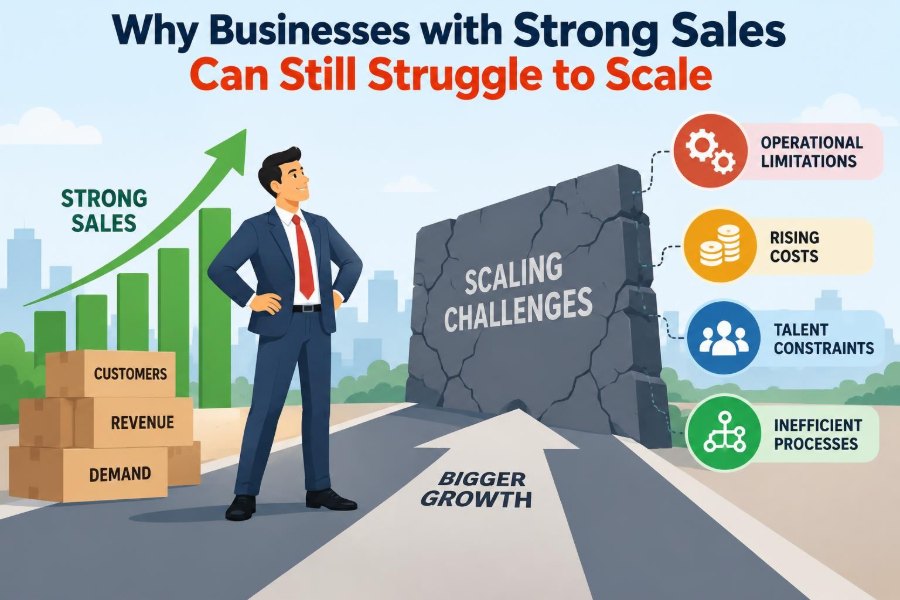

A company can have a full order book, a busy sales team, and customers who genuinely want its product—and still feel as though it is constantly behind. Every new deal brings relief, followed by another rush of hiring, delivery problems, customer questions, and cash pressure.
This situation surprises people because sales are often treated as the clearest sign of business health. Revenue matters deeply, but it does not automatically create the systems, capabilities, or financial resilience required to serve a much larger customer base.
Scaling means increasing output without costs, complexity, errors, or dependence on a few people rising at the same rate. That is a different challenge from winning the next sale.
For students, founders, managers, and team leaders, understanding the gap between strong sales and scalable operations helps explain why promising businesses sometimes stall at exactly the moment they appear to be succeeding.
📈 Sales Growth and Scaling Are Not the Same
Sales growth means a business is selling more than before. Scaling means it can handle that extra demand repeatedly, profitably, and reliably.
A freelance designer may double revenue by working twice as many hours. That is growth, but it is not yet scale. A design firm with documented workflows, trained staff, quality checks, and a repeatable client onboarding process can take on more work without one person becoming the bottleneck.
The distinction matters because a business can celebrate rising revenue while quietly building a larger and more fragile operating problem.
🧱 Revenue Can Hide a Weak Operating Foundation
Early sales often happen through improvisation. Founders personally solve exceptions, employees remember processes rather than document them, and customers receive individual attention that cannot be replicated indefinitely.
These methods can work well when volumes are low. At higher volume, however, every informal workaround becomes harder to coordinate. A missing approval step, unclear handoff, or undocumented pricing exception may affect dozens of orders rather than one.
Strong sales can therefore conceal a weak foundation until demand exposes it. The challenge is not that flexibility is bad; it is that flexibility needs to become a designed operating system before it turns into disorder.
💰 Revenue Is Not Cash in the Bank
A sale recorded today may not be paid for until much later. Meanwhile, the business may need to buy inventory, pay staff, ship goods, or fund implementation before receiving the customer’s payment.
This timing difference is called the cash conversion cycle: the period between spending cash to deliver a product or service and collecting cash from the customer. Rapid growth can make this period more painful because every new order requires more upfront funding.
A business can be profitable on paper and still struggle to meet payroll or supplier obligations. Cash-flow forecasting is therefore a scaling tool, not merely an accounting exercise.
🧾 Thin Margins Magnify Growth Pressure
High revenue does not help much if each sale leaves too little money after direct costs, discounts, returns, delivery, commissions, and support. A thin margin gives management little room to absorb mistakes or invest in better systems.
For example, a retailer may increase online orders rapidly but lose much of the value through expensive fulfilment and frequent returns. More orders then create more work without producing enough contribution toward overhead and improvement.
Managers should examine contribution margin—the amount left from a sale after its direct variable costs—not just total revenue. Growth that consistently consumes cash is not healthy scale.
🎯 The Wrong Customers Can Create Busywork
Not all revenue is equally scalable. Some customers fit a company’s offering, buying process, service model, and payment terms. Others require extensive customization, unusual contract clauses, constant intervention, or unplanned support.
Winning every available deal can pull a business in too many directions. A software provider that promises unique features to each client may build a collection of special projects instead of a manageable product.
A clearer ideal customer profile helps teams qualify opportunities. It does not mean refusing all exceptions; it means understanding the operational and financial cost before making one.
🛠️ Custom Work Often Resists Repeatability
Customization can be valuable, especially in consulting, professional services, manufacturing, and business-to-business sales. The risk appears when customization is sold as though it were a standardized product.
Every one-off specification requires extra scoping, training, production decisions, testing, and support. If these efforts are not separately priced, the organization becomes busier while its margins weaken.
Businesses that scale custom work usually create boundaries: standard packages, modular options, defined change requests, and clear rules for when bespoke work deserves premium pricing. Repeatability does not eliminate expertise; it directs expertise where it adds the most value.
🔄 Sales Promises Must Match Delivery Capacity
Sales teams are rewarded for winning customers, while operations teams are judged on delivery, quality, and cost. When those functions operate with different assumptions, customers receive promises the business cannot reliably keep.
A salesperson may offer a short implementation timeline to close a deal without knowing that the delivery team is already fully committed. The sale appears positive initially, but delays, overtime, and disappointed customers follow.
Regular capacity reviews, shared definitions of what can be sold, and feedback from delivery teams reduce this conflict. Sales discipline should protect customer trust, not merely maximize signed contracts.
🏭 Capacity Is More Than Headcount
When demand rises, managers often assume the answer is hiring. People matter, but capacity also depends on equipment, supplier reliability, workspace, software licences, managerial attention, and time to train new employees.
One constrained step can limit the entire process. A manufacturer may add assembly workers yet remain restricted by a slow inspection station. A service firm may hire consultants but lack enough experienced managers to review their work.
Identifying the bottleneck—the point that sets the maximum flow of work—prevents expensive but ineffective expansion. Capacity planning asks what limits output now and what will limit it after the next stage of growth.
⏱️ Bottlenecks Move as the Business Changes
Solving one constraint usually reveals another. After a company improves lead generation, sales qualification may become overloaded. After it expands production, shipping or customer support may become the new delay.
This is normal. The mistake is treating a bottleneck as a one-time fault rather than an ongoing management question. Teams need measures that show waiting time, work in progress, error rates, and backlog at key stages.
A useful practical habit is to review where work sits idle each week. The goal is not to keep every person busy; it is to keep the overall customer journey moving at a sustainable pace.
📋 Processes Need to Live Outside People’s Heads
A business becomes vulnerable when crucial work depends on an individual remembering what to do. This is common in successful small firms, where experienced employees have developed efficient personal methods over time.
Documenting a process does not require a large manual. A simple checklist, decision guide, template, or recorded walkthrough can make an important task easier to train, audit, and improve.
Start with processes that create frequent delays, customer complaints, financial risk, or rework. Standardization should focus on the repeatable core, while leaving room for informed judgment where situations genuinely differ.
🤝 Handoffs Create Hidden Failure Points
Many customer problems occur not within a department but between departments. Marketing passes a lead to sales, sales hands an account to implementation, and implementation transfers it to support. At each handoff, context can disappear.
Consider a hypothetical agency that wins a campaign based on an informal client conversation. If the account team receives only a brief note, it may miss key expectations about approvals, timing, or audience. Rework becomes likely.
Clear ownership, shared records, and a defined “ready to hand over” standard reduce this risk. A smooth handoff is an operational product in its own right.
🧠 Founder Dependence Limits Growth
Founders often drive early success through relationships, technical knowledge, fast decisions, and persistence. The same strengths can become constraints when every major sale, approval, escalation, or hiring decision requires their involvement.
If the founder is the only person able to resolve exceptions, the business has a single point of failure. Their calendar becomes the organization’s capacity limit.
Delegation is not simply assigning tasks. It requires giving people decision rights, context, training, and feedback. Leaders must distinguish between decisions that truly need their involvement and those that can be made safely closer to the work.
👥 Hiring Quickly Does Not Create a Team Quickly
Fast growth often creates urgent vacancies. Filling seats may relieve immediate pressure, but rushed hiring can create inconsistent performance, unclear expectations, and more management work for already stretched leaders.
New employees need onboarding, practical training, access to information, and clarity about what good work looks like. Without these, experienced staff spend much of their time answering repeated questions, which can reduce output in the short term.
A scalable workforce plan includes role definitions, training materials, realistic ramp-up periods, and managers with enough time to coach. Hiring should follow a workload pattern, not just a feeling that everyone is overwhelmed.
🧭 Middle Management Becomes Essential
As a business grows, a founder cannot directly coordinate every person and project. Middle managers translate strategy into priorities, solve everyday problems, develop employees, and surface risks before they become crises.
Businesses sometimes delay this layer because it feels like overhead. Yet the absence of capable managers can be more costly: unclear priorities, inconsistent decisions, employee burnout, and leaders trapped in operational detail.
The right structure varies by business. What matters is that teams have accessible decision-makers and that responsibilities are not blurred across several people who assume someone else is handling the issue.
📊 Metrics Can Encourage the Wrong Behavior
People tend to respond to what is measured and rewarded. If sales staff are judged only on contract value, they may prioritize deals that are difficult to deliver. If support is judged only on speed, representatives may close cases before customers are truly helped.
Balanced metrics connect commercial success with operational reality. For example, a company might track revenue quality, gross margin, implementation time, renewal rates, customer complaints, and overdue receivables alongside new sales.
No dashboard removes judgment. But a small set of connected measures makes trade-offs visible and reduces the chance that one department succeeds by transferring costs to another.
🔍 Data Quality Breaks Down Under Volume
Spreadsheets, inboxes, and personal notes can manage a small number of customers. As transactions increase, duplicate records, inconsistent naming, missing fields, and outdated status updates make it harder to see what is actually happening.
Bad data creates practical problems: invoices go to the wrong contact, stock forecasts become unreliable, and managers make decisions using conflicting reports. Adding software without improving data habits can merely automate confusion.
Define key data fields, establish who owns them, and keep systems simple enough that people will use them. Reliable information is a necessary input for forecasting, prioritization, and accountability.
💻 Technology Should Remove Friction, Not Add Complexity
Growing businesses often buy new tools to solve visible pain. A customer relationship management system, project platform, or inventory system can help—but only when its workflow matches the business’s needs.
Technology cannot compensate for an unclear process. Automating a poor approval system may make it faster to send work through unnecessary steps. Complex tools can also create adoption problems when teams receive little training.
Choose technology around a specific operational question: what repeated task, decision delay, or data gap should this solve? Pilot important changes, assign ownership, and measure whether the tool reduces effort or errors.
📦 Inventory Growth Can Trap Working Capital
Product businesses face a difficult balance. Too little inventory leads to stockouts and missed sales; too much inventory locks cash into goods that may move slowly, become obsolete, or require storage.
Sales enthusiasm can encourage optimistic purchasing. Yet demand may vary by product, season, channel, or region. A popular product line does not mean every item deserves deeper stock.
Better forecasting combines sales history with current orders, lead times, supplier reliability, and known changes in demand. It should also include a plan for slow-moving stock rather than assuming it will eventually sell itself.
🚚 Supply Chains Can Fail at Higher Volumes
A supplier that performs well with small, occasional orders may not be able to support larger, frequent orders with consistent quality. Shipping capacity, packaging, raw materials, and lead times can all become constraints.
Relying on one supplier may seem efficient, but it creates concentration risk. Diversifying suppliers can reduce vulnerability, although it may also increase coordination and quality-control work.
Scaling supply requires honest conversations about capacity, service levels, and contingency plans. The lowest purchase price is not always the lowest total cost if unreliable delivery repeatedly disrupts customers.
🛡️ Quality Problems Multiply with Volume
At low volume, a manager can personally inspect work or recover from a mistake with a quick call. At high volume, even a small defect rate can produce many refunds, reworks, complaints, and damaged relationships.
Quality control should be built into the process rather than left to a final rescue effort. This may involve acceptance criteria, sample checks, peer review, automated validation, or feedback loops from customers.
The aim is not perfection at any cost. It is to identify errors early, understand their root causes, and decide which controls are proportionate to the risk and customer expectation.
💬 Customer Support Reveals the Real Operating Model
Support tickets, returns, cancellations, and repeated questions show where the customer experience differs from the company’s internal assumptions. They are often treated as a cost centre, when they can be a valuable source of operational evidence.
If customers repeatedly ask how to use a feature, the issue may be onboarding or product design rather than support staffing. If they complain about unexpected fees, the issue may be sales communication or pricing clarity.
Review support themes alongside sales and delivery data. A company that learns from recurring friction can reduce demand for support rather than only trying to answer requests faster.
🌱 Retention Matters as Much as Acquisition
New sales can make a business appear to be expanding even if existing customers quietly leave. Replacing churned customers usually demands continued sales effort and can mask problems in value delivery.
Retention is especially important where revenue depends on subscriptions, repeat purchases, service contracts, or referrals. A customer who renews because the business reliably solves a problem contributes differently from a customer acquired through a heavy discount and lost soon after.
Track why customers stay, expand, reduce usage, or leave. The goal is not to retain every customer regardless of fit, but to learn whether the business is delivering on the promise that generated the sale.
⚖️ Pricing Must Fund the Service Promise
Underpricing is a common way to win early deals. It may be sensible for a limited test or a deliberate market-entry decision, but it becomes dangerous when the lower price is treated as permanent while service expectations rise.
Pricing should reflect the resources required to acquire, deliver, support, and improve the offering. It should also account for the value of scarce capacity, particularly when experts or specialized equipment are involved.
Clear pricing structures reduce internal confusion. They help salespeople explain what is included, give operations a realistic basis for planning, and make exceptions visible rather than silently normal.
🧮 Forecasting Turns Hope Into Decisions
Forecasting does not mean predicting the future perfectly. It means using current information to test what the business may need if sales, costs, delivery times, or cash collections change.
A practical forecast can connect expected demand with staffing, inventory, supplier commitments, cash needs, and likely delivery capacity. Managers should update it when major assumptions change instead of treating an annual plan as fixed truth.
Scenario planning is useful here. Ask what happens if a large customer pays late, a supplier misses a delivery, or demand rises faster than hiring. Preparing options early is cheaper than improvising during a crisis.
🚦Controlled Growth Beats Unplanned Acceleration
Turning down work can feel uncomfortable, particularly for a young business. But accepting more demand than the organization can serve may produce revenue now while weakening reputation, morale, and customer trust later.
Controlled growth can include waitlists, phased rollouts, capped onboarding, selective sales targets, or temporary limits on customization. These choices are not signs of low ambition; they are ways to protect the conditions required for sustainable expansion.
The right pace depends on cash reserves, operational maturity, market opportunity, and the cost of disappointing customers. Management’s task is to make that trade-off explicit.
🧪 Test the Model Before Replicating It
Before expanding into a new region, channel, product line, or customer segment, businesses benefit from proving that the existing model works consistently. One excellent location or account may rely on unusual local conditions or exceptional people.
A pilot can test whether customer demand, pricing, training, supply, and support remain viable outside the original setting. It should have clear learning goals, not merely a target for rapid sales.
Replication becomes safer when the business understands which elements are essential, which can be adapted, and which costs rise only after expansion. Scale is often built through disciplined repetition of lessons from smaller tests.
🗺️ Create a Clear Operating Playbook
An operating playbook brings together the practical rules that make the business deliver consistently. It can cover customer qualification, pricing approvals, onboarding, service standards, escalation routes, quality checks, and reporting rhythms.
The best playbooks are usable, not ceremonial. Employees should be able to find the answer to a common question quickly, while leaders review the material as the business learns.
Think of it as a map rather than a cage. It gives people a reliable route for routine work and makes exceptions easier to identify, discuss, and handle deliberately.
🔁 Build Feedback Loops Into Daily Management
Scaling organizations need a way for information to move upward, downward, and across teams. Frontline employees often see emerging problems first, while senior leaders may see financial or strategic patterns that teams cannot view alone.
Short regular reviews can connect these perspectives. Useful questions include: Where is work getting stuck? What customer promise is hardest to keep? Which exception keeps repeating? What decision needs clearer ownership?
Feedback matters only when it leads to action. Assign an owner, set a review date, and communicate what changed. This builds trust and prevents the same operational warning from being raised repeatedly without resolution.
🧯 Protect the Team From Permanent Firefighting
Some urgency is unavoidable in business. Permanent urgency is different: it normalizes rushed decisions, skipped checks, long hours, and a culture where people are praised for rescuing preventable problems.
Firefighting often looks productive because visible crises get solved. Yet it leaves little time to improve the process that caused the crisis. Over time, experienced employees may burn out or leave, taking valuable knowledge with them.
Leaders should reserve capacity for improvement work. Fixing a recurring source of errors, clarifying a handoff, or training a second person for a critical task can be more valuable than another short-term rescue.
✅ The Core Principle: Build Capability Alongside Demand
Strong sales are an invitation to build, not proof that the business is ready for unlimited growth. Sustainable scaling requires commercial success to be matched by cash discipline, appropriate margins, reliable capacity, repeatable processes, capable people, and honest customer promises.
There is no universal sequence that fits every organization. A software company may prioritize infrastructure and onboarding, while a manufacturer may focus on suppliers, inventory, and quality controls. The common task is to find the constraint that demand is exposing and strengthen it before it harms the next stage of growth.
When leaders treat operations as a strategic capability rather than backstage administration, sales become easier to convert into durable value for customers, employees, and the business itself.
A business truly scales when its ability to deliver grows as deliberately as its ability to sell. That balance turns momentum into a company that can keep its promises as it gets bigger. 📊🌱🤝