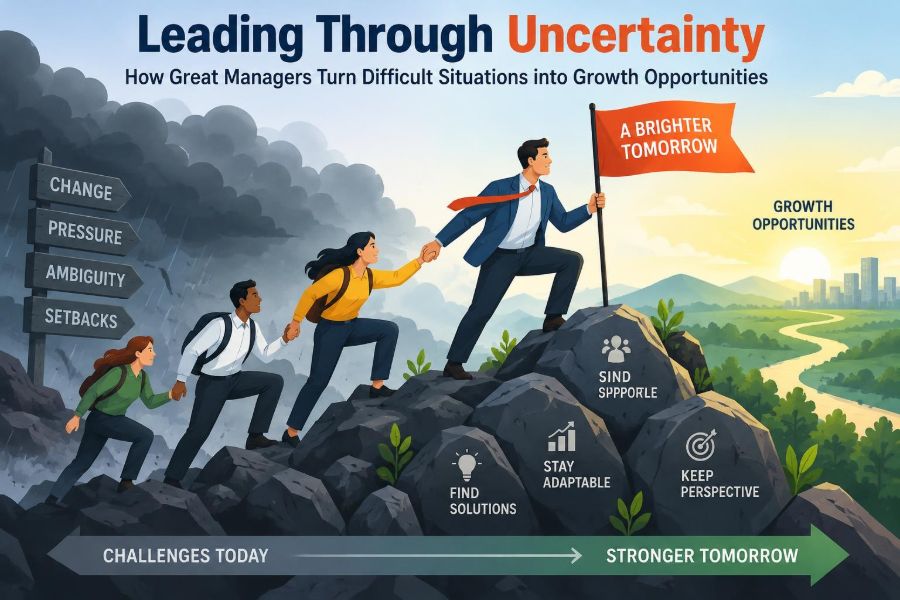

A key customer pauses an order. A supplier misses a deadline. A reorganization changes reporting lines with little warning. For the people doing the work, uncertainty often arrives as a series of ordinary messages that suddenly make the week feel less predictable.
Managers cannot always remove the disruption. They may not control market shifts, budget constraints, technical failures, or decisions made above them. What they do control is how the team interprets the situation, organizes its response, and learns from what happens next.
This is why difficult periods reveal so much about management. A team does not need a leader who pretends to know everything. It needs someone who can create clarity without false certainty, make decisions with incomplete information, and protect people’s ability to do good work.
Handled well, uncertainty can expose weak assumptions, improve processes, develop new capabilities, and strengthen trust. Handled poorly, the same conditions can produce rumor, paralysis, rushed choices, and burnout.
🌫️ Understanding What Uncertainty Really Means
Uncertainty is not simply a lack of information. It is the condition of having incomplete, changing, or ambiguous information while still needing to act. A manager may know that demand is falling without knowing how long it will last, or know that a system is vulnerable without knowing when it will fail.
The practical challenge is to distinguish uncertainty from ignorance. Ignorance can often be solved by finding a missing fact. Uncertainty may remain even after serious analysis because the future depends on events that have not happened yet.
🧭 Why Teams Look to Managers First
During disruption, employees watch managerial behavior closely. A manager’s tone, priorities, and willingness to answer difficult questions become signals about whether the environment is manageable or unsafe.
That does not mean managers must project constant confidence. Calmly saying, “I do not know that yet; here is what we are checking and when I will update you,” is usually more useful than an overly certain answer that later proves wrong.
🔍 Separate Facts, Assumptions, and Fears
A simple but powerful early step is to sort what the team is hearing into three categories: confirmed facts, reasonable assumptions, and unverified concerns. These categories often become mixed together in fast-moving situations.
For example, a confirmed fact might be that a client has delayed a project. An assumption might be that the project will restart next quarter. A fear might be that layoffs are imminent. Treating all three as facts makes rational planning much harder.
- Facts guide immediate decisions.
- Assumptions should be tested and revisited.
- Fears deserve acknowledgment, but not automatic acceptance as predictions.
📡 Communicate a Reliable Rhythm
When information is scarce, people often fill silence with speculation. Regular communication reduces that vacuum. The update does not need to contain dramatic news; its value comes from being predictable and honest.
A manager might establish a short weekly briefing during a major change: what is known, what has changed, what decisions are pending, and what employees should do now. A reliable rhythm is more stabilizing than occasional, polished announcements.
🗣️ Say What You Know—and What You Do Not
Transparency is not the same as sharing every private detail. Managers may have legitimate confidentiality obligations, particularly around personnel, legal, or commercial matters. But confidentiality should not become a vague excuse for avoiding all communication.
Useful language names the boundary clearly: “I cannot discuss individual staffing decisions, but I can explain the process, the timing, and how our team’s work is being assessed.” This preserves trust better than evasive reassurance.
🎯 Create a Clear Near-Term Priority
Uncertainty expands the number of things that seem urgent. Great managers narrow attention to the few outcomes that matter most over the next days or weeks. This prevents teams from responding to anxiety with scattered activity.
A product team facing a service outage, for instance, may temporarily prioritize restoring reliability, communicating with affected customers, and documenting the cause. New feature work can wait. The priority is not permanent; it is appropriate to the moment.
🧩 Break the Situation into Manageable Decisions
Large unknowns can make every decision feel equally risky. Break the problem into smaller choices with different time horizons: what must happen today, what can be decided this week, and what should wait for more evidence.
This approach avoids two common errors: delaying every decision until certainty appears, and making irreversible choices merely to feel decisive. Good management often means deciding the reversible parts quickly and treating irreversible commitments with more care.
🚦Use Decision Thresholds Instead of Guesswork
A decision threshold is a pre-agreed condition that triggers action. Rather than arguing repeatedly about whether conditions are “bad enough,” the team defines the evidence that will change its plan.
For example, a manager could agree that if a critical vendor misses two additional delivery milestones, the team will activate an alternative supplier review. Thresholds do not predict the future. They make responses more consistent when pressure rises.
🧪 Run Small, Reversible Experiments
When the right path is unclear, a limited experiment can generate better information than extended debate. A pilot, prototype, trial workflow, or temporary customer offer can test an assumption while containing the downside.
Imagine a retailer unsure whether customers will use curbside pickup. Instead of redesigning every location, it could trial the service at a small number of sites, specify what success would look like, and decide afterward whether to expand, adjust, or stop.
📊 Build a Simple Operating Picture
Teams need a shared view of reality, not a dashboard crowded with every available metric. Choose a small set of indicators that show whether the situation is improving, stable, or worsening.
| Question | Useful indicator | Management use |
|---|---|---|
| Can we meet customer commitments? | Backlog, delivery timing, service issues | Set operational priorities |
| Do we have enough capacity? | Workload, staffing coverage, bottlenecks | Reallocate work or pause lower-value tasks |
| Is the response working? | Quality, customer feedback, error trends | Continue, adapt, or end an intervention |
Metrics should inform judgment, not replace it. Numbers can reveal a pattern, but conversations with customers and frontline employees often explain why the pattern exists.
👂 Listen Closest to the Work
Frontline employees often see emerging problems before they reach formal reports. They know where customers hesitate, which handoffs fail, and which workaround is becoming routine. Managers who only receive polished summaries lose this early-warning system.
Create direct channels for operational insight: brief check-ins, open office hours, site visits, or structured retrospectives. Listening is most valuable when employees can raise concerns without being labeled negative or resistant.
🛡️ Protect Psychological Safety
Psychological safety is the shared belief that people can raise questions, admit mistakes, and challenge ideas without humiliation or retaliation. It does not mean lowering standards or avoiding accountability.
Under uncertainty, psychological safety matters because bad news needs to travel quickly. If people hide an error to avoid blame, a manageable issue can become a costly crisis. Managers set the tone by responding to early warnings with curiosity before judgment.
⚖️ Balance Speed with Deliberation
Some situations demand immediate action, such as a safety incident or a serious service failure. Others appear urgent because anxiety is high, not because delay will cause material harm. A manager must tell the difference.
Ask two questions: What is the cost of waiting? What is the cost of being wrong? If both are high, bring in relevant expertise and document the decision logic. If reversal is easy, move faster and learn.
🧠 Challenge the First Explanation
Stress encourages simple stories: sales are down because the market is weak; a project is late because people are not working hard enough; customers are unhappy because expectations are unreasonable. These explanations may contain some truth, but they can conceal the actual mechanism.
Use a brief root-cause inquiry. What changed? Where in the process does the problem appear? Is it consistent across groups? What evidence would contradict our explanation? This prevents solutions that treat symptoms while leaving the source untouched.
🔄 Adapt Plans Without Losing Direction
Changing a plan is not evidence that planning failed. It is often evidence that the team is paying attention. The key is to explain what has changed and what remains stable.
A manager might say, “Our goal of retaining key customers remains the same. We are changing the sequence of work because the implementation risk is higher than we expected.” This connects adaptation to purpose rather than making it feel like random reversal.
🤝 Coordinate Across Boundaries
Difficult situations rarely respect departmental lines. A supply problem affects purchasing, operations, customer service, finance, and sales in different ways. When each function optimizes only its own workload, the organization can create new bottlenecks.
Cross-functional coordination works best when ownership is explicit: who decides, who provides input, who communicates externally, and who tracks follow-through. A short shared plan can prevent many duplicated meetings and contradictory messages.
🧱 Give People Structure, Not Micromanagement
Uncertainty can tempt managers to monitor every task. This may produce a temporary sense of control, but it slows decisions and signals distrust. People closest to the work often need room to adjust their methods.
Instead, set clear guardrails: desired outcome, deadline, budget or risk limits, decision rights, and reporting points. Structure tells employees where the boundaries are; autonomy lets them use judgment within those boundaries.
🌱 Develop Capability During the Disruption
Periods of change frequently expose skill gaps. A new operating model may require better data literacy, customer conversations, project coordination, or conflict management. Treating these gaps only as performance failures misses a development opportunity.
Targeted learning can be practical rather than elaborate: pairing an experienced employee with a newer colleague, rehearsing difficult customer calls, or teaching a team how to use a newly required tool. Capability-building improves both the immediate response and future resilience.
💬 Address Emotions Without Becoming a Therapist
Workplace uncertainty has an emotional effect. People may feel worried, frustrated, disappointed, or exhausted. Ignoring those reactions does not make them disappear; it often pushes them into disengagement or conflict.
A manager’s role is not to diagnose or solve every personal problem. It is to acknowledge the reality of the moment, make support resources visible where available, and ask practical questions such as, “What is making your work hardest right now?”
🔥 Watch for Burnout and Hidden Overload
During a crisis, teams sometimes sustain extraordinary effort for a short period. The risk is assuming that this pace can continue indefinitely. Long hours, constant reprioritization, and emotional labor can drain even highly committed employees.
Managers should look beyond output. Rising mistakes, missed handoffs, irritability, silence in meetings, and unused leave can all suggest overload. Reduce nonessential work, rotate demanding duties where possible, and make recovery part of the plan rather than a reward for finishing everything.
🚫 Avoid False Reassurance
“Everything will be fine” may sound kind, but it can damage credibility when nobody can know whether it is true. Employees often recognize uncertainty already; they need grounded support, not a promise that a manager cannot keep.
Replace false reassurance with useful commitment: “I cannot promise the outcome, but I can promise we will share updates promptly, make decisions fairly, and focus on what we can influence.”
⚠️ Do Not Confuse Activity with Progress
Uncertain periods can produce meeting overload, long email threads, and constant status requests. These activities may create visibility, but they do not necessarily advance the work.
Review recurring work ruthlessly. Which meetings produce decisions? Which reports change actions? Which approvals protect quality, and which simply add delay? Removing low-value coordination creates capacity for problem-solving.
🧾 Document Decisions and Their Rationale
A lightweight decision log is especially useful when circumstances are changing. Record the decision, the evidence available at the time, key assumptions, the owner, and the review date.
This is not bureaucracy for its own sake. It prevents the team from relitigating settled choices, clarifies accountability, and makes later learning more accurate. People can assess a past decision based on what was knowable then, rather than judging it only by the outcome.
🔎 Review Outcomes Without Hunting for Blame
After a difficult event, conduct a review while details are still available. Ask what happened, what helped, what made the response harder, and what should change. This is sometimes called a retrospective or after-action review.
Accountability still matters. If someone ignored a clear obligation or acted carelessly, that should be addressed. But a learning review also examines system conditions: unclear roles, conflicting incentives, inadequate training, weak controls, or unrealistic workloads.
📚 Turn Lessons into Operating Changes
A lesson is not useful merely because it was discussed. It becomes valuable when it changes a process, a checklist, a role definition, a training practice, or a decision rule.
Suppose a project suffered because customer requirements were vague. The improvement may be a required discovery session and written acceptance criteria before work begins. The lesson is then built into future work rather than stored in a meeting note.
🌉 Build Trust Through Fairness
Trust is tested most sharply when trade-offs are unavoidable. Employees pay attention to who receives information, how workloads are distributed, whether exceptions are explained, and whether leaders follow the rules they set for others.
Fairness does not mean every person receives the identical outcome. It means decisions follow understandable principles, relevant information is considered, and people are treated with dignity. Explain the process even when the outcome will disappoint someone.
🧭 Know When to Escalate
Managers should not carry every uncertainty alone. Escalation is appropriate when a problem exceeds the team’s authority, requires specialist expertise, creates significant legal or safety exposure, or involves competing priorities that only senior leaders can resolve.
Escalate with a concise brief: the issue, its impact, options considered, recommendation, decision needed, and deadline. This makes it easier for senior stakeholders to help rather than forcing them to reconstruct the problem from fragmented updates.
🏔️ Lead by Modeling Adaptability
Employees learn from what managers do more than from what managers say. A leader who changes course after receiving better evidence demonstrates that learning is valued. A leader who defends every old decision teaches people to hide contrary information.
Model adaptability without becoming inconsistent. Explain your reasoning, admit when an assumption was wrong, and show what will change as a result. This turns revision into a professional strength rather than an embarrassment.
📝 A Practical Uncertainty Response Routine
When a difficult situation first emerges, managers can use a simple routine to convert confusion into coordinated action:
- State the known facts and the most significant unknowns.
- Clarify the immediate objective and the people affected.
- Assign ownership for fact-finding, communication, and action.
- Choose the next reversible step and define review points.
- Set an update rhythm, even if the update is simply that no new facts have emerged.
- Capture lessons once the immediate pressure has eased.
This routine will not eliminate uncertainty. It gives the team a way to move through it without pretending it does not exist.
✨ The Core Principle: Create Clarity, Capacity, and Learning
Great managers do not turn every difficult situation into a success story. Some losses cannot be avoided, and some decisions will still have painful consequences. Their contribution is more realistic and more valuable: they help people see clearly, act responsibly, and improve the organization’s ability to respond next time.
Clarity means separating evidence from rumor and setting focused priorities. Capacity means protecting attention, energy, skills, and decision rights. Learning means converting experience into better ways of working. Together, these practices make uncertainty less paralyzing and growth more possible.
The strongest managers do not promise certainty; they build teams that can think, communicate, and adapt when certainty is unavailable. That is how difficult moments become opportunities to develop stronger people, better systems, and more durable judgment. 🌦️📈🤝