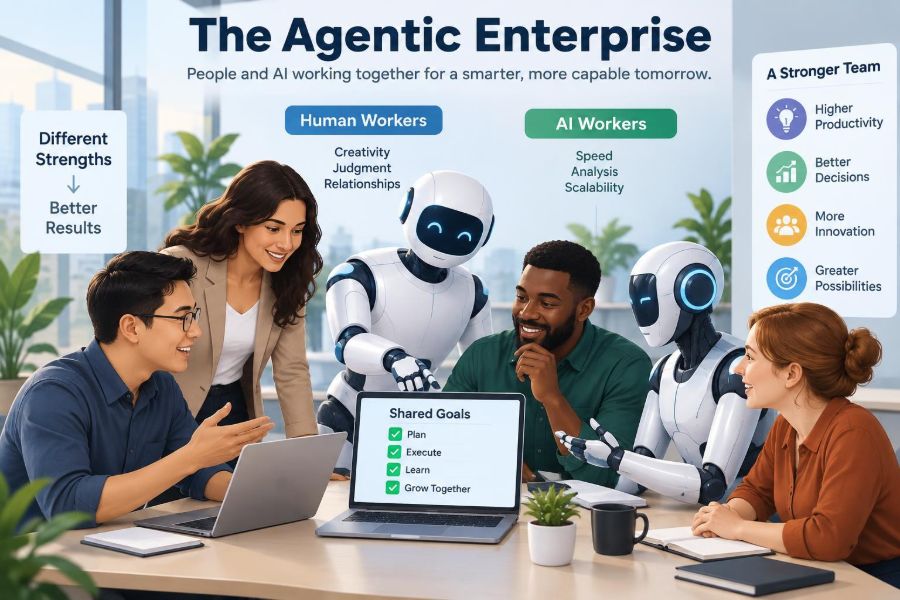

A customer-support manager opens a morning dashboard. Overnight, an AI system sorted incoming requests, drafted replies to routine questions, flagged a possible billing issue, and assigned three emotionally sensitive cases to experienced people. The manager’s work is no longer simply checking whether staff are busy. It is deciding whether the system made sound choices, where a human judgment is needed, and how the team should improve the process.
Similar scenes are emerging in marketing, finance, software development, operations, and professional services. The change is not that every employee is being replaced by a chatbot. It is that some organizations are beginning to use AI systems that can pursue a goal through multiple steps, use approved tools, and hand work back to people when necessary.
This creates a management challenge that is easy to underestimate. A company can buy software quickly, but it cannot safely delegate work without defining authority, accountability, information access, quality standards, and escalation routes.
The emerging agentic enterprise is therefore less about impressive AI demonstrations and more about designing a reliable operating system for mixed teams of human and AI workers.
🧭 What an Agentic Enterprise Means
An agentic enterprise is an organization that uses AI agents as active participants in business workflows rather than as passive tools. An AI agent can interpret an objective, break it into tasks, retrieve relevant information, use permitted software tools, and propose or carry out bounded actions.
A spreadsheet formula and a conventional automation can be useful, but they normally follow a fixed sequence. An agent has more flexibility in deciding the next step. That flexibility is valuable in messy work, but it also creates more need for controls.
🤖 AI Agents Are Not Simply Chatbots
A chatbot generally responds to a prompt. An agent may respond to a goal such as “resolve eligible address-change requests,” then check identity records, update a system, notify the customer, and log the action.
The distinction matters because the risk changes once a system can act. An inaccurate answer in a private draft is one kind of problem. An incorrect account update, purchase request, or public message is another.
🧩 The Building Blocks of an Agent
Most business agents combine several capabilities: a language model to interpret instructions, access to data or documents, tools that let it interact with systems, and rules that constrain its behavior. Some also retain limited memory of a case or workflow.
Managers should ask what each component can do, not just what the agent appears to say in a demonstration. Tool access determines practical power; data access determines what the agent can know; controls determine whether that power is appropriately contained.
🎯 Why Companies Are Exploring This Model
Many knowledge-work processes contain repetitive coordination: finding information, updating records, drafting standard communications, checking forms, and routing exceptions. Agents may reduce the time people spend moving work between systems or searching for routine answers.
The goal should not be “automate as much as possible.” A stronger goal is to remove low-value friction while preserving the human work that requires judgment, empathy, negotiation, creativity, and responsibility.
🔄 From Individual Tasks to End-to-End Workflows
Early AI use often focused on isolated tasks, such as summarizing a meeting or drafting an email. Agentic work becomes more consequential when systems connect tasks into a workflow: receive a request, classify it, gather evidence, generate a recommendation, obtain approval, and update records.
That shift exposes weak processes. If no one agrees on what counts as a complete request or who owns exceptions, an agent will not solve the ambiguity. It will make the ambiguity visible faster.
🧑💼 Human Workers Remain Accountable
An AI agent does not carry legal, ethical, or managerial accountability in the way an employee or executive does. Even when an agent takes an approved action, a named human owner should be responsible for the workflow’s outcomes.
This is especially important when work affects customers, employees, money, safety, or compliance. Delegation to software does not remove the organization’s obligation to explain and correct what happened.
📋 Define Work by Decisions, Not Job Titles
“Use AI in sales” is too broad to manage. Leaders need to decompose work into specific decisions and actions: research a prospect, qualify a lead, recommend a discount range, create a proposal draft, or approve a contractual exception.
Each activity has a different error cost. Drafting prospect research may be low risk; promising a discount can be commercially sensitive. Breaking work down helps organizations choose the right degree of autonomy.
🚦 Choose Levels of Autonomy Deliberately
Autonomy should be treated as a design choice rather than an all-or-nothing feature. A practical model ranges from assistance to supervised action to limited independent action within clear boundaries.
| Level | What the agent does | Typical use |
|---|---|---|
| Assist | Creates drafts, summaries, or recommendations | Meeting notes or first-response drafts |
| Recommend | Proposes an action for human approval | Expense exception or supplier shortlist |
| Act within rules | Completes low-risk actions under set conditions | Updating a verified contact preference |
| Escalate | Stops and routes uncertain or sensitive cases | Complaints, unusual payments, or policy conflicts |
The right level depends on reversibility, impact, data sensitivity, and the reliability of the underlying process.
🛑 Design Clear Boundaries Before Deployment
A useful agent needs explicit permissions and prohibitions. “Help customers” is not an operating instruction. “Answer questions using the approved knowledge base; do not modify subscriptions; escalate cancellation requests” is far more manageable.
Boundaries should cover both actions and language. An agent should know when it may send a message, when it may prepare a draft only, and which claims it must never make without review.
🔐 Access Is the Real Security Question
Giving an agent access to email, files, customer records, payment systems, or code repositories can turn a capable assistant into a powerful operator. Access should follow the principle of least privilege: provide only the permissions needed for the defined task.
Separate credentials, restricted environments, approval gates, and time-limited permissions can reduce exposure. The question is not merely whether the model is trustworthy; it is what damage becomes possible if instructions, data, or tools are mishandled.
🧼 Data Quality Sets the Ceiling
Agents depend on the information they retrieve. If product policies are scattered across outdated documents, customer records are incomplete, or definitions vary by department, the agent will reflect that disorder.
Before automating, teams should identify authoritative sources, retire obsolete material, and clarify ownership. This work can feel unglamorous, but a clean knowledge base is often more valuable than a more elaborate prompt.
🧠 Context Engineering Replaces One Perfect Prompt
Reliable behavior rarely comes from a single clever instruction. Context engineering means designing the information, rules, examples, tools, and workflow state that an agent receives at the right moment.
For example, a procurement agent may need the purchase policy, approved supplier list, budget code, request history, and a rule for when to escalate. Providing this structured context is more dependable than asking it to “make a good purchasing decision.”
✅ Build Quality Checks Into the Flow
Quality control should happen during the workflow, not only after an error reaches a customer. Checks can verify whether required fields are present, a claim is supported by a source, an amount is within a threshold, or an action conflicts with policy.
Some checks are deterministic and easy to automate. Others require judgment, such as whether a response sounds dismissive or a recommendation is appropriate for a sensitive client. Mixed teams need both kinds.
👀 Human Review Should Be Purposeful
Putting a person in every step may eliminate much of the benefit, while reviewing nothing may be unsafe. The useful question is where review changes the outcome most: before irreversible action, at high-value thresholds, or when the system is uncertain.
Reviewers need enough context to judge the work. A one-click approval screen without evidence encourages rubber-stamping. Good review shows the proposed action, supporting information, policy basis, and available alternatives.
⚠️ Escalation Is a Core Capability
A well-designed agent does not try to resolve every case. It recognizes signals that call for a person: missing information, conflicting records, unusual requests, emotional distress, low confidence, or a decision outside its authority.
Escalation routes should name who receives the case and what information travels with it. Otherwise, the employee must redo the investigation, creating delay and frustration for both staff and customers.
🧪 Test Workflows Like Operational Systems
Teams should test agents with normal cases, edge cases, incomplete inputs, contradictory instructions, and deliberate attempts to push the system outside its role. A polished demo based on clean examples says little about day-to-day reliability.
A hypothetical travel-booking agent, for instance, should be tested not only on a standard itinerary but on missing passport details, a request that violates policy, a duplicate booking, and a traveler who needs an accommodation.
📏 Measure Outcomes, Not Activity
It is tempting to measure how many tasks an agent completed or how many hours it appeared to save. Those figures can hide rework, poor customer experiences, or mistakes moved downstream.
Better measures vary by workflow but may include completion quality, time to resolution, escalation rate, correction rate, customer satisfaction, compliance exceptions, and employee workload. Compare performance against the prior process, not against an unrealistic ideal.
🪵 Keep an Audit Trail
For consequential workflows, organizations need records of what the agent received, which sources or rules it used, which tools it called, what it proposed or did, and who approved exceptions. This is an audit trail.
Logs support troubleshooting, learning, and accountability. They also make it easier to distinguish a model error from a bad data source, an unclear policy, a tool failure, or an employee’s override decision.
🧯 Plan for Errors and Reversals
No operational system will be error-free. Resilience comes from limiting blast radius: use small pilots, cap transaction values, require confirmation for sensitive actions, and make actions reversible where possible.
Teams should agree in advance on how to pause an agent, correct affected records, notify relevant people, and investigate the cause. A response plan is not pessimism; it is a normal part of responsible operations management.
🏗️ Process Redesign Matters More Than Layering
A common mistake is placing an agent on top of an inefficient process and expecting transformation. If five approvals exist because no one trusts the data, adding AI may generate five faster approvals without solving the underlying issue.
Instead, map the workflow, remove needless handoffs, standardize inputs, and then decide where an agent adds value. The best design may change responsibilities rather than simply speeding up existing steps.
🧑🤝🧑 Redesign Roles With Employees, Not Around Them
Employees often know where exceptions occur, what customers actually ask, and which informal checks prevent costly mistakes. Excluding them from design loses valuable operational knowledge and can create understandable resistance.
Roles may shift toward reviewing unusual cases, improving knowledge sources, coaching customers, managing relationships, and monitoring system performance. Managers should describe these changes honestly rather than implying that every task will remain identical.
🎓 Build AI Management Literacy
Workers do not all need to become machine-learning specialists. They do need practical literacy: what the tool can and cannot do, how to give it useful context, how to verify outputs, when to override it, and how to report failures.
Managers need an additional layer of skill. They must set objectives, establish decision rights, interpret performance data, and avoid treating fluent language as proof of correct reasoning.
🗣️ Change Management Is an Operating Requirement
New workflows affect status, workload, performance expectations, and professional identity. A sudden rollout with vague assurances can cause people to hide problems or avoid the tool entirely.
Communicate what is changing, why the workflow was selected, what remains human-owned, and how feedback will influence the design. Early users should have a visible way to raise concerns without being blamed for slowing innovation.
⚖️ Fairness, Bias, and Customer Impact
An agent can reproduce patterns in its training data or make uneven recommendations when information is incomplete. Risk is higher when systems influence hiring, credit-like decisions, pricing, eligibility, performance management, or access to essential services.
Organizations should examine outcomes across relevant groups where appropriate and lawful, test for disparate errors, and provide meaningful routes for review. Sensitive decisions generally deserve stronger human judgment and governance, not weaker oversight.
📜 Governance Should Match the Risk
Not every internal drafting assistant needs the same oversight as an agent that changes financial records. A risk-based governance model classifies use cases by impact, sensitivity, autonomy, and regulatory obligations.
Governance can assign owners for business outcomes, technical operation, security, privacy, legal review, and employee impact. Clear ownership prevents a familiar failure: everyone assumed someone else had checked the risk.
🔗 Avoid a Patchwork of Unmanaged Agents
Departments may independently adopt tools that access overlapping data and make inconsistent decisions. This can create duplicated costs, fragmented customer experiences, and security gaps.
A central team does not need to control every experiment, but it should provide shared standards for identity, access, approved data, monitoring, vendor assessment, and incident reporting. Think of it as a common road system, not a command-and-control barrier.
🏁 Start With a Narrow, Valuable Use Case
The strongest early use cases have a clear goal, sufficient data, a repeatable workflow, measurable outcomes, and a manageable error cost. Internal IT help, document intake, knowledge retrieval, and routine service triage may be sensible starting points when properly scoped.
Avoid choosing a project solely because it looks impressive. A modest workflow that becomes reliable teaches the organization more than a highly autonomous project that cannot be safely operated.
🧭 A Practical Implementation Sequence
- Map the current process, including exceptions and handoffs.
- Define the business outcome and the human owner.
- Classify decisions by risk and choose an autonomy level.
- Prepare trusted data sources, permissions, rules, and escalation paths.
- Test with realistic and adverse cases before a limited pilot.
- Monitor outcomes, collect user feedback, and improve the workflow before scaling.
This sequence is deliberately less glamorous than “deploy an agent.” It is also closer to how organizations successfully introduce any operational capability.
🌱 The Core Principle: Manage the System, Not the Hype
Agentic enterprises will not be defined by how many AI agents they announce. They will be defined by whether they can combine machine speed with human judgment in ways that customers, employees, and regulators can trust.
The central management task is to make decision rights visible: what the agent may do, what it must show, when it must stop, and who owns the result. When these choices are explicit, AI can become a useful colleague within a well-run system rather than an unpredictable black box.
The agentic enterprise succeeds when companies design human accountability, trustworthy information, and controlled autonomy together—not when they treat AI as a substitute for management. The technology may change quickly; the need for clear responsibility, sound processes, and thoughtful leadership does not. 🤖🧭🤝