
You may be the person who turns vague requests into workable plans, notices a delivery risk before it becomes a crisis, or helps colleagues resolve a disagreement without losing momentum. At work, these actions can feel like part of the job rather than a special capability.
Yet many small businesses, founders, and growing teams do not have experienced management support when they need it. They may be busy, capable, and deeply knowledgeable about their product, but still struggle to set priorities, run projects, delegate, or make decisions consistently.
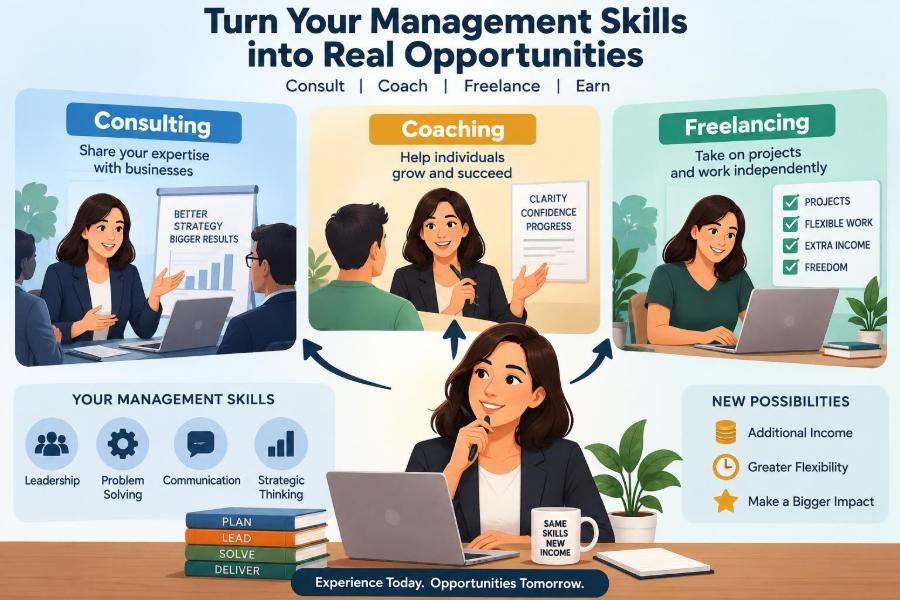
That gap creates an opportunity. Management experience can become paid work outside a traditional management role through consulting, coaching, and freelance services.
The shift is not automatic. It requires translating broad experience into a clear problem you can solve, an outcome a client can recognize, and a service you can deliver responsibly. The aim is not to present yourself as an all-purpose expert; it is to make useful managerial judgment available in a focused form.
🧭 Management skill is a practical asset
Management is often described through job titles, but its market value comes from repeatable actions: planning work, aligning people, allocating resources, improving processes, and reviewing results. These actions reduce confusion and help organizations move from intention to execution.
A client rarely buys “management.” They buy a clearer workflow, a realistic launch plan, a better meeting rhythm, or support for a newly promoted supervisor. Your first task is to connect what you do with a visible business need.
🔎 Start with the problems you already solve
Look back over your work and identify moments when you made progress easier for others. Useful evidence includes projects brought back on track, handovers improved, customer issues reduced, or teams helped through change.
Describe each situation in plain language: what was happening, what you did, and what became easier or better. This exercise reveals patterns more reliably than a list of responsibilities from a job description.
- “I created a weekly planning process for a team with conflicting priorities.”
- “I helped new team leads give clearer feedback.”
- “I mapped an approval process that was delaying customer work.”
🧩 Separate transferable skills from industry expertise
Some strengths travel well across sectors. Project scoping, stakeholder communication, meeting design, performance conversations, and process mapping are examples of transferable management skills.
Other work depends heavily on a particular industry, system, regulation, or technical discipline. That does not make it less valuable, but it affects your positioning. A former retail operations manager might serve independent retailers especially well, while also offering general workflow support to service businesses.
🛠️ Understand the three income paths
Consulting, coaching, and freelancing overlap, but clients expect different things from each. Choosing the right frame helps you set boundaries and describe your offer accurately.
| Path | Primary contribution | Typical outcome |
|---|---|---|
| Consulting | Diagnosis and recommendations | A plan, process, decision, or implementation roadmap |
| Coaching | Structured reflection and accountability | A client develops judgment, habits, and confidence |
| Freelancing | Hands-on delivery | A defined operational task is completed |
A single engagement can contain elements of all three, but the core promise should stay clear. Confusion about your role often becomes confusion about scope, authority, and payment.
🧠 Consulting turns diagnosis into direction
A management consultant examines a business challenge, asks questions, gathers relevant evidence, and recommends a practical course of action. The value lies not only in knowing management concepts, but in applying them to the client’s constraints.
For example, a consultant might review why a small agency repeatedly misses deadlines. The answer may involve unclear ownership, unrealistic intake, weak prioritization, or all three. A useful recommendation identifies the underlying operating problem rather than merely telling people to “communicate better.”
🤝 Coaching develops the manager, not the answer
Coaching is appropriate when the client needs to build their own capacity. A newly promoted manager may need space to think through delegation, difficult conversations, confidence, or decision-making patterns.
A coach can offer frameworks, questions, observation, and accountability, but should not imply that coaching is therapy, legal advice, or a substitute for specialist support. Be explicit about what your coaching does and does not cover.
⚙️ Freelance operations work creates immediate capacity
Freelance management support is more hands-on. You might build a project tracker, coordinate a product launch, document standard operating procedures, prepare meeting materials, or run a temporary operations function.
This route can be easier for clients to understand because the deliverable is concrete. It also demands careful capacity planning: if clients are paying for your direct effort, your income is closely tied to available time unless you standardize or productize parts of the work.
🎯 Choose a specific client and situation
“I help businesses improve management” is too broad for most buyers. A narrower message makes it easier for the right person to recognize themselves in your offer.
Start with a group you understand and a situation that occurs often. Examples include creative agencies with growing project teams, local service businesses hiring their first supervisor, or nonprofit teams needing practical planning systems.
Narrow positioning does not permanently restrict you. It gives you a credible starting point and allows your expertise to become visible through relevant examples.
💡 Define an outcome, not just an activity
Clients do not necessarily want a workshop, dashboard, or set of meetings. They want the change those activities make possible: clearer ownership, faster decisions, fewer dropped tasks, or a manager who can lead regular one-to-ones.
A strong offer connects method and outcome. For instance: “I help small professional-service teams create a simple project intake and weekly planning system so urgent work stops displacing agreed priorities.”
📦 Turn expertise into a service package
Packages reduce uncertainty for both sides. Rather than offering undefined “support,” set out the starting problem, stages of work, client responsibilities, deliverables, timeframe, and review point.
A process-improvement package might include an initial discovery session, interviews with key users, a workflow map, a prioritized improvement plan, and an implementation check-in. The exact format should fit the problem, not a template copied from another consultant.
🧪 Validate demand before building a brand
It is tempting to spend weeks on a name, website, or elaborate course. A more useful early test is a conversation with people who resemble potential clients. Ask how they currently handle the problem, what it costs them in time or missed opportunities, and what they have already tried.
Do not treat polite interest as demand. Stronger signals include a request for a proposal, an introduction to a decision-maker, a paid pilot, or a willingness to schedule a next step.
🗣️ Conduct discovery conversations with care
A discovery conversation is not a performance of expertise. It is a structured effort to understand the client’s situation and decide whether your service is a good fit.
- What would be different if this problem were resolved?
- Who is affected by it, and who can make decisions?
- What has made previous attempts difficult?
- What constraints—budget, time, systems, authority—must the work respect?
Listen for the difference between a symptom and a cause. Missed deadlines may be a planning issue, but they may also reflect too much work, unclear strategy, or an approval bottleneck.
📋 Scope work so expectations are visible
Scope is a shared definition of what will and will not be done. It protects the client from ambiguity and protects you from gradually absorbing unrelated work.
Put the key terms in writing: objectives, deliverables, timeline, meetings, access needed, responsibilities, fees, payment timing, revision limits, and how changes will be agreed. For significant engagements, use an appropriate written agreement and seek qualified legal or financial advice where necessary.
💰 Price the value and the effort honestly
Pricing is not simply a calculation of confidence. It must reflect the time, preparation, risk, overhead, expertise, and responsibility involved. A fixed project fee can suit a well-defined outcome; an hourly or day rate may be safer when the scope is still uncertain.
A retainer can work for ongoing advisory or operational support, provided the available hours, response expectations, and excluded work are clear. Avoid promising business results that depend on choices and conditions beyond your control.
🧾 Build a simple evidence portfolio
Clients need reason to trust you, especially before you have an independent consulting track record. A portfolio can show selected work samples, anonymized process maps, workshop outlines, before-and-after examples, and short case narratives.
Respect confidentiality. Never reuse an employer’s or client’s documents, data, internal methods, or names without clear permission. When sensitive details matter, describe the situation at a high level and focus on your method and contribution.
📈 Use case studies to show your thinking
A good case study is more than a success story. It explains the context, the challenge, your actions, the limits of your role, and the observed outcome. If exact measures are confidential or unavailable, do not invent them.
A hypothetical example might describe an operations freelancer who found that work requests arrived through several channels. By creating one intake form and a weekly prioritization meeting, the team gained a shared view of commitments. The lesson is the mechanism: one visible queue improves coordination when everyone agrees to use it.
🧑🏫 Design workshops around real work
Management workshops can be a valuable consulting or freelance product, but information alone rarely changes practice. Participants need to apply ideas to their own priorities, decisions, and conversations.
For a delegation workshop, use a live task list, clarify decision rights, and let participants practice stating the outcome, constraints, and check-in points. Follow-up matters because the hard part is using the skill during a busy week.
🗓️ Offer one-to-one coaching with structure
A coaching relationship benefits from a repeatable rhythm: a goal, regular sessions, reflections between sessions, and periodic review. The client should remain responsible for their choices and actions.
Keep records carefully and protect privacy. If a conversation raises serious wellbeing, employment, legal, or safeguarding concerns outside your competence, acknowledge the limit and encourage appropriate professional support rather than trying to solve it alone.
🔄 Create repeatable delivery systems
Consistency makes independent work more sustainable. Use checklists for onboarding, discovery, project close-out, and follow-up. Keep templates for proposals and meeting notes, while adapting the substance to each client.
Systems are not bureaucracy for its own sake. They reduce preventable errors, make client experience more reliable, and free attention for the judgment that clients are actually paying for.
📊 Measure progress without manufacturing certainty
Agree early on what progress would look like. Depending on the engagement, this could include cycle time, overdue tasks, project visibility, meeting attendance, customer response time, or a manager’s completion of agreed practices.
Numbers are helpful only when interpreted in context. A lower backlog may reflect a better process, less demand, or work being moved elsewhere. Combine operational indicators with conversations about whether the change is actually helping.
🧱 Set boundaries around availability and authority
Independent managers can accidentally become the person everyone asks to decide. Unless you are hired into an interim leadership role, the client’s leaders should retain ownership of their people, priorities, and final decisions.
Define communication channels, response times, meeting limits, and escalation routes. These boundaries make your contribution easier to use and reduce the risk of dependency.
⚖️ Manage conflicts, confidentiality, and ethics
Before accepting work, consider whether a current employer, client, or personal relationship creates a conflict of interest. Review contractual obligations and do not use confidential knowledge to compete unfairly.
Ethical practice also means being truthful about competence. Decline or partner on work that requires specialist legal, accounting, clinical, technical, or human-resources expertise you do not hold.
🚫 Avoid promising transformation too broadly
Management interventions can improve clarity and habits, but they cannot fix every business problem. Poor strategy, inadequate resources, unresolved conflict, and market conditions may limit what an engagement can achieve.
Specific promises are more credible than grand claims. Say what you will deliver—such as a decision framework, operating rhythm, or coaching process—and describe the conditions required for it to work.
🧯 Recognize common early mistakes
New independent professionals often under-scope work, accept every request, and delay difficult conversations about payment or access. These choices can turn a promising project into unpaid, stressful labor.
- Starting work before agreement on goals and fees
- Calling every conversation “coaching” when advice is expected
- Offering unlimited support through informal messages
- Using generic tools without understanding the client’s workflow
- Taking responsibility for outcomes controlled by someone else
Each mistake is easier to prevent through clear language at the beginning than to repair after expectations have diverged.
🌱 Build credibility through small, useful engagements
Your first assignment need not be a major transformation project. A focused project—facilitating a planning day, reviewing an onboarding workflow, or supporting a first-time manager for several sessions—can produce learning, evidence, and referrals.
Small engagements also let you refine your method. Notice where clients need more explanation, where deliverables create the most value, and which problems you are genuinely equipped to solve.
🤔 Balance independence with professional development
Working independently can expose gaps that a larger employer previously covered: sales, contracts, bookkeeping, technology, facilitation, or specialist knowledge. Treat these as capabilities to build, not signs that you are unqualified.
Supervision, peer networks, mentoring, and relevant training can improve judgment. For coaches in particular, ongoing reflective practice helps prevent blind spots and keeps the client’s needs at the center.
📣 Market through clarity and relationships
Marketing does not require constant self-promotion. It means helping appropriate people understand the problem you solve, the way you work, and the evidence behind your offer.
Share useful observations, teach a practical tool, contribute thoughtfully to professional communities, and ask satisfied clients for permission to use feedback or for introductions. A referral is strongest when the referrer can clearly explain who you help.
🧭 Decide whether to specialize or expand
As work develops, you may deepen one niche or add related services. Specialization can make sales easier and delivery sharper; broader work can provide variety and resilience when one market slows.
Choose based on evidence rather than fear of missing out. Review which projects are profitable, energizing, ethically comfortable, and likely to recur. Then refine your offer deliberately.
🏁 The core principle: make judgment usable
Management experience becomes independent income when it is converted into a usable service: a defined client problem, a credible method, clear boundaries, and work that helps people act differently. The value is not your title or a collection of fashionable frameworks.
Whether you consult, coach, or freelance, clients need practical progress and honest guidance. Start where your experience is strongest, make a modest and specific promise, and improve your service through each real engagement.
The most sustainable path is to turn proven management judgment into clear, ethical help that clients can understand, use, and trust. Build slowly enough to learn, and confidently enough to ask for fair payment. 📊🤝🌱