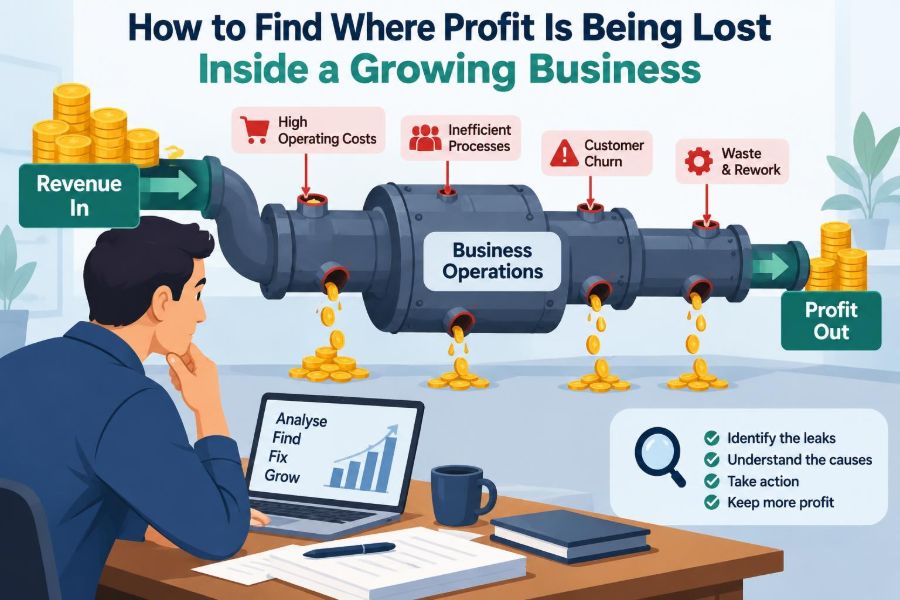

A business can be busier than ever and still feel strangely short of cash. Orders are coming in, the team is expanding, and customers are talking about the brand. Yet the owner keeps asking the same question: if sales are growing, why is profit not growing with them?
This situation is common because revenue is highly visible while profit leakage is usually hidden across dozens of small decisions. A discount approved to win a deal, a rush shipment, a slow-paying customer, or an extra layer of management can each look reasonable in isolation.
Growth also makes old habits harder to see. A process that worked when a company served 20 customers may quietly become expensive when it serves 2,000.
Finding lost profit is not about blaming departments or cutting every cost. It is a disciplined effort to understand where value is created, where it is consumed, and which problems deserve attention first.
🔍 Start With the Difference Between Revenue and Profit
Revenue is the total amount earned from sales. Profit is what remains after the business pays the costs required to make, deliver, sell, and support those sales.
A company can increase revenue while becoming less profitable if costs rise faster than sales or if new sales carry weak margins. That is why “we are growing” is not enough information for a manager.
Begin by separating three useful measures:
- Gross profit: revenue minus direct costs of producing or purchasing what was sold.
- Operating profit: gross profit minus operating expenses such as payroll, rent, marketing, and administration.
- Cash flow: money moving into and out of the business, which may differ from profit because invoices can remain unpaid.
🧭 Treat Profit Leakage as a Search Problem
Profit leakage means avoidable value slipping away somewhere between a customer’s order and the cash received. It can arise from errors, waste, weak pricing, unproductive work, poor controls, or decisions made without current data.
The useful question is not simply, “Where can we cut spending?” Ask: where does the business spend money or give away value without receiving a comparable return?
This approach protects productive investment. Training, reliable equipment, and strong customer service may cost money while improving long-term profit. Leakage is different: it is expenditure or lost revenue that does not support the business’s goals.
📈 Confirm That the Problem Is Real
Before investigating individual causes, compare results over time. Look at monthly or quarterly revenue, gross margin, operating expenses, operating profit, and cash collected.
Margins are often more revealing than totals. If revenue rises from one period to the next but gross margin percentage falls, the company may be selling more low-margin work, offering larger discounts, or facing higher direct costs.
Use comparable periods where possible. A seasonal retailer should not assume that a quiet month signals failure if that month is normally quiet; instead, compare it with the same period in prior years and with the budget.
🧮 Build a Simple Profit Map
A profit map traces the journey from a sale to the money left after fulfilling it. It turns a broad concern into a sequence of measurable stages.
- How does the business acquire the customer?
- What price and terms are agreed?
- What materials, labor, systems, and delivery are required?
- What support, rework, returns, or warranty costs follow?
- When is payment actually received?
A hypothetical catering company may discover that a corporate event looks profitable at the quoted price. Once last-minute staffing, food waste, overtime, and late payment are included, the event may contribute little or no profit.
🧱 Separate Fixed Costs From Variable Costs
Fixed costs generally stay similar within a period regardless of sales volume, such as office rent or a salaried manager. Variable costs rise or fall with activity, such as packaging, sales commissions, delivery charges, or ingredients.
This distinction helps diagnose the source of pressure. Falling gross margin often points toward variable costs or pricing. Rising overhead with stable gross margin may point toward fixed operating costs, duplicated roles, or systems that no longer fit the business.
Some costs are mixed. Utility bills, for example, may include a base charge plus usage. The categories are tools for analysis, not perfect labels.
🧾 Recheck Pricing Before Chasing Expense Cuts
Pricing is one of the most powerful and most overlooked drivers of profit. Businesses often review supplier costs more frequently than they review what they charge customers.
Prices may have been set when input costs, service expectations, or the competitive position of the business were different. A price can also be technically profitable but insufficient to cover the added complexity of a customer’s demands.
Review whether prices reflect:
- Current material, labor, and delivery costs
- Order size and service intensity
- Custom work, rush requests, and special handling
- Payment terms and credit risk
- The value the customer receives, not only competitor prices
🏷️ Measure Discount Discipline
Discounts are not automatically bad. They can help win a strategic customer, clear inventory, or reward a larger commitment. But untracked discounting can erase margin quickly.
Record the original quoted price, approved discount, reason, approver, and final margin. Patterns soon emerge: perhaps a sales team discounts late in the month, or a particular product is routinely negotiated below a sustainable level.
Set clear guardrails. For example, discounts beyond a defined threshold may require approval and a documented reason. The purpose is not bureaucracy; it is making the cost of a concession visible.
👥 Find Which Customers Actually Create Profit
Top-line customer rankings can mislead. A large customer may generate impressive revenue while demanding extensive support, frequent changes, small urgent deliveries, and lengthy payment terms.
Estimate customer profitability by allocating relevant costs, not just product cost. Include sales effort, onboarding, account management, returns, service calls, and collection work when these differ substantially between accounts.
Do not use the result mechanically. Some low-profit customers are strategically valuable because they create referrals, fill spare capacity, or lead to profitable work. The key is to make that strategic choice consciously rather than assume every sale helps equally.
🧩 Examine Product and Service Mix
Growing firms commonly add products, packages, or bespoke services to meet demand. Over time, the portfolio can become difficult to produce, explain, stock, and support.
Analyze contribution by product or service line. Contribution margin is the amount left from a sale after its directly variable costs are paid; it helps show which offerings contribute toward fixed costs and profit.
A low-margin offering may still deserve a place if it brings customers into a profitable relationship. However, a complicated item with weak contribution, high error rates, and no strategic role is a strong candidate for redesign, repricing, or removal.
🛠️ Look for Rework and Quality Failure
Rework is work done twice because the first attempt was incomplete, wrong, damaged, or unacceptable. It drains labor capacity and can create further costs through expedited shipping, refunds, lost trust, and management time.
Track defects at the point they occur rather than relying only on customer complaints. A team may quietly correct many errors before a customer sees them, making the problem invisible in sales data.
Useful measures include return reasons, error types, rework hours, scrap, missed deadlines, and warranty claims. The goal is to identify the underlying process failure, not merely tell employees to be more careful.
⏱️ Calculate the Cost of Waiting
Profit is lost when people, products, or decisions wait unnecessarily. A production team waiting for approvals, a technician searching for information, or a customer order sitting in a queue all create cost without creating value.
Map the actual workflow from request to completion. Measure both touch time, when someone is actively working, and elapsed time, when the item is moving or waiting. The gap often reveals bottlenecks.
Reducing waiting can improve capacity without hiring. It may require clearer ownership, simpler approvals, better scheduling, or information available at the moment work begins.
🚚 Investigate Freight, Fulfillment, and Rush Costs
Delivery expenses can climb unnoticed when a business grows quickly. Rush shipments, split orders, failed deliveries, poor packaging, and small order quantities frequently create avoidable charges.
Compare shipping cost by customer, product, route, and order size. A general average can conceal a handful of accounts or locations causing most of the expense.
Possible responses include minimum order values, delivery-day schedules, better demand forecasts, consolidated shipments, or charging appropriately for premium speed. Each option should be tested against customer expectations before implementation.
📦 Count Inventory More Carefully
Inventory ties up cash and carries risks: damage, expiry, obsolescence, shrinkage, and storage cost. Too little inventory can also hurt profit through missed sales and urgent purchasing.
Look for slow-moving items, repeated stockouts, unexplained discrepancies, and products purchased in quantities that do not match actual demand. Physical counts should be reconciled with system records, with differences investigated rather than simply adjusted away.
A growing company may need stronger replenishment rules. What once worked through a founder’s memory needs documented reorder points, ownership, and regular review.
💸 Watch Purchasing Variance
Purchasing variance is the difference between what the business expected to pay and what it actually paid. It can reveal supplier price increases, poor buying discipline, missed volume agreements, or emergency purchases.
Compare purchase prices for key inputs over time and across suppliers. Also examine non-price factors such as defects, lead times, reliability, and payment terms. The cheapest supplier is not always the lowest-cost choice once delays and quality problems are included.
Centralizing visibility over major purchases can prevent separate teams from making inconsistent deals or ordering the same materials at different prices.
🧑💼 Question Payroll Growth With Care
Payroll is often the largest operating expense, so it deserves close attention. But treating headcount reduction as the first answer can damage service, increase turnover, and leave remaining staff overloaded.
Instead, ask whether each role has clear outcomes, appropriate workload, and the tools needed to perform well. Growth can create duplicate reporting, unclear handoffs, meetings that replace decisions, and managers who spend most of their time chasing status updates.
Look for capacity and output alongside payroll. A rising labor cost may be justified if it supports profitable volume; it is concerning when it mainly compensates for process confusion.
🔄 Spot Process Complexity Creep
Complexity creep occurs when exceptions, extra approvals, custom terms, and one-off workarounds gradually become normal. Each may have begun as a reasonable accommodation, but together they make operations slower and more error-prone.
Ask teams which steps they consider pointless, repetitive, or confusing. Frontline employees often know where effort is wasted because they live with the process every day.
Standardization does not mean refusing all exceptions. It means designing a clear default path and pricing or approving exceptions according to their real cost.
📣 Connect Marketing Spend to Commercial Outcomes
Marketing should be assessed beyond impressions or website traffic. The commercial questions are whether it attracts suitable prospects, what it costs to acquire a customer, and whether those customers become profitable over time.
Track the path from campaign to lead, qualified opportunity, sale, repeat purchase, and retained margin where the data is available. Attribution is imperfect: customers may encounter several messages before buying. Even so, rough discipline is better than treating all marketing activity as equally productive.
Stop or redesign activity that repeatedly produces unqualified demand. Increase investment only where the business can fulfill demand profitably.
🤝 Check Sales Handoffs and Promises
Profit often disappears between sales and operations. A salesperson may promise a custom feature, unusually fast deadline, free implementation, or flexible return terms without understanding the delivery cost.
Create a structured handoff for non-standard deals. Operations, finance, or service teams should be able to review commitments that materially affect margin, capacity, or risk before the customer is promised them.
This is not meant to slow all selling. Standard offers should move quickly; exceptions need visibility because they are where hidden cost tends to accumulate.
📅 Measure Revenue Quality, Not Just Sales Volume
Not all revenue has the same economic value. Recurring contracts with predictable usage and prompt payment may be more valuable than one-off projects with changing scope and uncertain collection.
Consider revenue quality through factors such as margin, repeatability, payment reliability, concentration risk, service burden, and likelihood of renewal. This helps management avoid chasing volume that strains the business.
A company can deliberately accept lower-margin work during a strategic period, but it should know the trade-off and set a point for reassessment.
🏦 Follow Cash Through Accounts Receivable
Profit recorded on an invoice is not the same as cash in the bank. When customers pay late, the company may need borrowing or may delay supplier payments, payroll investment, and growth plans.
Review outstanding invoices by age and customer. Identify disputed invoices, repeat late payers, missing purchase-order details, and unclear billing practices. Many collection problems start earlier, when the scope, acceptance criteria, or invoice information is not agreed clearly.
Improve cash conversion through accurate invoicing, prompt follow-up, sensible credit checks, deposits for appropriate projects, and payment terms that match the company’s cash needs.
⚖️ Separate One-Off Events From Recurring Leaks
A single equipment repair, legal dispute, relocation, or customer insolvency can hurt one period’s result. These events matter, but they require a different response from a recurring operational leak.
Classify unusual costs separately while still learning from them. If emergency repairs recur because maintenance is deferred, the expense is not truly one-off. If a customer default exposes weak credit approval, the underlying risk may be repeatable.
This distinction prevents managers from overreacting to noise or overlooking a pattern hidden inside “exceptional” expenses.
📊 Use a Focused Dashboard
A dashboard should support decisions, not create reporting work for its own sake. Choose a small set of measures that connect directly to the company’s profit map.
| Area | Useful signal | Question it raises |
|---|---|---|
| Pricing | Average discount and margin by deal | Are concessions being controlled? |
| Operations | Rework, on-time delivery, and cycle time | Where is capacity being wasted? |
| Customers | Margin and payment behavior by account | Which relationships need action? |
| Cash | Aged receivables and cash collection | Are invoices turning into cash? |
Review trends, not isolated numbers. A metric becomes useful when someone owns it, understands its limits, and can act when it changes.
🕵️ Use Variance Analysis to Ask Better Questions
Variance analysis compares actual results with a budget, forecast, standard cost, or prior period. It does not explain the cause by itself, but it directs attention to the differences worth investigating.
For example, higher labor cost could result from more orders, lower productivity, overtime, pay changes, or a shift toward labor-intensive work. Breaking a large variance into its drivers prevents simplistic conclusions.
Use a consistent process: identify the variance, validate the data, find the operational driver, estimate the financial effect, assign an owner, and check whether the corrective action worked.
🗣️ Ask Frontline Teams What the Numbers Miss
Financial reports show where results changed; employees often explain why. Customer-service representatives may know which policies trigger repeat calls. Warehouse staff may see where orders are picked twice. Project managers may recognize clients whose scope changes never reach the invoice.
Create a blame-free way to raise issues. People will hide problems if every reported error becomes a personal criticism. Focus conversations on process design, evidence, and practical fixes.
Qualitative insight should be tested against data, but it is a valuable source of hypotheses that dashboards alone may never reveal.
🎯 Prioritize Leaks by Value and Controllability
Do not launch twenty improvement projects at once. Rank opportunities by likely financial impact, confidence in the diagnosis, effort required, implementation risk, and time to benefit.
A useful first action is often a high-frequency problem with a clear owner: repeated invoicing errors, unauthorized discounts, excessive expedited freight, or avoidable rework. Quick wins build confidence and release time for deeper structural work.
Some large issues take longer, such as replacing outdated software or redesigning a product range. These deserve a business case, milestones, and realistic transition planning.
🧪 Test Changes Before Scaling Them
A remedy can create new problems if it is imposed too broadly. A tighter approval process may reduce discounting but slow legitimate deals. Lower inventory may free cash but increase stockouts.
Where possible, pilot the change in one team, customer segment, product group, or location. Define what success and acceptable trade-offs look like before starting.
Then compare results with the previous process, gather operational feedback, and adjust. Small, measured experiments are especially useful when the business lacks perfect data.
🚫 Avoid the Most Common Wrong Responses
Broad cost cutting can make the numbers look better briefly while weakening the business. Cutting maintenance, training, quality checks, or customer support may simply shift costs into the future.
Other frequent mistakes include:
- Using company-wide averages that hide unprofitable products or customers
- Blaming a department before understanding the full workflow
- Measuring activity, such as calls or shipments, without measuring outcomes
- Assuming software will solve unclear processes
- Ignoring small losses because each one seems insignificant
The strongest response is targeted: preserve activities that create value and correct the specific conditions causing value to leak.
🔁 Make Profit Review a Management Routine
Profit protection is not a one-time cleanup project. Costs, customer expectations, supplier terms, and business mix change continuously as a company grows.
Set a regular rhythm for reviewing margins, major variances, customer profitability, cash collection, and operational indicators. The right frequency depends on the business; fast-moving operations may need weekly visibility, while others can review some measures monthly.
Document decisions and expected results. This creates accountability and helps managers distinguish between actions that genuinely improved economics and those that only appeared promising.
🌱 Keep Growth and Profitability Connected
Healthy growth requires capacity, investment, and sometimes short-term expense. The goal is not to make every cost smaller; it is to make sure growth creates enough value to fund itself.
Before entering a new market, hiring rapidly, adding a service, or accepting a large contract, estimate the full operating consequences. Consider support needs, working capital, systems, training, and the risk of disrupting reliable existing work.
Growth becomes more durable when leaders ask not only “Can we win this revenue?” but also “Can we deliver it repeatedly at an acceptable margin?”
✅ The Core Principle: Follow the Economics of Real Work
Lost profit is rarely found in one dramatic place. More often, it accumulates where commercial promises, operational work, and financial records fail to connect.
Trace real transactions from quote to cash. Compare expected margin with actual cost. Examine differences by customer, product, team, and process rather than relying on company-wide totals. Then fix the highest-value causes while protecting the capabilities customers genuinely value.
The discipline is simple, even when the investigation is not: make the economics of everyday work visible, and use that visibility to make better choices.
A growing business protects profit when it measures what each sale truly requires, corrects repeatable waste, and treats cash, service, and margin as connected parts of the same system. 📊🔍🌱