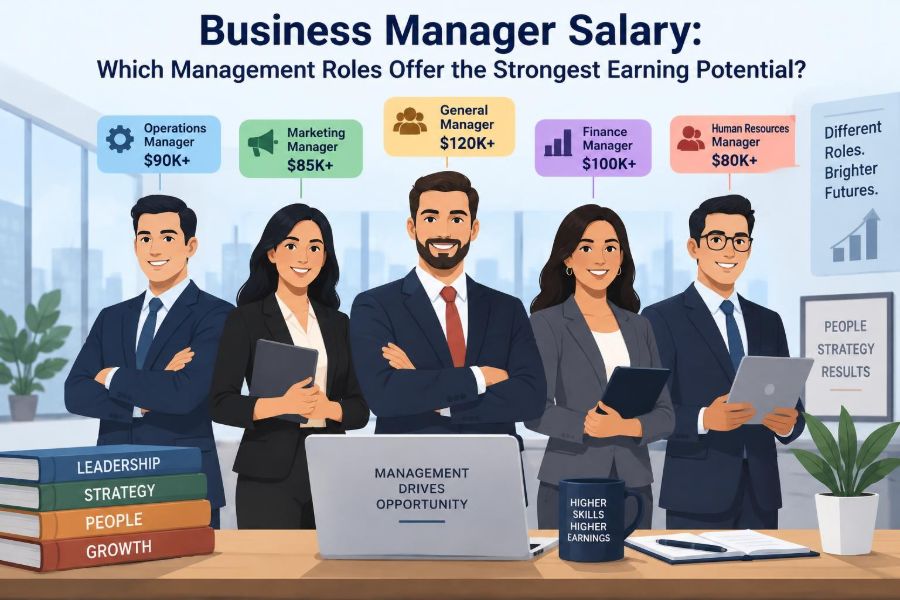

A capable manager can spend the morning solving a supplier problem, the afternoon coaching a struggling employee, and the evening explaining results to senior leaders. The job title may simply say “manager,” but the responsibility—and the pay—can look very different from one workplace to another.
This creates a frustrating question for students choosing a path and professionals planning a move: which management roles actually offer the strongest earning potential? A retail manager, a project manager, an operations manager, and a product manager may all lead people or processes, yet they operate in very different business environments.
Salary is not only a reward for working hard. It is usually connected to the size of decisions a person owns, the revenue or risk affected by those decisions, the scarcity of their skills, and the industry’s ability to pay.
Understanding those forces helps you look beyond attractive job titles. It also makes it easier to build a management career that fits both your strengths and your financial goals.
🧭 What “Business Manager” Can Mean
Business manager is a broad label rather than one standardized occupation. In a small company, it may describe the person overseeing budgets, staff, operations, and customer service. In a large organization, those responsibilities are often divided among specialist managers.
For example, a business operations manager may improve internal workflows, while a sales manager leads a revenue-producing team. A finance manager controls planning and reporting, and a product manager guides what the company builds.
That difference matters because compensation is usually tied to the specific function, not the word “manager” alone. Always read the actual responsibilities, reporting line, and performance measures behind a title.
💰 How Management Compensation Is Usually Built
A management salary is often more than base pay. The full package can include performance bonuses, sales commission, profit-sharing, equity awards, retirement contributions, insurance, paid leave, and professional-development support.
Two jobs with similar base salaries can therefore have very different total value. A sales manager with a lower fixed salary may earn considerably more in a strong year through commission, while a public-sector manager may receive steadier pay and more predictable benefits.
When comparing opportunities, distinguish between guaranteed compensation and variable compensation. Variable pay can create upside, but it may depend on targets, market conditions, team performance, or company results.
📈 Why Some Management Roles Pay More
Higher-paying management roles tend to sit close to one or more major business levers: revenue, profit margin, capital allocation, regulation, customer retention, or technical advantage. Mistakes in these areas can be expensive, while good decisions can have a large effect.
A manager responsible for a national supply network or a major software product may influence far more value than a manager supervising one small location. That does not make one role inherently more worthwhile; it explains why organizations often price responsibility differently.
Pay also rises when success requires expertise that is hard to replace. Industry knowledge, financial judgment, data fluency, and the ability to lead through uncertainty can all increase a manager’s market value.
🏢 Industry Often Matters as Much as Role
The same management discipline can command different pay across industries. Companies in technology, financial services, pharmaceuticals, energy, professional services, and high-value manufacturing may have larger budgets or more specialized needs than organizations with thinner margins.
Consider an operations manager. In a small local business, the role may focus on scheduling and day-to-day coordination. In a regulated manufacturing facility or large distribution network, it may involve compliance, safety, inventory, automation, and multimillion-dollar capacity decisions.
Industry fit should never be treated as a simple shortcut to a high salary. It may also bring demanding hours, location constraints, technical learning requirements, or more volatile business cycles.
🗺️ Location Changes the Meaning of a Salary
Management pay varies by country, region, city, and even commuting area. Locations with high living costs, concentrated corporate headquarters, or intense competition for talent may offer higher nominal salaries.
However, a larger paycheck does not automatically produce a better standard of living. Housing, taxes, transport, childcare, and the cost of services can absorb much of the difference. Remote and hybrid roles have also widened the options for some professionals, although employers may still adjust pay by location.
Compare purchasing power, career opportunity, and lifestyle together. A role that supports advancement and manageable living costs can be stronger than a higher offer with little room to save or grow.
👥 Scope of Leadership Is a Major Pay Driver
Organizations generally pay more when a manager leads a larger, more complex area of work. Scope can mean the number of employees, the budget controlled, the geographic territory covered, the number of customers served, or the importance of the business unit.
Leading ten people in one department and leading ten managers across several regions require different capabilities. The second role involves building leadership layers, setting systems, interpreting broader data, and aligning competing priorities.
A useful question in interviews is: “What decisions will this role own?” A clear answer reveals much more about seniority than an impressive title does.
⚙️ Operations Management: High Value Through Execution
Operations managers turn business plans into reliable daily performance. They may oversee production, procurement, quality, logistics, staffing, facilities, service delivery, or process improvement.
Strong earning potential appears when operations are large, technical, regulated, or time-sensitive. A manager who reduces waste, improves delivery reliability, or prevents costly downtime directly affects margins and customer experience.
The trade-off is that operational work can be intense. Problems do not always wait for business hours: a shipment delay, equipment failure, staffing gap, or safety incident may require immediate action. Professionals who enjoy practical problem-solving often find this path highly rewarding.
🏭 Supply Chain and Logistics Management
Supply chain managers coordinate the flow of materials, goods, information, and sometimes returns from suppliers to customers. Their work connects purchasing, inventory planning, transportation, warehousing, and demand forecasting.
These roles can offer strong compensation in complex networks because delays, shortages, excess inventory, and freight costs can materially affect profitability. Global sourcing, customs requirements, supplier risk, and digital planning systems add further complexity.
A promising path often combines management ability with operational literacy. Learning to interpret inventory turns, service levels, lead times, and capacity constraints helps a manager make decisions that are commercially credible rather than merely administrative.
🧮 Finance Management: Close to Capital Decisions
Finance managers help organizations understand performance and make decisions about budgets, forecasts, investments, costs, and financial risk. Depending on the role, they may manage accounting teams, financial planning and analysis, treasury, internal controls, or business partnering.
Because finance influences how money is allocated, these roles often carry substantial responsibility. Senior finance leadership can be particularly well compensated, but progression usually requires deep technical knowledge, careful judgment, and a strong record of accuracy.
Credentials may help in some finance paths, especially where accounting or regulated responsibilities are involved. Requirements vary by location and employer, so candidates should investigate the specific role rather than assuming one qualification fits every finance-management job.
📊 Product Management: Connecting Customers and Strategy
Product managers guide the direction of a product or service by balancing customer needs, business objectives, technology constraints, and market opportunities. They do not always directly manage people, but they often lead cross-functional work.
In digital businesses, product management can offer notable earning potential because product choices influence growth, retention, pricing, and competitive position. A successful decision can affect thousands or millions of users; a poor one can waste substantial development effort.
This path suits people who enjoy ambiguity and influence without relying only on formal authority. It requires clear communication, prioritization, market understanding, and comfort using evidence without expecting perfect information.
💻 Technology and IT Management
Technology managers oversee systems, software teams, infrastructure, cybersecurity programs, data functions, or digital transformation projects. Their compensation can be strong because businesses increasingly depend on reliable, secure technology to operate.
Technical fluency is usually essential, even when the manager is not writing code every day. They must ask informed questions about risk, architecture, delivery timelines, vendor commitments, privacy, and resilience.
Cybersecurity and data-related leadership can be especially consequential because failures may disrupt operations, expose sensitive information, or create legal and reputational problems. The responsibility is significant, and so are the expectations for sound judgment.
📣 Sales Management: High Upside, Higher Variability
Sales managers recruit, coach, and direct teams responsible for winning and retaining customers. Since these roles sit directly beside revenue, they can offer some of the strongest total earning potential in management.
That potential often comes through commission or bonus plans. A manager may be rewarded for team revenue, new accounts, renewal rates, profitability, or attainment of a sales target. In a weak market, the same variable structure can reduce earnings.
Before accepting a sales-management role, examine how targets are set, how territories are assigned, whether customer demand is established, and how often compensation plans change. A generous-looking plan is less valuable if its goals are consistently unrealistic.
🤝 Customer Success and Account Management Leadership
Customer success and account management leaders focus on helping clients gain value after a sale, particularly in service and subscription-based businesses. Their teams may manage onboarding, renewals, adoption, support coordination, and account growth.
Pay can be attractive when renewals and expansion revenue are central to the company model. Retaining a major customer is often commercially valuable, especially where acquiring replacement customers is expensive or slow.
These roles reward a combination of relationship management and commercial discipline. The best leaders can empathize with customers while still tracking account health, product usage, contract risk, and opportunities for responsible growth.
📢 Marketing Management: Value Depends on Commercial Connection
Marketing managers may lead brand, digital campaigns, content, demand generation, market research, communications, or customer acquisition. Compensation varies widely because “marketing” covers both creative and highly analytical work.
Roles with a clear connection to revenue, customer acquisition, pricing, or market expansion often have stronger earning potential. For instance, a manager accountable for a measurable demand-generation program usually faces different expectations than one focused solely on internal communications.
Marketing leaders increase their value by understanding unit economics: what it costs to acquire a customer, how long the customer stays, and whether marketing activity creates profitable demand rather than attention alone.
🧑💼 Human Resources Management
Human resources managers shape hiring, employee relations, compensation, learning, workforce planning, and organizational culture. Their work becomes particularly strategic during rapid growth, restructuring, mergers, labor shortages, or major policy changes.
Senior HR roles can offer strong earnings when they advise executives on workforce risk and business strategy. In larger or regulated organizations, expertise in employment practices, benefits, labor relations, or global mobility can be highly valued.
The misconception is that HR is purely administrative. Effective HR leadership connects people decisions to operational results: whether the organization can recruit skills, retain key employees, build capable leaders, and manage change fairly.
📋 Project and Program Management
Project managers organize defined initiatives with a scope, timeline, budget, and set of deliverables. Program managers coordinate several related projects so that they produce a broader business outcome.
Earning potential rises when projects involve complex technology, capital investment, regulation, major clients, or enterprise-wide change. The manager must balance competing stakeholders, identify risks early, and keep decisions moving.
Certification can be useful, but it is not a substitute for experience. Employers usually care most about evidence that you can deliver difficult work, communicate clearly under pressure, and prevent small problems from becoming expensive delays.
🏗️ Construction and Engineering Management
Construction and engineering managers oversee work where schedules, safety, design, suppliers, labor, quality, and budgets must align. These roles may offer strong compensation because errors can create costly rework, delays, or safety hazards.
Many positions require technical backgrounds, licenses, or knowledge of industry standards. Management skill alone may not be enough to earn trust when decisions affect structural integrity, site safety, or complex equipment.
Career progression often depends on demonstrating that you can deliver reliable results across increasingly large projects. A manager who protects safety and quality while controlling cost becomes valuable because those goals frequently pull in different directions.
🏥 Healthcare Administration Management
Healthcare managers may oversee clinics, hospital departments, care operations, billing functions, quality programs, or health-service networks. The field can offer stable demand, but compensation depends heavily on organization size, specialty, and regulatory complexity.
These roles require a careful balance between financial stewardship and patient-centered service. Staffing, privacy, safety, clinical coordination, and reimbursement systems can all affect daily decisions.
Healthcare administration is not a shortcut to high pay. It can involve demanding accountability and specialized knowledge. It may suit managers motivated by mission-driven work who can also handle complex operations and policy constraints.
🛍️ Retail and Hospitality Management
Retail and hospitality management develops valuable skills in scheduling, service recovery, merchandising, inventory, staffing, and frontline leadership. It can be an excellent training ground because managers see the direct consequences of operational decisions every day.
Compensation at individual locations may be more modest than in some corporate roles, particularly where margins are tight. Earning potential can rise substantially at regional, multi-site, franchise, corporate operations, revenue-management, or brand leadership levels.
A common mistake is assuming that the industry limits a career permanently. A manager who can improve customer experience and run disciplined operations may later move into corporate operations, supply chain, training, or multi-unit leadership.
🌱 General Management and Business Unit Leadership
General managers oversee a broad part of a business, often combining responsibility for people, operations, customer outcomes, revenue, and profit. This is one of the clearest paths toward senior executive leadership because it requires a whole-business view.
Many general management roles are evaluated through profit and loss responsibility, often shortened to P&L responsibility. This means the leader is accountable for both income and costs within a business unit, not merely for one functional activity.
That breadth can create high earning potential, but it also increases exposure. A general manager cannot attribute weak results solely to another department; they are expected to align functions and make trade-offs.
🎯 P&L Responsibility Is a Powerful Career Signal
P&L responsibility signals that a manager can connect decisions to commercial outcomes. They may need to set priorities among pricing, staffing, investment, customer service, inventory, and growth—often with incomplete information.
You do not need to wait for a general-manager title to develop this capability. Ask to own a budget, lead a cross-functional improvement effort, present a business case, or manage a small revenue line.
For instance, a service manager who tracks labor cost, customer retention, and capacity utilization is building a more commercially valuable profile than one who reports only activity levels. The key is learning how operational choices affect financial results.
🎓 Education, Credentials, and Their Limits
A degree in business, management, finance, engineering, technology, or a related discipline can open doors, especially for entry-level programs and specialized functions. Graduate study may also help with a career transition or access to certain leadership networks.
Yet credentials do not guarantee management pay. Organizations pay for the ability to improve results, lead people, handle complexity, and make reliable decisions. A qualification is most useful when paired with visible practical capability.
Choose education based on the skills your target path requires. Financial analysis may matter for corporate finance; technical knowledge may matter for IT; negotiation and commercial understanding may matter for sales leadership. Avoid collecting credentials without a clear purpose.
🧠 Skills That Raise a Manager’s Market Value
Across industries, several capabilities consistently make managers more useful: financial literacy, communication, decision-making, data interpretation, negotiation, coaching, and change management. The exact blend varies, but the pattern is clear.
- Financial literacy: reading budgets, understanding margin, and evaluating trade-offs.
- Data fluency: using evidence to diagnose a problem rather than relying only on intuition.
- People leadership: setting expectations, giving feedback, and developing capable teams.
- Commercial judgment: seeing how customer needs, costs, competition, and strategy connect.
- Execution: converting a plan into accountable actions and measurable progress.
A manager does not need to be the best specialist in every area. They do need enough understanding to ask good questions and bring the right people together.
🪜 Building a Path Toward Higher-Paying Roles
Career growth is rarely a straight climb from supervisor to executive. The strongest moves usually increase one of three things: scope, scarcity of expertise, or closeness to strategic business outcomes.
Start by identifying the kind of value you want to create. If you enjoy operational systems, build experience in process improvement and supply chain. If you enjoy customers and persuasion, develop sales or account leadership. If you enjoy analysis and investment choices, move toward finance or strategy.
Then seek assignments that produce evidence. “Managed a team” is vague. “Improved an onboarding process, reduced recurring errors, and trained team leads” shows the kind of impact employers can evaluate.
🗣️ Negotiating a Management Offer Thoughtfully
Salary negotiation works best when it is grounded in the role’s scope and the value you can bring. Research comparable roles through reputable local sources, but remember that public figures are broad reference points, not promises.
Discuss the whole package: base salary, target bonus, commission mechanics, equity where applicable, benefits, flexibility, review timing, and support for development. Ask whether the role has a clear progression path and how performance is assessed.
Use specific evidence from your experience. Rather than saying you are a hard worker, explain the scale of teams, budgets, projects, customers, or improvements you have handled. Keep the conversation professional and avoid treating a negotiation as an ultimatum unless you are prepared for the result.
⚠️ Common Salary Comparison Mistakes
Comparing titles without context is one of the biggest errors. A “director” in a small firm may manage a narrow function, while a “manager” in a global company may lead a substantial operation.
- Focusing on base salary while ignoring unstable commission or weak benefits.
- Assuming a high-cost location automatically means greater financial security.
- Taking on a larger title without confirming decision authority or resources.
- Overlooking hours, travel, on-call expectations, and stress exposure.
- Chasing a fashionable function without building the underlying skills it requires.
Good career decisions account for financial reward, but also sustainability. A role that leads to burnout or offers no transferable learning may be expensive in ways an offer letter cannot show.
⚖️ Higher Earnings Often Come With Trade-Offs
Roles with the strongest upside can involve longer hours, higher visibility, tougher targets, travel, difficult personnel decisions, or responsibility during crises. Variable pay can make income less predictable, and senior jobs may offer less day-to-day separation from work.
There is no universal “best” management role. Someone who values predictable schedules may prefer finance, public administration, or internal operations over commission-heavy sales leadership. Someone energized by rapid growth may make the opposite choice.
The practical goal is not to maximize salary at any cost. It is to find a role where the demands are sustainable and the rewards match the responsibility you are willing to carry.
🔍 Questions to Ask Before Choosing a Management Path
A few well-chosen questions can reveal whether a role has genuine earning potential and healthy conditions:
- What outcomes define success in the first year?
- Which decisions can this manager make independently?
- What budget, revenue, customers, or risk does the role influence?
- How is variable pay calculated, and what conditions can change it?
- What capabilities distinguish people who advance here?
- What support, authority, and team capacity come with the accountability?
Answers reveal whether the role is a meaningful leadership opportunity or simply a demanding coordination job with a managerial label.
🌟 The Core Principle: Follow Value, Scope, and Fit
The management roles with the highest earning potential are usually those that influence substantial revenue, profit, risk, capital, or strategic advantage. Sales, product, technology, finance, operations, supply chain, and general management can all lead to strong compensation when the business context is large and complex.
But job function is only one part of the equation. Industry, location, total compensation, leadership scope, technical depth, performance expectations, and personal fit all shape the real value of an opportunity.
A smart career plan combines ambition with evidence. Build skills that solve costly problems, take on increasing responsibility, learn the economics of your organization, and choose environments where that contribution is recognized.
The strongest management career is not defined by the highest-sounding title, but by your ability to create measurable value in a role whose demands and rewards genuinely fit your life. 📊🚀🌱