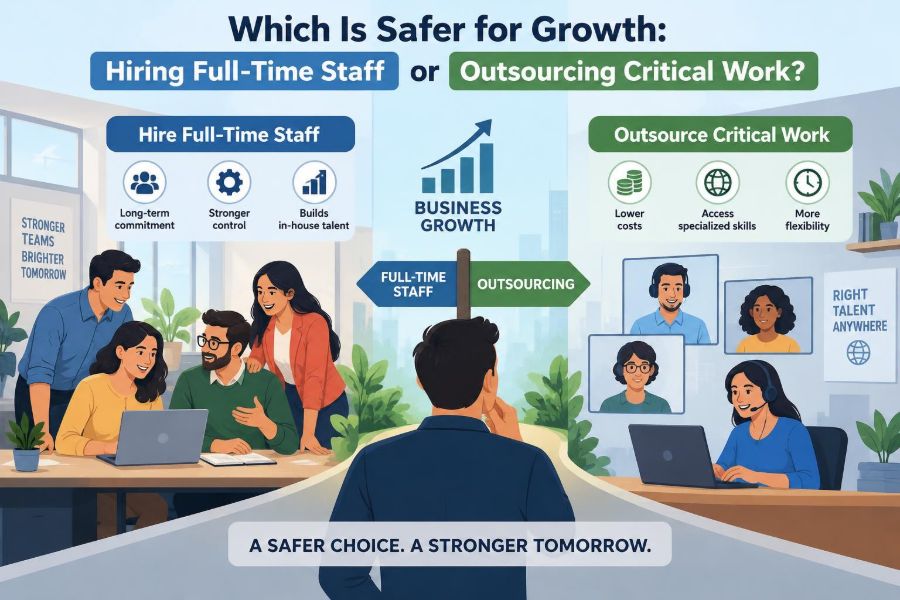

A growing company wins a large client, launches a new product, or sees orders rise faster than expected. The immediate problem is familiar: there is more work than the current team can reliably handle.
Someone suggests hiring. Another person argues for an outside specialist or agency. Both choices can sound prudent, and both can create expensive problems when made for the wrong reasons.
The stakes rise when the work is critical: customer support, software development, finance, manufacturing quality, cybersecurity, or a core marketing channel. A short-term capacity decision can affect customer trust, intellectual property, cash flow, and the company’s ability to learn.
The safer choice is rarely determined by a slogan such as “build in-house” or “stay lean.” It depends on what the work means to the business, how predictable demand is, and what risks the organization can actually manage.
🧭 Start With What “Safer for Growth” Really Means
Safety is not simply spending the least money this quarter. For a growing business, a safer decision preserves the ability to serve customers, adapt to changing conditions, protect vital knowledge, and avoid commitments it cannot sustain.
Hiring full-time staff reduces some risks, such as loss of internal context. Outsourcing can reduce others, such as committing to fixed payroll before demand is proven. The useful question is: which arrangement leaves the business more resilient if the next six to twelve months do not go exactly as planned?
📌 Separate Core Work From Necessary Work
All work may be necessary, but not all work is core. Core work is closely tied to why customers choose the company, how it earns money, or how it maintains a meaningful advantage.
Payroll administration may be essential but usually does not define a retailer’s customer value. Product design may do so. This distinction does not automatically require internal hiring, but it sets a much higher bar for outsourcing work that shapes the business’s future.
🔍 Define “Critical” More Carefully
Critical work is work whose failure would cause serious harm: lost revenue, regulatory trouble, customer churn, operational disruption, or reputational damage. It can be core, but it does not have to be.
For example, a company’s website may not be its competitive advantage, yet a security failure on that site can be critical. Treat criticality as a risk category, not as a synonym for prestige or seniority.
🏗️ Understand the Full-Time Employment Model
A full-time employee becomes part of the organization’s operating system. The company directs priorities, invests in training, builds institutional knowledge, and usually expects the person to contribute beyond a narrowly defined deliverable.
That arrangement is valuable when work requires continual judgment, close collaboration, and a deep understanding of customers or internal processes. It also creates ongoing obligations: compensation, benefits where applicable, management time, equipment, onboarding, and the cost of retaining the person during quieter periods.
🤝 Understand What Outsourcing Actually Includes
Outsourcing is not one model. It may involve an independent contractor, a freelancer, a specialist consultancy, a managed service provider, a business process provider, or an agency with a complete team.
These options differ sharply. One experienced contractor embedded in weekly planning meetings is not equivalent to a distant vendor receiving a brief once a month. Decision-makers should specify the model before debating its merits.
💵 Compare Total Cost, Not Just the Visible Rate
An employee’s salary is not the whole cost, and a vendor’s quoted fee is not the whole cost. Both options consume management attention and create coordination work.
| Cost area | Full-time staff | Outsourced provider |
|---|---|---|
| Direct payment | Salary and applicable benefits | Hourly, project, retainer, or service fee |
| Setup | Recruiting, onboarding, training, equipment | Selection, contracting, knowledge transfer |
| Management | Coaching, performance management, career support | Briefing, review, vendor governance, escalation |
| Change cost | Harder to reduce capacity quickly | May involve minimum terms, handover, or switching costs |
| Knowledge retention | Usually remains closer to the business | Depends heavily on documentation and contract terms |
A lower hourly rate can become expensive if requirements are unclear and rework grows. Conversely, a high specialist fee can be economical if it avoids a prolonged search and solves a time-sensitive problem well.
📈 Match Capacity to Demand Predictability
Full-time hiring is generally easier to justify when demand is stable, recurring, and likely to remain above one person’s productive capacity. It gives the business dependable availability and lets staff improve the process over time.
Outsourcing is often safer when demand is seasonal, experimental, volatile, or tied to a one-off project. A business that has not validated a new service should be cautious about turning a temporary workload into a permanent cost base.
⏱️ Consider Speed Without Ignoring Readiness
An external specialist can sometimes begin sooner than a carefully recruited employee. This matters during a product launch, compliance deadline, or operational backlog.
But speed has two parts: time to access talent and time to make that talent effective. A provider unfamiliar with the company’s data, systems, and decision-makers may need substantial ramp-up. Urgency does not remove the need for a precise brief.
🧠 Protect Institutional Knowledge
Institutional knowledge includes the unwritten details that make work succeed: why an exception exists, which customer concerns signal a larger issue, and how teams resolve conflicts. It accumulates slowly and can disappear quickly.
For work with many exceptions or close connections to strategy, internal ownership is often safer. If outsourcing is chosen, require shared documentation, recorded decisions where appropriate, process maps, and a clear handover plan from the first day.
🔐 Treat Data and Intellectual Property as Design Constraints
Critical work may expose customer records, product plans, source code, financial information, or trade knowledge. Before outsourcing, identify exactly what information the provider needs and whether access can be limited.
Contracts, confidentiality obligations, access controls, and ownership clauses matter, but they do not eliminate operational risk. The company still needs sensible permission settings, audit trails where warranted, and a process for removing access when the engagement ends.
⚖️ Distinguish Control From Accountability
With employees, managers can usually set priorities, redesign roles, and adjust day-to-day work more directly. With an outsourced provider, the organization buys an agreed service or outcome, not unlimited control over how a separate business operates.
This distinction affects fast-moving work. If priorities change every week, a provider may face repeated scope changes and delays. If outputs can be specified clearly, outsourcing can work very well because accountability is easier to measure.
🧩 Ask Whether the Work Can Be Specified
Outsourcing works best when the business can define the problem, the expected deliverables, quality standards, timelines, and decision rights. Examples include a security assessment with a defined scope or payroll processing with documented inputs.
It is less straightforward when the work is exploratory. A new product strategy, an undefined customer experience problem, or early research often depends on rapid learning and changing questions. In those cases, an internal owner may be essential even if outside experts contribute.
🌱 Use Hiring to Build a Long-Term Capability
Hiring is an investment in capability, not merely capacity. A strong employee can improve processes, mentor others, spot adjacent opportunities, and connect lessons across projects.
This matters when a function will become more central as the company grows. A small firm might outsource early financial operations, then hire an internal finance leader once decisions about pricing, cash planning, and controls need continuous attention.
🛠️ Use Outsourcing to Access Scarce Expertise
Some capabilities are valuable but do not require a permanent in-house role. Specialized tax advice, penetration testing, complex legal review, niche engineering, and brand research may demand expertise that a growing company uses only intermittently.
Trying to hire every specialist can create idle capacity and dilute management focus. A qualified provider may bring tools, methods, and experience across similar assignments that would take an internal team years to develop.
🧪 Test Uncertain Work Before Building a Department
Outsourcing can be a disciplined way to test a new channel, product feature, or operating process. The goal is not to avoid commitment forever; it is to learn what level and type of commitment the evidence supports.
Imagine a retailer considering a new video-content program. A pilot with an external production partner can reveal the production rhythm, approval burden, and customer response before the retailer hires a permanent content team. The pilot should have learning goals, not merely a deadline.
🔄 Watch for Vendor Dependency
A provider becomes a dependency when the company cannot reasonably operate, change suppliers, or understand its own service without that provider. Dependency is especially risky where the vendor controls unique data, undocumented processes, or essential technical access.
Dependency is not always unacceptable. It should be visible and managed. Keep copies of key records, define data portability, avoid unnecessary proprietary lock-in, and maintain enough internal understanding to evaluate the provider’s work.
👥 Account for Management Capacity
A common mistake is assuming outsourcing removes management. It changes management. Leaders still need to define outcomes, answer questions, review quality, handle conflicts, and make timely decisions.
Likewise, hiring without capable supervision can lead to unclear priorities and underused talent. The safer option is partly the one the organization has the capacity to govern well right now.
📣 Keep Customer Feedback Close to the Business
Customer-facing work generates information, not just transactions. Support conversations reveal confusing product features; sales objections expose gaps in positioning; delivery complaints show where operations are failing.
Outsourcing customer contact can be efficient, particularly for predictable inquiries. But leadership should ensure insights flow back into product and operations decisions. If an outside team handles every complaint while internal teams see only summary reports, the business may learn too slowly.
✅ Build Quality Into the Arrangement
Quality does not emerge from a job title or a vendor logo. It needs observable standards, review points, and clear ownership of corrections.
- Define what an acceptable output looks like, including examples where useful.
- Set service levels only for measures the business can monitor and act on.
- Use staged reviews for high-risk work rather than waiting for final delivery.
- Clarify who approves changes, accepts work, and resolves defects.
For employees, quality systems may include peer review and training. For providers, they may include acceptance criteria and escalation routes. The principle is the same: make expectations usable before problems arise.
🚨 Plan for Failure Before It Happens
Every arrangement can fail through illness, resignation, missed deadlines, financial stress, poor performance, or a sudden demand spike. Risk is lower when the response is already partly designed.
An employee model needs cross-training and documented responsibilities so one departure does not halt the function. An outsourced model needs backup contacts, continuity terms, transition assistance, and a practical exit route. Critical work should never rely entirely on one person or one supplier.
📜 Get Contracts and Employment Rules Right
Employment status, confidentiality, tax treatment, data handling, and industry-specific obligations can have legal consequences that vary by location and circumstance. A contractor cannot simply be labelled independent if the real working arrangement suggests otherwise.
For significant engagements, obtain appropriate legal, HR, tax, and data-protection guidance. A commercial decision made without considering these rules can create costs that outweigh the intended flexibility.
🧮 Avoid the False Choice of All In or All Out
Many successful operating models are deliberately mixed. The business keeps strategic ownership and core decision-making inside while using external capacity or specialized support around it.
A software company, for instance, may employ a product manager and technical lead internally while using a specialist firm for a defined security review. The internal team retains product context; the outside team contributes focused expertise.
🪜 Choose a Hybrid Model With Clear Boundaries
A hybrid model fails when nobody knows who owns the result. It succeeds when the internal and external roles are complementary rather than overlapping.
Useful boundaries to define
- Internal ownership: strategy, customer priorities, architecture decisions, final approval, and knowledge retention.
- External contribution: specialist execution, temporary scale, independent review, or repeatable service delivery.
- Shared routines: planning meetings, issue escalation, documentation, performance reviews, and handovers.
These boundaries should be revisited as the company matures. What begins as a temporary external service may eventually become an internal function.
📊 Create a Decision Scorecard, Not a Gut Feeling
A scorecard does not make the decision automatic, but it exposes assumptions. List the criteria that matter for this particular role and discuss them with the people responsible for finance, operations, risk, and the work itself.
- Is demand stable enough to support a permanent role?
- Does the work create a lasting competitive capability?
- How sensitive are the data and intellectual property involved?
- Can outputs and quality standards be clearly specified?
- How quickly is capacity needed, and how long will ramp-up take?
- What happens if the individual or provider becomes unavailable?
Weighting criteria can help, but do not let a neat spreadsheet hide a non-negotiable risk, such as unacceptable data exposure or the absence of an internal accountable owner.
🧑💼 Scenario: A Growing E-Commerce Business
Consider a hypothetical online retailer whose order volume is increasing. It needs more customer support, better demand forecasting, and help improving its checkout experience.
Support volume may justify a mixed approach: internal leaders own the customer experience and escalation policy, while an external team handles documented, routine inquiries during a surge. Forecasting may require an internal analyst if it increasingly drives purchasing and cash decisions. A short, specialist user-experience project may be sensibly outsourced because the objective and timeframe can be defined.
The lesson is that one company can make different choices for different critical functions. “Outsource or hire” is usually the wrong unit of analysis.
🧱 Common Mistake: Outsourcing a Problem Nobody Understands
Businesses sometimes outsource because a function feels chaotic. If the underlying problem is unclear ownership, conflicting goals, or broken inputs, a vendor inherits the confusion rather than fixing it.
Before engaging a provider, write down the current process, pain points, available data, desired outcome, and unresolved decisions. External expertise can diagnose a problem, but the company must still be prepared to make choices.
🪤 Common Mistake: Hiring to Relieve Immediate Panic
A rushed hire can solve this month’s overload while creating a role with no durable purpose. This can be unfair to the employee and financially difficult for the business.
When possible, separate the emergency from the long-term design. Temporary support, overtime controls, workflow simplification, or a time-bound contract may stabilize the situation while leaders decide whether the workload is truly permanent.
🔁 Review the Choice as Growth Changes the Work
No staffing decision should be treated as permanent by default. Demand patterns, technology, customer expectations, and the company’s internal maturity change.
Set review points based on business milestones rather than habit. Review whether the provider still delivers value, whether internal knowledge is sufficient, whether the role has expanded, and whether risk exposure has changed. The safest arrangement at an early stage may be inadequate two years later.
🎯 The Core Principle: Own What You Must Learn and Control
There is no universally safer option. Full-time staff are often the stronger choice when work is continuous, strategically differentiating, difficult to specify, or deeply connected to customer learning and internal decision-making.
Outsourcing is often the stronger choice when demand is uncertain, expertise is highly specialized, work is bounded, or the business needs flexible capacity. A hybrid approach is often best when the company must retain accountability and knowledge while drawing on outside scale or skill.
The central test is simple: keep internal ownership of the decisions, knowledge, and relationships that determine the company’s future, then choose the staffing model that manages the remaining work with the least avoidable risk.
Safer growth comes from matching the work to the right level of ownership, flexibility, and control—not from treating hiring or outsourcing as a universal answer. 📊🤝🌱